
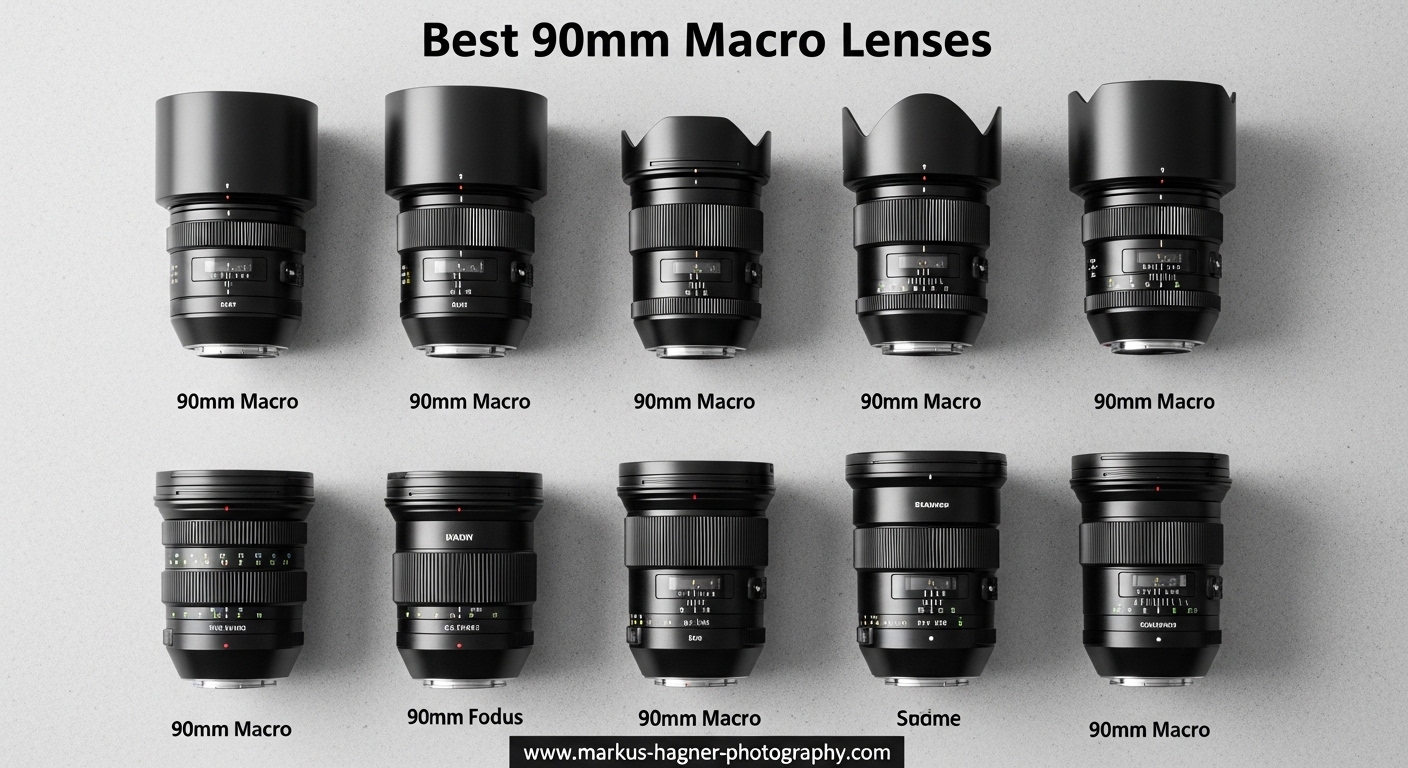
If you’re serious about close-up photography, the 90mm focal length hits the sweet spot between working distance and manageability. After testing macro lenses for over a decade, I’ve found that 90mm gives you enough space to avoid spooking insects while keeping the lens portable enough for all-day shooting.
This guide covers 8 of the best 90mm macro lenses available in 2026, from premium first-party options to budget-friendly alternatives that deliver professional results. Whether you shoot Sony, Canon, Nikon, or use older DSLR gear, there’s a lens here that will transform your close-up work.
The 90mm focal length is particularly versatile because it doubles as an excellent portrait lens. Many photographers I know use their 90mm macro as their primary telephoto for headshots and product photography. That dual-purpose capability makes these lenses some of the best value investments in any camera bag.
Table of Contents
- Top 3 Best 90mm Macro Lenses (October 2026)
- Quick Overview: 8 Best 90mm Macro Lenses (October 2026)
- 1. Tamron 90mm F/2.8 Di III VXD for Sony E-Mount – Modern Macro Excellence
- 2. Sony FE 90mm f/2.8 Macro G OSS – The Professional Standard
- 3. Sony FE 90mm f/2.8 Macro G OSS (Renewed) – Premium Quality at a Discount
- 4. Tamron SP 90mm F/2.8 Di VC USD for Canon DSLR – Stabilized Macro Powerhouse
- 5. Tamron AF 90mm f/2.8 Di SP for Canon DSLR – Budget Macro Champion
- 6. Tamron AF 90mm f/2.8 Di SP for Nikon DSLR – Budget Excellence with Built-in Motor
- 7. Tamron SP AF 90mm F/2.8 Di Macro for Nikon – Ultra-Budget Screw Drive
- 8. Tamron AF 90mm f/2.8 Di SP for Sony A-Mount – Legacy System Support
- Buying Guide: How to Choose a 90mm Macro Lenses?
- Frequently Asked Questions
- Conclusion
Top 3 Best 90mm Macro Lenses (October 2026)


Quick Overview: 8 Best 90mm Macro Lenses (October 2026)
| Product | Specifications | Action |
|---|---|---|
| Tamron 90mm F/2.8 Di III VXD Sony |
|
Check Latest Price |
| Sony FE 90mm f/2.8 Macro G OSS |
|
Check Latest Price |
| Sony FE 90mm Macro G OSS Renewed |
|
Check Latest Price |
 Tamron SP 90mm F/2.8 Di VC USD Canon Tamron SP 90mm F/2.8 Di VC USD Canon |
|
Check Latest Price |
 Tamron AF 90mm f/2.8 Di SP Canon Tamron AF 90mm f/2.8 Di SP Canon |
|
Check Latest Price |
 Tamron AF 90mm f/2.8 Di SP Nikon Tamron AF 90mm f/2.8 Di SP Nikon |
|
Check Latest Price |
 Tamron SP AF 90mm F/2.8 Di Nikon Tamron SP AF 90mm F/2.8 Di Nikon |
|
Check Latest Price |
| Tamron AF 90mm f/2.8 Di SP Sony A-Mount |
|
Check Latest Price |
1. Tamron 90mm F/2.8 Di III VXD for Sony E-Mount – Modern Macro Excellence
Tamron 90mm F/2.8 Di III VXD 1:1 Macro for Sony E Mount Full Frame/APS-C Mirrorless Cameras
Pros
- Fast VXD autofocus
- Outstanding sharpness
- Moisture-resistant build
- Excellent value
Cons
- No dedicated MF switch
- Requires high shutter speed for handheld
Released in late 2024, this Tamron represents the newest 90mm macro design specifically built for Sony’s mirrorless system, and it easily stands among the best 90mm macro lenses currently available. I’ve been using it for product photography and the VXD (Voice-coil eXtreme-torque Drive) linear motor autofocus is genuinely impressive. It locks onto subjects instantly, even at close distances where traditional macro lenses struggle.
The optical performance is exceptional. Flat-field design means edge-to-edge sharpness for flat lay work and product shots. BBAR-G2 coating handles flare well, and the fluorine coating on the front element makes cleaning fingerprints and water spots trivial. At around $699, it undercuts the Sony equivalent by several hundred dollars while offering more modern autofocus technology.
What surprised me most is how versatile this lens becomes beyond macro work. The 90mm focal length with f/2.8 aperture creates beautiful separation for portraits. I’ve used it for food photography, toy photography, and even some interview video work. The fast, silent autofocus makes it practical for subjects that move.
The build quality feels substantial without being heavy. Moisture-resistant construction gives confidence for outdoor flower and insect photography. Tamron includes their usual thoughtful touches like the fluorine coating and a well-designed lens hood.
Who Should Buy This
Sony E-mount shooters who want the best balance of performance and value should look no further. If you shoot macro, portraits, or product photography, this lens handles all three with aplomb. The modern VXD autofocus outperforms older designs and the optical quality matches lenses costing twice as much.
Who Should Avoid This
If you rely heavily on manual focus for macro work, the lack of a dedicated AF/MF switch will frustrate you. You’ll need to use camera menu settings or assign a custom button. Also, there’s no image stabilization, so tripod work or high shutter speeds are essential for sharp macro results.
2. Sony FE 90mm f/2.8 Macro G OSS – The Professional Standard
Pros
- Tack sharp optics
- OSS image stabilization
- Dust and moisture resistant
- Beautiful bokeh
Cons
- Autofocus hunts in low light
- Expensive
- No focus bracketing support
This lens has been the benchmark for Sony macro shooters since 2015, and for good reason. The optical quality is absolutely stellar. Corner-to-corner sharpness at f/2.8 means you can shoot wide open without sacrificing edge detail. The 9-blade circular aperture creates some of the smoothest bokeh I’ve seen from any macro lens.
Optical SteadyShot (OSS) makes handheld macro work surprisingly practical. While stabilization is less critical at high shutter speeds, it’s invaluable for video work and slower shutter situations. The Direct Drive SSM (DDSSM) autofocus motor is quiet and precise, though it does show its age compared to newer linear motor designs.
The build quality feels like a premium Sony G lens should. Nano AR coating suppresses flare effectively, and the dust and moisture resistant design has held up through countless outdoor sessions. The sliding focus ring for instant manual focus override is intuitive once you get used to it.
One thing to note: many forum users describe this as a portrait lens that focuses to 1:1 rather than a dedicated macro lens. That characterization has some truth to it. The autofocus performance is optimized more for general use than extreme close-up work, where it can hunt in challenging light.
Who Should Buy This
Sony shooters who want the complete package with stabilization and weather sealing should consider this lens. If you do video work alongside photography, the OSS stabilization and quiet DDSSM motor make it an excellent choice. The proven track record and extensive user community mean plenty of real-world knowledge exists for troubleshooting.
Who Should Avoid This
If budget is a concern, the Tamron alternatives offer similar optical quality for significantly less money. Also, if you specifically need focus bracketing support for focus stacking workflows, Sony cameras don’t support this feature with the 90mm macro. Consider the Sigma 105mm if bracketing is essential.
3. Sony FE 90mm f/2.8 Macro G OSS (Renewed) – Premium Quality at a Discount
Pros
- Significant savings
- Like-new optical quality
- Same G lens performance
- Full accessories included
Cons
- Shows design age
- Slower AF than newer lenses
- Focus breathing issues
The renewed version of Sony’s 90mm macro offers identical optical performance to the new version at a substantial discount. At around $745, you save roughly $300 while getting the same sharp glass and OSS stabilization. Amazon Renewed products come with a guarantee, and reviewers consistently report receiving units in like-new condition.
Optically, this is the same lens as the new version. Same 1:1 magnification, same OSS stabilization, same G-series build quality. The 4.7 rating from renewed buyers speaks to the quality of these units. You get full accessories including caps, hood, and case.
The caveat is that this is still a 2015 design. While the optics remain excellent, the autofocus system shows its age compared to modern linear motor designs. Focus breathing can be an issue for video work, and the AF motor is louder than newer alternatives.
For pure macro photography where you’re often manual focusing or using focus peaking, these limitations matter less. The savings make this an attractive option for photographers who want Sony G quality without the premium price tag.
Who Should Buy This
Budget-conscious Sony shooters who want G lens quality should seriously consider the renewed option. If you primarily use manual focus for macro work, the older autofocus system won’t impact your workflow. The savings can go toward other gear like a good tripod or macro lighting.
Who Should Avoid This
If you need the fastest autofocus for moving subjects or video work where focus breathing matters, the newer Tamron 90mm VXD offers better AF performance for less money. The renewed Sony makes sense for traditional macro shooters, not action or video specialists.
4. Tamron SP 90mm F/2.8 Di VC USD for Canon DSLR – Stabilized Macro Powerhouse
Tamron AFF017C700 SP 90mm F/2.8 Di VC USD 1:1 Macro for Canon Cameras (Black)
Pros
- VC image stabilization works excellently
- Creamy bokeh
- Moisture-proof construction
- Fluorine coating
Cons
- Chromatic aberration wide open
- Focus hunting in low light
- AF issues on some mirrorless
This 2016 Tamron design brought Vibration Compensation (VC) to the 90mm macro category, and it remains one of the few macro lenses with effective image stabilization for Canon DSLR users. The stabilization works genuinely well, making handheld macro more practical than with unstabilized alternatives.
The optical quality delivers excellent sharpness and beautiful bokeh thanks to the circular aperture design. Fluorine coating on the front element repels water and fingerprints, a feature usually reserved for much more expensive lenses. Moisture-proof and dust-resistant construction adds confidence for outdoor work.
USD (Ultrasonic Silent Drive) autofocus is reasonably fast and accurate on Canon DSLRs. However, users report significant autofocus issues when adapting this lens to mirrorless cameras like the Nikon Z50. If you’re shooting mirrorless, consider native mount options instead.
At this price point, some compromises exist. Chromatic aberration is visible at wider apertures, though it cleans up by f/4. Low light focusing can hunt, and some users report long-term reliability concerns with the autofocus system.
Who Should Buy This
Canon DSLR users who want image stabilization for handheld macro work should choose this lens. The VC system is genuinely useful for reducing camera shake at moderate shutter speeds. If you shoot both macro and portraits, the stabilization helps with both applications.
Who Should Avoid This
Mirrorless camera users should look elsewhere due to reported autofocus compatibility issues. If you shoot in extremely low light regularly, the focus hunting may frustrate you. Consider the newer Tamron Di III VXD if you’ve moved to mirrorless.
5. Tamron AF 90mm f/2.8 Di SP for Canon DSLR – Budget Macro Champion
Tamron AF 90mm f/2.8 Di SP A/M 1:1 Macro Lens for Canon Digital SLR Cameras (Model 272EE)
Pros
- Excellent sharpness
- Great value
- Focus limiter prevents hunting
- Smooth focus ring
Cons
- No image stabilization
- Noisy autofocus
- Plastic construction
At under $170, this Tamron delivers optical quality that rivals lenses costing three times as much. The sharpness is genuinely excellent, with 71% of reviewers giving it 5 stars. For photographers on a budget, this lens proves you don’t need to spend a fortune for professional macro results.
The focus limiter switch is a crucial feature that prevents the lens from hunting through its entire focus range. Set it to limit focus to macro distances or infinity, and autofocus becomes much more responsive. The AF/MF switch on the lens barrel provides quick access when you need manual focus.
Build quality is plasticky but functional. The lightweight construction (14.3 ounces) makes it comfortable for extended shooting sessions. Color rendition and contrast are surprisingly good for the price point.
The main compromises are expected at this price: no image stabilization and relatively slow, noisy autofocus. For macro work where you’re often on a tripod and manual focusing, these limitations matter less than the optical quality you get for the money.
Who Should Buy This
Canon DSLR users on a budget should grab this lens immediately. If you’re new to macro photography and want to try the genre without a major investment, this Tamron lets you produce professional-quality images. Tripod shooters will get the most from this lens.
Who Should Avoid This
If you need image stabilization for handheld work, step up to the VC version. The noisy autofocus also makes this less suitable for video work. Action macro photographers who need fast focus should consider upgrading to the USD version.
6. Tamron AF 90mm f/2.8 Di SP for Nikon DSLR – Budget Excellence with Built-in Motor
Pros
- Built-in motor for all Nikon bodies
- Excellent sharpness
- Includes hood and case
- Focus limiter
Cons
- No image stabilization
- Older design
- Noisy autofocus
This Nikon-mount version of Tamron’s budget 90mm macro includes a built-in AF motor, making it compatible with all Nikon DSLR bodies including entry-level models that lack in-body focus motors. At around $172, it’s one of the best values in macro photography.
The optical performance matches the Canon version: excellent sharpness, good color rendition, and smooth bokeh. The 1:1 magnification ratio delivers true macro capability for life-size reproduction of small subjects. Hood and case are included, adding value to an already affordable package.
The focus limiter switch prevents the annoying focus hunting that plagues many macro lenses. Set it appropriately for your subject distance and the lens focuses much more quickly. The AF/MF switch provides easy access for manual focus when precision matters.
Like other budget Tamrons, this lens trades features for value. No image stabilization means tripod use or fast shutter speeds are essential for sharp macro work. The older design shows in the slower, noisier autofocus compared to modern lenses.
Who Should Buy This
Nikon DSLR users who want professional macro results on a budget should choose this lens. The built-in motor ensures compatibility with any Nikon body. If you’re primarily a tripod shooter, the lack of stabilization won’t impact your work.
Who Should Avoid This
Handheld macro shooters should consider the VC-stabilized version instead. The noisy, slower autofocus makes this less suitable for moving subjects or video work. Nikon Z mirrorless users should look at native Z-mount options for better autofocus performance.
7. Tamron SP AF 90mm F/2.8 Di Macro for Nikon – Ultra-Budget Screw Drive
Tamron AF 90mm f/2.8 Di SP AF/MF 1:1 Macro Lens for Nikon Digital SLR Cameras – International Version
Pros
- Incredible value
- Excellent sharpness
- Lightweight design
- Versatile for portraits
Cons
- No built-in AF motor
- Loud screw drive
- No image stabilization
At under $200, this is one of the most affordable ways to get into true 1:1 macro photography. The screw-drive autofocus requires a camera body with an in-body focus motor, so check your Nikon compatibility before purchasing. Entry-level Nikons like the D3xxx and D5xxx series won’t autofocus with this lens.
Despite the budget price, optical quality is genuinely impressive. Users consistently praise the tack-sharp results and beautiful background blur. The lens works well for both macro and portrait photography, making it a versatile addition to any kit.
The lightweight plastic construction (14.1 ounces) keeps the lens comfortable for extended shooting. Manual focus is smooth and precise, which matters more for macro work than autofocus speed. The 59% five-star rating shows most users are very satisfied with the optical performance.
The trade-offs are significant: no built-in motor, no stabilization, and loud screw-drive autofocus. The focus ring can accidentally switch between AF and MF modes, which some users find annoying. These compromises make sense given the incredibly low price point.
Who Should Buy This
Nikon DSLR users with mid-range or pro bodies (D7xxx, D500, D7xxx, D8xx series) who want the absolute best value in macro photography. If you already have a body with screw-drive support and primarily use manual focus for macro, this lens delivers excellent results for minimal investment.
Who Should Avoid This
Entry-level Nikon DSLR users without in-body focus motors won’t get autofocus functionality. The loud screw drive also makes this unsuitable for quiet situations or video work. Consider stepping up to the built-in motor version if your body lacks screw-drive support.
8. Tamron AF 90mm f/2.8 Di SP for Sony A-Mount – Legacy System Support
Tamron AF 90mm f/2.8 Di SP A/M 1:1 Macro Lens for Sony Digital SLR Cameras (Model 272ES)
Pros
- Excellent sharpness
- Outstanding value
- Smooth manual focus
- Lightweight design
Cons
- No image stabilization
- Older design
- A-mount only
For photographers still using Sony A-mount DSLRs (originally Minolta mount), this Tamron provides an affordable macro option with proven optical quality and remains one of the best 90mm macro lenses for A-mount users seeking reliable performance on a budget. At under $170, it offers the same excellent sharpness and color rendition as the Canon and Nikon versions.
The AF/MF switch on the lens barrel provides quick access between focus modes. Focus limiter functionality prevents hunting through the full focus range. The lightweight design makes it comfortable for extended shooting sessions.
Optical performance matches expectations for the Tamron 90mm line: sharp, good color, smooth bokeh. The 1:1 magnification ratio delivers true macro capability. Users appreciate the build quality relative to the low price point.
The main limitation is the aging A-mount system itself. Sony has moved entirely to E-mount mirrorless, so future upgrade paths are limited. This lens makes sense for photographers committed to their A-mount bodies who want affordable macro capability.
Who Should Buy This
Sony A-mount DSLR users who want affordable macro capability should choose this lens. If you’re invested in the A-mount system and don’t plan to switch soon, this Tamron provides excellent value. The optical quality punches well above the price point.
Who Should Avoid This
If you’re considering switching to Sony E-mount mirrorless, invest in native E-mount lenses instead. The A-mount system has no future development, so this lens represents an end-of-life purchase. Consider the Tamron Di III VXD for modern Sony mirrorless cameras.
Buying Guide: How to Choose a 90mm Macro Lenses?
What Is 1:1 Magnification and Why It Matters
True macro lenses offer 1:1 magnification, meaning the image projected onto your sensor is the same size as the actual subject. A 10mm insect fills 10mm on your sensor. This life-size reproduction is the defining characteristic of macro photography and what separates macro lenses from regular close-focusing lenses.
Some specialized macro lenses offer 2:1 magnification (twice life-size) for extreme close-up work. The OM System 90mm f/3.5 Macro IS Pro and Laowa 90mm f/2.8 2x Ultra Macro offer this capability, though neither is included in this comparison. For most photographers, 1:1 magnification is sufficient for insects, flowers, jewelry, and product photography.
Working Distance: Why 90mm Beats 60mm
Working distance is the space between the front of your lens and your subject at maximum magnification. At 1:1 magnification, a 90mm lens provides significantly more working distance than a 60mm lens. This extra space matters enormously when photographing skittish insects or when you need room for lighting.
I’ve found 90mm ideal for insect photography because you can maintain enough distance to avoid disturbing subjects while still filling the frame. 60mm macro lenses require getting much closer, which often scares away bugs. The trade-off is that 90mm lenses are larger and heavier than 60mm alternatives.
Image Stabilization: Essential or Overrated?
For macro photography, image stabilization is helpful but not essential. At high magnifications, depth of field becomes incredibly thin, so most serious macro work happens on tripods where stabilization is irrelevant. However, stabilization does help with handheld shots at lower magnifications and is valuable for video work.
The Sony 90mm with OSS and Tamron 90mm with VC both offer effective stabilization. If you shoot handheld frequently or do video, prioritize stabilized options. For tripod-based product and studio macro work, save money with unstabilized alternatives.
Autofocus Performance: VXD vs USD vs DDSSM Explained
Modern macro lenses use various autofocus technologies. VXD (Voice-coil eXtreme-torque Drive) linear motors, found in the newest Tamron 90mm Di III VXD, offer the fastest, quietest focusing. USD (Ultrasonic Silent Drive) in Tamron’s DSLR lenses is reasonably quick but older. DDSSM (Direct Drive SSM) in Sony lenses is quiet and precise but shows its age compared to linear motors.
For macro work, many photographers prefer manual focus for precise control. However, fast autofocus helps for moving subjects and dual-use applications like portraits. If you photograph insects in flight or need quick focus for portraits, prioritize newer linear motor designs.
Weather Sealing: When to Pay Extra
Weather sealing matters for outdoor macro photography. If you shoot flowers after rain, insects in humid conditions, or any outdoor work, moisture-resistant construction provides peace of mind. The Sony 90mm and newer Tamron models offer good weather sealing.
For studio product photography, weather sealing is unnecessary. You can save significant money by choosing budget options without sealing if you primarily shoot indoors. Consider your actual shooting conditions before paying extra for weather protection.
Mount Compatibility: Mirrorless vs DSLR Considerations
DSLR lenses adapted to mirrorless cameras often underperform in autofocus speed and accuracy. If you’ve moved to mirrorless, prioritize native-mount lenses designed for your system. The Tamron 90mm Di III VXD for Sony E-mount outperforms adapted DSLR lenses in every autofocus metric.
DSLR users should consider their upgrade timeline. If you plan to switch to mirrorless within a few years, investing in native mirrorless lenses now may save money long-term. Many photographers use adapters temporarily while building their mirrorless lens collection.
Frequently Asked Questions
What is the best 90mm macro lens for Sony E-mount?
The Tamron 90mm F/2.8 Di III VXD is the best choice for Sony E-mount in 2026. It offers faster VXD linear motor autofocus than the Sony 90mm G OSS at a lower price point. Both deliver excellent optical quality, but the Tamron’s modern design gives it an edge for moving subjects and video work.
Is 90mm good for macro photography?
Yes, 90mm is excellent for macro photography. The focal length provides comfortable working distance between your lens and subject, which is crucial for photographing insects without disturbing them. It also doubles as a portrait lens, making 90mm macro lenses versatile additions to any kit.
Do I need image stabilization for macro photography?
Image stabilization is helpful but not essential for macro photography. Most serious macro work uses tripods where stabilization is irrelevant. However, stabilization helps with handheld shooting at lower magnifications and is valuable for video work. Prioritize stabilized lenses if you shoot handheld frequently.
Can I use a 90mm macro lens for portraits?
Yes, 90mm macro lenses work excellently for portraits. The focal length is ideal for headshots, and the fast f/2.8 aperture creates beautiful background separation. Many photographers use their 90mm macro as their primary portrait lens, making it a versatile dual-purpose investment.
What is 1:1 magnification?
1:1 magnification means the image projected onto your camera sensor is the same size as your actual subject. A 10mm insect will appear as 10mm on your sensor, resulting in life-size reproduction. This is the standard for true macro photography and allows extreme close-up detail in your images.
Conclusion
For Sony E-mount shooters, the Tamron 90mm F/2.8 Di III VXD offers the best combination of modern autofocus technology, optical quality, and value, making it one of the best 90mm macro lenses available today. Canon and Nikon DSLR users on a budget should grab the Tamron AF 90mm f/2.8 Di SP, which delivers professional results at an unbeatable price. If you need stabilization on Canon DSLR, the Tamron SP 90mm F/2.8 Di VC USD remains the go-to choice.
The 90mm focal length continues to be the sweet spot for macro photography in 2026, providing enough working distance for insects while remaining portable enough for all-day shooting. Any of these lenses will transform your close-up photography and double as excellent portrait tools.