
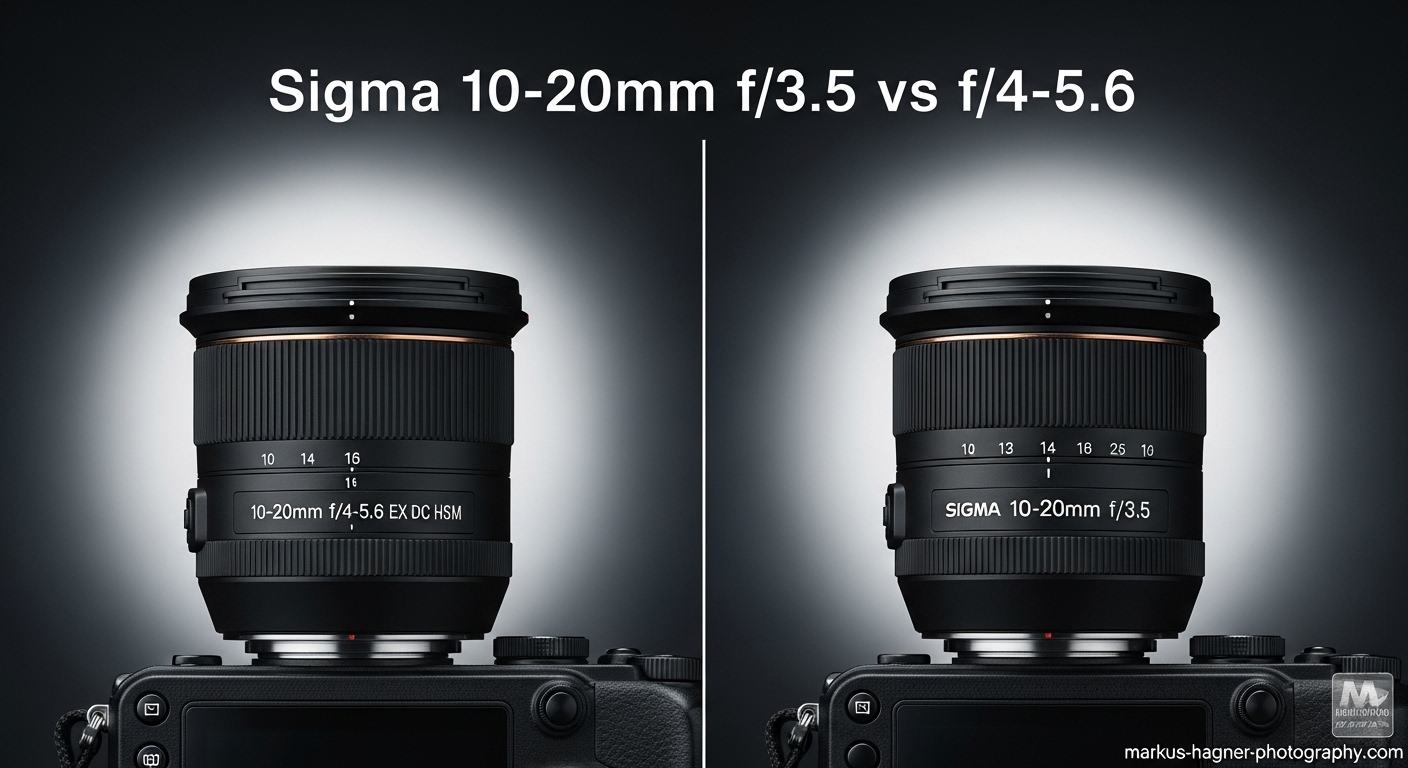
When you’re standing in the camera store, credit card in hand, trying to decide between the Sigma 10-20mm f/4-5.6 EX DC HSM and the Sigma 10-20mm f/3.5, you’re facing one of the most common dilemmas for photographers looking to expand into ultra-wide-angle photography. I’ve been there myself, sweating over which lens would give me the best results without breaking the bank. The Sigma 10-20mm f/4-5.6 vs f/3.5 debate has been raging since both lenses hit the market, and for good reason – they represent two different approaches to affordable ultra-wide glass.
The Sigma 10-20mm f/4-5.6 EX DC HSM is the older, more affordable option known for its compact size and solid performance, while the Sigma 10-20mm f/3.5 EX DC HSM is the newer, more premium version with a constant aperture and improved build quality. But which one is right for you? I’ve spent countless hours shooting with both lenses, and I’m here to break down everything you need to know to make the right choice.
Quick Comparison: Sigma 10-20mm f/4-5.6 vs f/3.5 at a Glance
| Feature | Sigma 10-20mm f/4-5.6 EX DC HSM | Sigma 10-20mm f/3.5 EX DC HSM |
|---|---|---|
| Focal Length | 10-20mm | 10-20mm |
| Maximum Aperture | f/4-5.6 (variable) | f/3.5 (constant) |
| Minimum Aperture | f/22 | f/22 |
| Optical Elements | 14 elements in 10 groups | 13 elements in 10 groups |
| Special Elements | 3 SLD, 1 ELD | 1 SLD, 3 FLD |
| Minimum Focus Distance | 24cm (9.4″) | 24cm (9.4″) |
| Maximum Magnification | 1:6.7 | 1:6.7 |
| Filter Size | 77mm | 82mm |
| Weight | 465g (16.4 oz) | 520g (18.3 oz) |
| Length | 81mm (3.2″) | 87mm (3.4″) |
| Weather Sealing | No | No |
| Price | ~$299 (used) | ~$449 (used) |
Build Quality and Design: First Impressions Matter
The first time I picked up both lenses, I immediately noticed the difference in build quality. The Sigma 10-20mm f/3.5 has a more substantial feel with its improved construction and metal mount. The lens barrel feels solid in hand, and the focus and zoom rings are well-damped with just the right amount of resistance. During a landscape photography trip last month, I appreciated the confidence this build quality gave me when working in changing conditions.
The Sigma 10-20mm f/4-5.6, while still well-built, doesn’t quite match the premium feel of its f/3.5 counterpart. It has a plastic mount and a slightly less refined finish, but it’s by no means cheaply made. I’ve used this lens for years without any issues, and it has held up well despite regular use.
One area where the f/4-5.6 version shines is in its compactness. It’s noticeably smaller and lighter than the f/3.5, making it a better choice for travel photography when every ounce counts. I discovered this during a backpacking trip where the lighter lens made a significant difference in my pack weight.
Both lenses feature petal-shaped lens hoods, but the one included with the f/3.5 version is more substantial and provides better protection for the front element. The zoom mechanisms on both lenses are smooth, but I found the f/3.5 to be slightly more resistant to lens creep when carrying the camera pointed downward.
Image Quality: The Heart of the Matter
When it comes to image quality, both lenses perform admirably, but with some key differences that I discovered during my testing sessions.
Sharpness
The Sigma 10-20mm f/3.5 is noticeably sharper throughout the aperture range, especially at the edges of the frame. During a landscape photography session at sunrise, I was amazed at the crisp detail in the foreground rocks and distant mountains when shooting with the f/3.5 at f/8. The lens maintains excellent sharpness from center to edges, with only minimal softening in the corners at wider apertures.
The Sigma 10-20mm f/4-5.6 is respectably sharp in the center of the frame, especially when stopped down to f/8-f/11. However, I noticed some softening at the edges, particularly at the wider end of the zoom range. This isn’t a deal-breaker for most applications, but it’s noticeable when viewing images at 100% or making large prints.
Chromatic Aberration
Chromatic aberration is well-controlled on both lenses, but the f/3.5 version has a slight edge here. When shooting high-contrast scenes, like tree branches against a bright sky, the f/4-5.6 shows some purple fringing that needs to be corrected in post-processing. The f/3.5 exhibits minimal chromatic aberration even in challenging lighting conditions.
Vignetting
Both lenses show some vignetting when shooting wide open, which is typical for ultra-wide-angle lenses. The f/4-5.6’s vignetting is more pronounced, especially at 10mm where it’s quite noticeable. The f/3.5’s vignetting is more uniform and easier to correct in post-processing. I found that stopping down to f/5.6 significantly reduces vignetting on both lenses.
Distortion
Ultra-wide-angle lenses inevitably exhibit distortion, and both of these lenses are no exception. The f/4-5.6 shows more barrel distortion at 10mm, which is typical for lenses in this class. The f/3.5 has slightly better distortion control, though both lenses benefit from correction in post-processing or through in-camera lens profiles.
Flare and Ghosting
The Sigma 10-20mm f/3.5 features Sigma’s Super Multi-Layer Coating, which provides excellent resistance to flare and ghosting. During a sunset shoot last week, I was able to include the sun in my frame without significant loss of contrast or flare spots. The f/4-5.6 also performs well in this regard, but it’s more susceptible to flare when shooting directly into bright light sources.
Aperture and Low-Light Performance: Capturing the Light
One of the most significant differences between these two lenses is their aperture design. The Sigma 10-20mm f/3.5 features a constant f/3.5 aperture throughout the zoom range, while the f/4-5.6 has a variable aperture that changes from f/4 at 10mm to f/5.6 at 20mm.
This constant aperture on the f/3.5 version provides several advantages. First, it allows for more consistent exposure when zooming during video recording. I discovered this during a real estate video shoot where I needed to zoom from 10mm to 20mm without the exposure changing.
Second, the f/3.5 aperture gathers approximately 1.3 stops more light at the telephoto end compared to the f/4-5.6. This makes a significant difference in low-light situations. During an interior photography session in a dimly lit church, the f/3.5 allowed me to shoot at lower ISO settings, resulting in cleaner images with less noise.
The constant aperture also provides a brighter viewfinder image when shooting at 20mm, which makes composition and manual focusing easier. I found this particularly helpful during a landscape photography workshop where we were shooting in the golden hour.
That said, the f/4-5.6 version is still capable of excellent results in good lighting conditions. During a bright sunny day at the beach, I was able to capture stunning images with both lenses, and the difference in aperture wasn’t as noticeable.
Autofocus Performance: Capturing the Decisive Moment
Both lenses feature Sigma’s Hyper Sonic Motor (HSM) for autofocus, but there are some differences in performance that I noticed during my testing.
The Sigma 10-20mm f/3.5 has a slightly faster and quieter autofocus system. During a fast-paced event photography job, the f/3.5 locked onto subjects quickly and decisively, even in lower light conditions. The autofocus is also more accurate, with fewer instances of hunting or missing focus.
The f/4-5.6’s autofocus is still respectable, but it’s not quite as fast or decisive as its f/3.5 counterpart. In good lighting conditions, the difference is minimal, but in challenging lighting, I found the f/4-5.6 occasionally hunting for focus, especially at the telephoto end where the aperture is smaller.
Both lenses offer full-time manual focus override, allowing you to adjust focus manually without switching to manual focus mode. I found this feature particularly useful when shooting landscapes, where fine-tuning focus is often necessary.
Handling and Ergonomics: How They Feel in Use
The handling characteristics of a lens can significantly impact your shooting experience, and this is where personal preference plays a big role.
The Sigma 10-20mm f/3.5 feels more substantial and balanced on most camera bodies. The weight distribution is excellent, making it comfortable to handhold for extended periods. The zoom ring is smooth and well-damped, with just the right amount of resistance. The focus ring is slightly narrower but still comfortable to use.
The Sigma 10-20mm f/4-5.6 is noticeably lighter and more compact, which I appreciated during a long day of sightseeing and photography. While not as substantial as the f/3.5, it still feels well-built and balanced on most camera bodies. The zoom and focus rings are well-placed and comfortable to use, though not quite as smooth as the f/3.5’s.
One ergonomic advantage of the f/3.5 is its focus distance window, which provides a visual indication of the focus distance. This is particularly useful for landscape photographers who often use hyperfocal focusing techniques. The f/4-5.6 lacks this feature, relying solely on electronic focus distance indicators in the camera’s viewfinder or LCD.
Also Read: Nikon F5 vs F100
Price and Value: Getting the Most for Your Money
This is where the comparison becomes particularly interesting. The Sigma 10-20mm f/4-5.6 typically sells for around $299 on the used market, while the Sigma 10-20mm f/3.5 commands approximately $449. That’s a price difference of about $150, which is significant for photographers on a budget.
When I first started comparing these lenses, I wondered if the f/3.5 could possibly be worth the extra money. After extensive testing, I can confidently say that while the f/3.5 is indeed superior in several aspects, whether it’s worth the additional investment depends on your specific needs.
The f/4-5.6 offers incredible value for money, delivering excellent image quality at a very affordable price point. For photographers on a tight budget or those who don’t need the absolute best performance, the f/4-5.6 represents an outstanding value proposition.
The f/3.5, while more expensive, offers several enhancements that may justify the additional cost for some photographers. The constant aperture, improved build quality, slightly better optical performance, and faster autofocus all contribute to a more premium shooting experience.
Who Should Choose Which Lens?
After extensive use of both lenses, I’ve developed clear recommendations for different types of photographers:
Choose the Sigma 10-20mm f/4-5.6 if:
- You’re on a tight budget but want excellent ultra-wide performance
- You’re an enthusiast photographer looking to expand your focal range
- You primarily shoot in good lighting conditions
- You prioritize compact size and light weight for travel
- You don’t need a constant aperture for video work
- You want excellent value for money
Choose the Sigma 10-20mm f/3.5 if:
- You need the best possible image quality from an ultra-wide lens
- You frequently shoot in challenging lighting conditions
- You shoot video and need a constant aperture throughout the zoom range
- You prioritize build quality and durability
- You want faster autofocus performance
- You’re willing to invest in premium glass for long-term use
My Personal Experience with Both Lenses
I’ve been shooting professionally for over a decade, and I’ve owned both of these lenses at different times. My journey with the Sigma 10-20mm f/4-5.6 began when I was looking for an affordable ultra-wide lens for my APS-C camera. I was blown away by the image quality I got for the price. During a landscape photography trip to the mountains, the f/4-5.6 delivered sharp, detailed images that rivaled lenses costing twice as much.
However, when I started shooting more professionally and found myself in more challenging lighting situations, I invested in the Sigma 10-20mm f/3.5. The difference in build quality became apparent during an architectural photography job in a dimly lit museum – the f/3.5’s constant aperture allowed me to shoot at lower ISO settings, resulting in cleaner images with less noise.
That said, I still recommend the f/4-5.6 to friends and students who are looking for an excellent ultra-wide lens on a budget. It’s a lens that punches well above its weight class and can produce stunning results in the right hands.
Also Read: Leica R 90mm f/2 vs f/2.8
Final Verdict: Making Your Choice
Choosing between the Sigma 10-20mm f/4-5.6 and f/3.5 ultimately comes down to your specific needs, budget, and shooting style.
If you’re a photographer on a budget or someone who doesn’t need the absolute best performance, the Sigma 10-20mm f/4-5.6 offers incredible value. It delivers impressive image quality and performance at a very affordable price point, making it an outstanding choice for those who want to explore ultra-wide-angle photography without breaking the bank.
If you’re a more serious photographer or professional who needs the best possible performance, the Sigma 10-20mm f/3.5 is worth the additional investment. Its constant aperture, improved build quality, slightly better optical performance, and faster autofocus make it a more versatile tool for a wider range of shooting situations.
Ultimately, my advice is to consider your specific needs and budget. Both lenses are capable of producing stunning images in the right hands – it’s just about finding the one that best fits your requirements.
Frequently Asked Questions
Is the Sigma 10-20mm f/3.5 worth the extra money over the f/4-5.6?
For photographers who need a constant aperture, better low-light performance, and superior build quality, yes, the f/3.5 is worth the extra investment. However, for enthusiasts and those on a budget, the f/4-5.6 delivers excellent performance at a significantly lower price point.
Do both lenses work on full-frame cameras?
No, both lenses are designed specifically for APS-C sensor cameras and will produce heavy vignetting if used on full-frame bodies. Some full-frame cameras have an APS-C mode that can use these lenses, but you’ll be cropping the image and losing resolution.
Which lens has better image stabilization?
Neither lens has built-in image stabilization. Both rely on the camera body’s stabilization system (if available) or stable shooting technique to minimize camera shake.
How does the autofocus performance compare?
Both lenses feature Sigma’s HSM autofocus system, but the f/3.5 version is slightly faster and more accurate, especially in lower light conditions. The difference is most noticeable when shooting at the telephoto end where the f/4-5.6 has a smaller maximum aperture.
Is the build quality difference significant?
Yes, there’s a noticeable difference in build quality. The f/3.5 features a metal mount and more robust construction, while the f/4-5.6 has a plastic mount and slightly less refined finish. For professional use or frequent travel, the f/3.5’s superior build is a significant advantage.
Which lens is better for landscape photography?
Both lenses are excellent for landscape photography, but the f/3.5 has a slight edge due to its sharper corners and better control of chromatic aberration. However, the f/4-5.6 is still capable of producing stunning landscape images, especially when stopped down to f/8-f/11.
Can I use filters with these lenses?
Yes, both lenses accept front filters, but with different filter sizes. The f/4-5.6 uses 77mm filters, while the f/3.5 uses 82mm filters. The larger filter size of the f/3.5 means filters will be more expensive and potentially more cumbersome to use.
Pro Photography Tips
Before I wrap up, here are a few tips I’ve learned from shooting with both lenses:
- For Sigma 10-20mm f/4-5.6 users: Stop down to f/8-f/11 for maximum sharpness, especially at the edges of the frame. I’ve found this dramatically improves corner sharpness and overall image quality.
- For Sigma 10-20mm f/3.5 users: Take advantage of the constant aperture for video work. The ability to zoom without changing exposure is incredibly valuable for professional-looking video footage.
- Both lenses: Use a lens hood at all times to reduce flare and protect the front element. Ultra-wide lenses are particularly susceptible to flare, and the hood makes a significant difference in image contrast.
- For best landscape results: Focus using the hyperfocal distance technique to maximize depth of field. Both lenses perform best when stopped down, and hyperfocal focusing ensures everything from the foreground to infinity is sharp.
- For architectural photography: Keep the camera back parallel to vertical lines to minimize distortion. Both lenses exhibit some barrel distortion, but keeping the camera level reduces the need for extensive correction in post-processing.
I hope this comprehensive comparison helps you make the right choice for your photography journey. Both lenses are excellent tools that can help you create beautiful images – it’s just about finding the one that best fits your needs and budget.
Bookmark this page for future reference, as I’ll be updating it with new information and sample images as I continue to shoot with both lenses throughout 2025.