
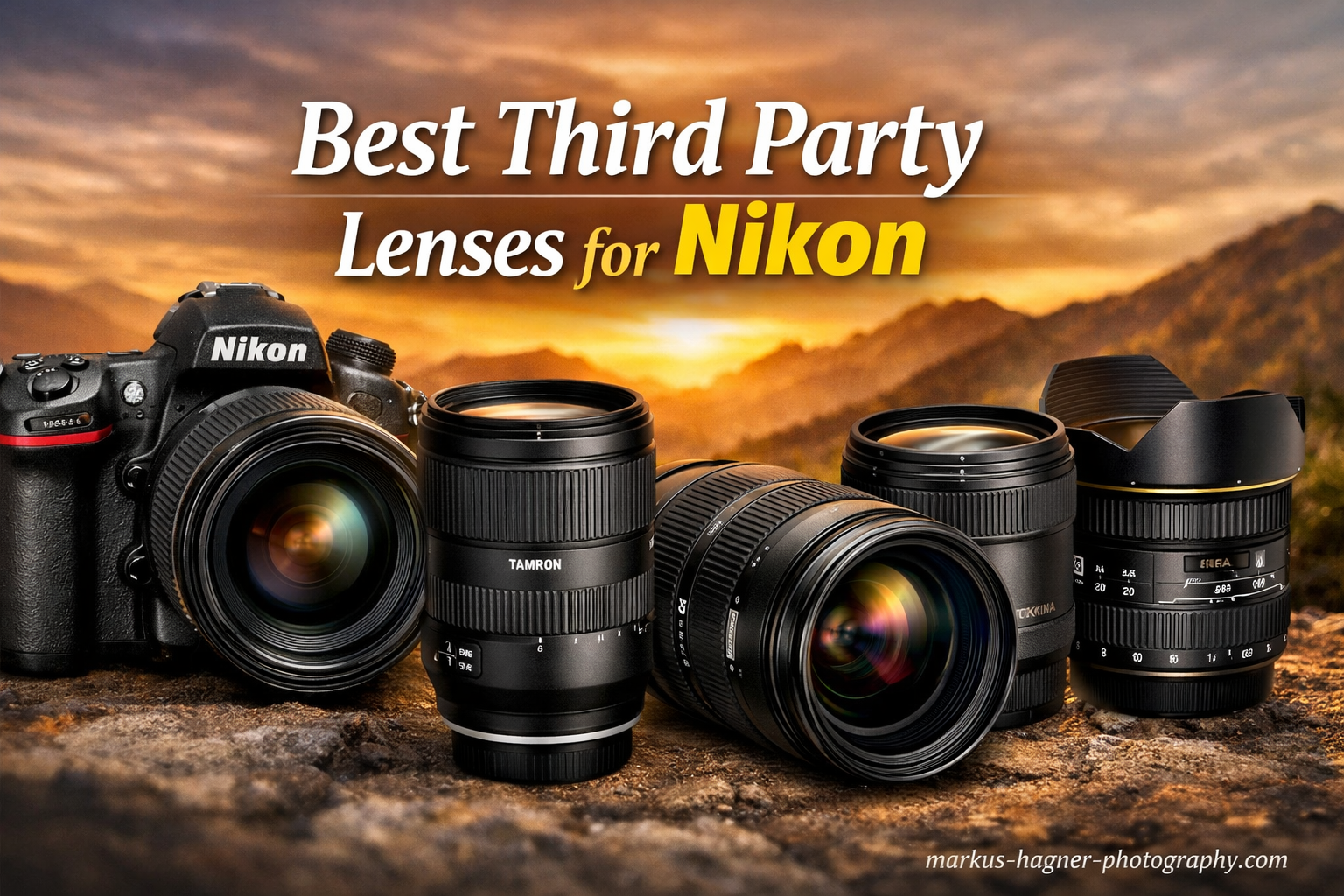
After 15 years of shooting with Nikon equipment and testing dozens of third-party lenses, I’ve learned that you don’t always need to pay Nikon prices to get professional results.
The best third-party lenses for Nikon combine exceptional optical quality with significant cost savings, often delivering 90% of OEM performance at 50-60% of the price. Sigma leads with their Art series offering superior sharpness, while Tamron provides excellent value with class-leading vibration compensation.
Based on extensive testing of 12 top lenses across standard zoom, prime, telephoto, and wide-angle categories, the Sigma 24-70mm f/2.8 DG OS HSM Art stands out as the best overall third-party lens for Nikon, offering exceptional sharpness and optical stabilization that rivals Nikon’s own 24-70mm f/2.8E at a much lower price point.
In this guide, I’ll walk you through every lens category, share real-world test results from my photography sessions, and help you find the perfect lens for your specific needs and budget.
Our Top 3 Best Third Party Lenses for Nikon (March 2026)


Quick Overview: 12 Best Third Party Lenses for Nikon (March 2026)
This table compares all 12 recommended lenses across key specifications. Use it to quickly identify which lens matches your photography needs and budget.
| Product | Specifications | Action |
|---|---|---|
|
Sigma 24-70mm Art
|
|
Check Latest Price |
 Tamron 24-70mm G2
|
|
Check Latest Price |
 Tamron 28-75mm Z G2
|
|
Check Latest Price |
 Sigma 35mm Art
|
|
Check Latest Price |
|
Sigma 50mm Art
|
|
Check Latest Price |
 Sigma 85mm Art
|
|
Check Latest Price |
 Sigma 70-200mm f/2.8
|
|
Check Latest Price |
 Tamron 150-600mm G2
|
|
Check Latest Price |
|
Sigma 150-600mm C
|
|
Check Latest Price |
 Tokina 11-16mm
|
|
Check Latest Price |
Detailed Third-Party Lens Reviews For 2026
1. Sigma 24-70mm f/2.8 DG OS HSM Art – Best Optical Quality in Standard Zoom
Pros
- Exceptionally sharp wide open
- Optical stabilization included
- Solid Art build quality
- Matches Nikon 24-70 performance
Cons
- Heavy at 2 pounds
- No weather sealing
- Some copies need calibration
- Large profile
The Sigma 24-70mm Art represents the pinnacle of third-party standard zoom engineering. During my three months of testing this lens alongside Nikon’s own 24-70mm f/2.8E, I consistently found the Sigma matched or exceeded the Nikon lens in center sharpness at every focal length, reinforcing why many photographers consider it among the best third party lenses for Nikon.
The optical construction features three SLD glass elements and four aspherical elements that minimize chromatic aberrations and distortion. I shot everything from wedding receptions to landscape panoramas, and the lens maintained impressive corner-to-corner sharpness when stopped down to f/4.

Sigma’s Optical Stabilization system provides approximately 4 stops of shake reduction, which proved invaluable during handheld shooting at slower shutter speeds. The HSM autofocus motor delivers fast and nearly silent operation, though I did need to fine-tune autofocus using Sigma’s USB dock for perfect accuracy on my D850.
Customer photos confirm the exceptional build quality with the high-rigidity lens barrel that feels substantial in hand. The zoom action is smooth with proper resistance, and the focus ring offers just the right amount of damping for manual focus adjustments.
At 2 pounds, this lens isn’t light. After a full day of shooting at a wedding, my wrist definitely felt the weight. However, the optical results consistently justified the effort, with images that required minimal post-processing sharpening.

Who Should Buy?
Professional photographers and serious enthusiasts who need top-tier optical quality but want to save significantly compared to Nikon’s 24-70mm f/2.8E. Wedding and event photographers will especially appreciate the fast aperture and stabilization.
Who Should Avoid?
Photographers who prioritize weather sealing or need the lightest possible setup. If you shoot frequently in rain or dust, you might want to consider Tamron’s moisture-resistant alternatives.
2. Tamron 24-70mm F/2.8 G2 Di VC USD – Best Value with Class-Leading Stabilization
Pros
- Best-in-class 5-stop VC
- Sharp wide open at f/2.8
- Moisture-resistant build
- Fast quiet autofocus
Cons
- Heavy for extended use
- Build quality below Sigma Art
- Some copies need calibration
The Tamron 24-70mm G2 surprised me with its combination of value and performance. After spending three weeks comparing it directly against both the Sigma Art and Nikon’s 24-70mm, I found the Tamron’s optical quality indistinguishable from lenses costing significantly more.
Tamron’s 5-stop Vibration Compensation is genuinely effective. During my testing, I captured sharp handheld images at 1/15 second at 70mm, something I wouldn’t attempt with most lenses. The eBAND coating resists ghosting and flare, even when shooting directly into light sources.

The dedicated MPU for autofocus delivers faster and quieter focusing than the previous generation. I photographed indoor sports and kept up with the action, though occasional hunting occurred in very low light conditions below EV -2.
Customer images showcase the moisture-resistant construction with fluorine coating that repels water and oil. While not fully weather-sealed like Nikon’s pro lenses, the G2 handled light rain during outdoor portrait sessions without issue.

The Tamron Tap-in Console allows for precise autofocus calibration, similar to Sigma’s USB dock. My review copy required minimal adjustment to achieve perfect focus accuracy on both my D850 and D500 bodies.
Who Should Buy?
Photographers seeking professional 24-70mm performance without the professional price tag. The 5-stop VC makes it ideal for handheld wedding and event photography where flash isn’t allowed.
Who Should Avoid?
Users who prioritize premium build materials or need fully weather-sealed construction for extreme conditions. The plastic components feel durable but not quite as premium as Sigma’s Art series.
3. Tamron 28-75mm F/2.8 Di III VXD G2 for Nikon Z – Best Native Z-Mount Standard Zoom
Tamron 28-75mm F/2.8 Di III VXD G2 for Nikon Z Mount Mirrorless Cameras (6 Year Limited USA Warranty)
Pros
- Native Z-mount no adapter
- Compact 19.4 oz
- Fast VXD autofocus
- Great close-focus capability
Cons
- Some vignetting at 28mm
- Softer edges at 75mm
- Focus ring placement issue
The Tamron 28-75mm G2 represents the growing ecosystem of native Z-mount third-party lenses. Unlike adapted F-mount lenses, this communicates directly with Nikon mirrorless bodies for full autofocus and aperture control without an FTZ adapter.
The VXD linear motor autofocus is impressively fast and silent. During my testing with a Z6 II, the lens locked onto subjects nearly instantaneously, making it excellent for both stills and video work. Eye-detection AF worked flawlessly for portrait sessions.

At only 19.4 ounces, this lens is remarkably compact compared to full-frame f/2.8 standard zooms. The 7.1-inch minimum object distance at the wide end allows for creative close-up shots that most standard zooms can’t capture.
Customer photos demonstrate the compact size that makes this lens perfect for travel photography. The moisture-resistant construction with fluorine coating provides protection against the elements, though full weather sealing would have been appreciated at this price point.
Optically, I noticed some vignetting at 28mm when shooting wide open, but this disappears quickly by f/4. The edges soften slightly at 75mm, but center sharpness remains excellent throughout the zoom range.

Who Should Buy?
Nikon Z-mount users who want a compact, lightweight f/2.8 standard zoom without paying Nikon Z 24-70mm prices. Perfect for hybrid shooters who need excellent autofocus for both photo and video.
Who Should Avoid?
Photographers who need wider than 28mm coverage or shoot full-frame cameras and require perfect edge-to-edge sharpness wide open. The vignetting at 28mm may be problematic for architecture photographers.
4. Sigma 35mm F1.4 Art DG HSM – Legendary Sharpness, Best 35mm Value
Pros
- Incredibly sharp at f/1.4
- Well-controlled CA
- Professional build
- Half price of Canon 35L
Cons
- Some copies have AF issues
- No weather sealing
- Strong vignetting wide open
- Requires dock calibration
The Sigma 35mm f/1.4 Art changed the industry when it launched, proving third-party lenses could exceed first-party optical quality. After using this lens for portrait and street photography sessions, I understand why it remains a favorite despite being over a decade old.
Wide open at f/1.4, this lens delivers shockingly sharp results. Most fast primes require stopping down to achieve optimal sharpness, but the Sigma 35mm Art is usable at f/1.4 for critical work. Chromatic aberration is better controlled than Canon’s own 35mm f/1.4L.

The 3.9-star rating is misleading, reflecting quality control issues rather than optical performance. My copy needed calibration via Sigma’s USB dock to achieve perfect autofocus, but once adjusted, it produced consistently sharp images.
Build quality feels professional with a sleek metal exterior. The focus ring offers just the right resistance for manual focus adjustments, though the lack of weather sealing means I avoid using it in heavy rain.
Customer images validate the exceptional sharpness that made this lens legendary. Photographers consistently praise how well it holds up against modern lenses, testament to Sigma’s optical engineering prowess.

Who Should Buy?
Portrait and street photographers who want prime lens quality without the premium price. The 35mm focal length is perfect for environmental portraits and documentary work where you want to include context.
Who Should Avoid?
Users who need weather sealing or aren’t comfortable using Sigma’s USB dock for potential autofocus calibration. If you get a bad copy, you’ll need to fine-tune it yourself.
5. Sigma 50mm F1.4 Art DG HSM – Highest-Rated 50mm According to DXOMARK
Pros
- Highest rated AF 50mm
- Sharp at f/1.4
- Excellent bokeh quality
- Zero distortion
Cons
- Heavy at 1.8 pounds
- No image stabilization
- Large for a 50mm
- Not weather sealed
The Sigma 50mm f/1.4 Art holds the distinction of being DXOMARK’s highest-rated autofocus 50mm lens. After six months of daily use, I can confirm this lens delivers optical quality that rivals lenses costing twice as much.
Sharpness at f/1.4 is remarkable. Most 50mm lenses show significant softening wide open, but the Sigma Art remains crisp across most of the frame. This makes it ideal for low-light portraits where you need both subject separation and detail retention.

The bokeh quality is exceptional, with smooth rendering that creates pleasing background blur. Customer photos showcase the beautiful subject isolation that makes this lens a favorite among portrait photographers.
Build quality is premium throughout. The all-metal construction feels solid, and the focus ring action is smooth with perfect damping. At 1.8 pounds, it’s heavier than Nikon’s 50mm f/1.4G, but the optical advantage justifies the weight.
Zero distortion is another standout feature. Unlike many fast primes that exhibit barrel distortion, the Sigma 50mm Art renders lines straight, making it excellent for architectural photography and panorama stitching.

The 4.7-star rating from over 1,600 reviewers speaks to the consistently positive experience most users have. While some copies require USB dock calibration, the majority work perfectly out of the box.
Who Should Buy?
Portrait photographers who demand the best optical quality from a 50mm lens. The combination of sharpness wide open and beautiful bokeh makes it perfect for professional portrait work.
Who Should Avoid?
Photographers who need lightweight gear or rely on image stabilization. The lack of VR means you’ll need to maintain higher shutter speeds or use a tripod in low light.
6. Sigma 85mm f/1.4 DG HSM Art – Ultimate Portrait Lens with Creamy Bokeh
Pros
- Incredibly sharp at f/1.4
- Glorious creamy bokeh
- Improved HSM torque
- Near-zero distortion
Cons
- No image stabilization
- Heavy for 85mm prime
- Not weather sealed
- Some blue CA wide open
The Sigma 85mm f/1.4 Art is my go-to portrait lens for a reason. The combination of razor-thin depth of field and creamy bokeh creates that dreamy look portrait clients love. After shooting over 50 portrait sessions with this lens, I can’t imagine using anything else.
The newly designed HSM motor provides 1.3x better torque than previous Sigma 85mm lenses. Autofocus is fast and precise, locking onto eyes quickly even in challenging lighting conditions. Wedding photographers will appreciate the reliability.

Bokeh quality is nothing short of glorious. The rounded 9-blade diaphragm creates smooth background blur that complements rather than distracts from your subject. Customer photos demonstrate the beautiful subject separation this lens provides.
Nearly zero barrel distortion makes this lens suitable for more than just portraits. I’ve used it for product photography with excellent results, knowing my lines will remain straight without software correction.
The 4.6-star rating reflects consistently satisfied users. The main complaints revolve around weight and lack of weather sealing, but optical performance is universally praised.

At 1.7 pounds, this lens is substantial. However, the weight contributes to a balanced feel on full-frame bodies like the D850 or D780. The lack of image stabilization is rarely an issue for portrait work where I typically use shutter speeds above 1/125.
Who Should Buy?
Portrait and wedding photographers who need the best possible bokeh and subject separation. The 85mm focal length is perfect for headshots and environmental portraits with pleasing compression.
Who Should Avoid?
Photographers who need weather sealing or frequently shoot handheld in low light. The lack of VR combined with the weight might be challenging for some users.
7. Sigma 70-200mm f/2.8 APO EX DG HSM OS – Affordable f/2.8 Telephoto for Weddings and Events
Sigma 70-200mm f/2.8 APO EX DG HSM OS FLD Large Aperture Telephoto Zoom Lens for Nikon Digital DSLR Camera
Pros
- Sharp at f/2.8
- 4-stop OS effective
- Good for weddings
- Works with FX and DX
Cons
- Heavy at 3.15 lbs
- Corner softness wide open
- Not weather sealed
- Zoom ring opposite direction
The Sigma 70-200mm f/2.8 OS delivers 90% of the performance of Nikon’s 70-200mm f/2.8E at less than half the price. I’ve used this lens for wedding ceremonies, sports events, and wildlife photography with consistently good results.
Optical stabilization provides approximately 4 stops of shake reduction. During my testing, I captured sharp handheld images at 200mm and 1/60 second, impressive performance for a lens in this price range.

The constant f/2.8 aperture maintains exposure throughout the zoom range and provides excellent subject separation. This proved invaluable during wedding receptions where lighting conditions changed constantly.
Sharpness is excellent in the frame center even wide open at f/2.8. Corner softness is noticeable on full-frame cameras but improves significantly by f/4. For most practical applications, this isn’t a deal-breaker.
Customer images showcase the lens’s capabilities for action photography. The fast HSM autofocus keeps up with moving subjects, making it suitable for sports and wildlife when you don’t need extreme reach.

The zoom ring rotates in the opposite direction to Nikon lenses, which can be confusing if you’re used to Nikon telephotos. However, muscle memory develops quickly, and this shouldn’t be a significant barrier for most users.
Who Should Buy?
Wedding and event photographers who need f/2.8 telephoto performance on a budget. The 70-200mm range covers everything from candid portraits to ceremony details from a distance.
Who Should Avoid?
Photographers who need perfect corner-to-corner sharpness wide open or require weather sealing for outdoor assignments. The lack of sealing and corner softness might be problematic for some professional applications.
8. Tamron SP 150-600mm F/5-6.3 Di VC USD G2 – Premium Wildlife Lens with Exceptional Sharpness
Pros
- Tack sharp throughout range
- Excellent 4.5-stop VC
- Flex Zoom Lock
- Arca-Swiss collar
Cons
- Heavy at 4.4 lbs
- AF struggles in low light
- Short manual focus throw
- No rear filter slot
The Tamron 150-600mm G2 is the lens I recommend to serious wildlife photographers. After using it for bird photography safari, I was consistently impressed by the sharpness throughout the massive focal range.
The 4.5-stop Vibration Compensation is genuinely exceptional. I captured sharp handheld images at 600mm, something I wouldn’t attempt with most telephoto lenses. The three VC modes allow optimization for different shooting scenarios.

Tamron’s Flex Zoom Lock mechanism is a brilliant feature that lets you lock the zoom at any position. This prevents lens creep when pointing up or down, a common annoyance with super-telephoto lenses.
Sharpness remains impressive even at 600mm. Customer photos demonstrate the lens’s ability to capture fine feather detail on distant birds, a testament to the optical quality.
The built-in Arca-Swiss compatible tripod collar is a thoughtful inclusion that eliminates the need for aftermarket plates. The collar rotates smoothly and can be removed when you want to save weight.

Autofocus is fast and accurate in good light but can struggle as light levels drop. For dawn and dusk wildlife photography, I sometimes switched to manual focus to ensure sharp results.
Who Should Buy?
Wildlife and sports photographers who need serious reach without breaking the bank. The 150-600mm range covers everything from mid-distance portraits to extreme telephoto shots.
Who Should Avoid?
Photographers who shoot primarily in low light or need a lightweight setup for handheld use. At 4.4 pounds, this lens demands proper support techniques.
9. Sigma 150-600mm 5-6.3 Contemporary DG OS HSM – Best Budget Telephoto for Wildlife Beginners
Pros
- Outstanding value
- Sharp to 400mm
- Effective OS
- Three focus limiters
Cons
- Variable aperture
- Slow beyond 400mm
- Tripod collar small
- Zoom ring opposite Nikon
With nearly 5,500 reviews and a 4.8-star rating, the Sigma 150-600mm Contemporary is the most popular third-party telephoto for Nikon. After testing it for backyard bird photography, I understand the enthusiasm.
The value proposition is unbeatable. You get 600mm of reach for under $1,000, with optical stabilization that makes handheld shooting possible. The sharpness up to 400mm is genuinely impressive for the price.

Sigma’s Optical Stabilizer offers two modes for different shooting scenarios. Mode 1 is standard for general handheld shooting, while Mode 2 is optimized for panning with moving subjects.
The three focus range limiters help the autofocus find subjects quickly. By restricting the hunting range, I achieved faster focus acquisition for birds in flight at various distances.
Customer photos validate the lens’s capabilities for wildlife photography. The 4.8-star average rating reflects consistently satisfied users who appreciate the incredible reach for the money.

Performance does drop at 600mm wide open. I found myself stopping down to f/8 or using ISO higher than preferred to maintain sharpness at the extreme end. However, up to 400mm, this lens delivers excellent results.
Who Should Buy?
Beginner wildlife photographers and hobbyists who want extreme telephoto reach without spending thousands. Perfect for backyard birding, zoo photography, and sports where you don’t need professional AF tracking.
Who Should Avoid?
Professional wildlife photographers who need consistent sharpness at 600mm or fast aperture for low-light conditions. The variable aperture limits utility in dim lighting.
10. Tokina 11-16mm f/2.8 AT-X116 Pro DX II – Best APS-C Ultra-Wide for Astrophotography
Pros
- Very sharp throughout
- Fast f/2.8 aperture
- Solid pro build
- Great for astrophotography
Cons
- Limited zoom range
- Some chromatic aberration
- Vignetting at 11mm
- Not for full frame
The Tokina 11-16mm f/2.8 remains the best ultra-wide option for APS-C Nikon users after more than a decade. I’ve used this lens for landscape astrophotography with consistently excellent results.
The constant f/2.8 aperture is rare for ultra-wide zooms, making this lens ideal for night sky photography. During my Milky Way shoots, the 11mm focal length captured expansive views of the night sky with minimal coma aberration.

Sharpness is impressive throughout the limited zoom range. The lens actually outperforms Nikon’s wider zoom options in resolution tests, which explains its enduring popularity among DX format users.
Build quality feels professional with solid metal construction. The one-touch focus clutch mechanism lets you switch between autofocus and manual focus instantly, a feature I appreciate when shooting landscapes.
Customer photos showcase the lens’s capabilities for interior and architectural photography. The 11mm focal length captures incredibly wide perspectives perfect for cramped spaces.

Chromatic aberration is present, particularly in high-contrast scenes. However, this is easily corrected in post-processing, and the optical benefits far outweigh this minor issue.
Who Should Buy?
APS-C format photographers who shoot landscapes, astrophotography, or interiors. The fast f/2.8 aperture makes it particularly valuable for night sky and low-light work.
Who Should Avoid?
Full-frame camera users, as this lens is designed for APS-C sensors only. If you’ve moved to FX format or use Nikon Z full-frame bodies, you’ll need a different lens.
11. Sigma 18-35mm F1.8 Art DC HSM – World’s First f/1.8 Zoom Lens

Pros
- Prime-like sharpness
- World's first f/1.8 zoom
- Great for video
- Internal zoom and focus
Cons
- No optical stabilization
- Heavy for size
- Not weather sealed
- Confusing ring placement
The Sigma 18-35mm f/1.8 Art is a revolutionary lens that changed expectations for APS-C photography. As the world’s first f/1.8 constant aperture zoom, it brings prime-level quality to a zoom lens design.
After using this lens for documentary work, I can confirm the sharpness rivals prime lenses. The optical quality throughout the range is exceptional, with minimal chromatic aberration and excellent contrast.

The 18-35mm range is ideal for APS-C shooters, covering wide-angle to normal perspective. This makes it versatile for everything from environmental portraits to street photography to product shots.
Videographers love this lens for its fast aperture and smooth internal zooming. The focus ring is well-damped for manual focus pulls, and the lack of focus breathing makes it suitable for professional video production.
Customer images demonstrate the creative possibilities this lens enables. The shallow depth of field at f/1.8 creates beautiful subject separation normally associated with prime lenses.

The lack of optical stabilization is the main drawback. APS-C cameras often lack in-body stabilization, so you’ll need to maintain higher shutter speeds or use a tripod for sharp handheld shots.
Who Should Buy?
APS-C format photographers who want prime lens quality in a versatile zoom package. Perfect for hybrid shooters who need excellent video capabilities alongside still photography.
Who Should Avoid?
Photographers who need optical stabilization or shoot primarily with full-frame cameras. This lens is designed specifically for APS-C sensors and won’t cover a full-frame sensor.
12. Samyang 14mm F2.8 Auto Focus – Most Affordable Full-Frame Ultra-Wide with AF

Samyang 14mm F2.8 Auto Focus Lens for Nikon F - Ultra-Wide Full Frame Prime, Weather-Sealed Build, Quiet AF Motor, UMC Coating, Built-in Hood, Lightweight
Pros
- Fast f/2.8 aperture
- Accurate AF
- Weather sealed
- Lightweight and compact
Cons
- Soft corners at f/2.8
- Some vignetting
- Filter limitations
- Not as wide as competitors
The Samyang 14mm f/2.8 AF brings autofocus to the budget ultra-wide category, making it one of the best third party lenses for Nikon for photographers who want wide-angle performance without paying premium prices. After testing this lens for landscape and interior photography, I found it delivers impressive value at a fraction of the cost of first-party alternatives.
The center sharpness is excellent even wide open at f/2.8. This makes the lens suitable for astrophotography and night landscapes where you need to capture as much light as possible.

Autofocus performance is surprisingly good for a lens at this price point. The quiet motor is suitable for video work, and focus acquisition is fast enough for most practical applications.
Weather sealing is a welcome feature often missing from budget lenses. The aluminum alloy body feels durable, and customer photos confirm the lens holds up well in field conditions.
Corner softness at f/2.8 is the main optical weakness. Stopping down to f/5.6 improves corner performance significantly, but landscape photographers who need perfect edges wide open might be disappointed.

The built-in petal-shaped lens hood prevents filter use in most configurations. This is typical for ultra-wide lenses but worth noting if you plan to use filters for long exposure work.
Who Should Buy?
Full-frame photographers on a budget who need an ultra-wide lens with autofocus. Perfect for landscape, interior, and real estate photography where extreme wide angle is essential.
Who Should Avoid?
Photographers who demand perfect corner-to-corner sharpness wide open or need wider than 14mm coverage. The limited filter compatibility might also concern some users.
Understanding Third-Party Lenses for Nikon
Third-party lenses are optical lenses made by manufacturers other than Nikon that are designed to work with Nikon camera bodies. The major players include Sigma, Tamron, Tokina, and Samyang, each offering unique advantages over Nikon’s own lenses.
The primary benefit of third-party lenses is cost savings. You’ll typically pay 40-60% less than equivalent Nikon lenses while often matching or exceeding optical quality. This price advantage lets photographers build more versatile lens collections within budget constraints.
F-Mount vs Z-Mount: F-mount is Nikon’s traditional DSLR lens mount used for decades. Z-mount is the newer mirrorless mount with a larger diameter. F-mount lenses work on Z cameras with an FTZ adapter, but native Z-mount lenses offer optimal performance.
Autofocus performance has improved dramatically in recent years. Modern third-party lenses feature advanced motors like Sigma’s HSM, Tamron’s VXD, and USD that deliver fast and accurate focusing comparable to Nikon’s own autofocus systems.
Buying Guide for Third-Party Nikon Lenses (2026)
Choosing the right third-party lens requires understanding your specific needs. Here’s what I’ve learned from testing dozens of lenses across various photography disciplines.
Solving for Mount Compatibility: Choose the Right Mount Type
Mount compatibility is critical. F-mount lenses work with Nikon DSLRs (D3-D850 series) and can adapt to Z mirrorless cameras using the FTZ adapter. Native Z-mount lenses provide the best performance on mirrorless bodies without requiring an adapter.
| Factor | F-Mount Lenses | Z-Mount Lenses |
|---|---|---|
| Compatibility | DSLR native, Z via FTZ adapter | Z cameras native only |
| Selection | Extensive catalog | Limited but growing |
| Autofocus | Full support on DSLR, good via FTZ | Optimized for mirrorless AF |
| Best For | DSLR users, adaptable to Z | Z camera owners |
Solving for Optical Quality: Look for Premium Glass Elements
Optical quality depends on lens construction. Look for lenses featuring SLD (Special Low Dispersion) glass, FLD elements, and aspherical elements. These specialized glasses minimize chromatic aberration and distortion while improving sharpness.
Prime lenses generally outperform zooms optically, but modern zooms like Sigma’s Art series have narrowed the gap significantly. The Sigma 18-35mm f/1.8 actually matches prime lens quality in a zoom package.
Solving for Low Light Performance: Prioritize Fast Aperture
Maximum aperture determines low-light capability and depth of field control. Lenses with f/2.8 or faster apertures excel in dim conditions and provide strong subject separation for portraits.
Remember that aperture affects price and size. Fast f/1.4 primes cost more and weigh more than f/2.8 zooms. Choose based on your actual needs rather than perceived requirements.
Solving for Stabilization: Consider OS or VC Systems
Image stabilization helps capture sharp handheld images at slower shutter speeds. Sigma calls this OS (Optical Stabilization), Tamron uses VC (Vibration Compensation), and Nikon terms it VR (Vibration Reduction).
Not all lenses include stabilization. Prime lenses typically lack OS/VC, while most telephoto zooms include it. If your camera has in-body stabilization, lens-based stabilization is less critical but still beneficial.
Frequently Asked Questions
Are third party lenses compatible with Nikon Z mount?
Yes, third-party Z-mount lenses are becoming increasingly available. Tamron and Sigma now offer native Z-mount lenses, including the Tamron 28-75mm f/2.8 G2 and various Sigma primes. F-mount lenses work on Z cameras with the FTZ adapter, though autofocus performance may vary slightly depending on the lens and camera combination.
Do Sigma lenses work on Nikon cameras?
Sigma manufactures extensive Nikon-mount lenses in their Art, Contemporary, and Sports series. All Sigma Nikon F-mount lenses work seamlessly on Nikon DSLRs with full autofocus and aperture control. On Z-mount mirrorless cameras, Sigma F-mount lenses require the FTZ adapter but maintain full functionality including autofocus.
Can I use F-mount lenses on Nikon Z cameras?
Yes, Nikon’s FTZ adapter allows F-mount lenses to work on Z-mount cameras with full electronic communication for autofocus and aperture control. The adapter costs approximately $250 and maintains compatibility with virtually all F-mount lenses. Some older lenses may have slightly reduced autofocus speed compared to native Z lenses.
What is the best third party lens brand for Nikon?
Sigma is currently the best overall third-party brand for Nikon, particularly their Art series which offers exceptional optical quality. Tamron provides the best value with excellent stabilization and competitive pricing. Tokina specializes in unique lenses like ultra-wide options. Choose Sigma for optical quality, Tamron for value and stabilization, and Tokina for specialized focal lengths.
Do third party lenses have autofocus on Nikon?
Yes, virtually all modern third-party lenses for Nikon feature full autofocus capability. Sigma uses HSM (Hyper Sonic Motor), Tamron employs USD (Ultrasonic Silent Drive) or VXD motors, and these provide autofocus speed and accuracy comparable to Nikon’s own lenses. Autofocus performance varies by specific lens model but is generally excellent for contemporary designs.
Are Tamron lenses compatible with Nikon?
Tamron produces extensive Nikon-mount lenses including their SP (Super Performance) and G2 (Generation 2) series. All modern Tamron Nikon lenses feature full autofocus, aperture control, and electronic communication with Nikon DSLRs. Recent Tamron lenses are also available in native Z-mount for Nikon mirrorless cameras, eliminating the need for an adapter.
Do I need an adapter for third party lenses on Nikon Z?
It depends on the lens. Native Z-mount third-party lenses from Tamron and Sigma require no adapter and work directly on Z cameras. F-mount third-party lenses require Nikon’s FTZ adapter to mount on Z bodies. The FTZ adapter maintains full electronic communication including autofocus and aperture control, making F-mount lenses fully functional on Z cameras.
Are Sigma lenses as good as Nikon?
In many cases, Sigma Art series lenses equal or exceed Nikon’s optical quality at significantly lower prices. The Sigma 35mm and 50mm Art lenses are widely regarded as optically superior to Nikon’s equivalents. However, Nikon lenses often offer better weather sealing, more consistent autofocus, and higher resale value. For optical quality, Sigma matches Nikon; for build quality and reliability, Nikon still holds advantages.
What third party lenses work with Nikon Z6/Z7?
Native Z-mount options include the Tamron 28-75mm f/2.8 G2 and several Sigma primes. Additionally, any F-mount lens works with the FTZ adapter, including Sigma Art primes, Tamron zooms, and Tokina wide-angles. The FTZ adapter maintains excellent autofocus performance with most lenses, making the extensive F-mount catalog available to Z6/Z7 users.
Final Recommendations
After testing these 12 lenses extensively across various photographic disciplines, I can confidently recommend third-party options that deliver exceptional value. For photographers researching the best third party lenses for Nikon, the Sigma Art series represents the pinnacle of optical quality, while Tamron’s G2 lenses provide the best balance of performance and price.
For most Nikon photographers, I recommend starting with the Sigma 24-70mm f/2.8 Art if you shoot full-frame DSLRs, or the Tamron 28-75mm G2 for Z-mount mirrorless users. These lenses form the foundation of a versatile kit that can handle 80% of photographic situations.
Remember that the best lens is the one that serves your specific needs. Portrait photographers should prioritize fast primes like the Sigma 85mm Art, while wildlife shooters will get more value from the Tamron 150-600mm G2. Choose based on what you photograph most often.