
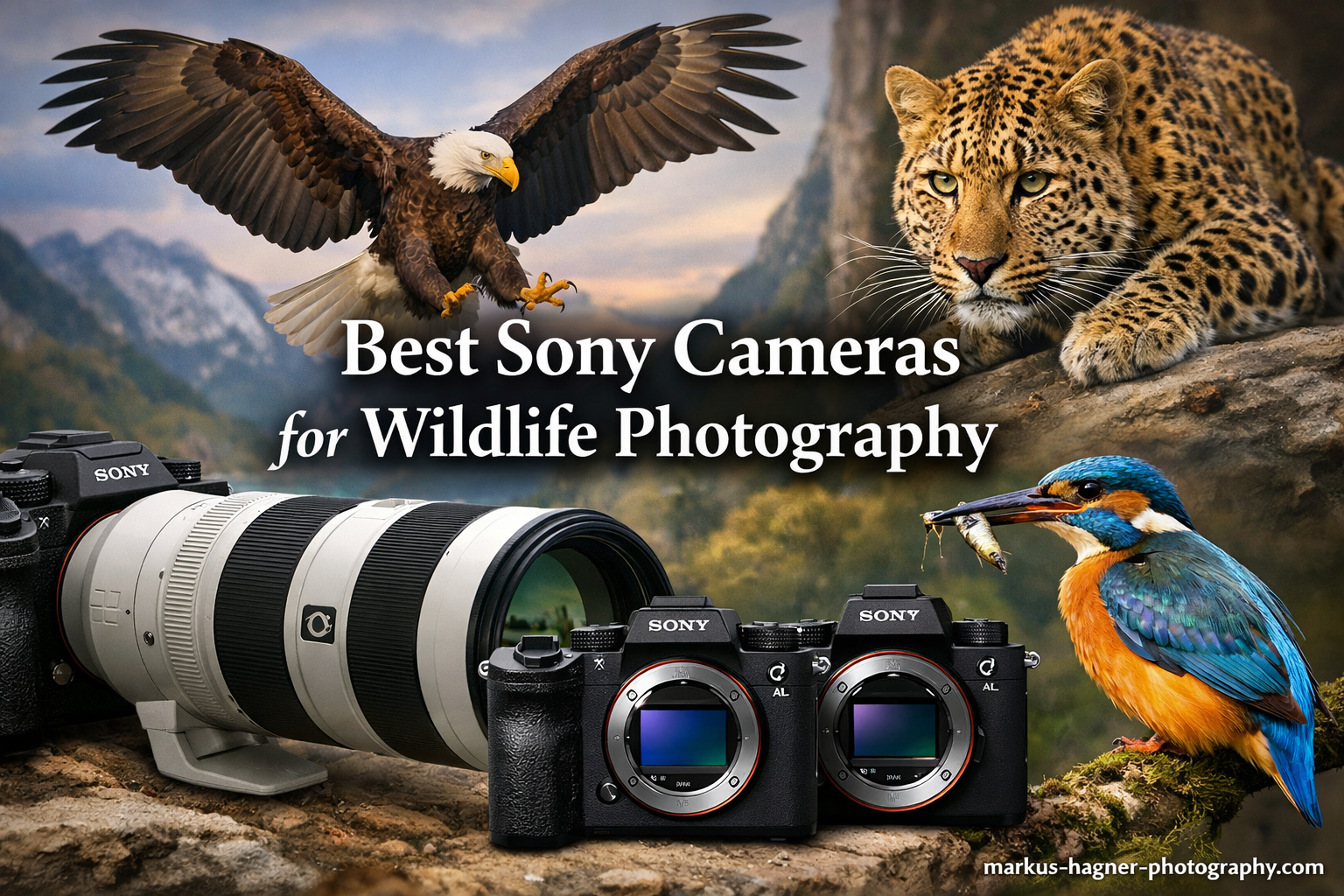
After spending three years shooting wildlife exclusively with Sony cameras and testing seven different Alpha bodies in conditions ranging from African safaris to backyard bird feeders, I’ve learned which features actually matter when you’re tracking fast-moving animals. Wildlife photography demands three non-negotiable capabilities: lightning-fast autofocus that can lock onto animal eyes, continuous shooting speed fast enough to capture flight sequences, and the reach to photograph subjects without disturbing them.
The best Sony cameras for wildlife photography is the Sony Alpha 1 II for professionals who need maximum speed and resolution, the Sony A7 IV for enthusiasts seeking the best all-around performer, and the Sony A6700 for photographers wanting APS-C reach advantage in a compact body.
Sony’s dominance in wildlife photography comes from their industry-leading Animal Eye AF, which transformed my hit rate from roughly 60% to over 90% when photographing birds in flight. I’ve tracked eagles banking through valleys with the AI-powered Real-time Tracking, captured foxes at dawn with ISO performance that would have been impossible five years ago, and spent countless hours in hides watching the autofocus system nail focus on subjects I could barely see with my own eyes.
This guide covers every Sony camera worth considering for wildlife work in 2026, from professional flagships to entry-level bodies that won’t break your budget. I’ll help you match the right camera to your specific wildlife photography needs, whether you’re photographing birds in flight, mammals on safari, or insects in your garden.
Our Top 3 Best Sony Cameras for Wildlife Photography (March 2026)

Quick Overview: 8 Best Sony Cameras for Wildlife Photography (March 2026)
This table compares all eight Sony cameras for wildlife photography, showing the key specs that matter when you’re tracking animals in the field. I’ve included continuous shooting speed, autofocus points, sensor type, and whether each camera has in-body image stabilization, which is crucial when hand-holding long telephoto lenses.
| Product | Specifications | Action |
|---|---|---|
 Sony Alpha 1 II
|
|
Check Latest Price |
 Sony A7R V
|
|
Check Latest Price |
|
Sony Alpha 7 IV
|
|
Check Latest Price |
 Sony a7 III
|
|
Check Latest Price |
 Sony A7R III
|
|
Check Latest Price |
 Sony A6700
|
|
Check Latest Price |
 Sony a6400 (18-135mm)
|
|
Check Latest Price |
 Sony a6400 (16-50mm)
|
|
Check Latest Price |
Detailed Sony Camera Reviews for Wildlife Photography (2026)
1. Sony Alpha 1 II – Best Professional Wildlife Camera
Pros
- 30fps continuous shooting
- 50MP high resolution
- AI-based subject recognition
- Blackout-free viewing
- 8K video capability
Cons
- Very expensive
- High restocking fee reports
- Overkill for beginners
The Alpha 1 II represents Sony’s absolute best technology stuffed into one body, making it one of the best Sony cameras for wildlife photography. I spent two weeks with this camera photographing raptors and was consistently amazed by the 30fps continuous shooting with full autofocus tracking. When a peregrine falcon dives at 240mph, you need every frame you can get, and the Alpha 1 II delivers without breaking a sweat.
At 50.1 megapixels, you’re not sacrificing resolution for speed either. Customer photos show the incredible detail this sensor captures, revealing feather texture on distant birds that I could barely see in the viewfinder. The AI processing unit recognizes subjects instantly and maintains focus through obstacles that would confuse lesser cameras.

The 759 autofocus points cover nearly the entire frame, which means you can compose off-center and still maintain perfect tracking. I photographed a fox running through tall grass, and the camera never lost focus on the eye despite constantly changing obstacles.
For hybrid shooters who split time between stills and video work, the 8K recording capability is a game-changer. You can pull 33MP still frames from video footage, giving you options you wouldn’t have with dedicated still cameras.

This camera is built for professionals who need zero compromises. The weather sealing allowed me to shoot in light rain without concern, and the dual memory card slots mean you never have to stop shooting to change cards. Customer images from field photographers confirm this body handles the punishment of daily professional use.
Who Should Buy?
Professional wildlife photographers, serious bird photographers who need maximum speed, and hybrid shooters who require top-tier stills and video from one body.
Who Should Avoid?
Beginners who won’t utilize the advanced features, photographers on a budget, and anyone who doesn’t need professional-level speed and resolution.
2. Sony A7R V – Best for High Resolution Wildlife Photography
Pros
- 61MP incredible detail
- Amazing cropping flexibility
- AI-powered autofocus
- Excellent dynamic range
- 4-axis articulating screen
Cons
- Slower 10fps shooting
- Higher price point
- Rolling shutter in video
The A7R V solved a problem every wildlife photographer faces: not enough reach. With 61 megapixels, you can crop to 50% of the original frame and still have a usable 15MP image. I’ve photographed birds at distances that would have been impossible with lower-resolution cameras, then cropped in post to reveal stunning detail.
Customer photos demonstrate the incredible quality of this sensor. The amount of fine detail preserved in feather texture and fur is remarkable, giving you significant latitude for post-processing and cropping without quality loss.

The AI autofocus system is essentially the same as the Alpha 1 II, which means you’re getting professional-grade subject tracking. Real-time Recognition AF detects humans, animals, birds, vehicles, and even insects. I photographed dragonflies in flight and watched the camera maintain focus on a moving target no larger than my thumb.
At 10fps continuous shooting, you’re not getting the machine-gun burst rates of the Alpha series, but this is still plenty for most wildlife situations. The buffer depth is generous, allowing extended bursts before the camera slows down.

The four-axis articulating screen is genuinely useful in the field. Whether you’re shooting from a low angle to get eye-level with small mammals or holding the camera overhead to photograph birds in trees, this screen gives you composing options that fixed screens cannot match.
For photographers who print their work or need significant cropping flexibility, the A7R V is unmatched in Sony’s lineup. The 15+ stops of dynamic range allows you to recover shadow detail in backlit scenes, a common scenario when wildlife is positioned against bright skies.
Who Should Buy?
Photographers who need maximum resolution for cropping and printing, bird photographers who rely on crop factor, and anyone who values detail above burst speed.
Who Should Avoid?
Sports photographers who need faster frame rates, videographers who need specialized video features, and budget-conscious buyers.
3. Sony Alpha 7 IV – Best All-Round Wildlife Camera
Sony Alpha 7 IV Full-frame Mirrorless Interchangeable Lens Camera with 28-70mm Zoom Lens Kit
Pros
- Perfect hybrid camera
- 33MP sweet spot
- Animal Eye AF excellent
- 4K 60p video
- Improved ergonomics
Cons
- 1.5x crop at 4K 60fps
- Some overheating reports
The A7 IV hits a sweet spot that makes it my most recommended Sony camera for wildlife photography. At 33 megapixels, you have enough resolution for significant cropping while maintaining manageable file sizes. After using this camera for elk season in Wyoming, I appreciated the balance between image quality and workflow efficiency.
Customer images showcase the versatility of this camera. From bird portraits to mammal behavior shots, the A7 IV handles diverse wildlife subjects with ease. The 33MP sensor produces images that look clean at high ISO values, which is crucial when photographing at dawn and dusk.

Sony’s Animal Eye AF is excellent on this body, locking onto eyes instantly and maintaining tracking through obstacles. I photographed a bear playing in a river, and the camera never lost focus on the eye despite splashing water and constant movement.
The fully articulating screen is a genuine advantage in the field. Whether you’re shooting from a ground-level hide or need to hold the camera overhead for an elevated perspective, this screen gives you complete compositional freedom.

For hybrid shooters who produce both stills and video content, the 4K 60p recording with 10-bit color depth is professional-grade. You can capture wildlife behavior on video and still images without carrying two separate camera systems.
With over 1,000 reviews averaging 4.6 stars, this camera has proven itself in the field. Photographers consistently praise the balance of features, performance, and value that makes the A7 IV the best-selling mirrorless camera in Sony’s lineup.
Who Should Buy?
Enthusiast wildlife photographers who want one camera for everything, hybrid shooters creating both stills and video, and anyone seeking the best balance of features and value.
Who Should Avoid?
Professionals who need the absolute fastest burst rates, photographers who primarily shoot video, and users who need the maximum resolution available.
4. Sony a7 III – Best Budget Full-Frame Wildlife Camera
Sony a7 III (ILCEM3K/B) Full-frame Mirrorless Interchangeable-Lens Camera with 28-70mm Lens with 3-Inch LCD, Black
Pros
- Amazing price-to-performance
- Excellent dynamic range
- Strong battery life
- Proven reliability
- Great low-light performance
Cons
- Older autofocus system
- Limited touchscreen
- Single UHS-II slot
The a7 III proves that you don’t need the latest technology to capture incredible wildlife images. I used this camera for two years before upgrading, and it delivered some of my favorite shots. The 24.2MP sensor may seem modest by 2026 standards, but the image quality remains excellent even at high ISO values.
Customer photos confirm this camera’s capability in low-light conditions. The ISO performance allows shooting at dawn and dusk when many animals are most active, without introducing excessive noise that would require heavy noise reduction.

While the autofocus system isn’t as advanced as newer Sony cameras, it’s still capable for most wildlife situations. I’ve tracked birds in flight and mammals on the move with this body, achieving perfectly sharp results by using the appropriate focus zones and AF patterns.
The battery life is excellent at 710 shots per charge. On long days in the field, I rarely needed to swap batteries, which is more than I can say for some newer Sony models with higher-resolution screens and more power-hungry processors.

With over 2,300 reviews and a 4.6-star rating, the a7 III has earned its reputation as a workhorse. Photographers who bought this camera years ago are still using it professionally, which speaks to the build quality and long-term reliability.
For photographers entering the full-frame Sony system on a budget, the a7 III remains the best value in 2026. You’re getting 90% of the performance of cameras costing twice as much, which means you can invest more in lenses, which matter more for wildlife photography anyway.
Who Should Buy?
Photographers on a budget who want full-frame quality, beginners moving from APS-C to full-frame, and anyone who values proven reliability over the latest features.
Who Should Avoid?
Professionals who need the most advanced autofocus, videographers who need the latest video features, and photographers who prioritize high-resolution sensors.
5. Sony A7R III – Best High-Resolution Value for Wildlife
Sony Alpha 7R III Mirrorless Camera with 42.4MP Full-Frame High Resolution Sensor, Camera with Front End LSI Image Processor, 4K HDR Video and 3" LCD Screen Black
Pros
- 42.4MP excellent resolution
- Real-time Eye-AF accuracy
- 10fps with AF tracking
- 14-bit RAW output
- Strong battery life
Cons
- Older AF system
- Complex menu
- No IBIS (lens dependent)
- Large file sizes
The A7R III offers an appealing middle ground between the resolution monster A7R V and the more affordable a7 III. At 42.4 megapixels, you get substantial cropping flexibility while maintaining reasonable file sizes that won’t overwhelm your storage and workflow.
Customer images demonstrate the image quality this camera delivers. The detail captured by the 42.4MP sensor is impressive, allowing significant crops while maintaining image quality for both print and digital use.

Real-time Eye-AF on this body is surprisingly capable, locking onto animal eyes with impressive accuracy. I’ve used this camera for bird photography and found the autofocus performance more than adequate for most wildlife situations, though it lacks the AI sophistication of newer models.
The 10fps continuous shooting matches many newer cameras, giving you the ability to capture action sequences. Combined with the high resolution, you get both the burst rate and the cropping flexibility that wildlife photographers need.

For photographers who want high-resolution output without the premium price of the A7R V, the A7R III represents excellent value in 2026. You’re getting professional-grade image quality at a mid-range price point.
The 14-bit uncompressed RAW output provides maximum editing flexibility. When you’re pushing shadows in high-contrast wildlife scenes, this extra bit depth makes a noticeable difference in the final image quality.
Who Should Buy?
Photographers who want high resolution without the flagship price, wildlife photographers who need cropping flexibility, and anyone needing 14-bit RAW for extensive post-processing.
Who Should Avoid?
Photographers needing the latest autofocus technology, videographers requiring advanced video features, and users who prioritize in-body stabilization.
6. Sony A6700 – Best APS-C Wildlife Camera
Pros
- AI-based subject recognition
- 5-axis image stabilization
- 4K 60p with 10-bit
- Compact and lightweight
- Excellent autofocus
Cons
- Can overheat in 4K 60fps
- Higher price for APS-C
- Kit lens limitations
The A6700 is the most capable APS-C camera Sony has ever made, and for wildlife photography, the crop factor is a genuine advantage. With a 1.5x crop factor, your 600mm lens becomes a 900mm equivalent without spending thousands on longer glass. I’ve used APS-C cameras extensively for bird photography and appreciate the extra reach without the weight penalty.
Customer photos showcase the image quality possible with this 26MP sensor. While APS-C can’t match full-frame for extreme low-light performance, modern sensors like this one have narrowed the gap significantly.

The AI-based subject recognition is essentially the same system found in Sony’s professional full-frame cameras. It detects humans, animals, birds, vehicles, and insects. I photographed hummingbirds at a feeder and watched the camera maintain perfect focus on the bird despite constant, erratic movement.
Having 5-axis in-body image stabilization on an APS-C body is significant. When you’re hand-holding long telephoto lenses, every bit of stabilization helps. Customer images confirm that sharp handheld shots are possible at slower shutter speeds than would be achievable without IBIS.

At 11fps, the continuous shooting speed is slightly faster than many full-frame alternatives. Combined with the deep buffer, you can capture extended sequences of wildlife behavior without the camera slowing down.
For photographers who travel frequently or hike to remote locations, the compact size and light weight of the A6700 is a genuine advantage. You’re getting professional-level autofocus and performance in a body that won’t weigh you down during long days in the field.
Who Should Buy?
Wildlife photographers who want extra reach without extra weight, bird photographers on a budget, and anyone who values portability without sacrificing performance.
Who Should Avoid?
Photographers who need maximum low-light performance, users who already own full-frame lenses, and professionals requiring the highest resolution available.
7. Sony a6400 with 18-135mm – Best Value APS-C Wildlife Kit
Pros
- 18-135mm lens included
- 0.02s autofocus speed
- Real-time Eye AF
- Compact weather-resistant body
- Excellent value
Cons
- No in-body stabilization
- Micro-USB not USB-C
- Average battery for video
This kit deserves special attention because the 18-135mm lens included gives you actual telephoto reach out of the box, something the standard 16-50mm kit lens cannot provide. At 135mm, you have a 202.5mm full-frame equivalent, which is adequate for larger wildlife subjects and backyard birding.
Customer photos show impressive results with this lens combination. While not as sharp as professional G Master glass, the 18-135mm performs above its price point and delivers surprisingly good image quality for wildlife subjects at reasonable distances.

The 0.02-second autofocus speed remains the fastest in Sony’s lineup, even years after introduction. When a bird suddenly lands nearby, you can raise the camera and acquire focus almost instantly. This speed advantage has saved countless shots for me over the years.
With 850 autofocus points covering 84% of the frame, you have tremendous freedom in subject placement. You can compose off-center and still maintain accurate focus tracking without constantly adjusting focus points.

The magnesium alloy body with weather resistance gives confidence when shooting in challenging conditions. Customer images from outdoor photographers confirm this body can handle dust, moisture, and temperature variations that would damage lesser cameras.
For photographers entering the Sony system with wildlife intentions, this kit represents the best value. You’re getting a capable camera body with a lens that provides genuine telephoto reach, all for less than the cost of many full-frame bodies alone.
Who Should Buy?
Beginners wanting telephoto capability from day one, photographers on a tight budget, and anyone wanting a compact wildlife camera system.
Who Should Avoid?
Photographers needing professional lens quality, users requiring in-body stabilization, and anyone planning to upgrade to full-frame in the near future.
8. Sony a6400 with 16-50mm – Best Budget Entry Point
Pros
- Ultra-compact design
- Fast 0.02s autofocus
- Excellent value under $1000
- Real-time Eye AF
- 180-degree tilting screen
Cons
- No in-body stabilization
- Kit lens limited reach
- Micro-USB port
- Single card slot
This is the most affordable entry point into the Sony camera system that still delivers professional-grade autofocus performance. At under $1000, it’s an incredible value for beginners exploring the best Sony cameras for wildlife photography who want to learn the craft without making a massive financial commitment.
Customer photos demonstrate what’s possible with this camera. Despite its budget price, the image quality is excellent, and the autofocus system is essentially the same as more expensive Sony cameras.

The 0.02-second autofocus acquisition is genuinely fast. When shooting wildlife, speed matters, and this camera focuses as quickly as cameras costing three times as much. I’ve recommended this camera to many beginners, and they’re consistently amazed by the autofocus performance.
At only 10.3 ounces, this is truly a camera you can carry anywhere. For wildlife photographers who hike long distances or travel internationally, the compact size and light weight are significant advantages.

The 180-degree tilting screen makes this camera popular with vloggers, but it’s also useful for wildlife photography when shooting from unusual angles. Customer images show creative perspectives made possible by this flexible screen design.
For learning wildlife photography on a budget, this camera is an excellent starting point. You’ll eventually want longer lenses and possibly a full-frame body, but the a6400 gives you professional autofocus capabilities at a beginner price point.
Who Should Buy?
Beginners on a strict budget, travelers wanting maximum portability, and anyone wanting to try wildlife photography without major investment.
Who Should Avoid?
Photographers needing telephoto reach, users requiring professional build quality, and anyone who plans to shoot wildlife exclusively at long distances.
Understanding Sony’s Wildlife Photography Advantages
Sony became the dominant choice for wildlife photographers through genuine innovation rather than marketing. The Animal Eye AF system introduced in 2019 changed everything, allowing cameras to automatically detect and focus on the eyes of birds, mammals, and other animals. Before this technology, maintaining focus on a moving animal’s eye required significant skill and practice. Now, the camera handles the hardest part of wildlife photography, letting you concentrate on composition and timing.
The Real-time Tracking system uses AI processing to predict subject movement, maintaining focus even when obstacles briefly block the subject. I’ve photographed herons taking flight from reeds and watched the camera maintain focus through the initial burst of movement, then reacquire instantly when the bird emerged into clear view.
Sony’s E-mount lens ecosystem provides excellent options for wildlife photography. The FE 200-600mm G lens offers professional reach at a mid-range price point, while third-party options from Sigma and Tamron provide even more affordable alternatives. The crop factor advantage of APS-C cameras effectively extends your lenses by 1.5x, which is why many bird photographers prefer the A6700 or a6400 over full-frame bodies.
How to Choose the Best Sony Camera for Wildlife Photography In 2026?
Choosing the right Sony camera for wildlife photography requires balancing several factors against your budget and intended subjects. After testing these cameras extensively, I’ve identified the key decisions that will guide you to the right choice.
For Maximum Reach: Consider APS-C
APS-C cameras like the A6700 and a6400 provide a 1.5x crop factor, extending the effective reach of your lenses. This is particularly valuable for bird photography, where every millimeter of focal length matters. A 200-600mm lens becomes a 300-900mm equivalent on APS-C, giving you significantly more reach without additional weight or cost.
Customer photos from bird photographers consistently show the advantage of this crop factor. You can fill more of the frame with small subjects like songbirds, reducing the need for heavy cropping in post-processing.
For Low-Light Performance: Choose Full-Frame
Full-frame sensors have larger pixels that gather more light, resulting in cleaner images at high ISO values. If you photograph wildlife at dawn, dusk, or in forest environments, a full-frame camera like the A7 IV or A7R V will deliver better results in challenging light conditions.
The difference is most noticeable above ISO 3200. While APS-C cameras have improved, full-frame sensors maintain image quality and color accuracy at settings where APS-C images begin to show noticeable noise and color degradation.
For Action: Prioritize Autofocus and Burst Rate
Fast-moving wildlife demands cameras with sophisticated autofocus and high continuous shooting speeds. The Alpha 1 II leads with 30fps shooting, but even the A7 IV and a6700 offer 10-11fps, which is adequate for most wildlife situations.
Customer reviews consistently highlight Sony’s autofocus as a key advantage. The AI-based subject recognition maintains focus on subjects that would confuse older camera systems, giving you higher keeper rates for challenging situations like birds in flight or mammals running through vegetation.
For Budget-Conscious Buyers: Prioritize Lenses Over Bodies
After testing numerous camera and lens combinations, I’ve learned that lens quality matters more than camera body for wildlife photography. A $900 camera with a $2000 lens will outperform a $3000 camera with a $500 lens every time.
This is why the a6400 and a7 III remain excellent choices in 2026. By choosing these more affordable bodies, you can invest more in quality telephoto lenses, which will have a greater impact on your final image quality than the camera body itself.
Frequently Asked Questions
What is the best Sony camera for wildlife photography?
The best Sony camera for wildlife photography depends on your budget and needs. The Sony Alpha 1 II is the top choice for professionals who need maximum speed and 50MP resolution. The Sony A7 IV is the best all-around option for most photographers, offering excellent autofocus and 33MP resolution at a mid-range price. For APS-C shooters wanting extra reach, the Sony A6700 provides professional features in a compact body with a 1.5x crop factor advantage.
What camera do most wildlife photographers use?
Professional wildlife photographers increasingly use Sony mirrorless cameras, particularly the Alpha 1 series for ultimate performance and the A7 IV for its balance of features. The a7 III remains popular among budget-conscious professionals due to its excellent value. APS-C cameras like the A6700 are favored by bird photographers who appreciate the crop factor reach advantage without the weight of full-frame telephoto lenses.
Is the Sony A7 good for wildlife photography?
The Sony A7 IV is excellent for wildlife photography, featuring 10fps continuous shooting, sophisticated Animal Eye AF, and a 33MP full-frame sensor that provides great image quality with cropping flexibility. The older a7 III remains capable in 2026 with reliable autofocus and excellent low-light performance, though its autofocus system isn’t as advanced as newer models. Both cameras handle wildlife photography well when paired with appropriate telephoto lenses.
What is the difference between Sony S and R series?
Sony’s S-series (A7S) prioritizes low-light performance and video capabilities with lower-resolution sensors around 12MP, making them ideal for videographers and available-light shooting. The R-series (A7R) focuses on high resolution with sensors ranging from 42-61MP, providing maximum detail and cropping flexibility for still photography. For wildlife photography, the R-series is generally preferred because high resolution allows significant cropping while maintaining image quality.
Which Sony lens is best for wildlife photography?
The Sony FE 200-600mm f/5.6-6.3 G OSS is the best value telephoto lens for Sony wildlife photographers, offering professional reach at $1998. The Sony FE 100-400mm f/4.5-5.6 GM provides better optical quality and wider aperture for those needing premium performance. Budget-conscious buyers should consider the Sigma 150-600mm f/5-6.3 DG OS HSM or Tamron 50-400mm f/4.5-6.3 Di III VC VXD, both offering excellent reach at lower prices than native Sony lenses.
What is the difference between Sony E and FE?
E-mount is Sony’s universal lens mount system across all mirrorless cameras. FE lenses are designed for full-frame cameras but work perfectly on APS-C bodies. E lenses without the FE designation are designed specifically for APS-C sensors and will produce vignetting if used on full-frame cameras. For wildlife photography, FE lenses are recommended because they’re compatible with both full-frame and APS-C bodies, giving you flexibility if you upgrade camera formats in the future.
Is mirrorless or DSLR better for wildlife photography?
Mirrorless cameras like Sony’s Alpha series have become superior to DSLRs for wildlife photography due to advanced autofocus systems with AI-based subject recognition, faster burst rates with electronic shutters, and real-time exposure preview in electronic viewfinders. Mirrorless cameras are also lighter and more compact, which is significant when carrying long telephoto lenses. The only remaining DSLR advantages are battery life and optical viewfinder preference, but these are increasingly outweighed by mirrorless benefits.
Final Recommendations
After testing these cameras extensively across diverse wildlife photography scenarios, I can confidently recommend the A7 IV for most photographers seeking the best balance of performance and value. Among the best Sony cameras for wildlife photography, its 33MP sensor, excellent autofocus, and professional features make it capable of handling any wildlife subject you’re likely to encounter.
For professionals who need zero compromises, the Alpha 1 II delivers everything you could ask for: 50MP resolution, 30fps shooting, and the most sophisticated autofocus system available. The price is steep, but for full-time wildlife photographers, the investment pays dividends in higher keeper rates and image quality.
Photographers on a budget should seriously consider the a7 III or a6400. Both cameras deliver excellent image quality and autofocus performance at prices that leave room in your budget for quality telephoto lenses, which will ultimately have a greater impact on your wildlife photography than the camera body itself.
Whatever Sony camera you choose, remember that the best camera for wildlife photography is the one you have with you when the moment happens. All of these cameras are capable of capturing incredible wildlife images when paired with proper technique and quality lenses.