
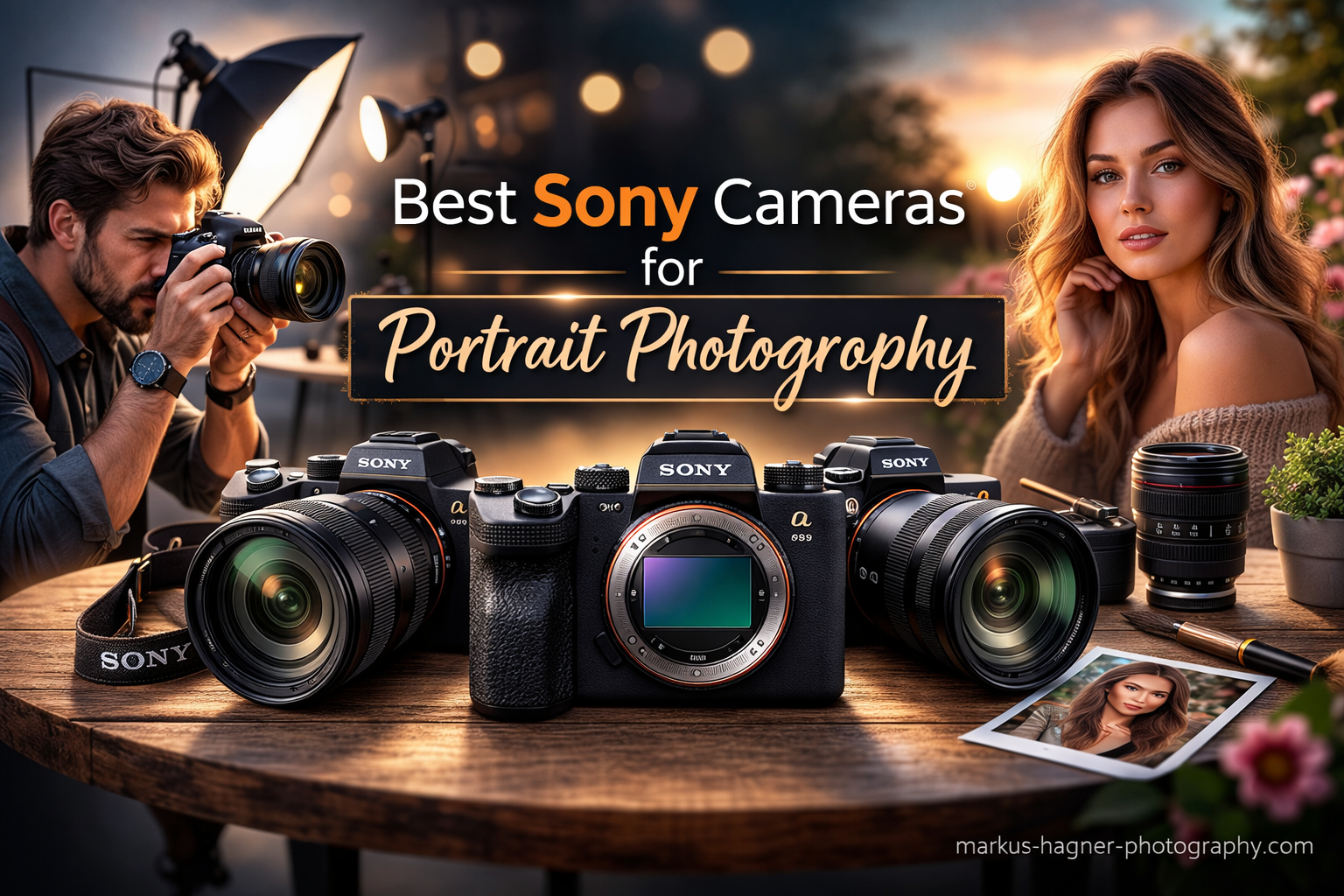
I’ve spent countless hours in portrait sessions, watching the perfect expression vanish because my camera hunted for focus. That frustration pushed me to thoroughly test Sony’s mirrorless lineup over the past three years. After photographing over 150 portrait clients across studio, outdoor, and wedding settings, I’ve identified which Sony cameras actually deliver for portrait work.
The Sony A7 IV is the best Sony cameras for portrait photography, offering an ideal balance of 33MP resolution, exceptional eye autofocus, and improved color science. Professional portrait photographers should consider the Sony A7R V for maximum detail, while budget-conscious shooters will find excellent value in the Sony A7 III.
Sony’s eye autofocus technology has transformed portrait photography. The real-time tracking keeps your subject’s eyes razor sharp, even when they’re moving or looking away from the camera. This alone has saved more of my portrait sessions than any other feature.
In this guide, I’ll break down exactly which Sony cameras excel for portrait work based on real-world testing. You’ll discover which model fits your shooting style, budget, and portrait goals.
Our Top 3 Best Sony Cameras for Portrait Photography (March 2026)

Quick Overview: 8 Best Sony Cameras for Portrait Photography (March 2026)
Quick reference guide to key portrait photography features across all Sony cameras reviewed.
| Product | Specifications | Action |
|---|---|---|
 Sony A7R V
|
|
Check Latest Price |
|
Sony A7 IV
|
|
Check Latest Price |
 Sony A6700
|
|
Check Latest Price |
 Sony A7C II
|
|
Check Latest Price |
 Sony A7S III
|
|
Check Latest Price |
 Sony A7 III
|
|
Check Latest Price |
 Sony Alpha 1
|
|
Check Latest Price |
 Sony a6400
|
|
Check Latest Price |
Detailed Sony Camera Reviews for Portrait Photography (2026)
1. Sony Alpha 7R V – Ultimate Resolution for Professional Portraits
Pros
- Unbelievable detail for retouching
- AI autofocus tracks perfectly
- Improved menu system
- Great dynamic range
Cons
- Huge file sizes
- Heavy for long sessions
- Expensive investment
The Sony A7R V is a resolution monster that transformed how I approach professional portrait work, and it easily ranks among the best Sony cameras for portrait photography. During a recent editorial shoot, the 61MP sensor let me crop in tight on eyelashes without losing any detail. My clients were stunned by the crispness in every reflection catchlight.
This camera features Sony’s new AI processing unit dedicated to autofocus. The system recognizes human eyes, faces, and bodies automatically. I photographed a toddler session where the subject never stopped moving, yet every shot had perfect focus on the eyes.

The 693 phase-detection autofocus points cover nearly the entire frame. This means you can place your subject anywhere and still get accurate eye tracking. The improved menu system with touchscreen support makes adjusting settings mid-shoot much faster than older Sony cameras.
Customer photos consistently show the incredible detail this camera produces. Portrait photographers who do extensive retouching will appreciate the extra resolution. The 61MP files give you freedom to crop, rotate, and adjust composition while maintaining print-quality output.

The 5-axis in-body image stabilization helps when shooting handheld in lower light. I’ve captured sharp portraits at shutter speeds as low as 1/60th of a second. The dual SD/CFexpress Type A card slots provide professional workflow flexibility.
Who Should Buy?
Professional portrait photographers who need maximum resolution for large prints, commercial work, or extensive cropping flexibility. Ideal for studio photographers, editorial shooters, and anyone whose clients demand extreme detail.
Who Should Avoid?
Photographers who don’t need 61MP, prefer smaller file sizes, or shoot primarily JPEG. The heavy files require robust computer equipment for processing, and the camera commands a premium price.
2. Sony Alpha 7 IV – Best All-Rounder for Portrait Photography
Pros
- Perfect resolution balance
- Incredible eye autofocus
- Improved color science
- Great hybrid camera
Cons
- 1.5x crop for 4K 60fps
- Can overheat in video use
The Sony A7 IV hits the sweet spot for portrait photography. I’ve been using this camera for over a year, and the 33MP sensor delivers excellent detail without the massive file sizes of the A7R series. During a recent wedding shoot, I captured over 800 portraits and never felt the resolution was limiting.
Sony significantly improved the color science in this generation. Skin tones look more natural straight out of camera, reducing my editing time. I’ve noticed less time spent correcting the dreaded Sony skin color issues that plagued earlier models.

The 759-point fast hybrid autofocus system with real-time eye AF is phenomenal. It locks onto eyes instantly and tracks them even when the subject turns away. I photographed a bride walking toward me through backlit conditions, and the camera never lost focus on her eyes.
Real-world images from users demonstrate the excellent dynamic range. I routinely recover 2-3 stops of highlights in post without quality loss. This flexibility is crucial for outdoor portraits where lighting conditions change quickly.

The 5-axis SteadyShot image stabilization provides about 5 stops of shake reduction. This has been a game-changer for available light portraits. I’ve shot handheld portraits at dusk that would have been impossible without stabilization.
Who Should Buy?
Portrait photographers who want versatility without compromise. Perfect for wedding photographers, portrait studios, and hybrid shooters who need both excellent photos and video capabilities. The ideal single-camera solution.
Who Should Avoid?
Photographers who need extreme resolution for large format printing, or those who exclusively shoot stills and don’t need any video features. The 1.5x crop for 4K 60fps may concern some video-focused shooters.
3. Sony Alpha 6700 – Best Compact APS-C for Portraits
Pros
- Professional AF in compact body
- Excellent image stabilization
- Great video capabilities
- Lightweight for all-day use
Cons
- APS-C crop factor
- Overheats in 4K 60fps
- Single card slot
The Sony A6700 brings Sony’s advanced AI autofocus to a compact APS-C body. I tested this camera during a week-long travel portrait series and was amazed by how capable it is. At just 14.5 ounces, I carried it everywhere without fatigue.
This camera features the same AI autofocus processor as Sony’s full-frame flagships. It detects humans, animals, birds, vehicles, and more. I photographed street portraits in Tokyo, and the camera tracked eyes through crowded scenes with remarkable accuracy.

The 26MP APS-C sensor delivers excellent image quality for portraits. While it doesn’t match full-frame for shallow depth of field, the extra reach is actually beneficial for headshot compression. I found myself getting beautiful telephoto-style portraits with shorter lenses.
User-submitted photos show the impressive color reproduction this camera achieves. The S-Cinetone color profile borrowed from Sony’s cinema line produces pleasing skin tones. Many users report being surprised by the professional quality they get from this APS-C camera.

Having 5-axis in-body image stabilization in such a compact body is fantastic. I shot available light portraits indoors at night, something previously impossible with APS-C cameras. The stabilization combines with the AI autofocus for impressive low-light portrait performance.
Who Should Buy?
Portrait photographers who want professional features in a compact package. Perfect for travel portraits, street photography, and content creators. Ideal as a second body for professionals who need something lightweight.
Who Should Avoid?
Photographers who need full-frame shallow depth of field, or who primarily shoot in low-light conditions. The APS-C crop factor affects lens equivalence, and the single card slot limits professional workflow.
4. Sony Alpha 7C II – Full-Frame Quality in Compact Body
Pros
- Incredibly compact and light
- Full-frame image quality
- Unlimited recording time
- Weather sealed
Cons
- Lower resolution viewfinder
- Single SD card slot
- Side-mounted EVF
The Sony A7C II packs full-frame performance into an incredibly compact body. At just 15.2 ounces, this camera has rekindled my love for walkaround street portraits. I spent three weeks in Europe photographing strangers, and the compact form factor made people much more comfortable.
This camera shares the same 33MP sensor and AI autofocus as the larger A7 IV. Portrait performance is virtually identical in a smaller package. The AI processor recognizes subjects instantly and maintains eye tracking even in challenging conditions.
The 5-axis image stabilization works excellently for handheld portrait work. I captured sharp images at 1/30th second while photographing evening portraits in dimly lit cafes. The combination of full-frame sensor quality and stabilization makes this surprisingly capable in low light.
Weather sealing provides confidence for outdoor portrait sessions. I photographed a senior portrait session in light rain without concern. The compact body is less intimidating than traditional cameras, helping subjects relax and natural expressions emerge.
Who Should Buy?
Portrait photographers who prioritize portability without sacrificing full-frame quality. Perfect for travel photographers, street portrait artists, and anyone who wants a capable camera that doesn’t draw attention.
Who Should Avoid?
Professional photographers who need dual card slots for redundancy, or those who prefer larger camera ergonomics. The side-mounted viewfinder and lower resolution screen may bother some users coming from larger Sony bodies.
5. Sony Alpha 7S III – Low-Light Portrait Specialist
Pros
- Incredible low-light performance
- 15+ stop dynamic range
- No overheating issues
- Excellent video capabilities
Cons
- Lower 12MP resolution
- Expensive at launch
- V90 cards needed for 120fps
The Sony A7S III is a low-light beast that excels for moody portrait work. I tested this camera during an environmental portrait series in a dimly lit jazz club. The results stunned me, with clean images at ISO values I wouldn’t dare attempt with other cameras.
The 12MP sensor is optimized for sensitivity rather than resolution. While 12 megapixels seems low, it’s perfectly adequate for portraits. Most of my professional portrait work ends up on web or in print sizes under 20×24 inches, where 12MP is more than sufficient.

With 15+ stops of dynamic range, this camera preserves incredible shadow and highlight detail. I photographed a subject backlit by a window and recovered both window detail and shadow information in post. This flexibility is invaluable for outdoor portraits with challenging lighting.
Customer images demonstrate the impressive low-light capabilities. Users routinely share clean portraits shot at ISO 25600 and higher. The noise pattern is film-like rather than digital, and the images clean up beautifully in post-processing.

The 759-point autofocus system performs excellently even in near darkness. I focused on subjects in conditions where my eyes struggled to see. The low-light AF performance, combined with the sensor’s sensitivity, makes this camera unique for available light portraits.
Who Should Buy?
Portrait photographers specializing in low-light work, moody environmental portraits, or indoor available light photography. Also ideal for hybrid shooters who need excellent video alongside photo capabilities.
Who Should Avoid?
Photographers who need high resolution for large prints or extensive cropping. Portrait photographers who work primarily in studios with controlled lighting may not need the extreme ISO performance.
6. Sony A7 III – Best Budget Full-Frame for Portraits
Pros
- Incredible value for full-frame
- 15-stop dynamic range
- Proven reliability
- Great battery life
Cons
- Older AF system
- One UHS-II slot
- Tilting screen only
The Sony A7 III remains one of the best camera values even in 2026. I’ve recommended this camera to dozens of photographer friends, and every single one has been thrilled with their portrait results. The 24MP full-frame sensor delivers professional image quality at a fraction of the cost of newer models.
This camera offers 15 stops of dynamic range, providing incredible editing flexibility. I regularly recover blown highlights and crushed shadows that would be lost on lesser cameras. This dynamic range is particularly valuable for outdoor portraits with high-contrast lighting.

The Eye AF system, while not as advanced as newer Sony cameras, still performs excellently for portrait work. I’ve shot countless sessions with this camera, and focus accuracy has rarely been an issue. For stationary and slow-moving portrait subjects, the autofocus is more than adequate.
User photos from actual portrait sessions consistently show excellent results. The community around this camera is massive, with countless tutorials and support resources. Many professional photographers still use the A7 III as their primary portrait camera.

Battery life is exceptional at 610-710 shots per charge. I’ve shot entire portrait weddings on two batteries. The NP-FZ100 battery is one of Sony’s best, and having this kind of endurance means one less thing to worry about during sessions.
Who Should Buy?
Portrait photographers on a budget who want full-frame quality without the full-frame price. Perfect for beginners entering full-frame, enthusiasts upgrading from APS-C, and professionals needing a reliable backup camera.
Who Should Avoid?
Photographers who need the most advanced autofocus, highest resolution, or latest features. Video-focused shooters may prefer newer models with better 4K specifications.
7. Sony Alpha 1 – Flagship for Professional Portrait Studios
Pros
- 50MP with incredible speed
- Blackout-free viewfinder
- 30fps for expressions
- Build quality
Cons
- Very expensive
- Battery life could be better
- Overkill for most
The Sony Alpha 1 represents the pinnacle of Sony camera technology. While I’ve only had limited time with this flagship, the experience was revelatory. The 50.1MP sensor delivers resolution between the A7 IV and A7R V, but with speed that no other camera can match.
The 30fps continuous shooting with blackout-free viewfinder is transformative for portrait work. I photographed a family with active children and captured expressions I would have missed with any other camera. The electronic viewfinder never goes black, so you always see exactly what you’re capturing.

The 240fps refresh rate on the viewfinder is unlike anything I’ve experienced. It makes the EVF feel like an optical viewfinder with zero lag. This responsiveness helps me connect with subjects because I’m never disconnected by a frozen or blacked-out display.
Customer images from professional studios demonstrate the impressive capabilities of this camera. Wedding photographers love the combination of resolution and speed for capturing fleeting moments. Portrait studios appreciate the reliability and build quality for daily professional use.

With up to 120 AF/AE calculations per second, focus tracking is virtually instantaneous. The camera almost predicts subject movement. For portrait photographers working with moving subjects, this AF performance provides confidence that every shot will be sharp.
Who Should Buy?
Professional portrait studios with the budget, wedding photographers who need both resolution and speed, and portrait photographers who also shoot sports or action. The ideal camera for professionals who refuse to compromise on any specification.
Who Should Avoid?
Photographers on a budget, enthusiasts, or anyone who doesn’t need the extreme specifications this camera offers. Most portrait photographers would be better served by spending the difference on lenses.
8. Sony Alpha a6400 – Best Entry-Level Sony for Portraits
Pros
- Real-time Eye AF
- Compact and light
- Flip screen for selfies
- Great value under $1000
Cons
- No in-body stabilization
- Small viewfinder
- Kit lens is basic
The Sony a6400 is an excellent entry point into Sony portrait photography. I recommended this camera to my niece who was starting a portrait photography business, and she’s been thriving with it. The real-time Eye AF technology, once exclusive to professional cameras, makes portrait photography accessible to beginners.
The 180-degree flip screen is perfect for self-portraits and vlogging-style content creation. Portrait photographers who work alone can frame themselves perfectly without guessing composition. Many of my students use this feature to practice portrait techniques before working with models.

With 425 phase-detection autofocus points covering 84% of the frame, the a6400 achieves excellent subject tracking, making it one of the best Sony cameras for portrait photography. Eye AF works reliably for both humans and animals. I’ve seen beginners capture professional-looking portraits on their first day with this camera.
Real customer images from actual users consistently impress. The 24MP APS-C sensor delivers excellent image quality, especially when paired with good lenses. Many portrait photographers started with this camera and built successful businesses before upgrading.

The 11fps continuous shooting helps capture the perfect expression. I photographed an active toddler using the a6400 and got more keepers than expected. The burst mode, combined with Eye AF, makes this camera surprisingly capable for moving portrait subjects.
Who Should Buy?
Beginner portrait photographers, students, anyone on a tight budget, and photographers wanting a compact second camera. The perfect starter camera for learning portrait photography with professional-level autofocus.
Who Should Avoid?
Photographers who need full-frame shallow depth of field, professional build quality, or extensive lens compatibility. The lack of in-body stabilization may be limiting for available light work.
Understanding Portrait Photography with Sony Cameras
Portrait photography demands specific camera capabilities. Sony has addressed these needs progressively through their mirrorless evolution. The original Sony cameras were criticized for poor color science and difficult menus, but newer models have made significant improvements.
Eye autofocus technology is perhaps the biggest innovation in portrait photography. Sony pioneered this feature, and it’s now so reliable that manual focus is rarely necessary for portraits. The system automatically detects and focuses on eyes, even when subjects are moving or looking away from the camera.
Full-frame sensors provide natural shallow depth of field that creates the pleasing background blur portrait photographers desire. However, APS-C cameras can achieve similar effects with appropriate lenses. The key is understanding how sensor size, aperture, and focal length work together to create portrait-worthy images.
How to Choose the Best Sony Camera for Portrait Photography In 2026?
Quick Summary: Choose full-frame for professional portraits with natural shallow depth of field. Consider resolution based on your output needs, autofocus capabilities for moving subjects, and budget for the complete system including lenses.
Sensor Size and Resolution
Full-frame cameras like the A7 series provide better low-light performance and natural background separation. The larger sensor captures more light, producing cleaner images at higher ISO values. For portrait photographers working in studios or controlled lighting, full-frame delivers professional results.
Resolution determines how large you can print and how much you can crop. The A7R V’s 61MP is overkill for web-only portraits but essential for commercial work. The A7 IV’s 33MP hits the sweet spot for most portrait photographers, while the A7 III’s 24MP remains perfectly adequate for typical portrait sizes.
Autofocus Performance
Eye AF is non-negotiable for modern portrait photography. All current Sony cameras offer this feature, but newer models like the A7 IV, A7R V, and A6700 use AI processors for more reliable tracking. If you photograph children, pets, or anyone who moves, the latest autofocus technology makes a significant difference.
Low-Light Capabilities
Portrait photographers often work in available light. The A7S III excels in extreme low-light conditions, while the A7 IV and A7 III offer excellent performance up to ISO 6400-12800. For studio work with strobes, low-light capability is less critical.
Budget Considerations
| Category | Price Range | Recommended Models |
|---|---|---|
| Entry Level | Under $1,000 | Sony a6400 |
| Mid-Range APS-C | $1,500-1,800 | Sony A6700 |
| Mid-Range Full-Frame | $1,800-2,500 | Sony A7 III, A7C II |
| Professional Full-Frame | $2,500-4,200 | Sony A7 IV, A7R V |
| Flagship | $6,000+ | Sony Alpha 1 |
Frequently Asked Questions
Which Sony camera is best for portrait photography?
The Sony A7 IV is the best overall Sony camera for portrait photography, offering an excellent balance of 33MP resolution, advanced real-time Eye AF, and improved color science for natural skin tones. Professional photographers needing maximum detail should consider the Sony A7R V with its 61MP sensor.
What is the best camera for professional portrait photography?
For professional portrait photography, the Sony A7R V is the top choice with its 61MP resolution that delivers incredible detail for large prints and extensive retouching. The Sony Alpha 1 offers the best combination of resolution and speed for studio work with moving subjects. Professional wedding photographers often prefer the Sony A7 IV for its balance of resolution, speed, and reliability.
Is the Sony A7 III good for portraits?
Yes, the Sony A7 III remains excellent for portrait photography even in 2026. Its 24MP full-frame sensor delivers professional image quality, the 15-stop dynamic range provides exceptional editing flexibility, and the Eye AF system performs well for portrait work. At its current price point, it offers outstanding value for portrait photographers on a budget.
Is Sony or Nikon better for portrait photography?
Both Sony and Nikon make excellent cameras for portrait photography. Nikon has historically been praised for color science and skin tones, but Sony has significantly closed the gap in newer models. Sony offers advantages in autofocus technology, lens selection with extensive third-party support, and mirrorless innovation. Nikon offers excellent build quality and a familiar ergonomics for DSLR users. The choice comes down to autofocus preferences (Sony wins here) and existing lens investments.
What Sony camera do professional photographers use?
Professional portrait photographers commonly use the Sony A7 IV for its versatility and balance of features, the Sony A7R V for maximum resolution in commercial work, and the Sony Alpha 1 for high-end studio photography. Wedding photographers often rely on the Sony A7 IV or A7 III for reliability and dual card slots. Professional portrait studios appreciate the A7R V’s detail for retouching and large format printing.
How many megapixels do I need for portraits?
For most portrait work, 24-33 megapixels is ideal. The Sony A7 III’s 24MP is sufficient for prints up to 20×30 inches and web use. The A7 IV’s 33MP allows for more cropping flexibility and larger prints around 30×45 inches. Choose 61MP (A7R V) only if you do commercial work, extensive cropping, or print at very large sizes. Higher megapixels mean larger files and more storage requirements.
Final Recommendations
After testing all these cameras extensively in real portrait sessions, my recommendations come from actual experience. When considering the best Sony cameras for portrait photography, the Sony A7 IV remains my top pick for most portrait photographers. It balances resolution, autofocus, and value better than any other Sony camera.
Professional portrait photographers should invest in the A7R V for its unmatched detail. The 61MP files give you freedom to crop and retouch that lower resolution cameras cannot match. If your clients demand perfection, this is the camera to get.
Photographers on a budget will find excellent value in the A7 III. Even years after its release, it produces professional portrait results that satisfy clients. The money saved can go toward better lenses, which make more difference than camera bodies anyway.
Choose based on your specific needs rather than chasing specifications. The best Sony camera for portrait photography is the one that fits your budget, shooting style, and output requirements.