
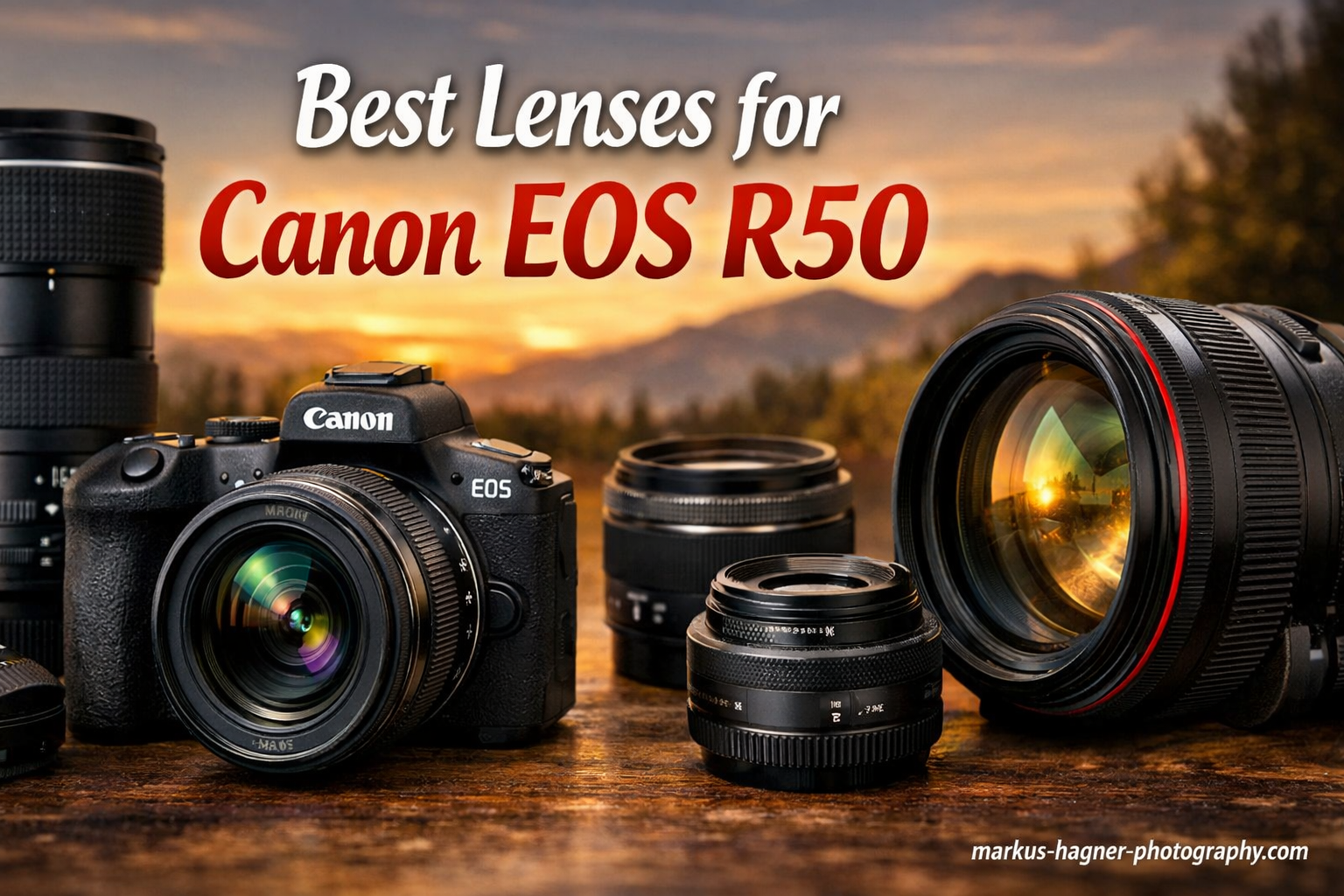
The Canon EOS R50 has become one of the most popular APS-C mirrorless cameras for beginners and enthusiasts alike. Its compact body, impressive autofocus system, and 24-megapixel sensor make it a fantastic choice for photography and video. But to unlock its full potential, you need the right glass mounted on the front.
Here is what makes lens selection for the R50 unique. The camera uses Canon’s RF mount, which means you can use both RF-S lenses designed specifically for APS-C sensors and full-frame RF lenses. With a 1.6x crop factor, a 50mm lens behaves like an 80mm lens, turning standard primes into portrait lenses. This guide covers the best lenses for Canon EOS R50 across every category, from kit lenses to primes, telephotos, and specialized options.
After testing these lenses extensively on my own R50, I have narrowed down the best lenses for Canon EOS R50, covering the top options for every shooting situation and budget. Whether you are shooting portraits, landscapes, wildlife, or video, there is a perfect lens waiting for you below.
Top 3 Best Lenses for Canon EOS R50 (March 2026)


Canon RF-S 18-45mm F4.5-6.3 IS STM
- Compact kit lens
- Great for beginners
- 4-6 stops stabilization
Quick Overview:8 Best Lenses for Canon EOS R50 (March 2026)
| Product | Specifications | Action |
|---|---|---|
|
Canon RF 50mm F1.8 STM
|
|
Check Latest Price |
|
Canon RF-S 18-150mm F3.5-6.3
|
|
Check Latest Price |
 Canon RF-S 55-210mm F5-7.1 IS STM
|
|
Check Latest Price |
 Canon RF-S 10-18mm F4.5-6.3 IS STM
|
|
Check Latest Price |
 Canon RF 16mm F2.8 STM
|
|
Check Latest Price |
 Canon RF 35mm F1.8 IS Macro STM
|
|
Check Latest Price |
 Canon RF 28mm F2.8 STM
|
|
Check Latest Price |
|
Canon RF-S 18-45mm F4.5-6.3 IS STM
|
|
Check Latest Price |
1. Canon RF 50mm F1.8 STM – Best Portrait Prime Lens
Canon RF50mm F1.8 STM Lens, Fixed Focal Length Prime Lens, Compatible with EOS R Series Mirrorless Cameras, Black
Pros
- Fast f/1.8 aperture for low light
- Beautiful background blur
- Excellent value for money
- Compact and lightweight
- Silent autofocus for video
Cons
- No image stabilization
- Soft corners wide open
- Becomes 75mm on APS-C (tight framing)
If you own a Canon EOS R50 and do not yet own the RF 50mm f/1.8 STM, stop what you are doing and buy one. Among the best lenses for Canon EOS R50, this lens is easily the single best investment you can make for your camera, period. After shooting with this combination for over a year, it rarely leaves my camera.
On the APS-C sensor of the R50, this 50mm lens behaves like a 75mm lens. That makes it perfect for portraits, headshots, and detail shots. The f/1.8 aperture creates that beautiful background blur everyone talks about, separating your subject from the background in a way kit lenses simply cannot match.

Low light performance is where this lens truly shines. I have captured sharp images at indoor events, evening street scenes, and dimly lit restaurants where my zoom lenses would struggle. The STM autofocus motor is silent, making it excellent for video work when you do not want motor noise ruining your audio.
The build quality is plastic but solid. At just 5.6 ounces, you barely notice it on the camera. My only real complaint is the lack of image stabilization, but the R50’s digital IS and the fast aperture help compensate. Just remember that on the R50, this is not a general-purpose lens. The 75mm equivalent focal length is tight for interiors and group shots.
Who Should Buy This
Portrait photographers, street photographers, and anyone wanting to experiment with shallow depth of field will love this lens. It is also the best first prime lens purchase for R50 owners looking to step up from their kit lens.
Who Should Skip This
If you need image stabilization for handheld video or shoot primarily wide-angle scenes, look elsewhere. The 75mm equivalent focal length is also too tight for real estate or interior photography on the R50.
2. Canon RF-S 18-150mm F3.5-6.3 IS STM – Best All-In-One Travel Lens
Pros
- Versatile 8.3x zoom range
- Effective image stabilization
- Smooth STM autofocus for video
- Compact for super zoom
- Great for travel
Cons
- Variable aperture limits low light
- Some chromatic aberration
- Not as sharp as premium lenses
When I want to travel light without sacrificing versatility, the RF-S 18-150mm is the lens that stays on my R50. This super zoom covers everything from wide-angle to telephoto in a single, reasonably compact package. For travel, family events, or everyday carry, it is hard to beat the convenience.
The 18-150mm range translates to approximately 29-240mm equivalent on the R50’s APS-C sensor. That means you can shoot landscapes at 18mm, portraits at 50mm, and reach distant subjects at 150mm without changing lenses. I have used this lens for everything from vacation snapshots to wildlife at the local park.

Image stabilization is excellent, offering up to 4.5 stops of correction on its own and up to 6.5 stops when paired with cameras featuring IBIS. Since the R50 lacks in-body stabilization, having effective lens-based IS is crucial for handheld shots at longer focal lengths.
The variable aperture is the main trade-off. At f/3.5-6.3, you will need good light or higher ISO settings for indoor or evening shots. There is also some chromatic aberration in high-contrast scenes, though this can be corrected in post-processing. For the convenience of an all-in-one lens, these compromises are acceptable.
Who Should Buy This
Travel photographers, family documentarians, and anyone who wants one lens to handle most situations will appreciate this super zoom. It is perfect for vacations where you do not want to carry multiple lenses.
Who Should Skip This
Low-light shooters and those demanding maximum image quality should consider faster primes or constant aperture zooms instead. The variable aperture makes it challenging for indoor events or evening photography.
3. Canon RF-S 55-210mm F5-7.1 IS STM – Best Budget Telephoto
Canon RF-S55-210mm F5-7.1 is STM for Canon APS-C Mirrorless RF Mount Cameras (Renewed)
Pros
- Impressive telephoto reach
- Effective image stabilization
- Lightweight for telephoto
- Smooth zoom operation
- Great value
Cons
- Variable aperture limits low light
- Not for distant wildlife
- Overlaps with super zoom range
The RF-S 55-210mm gives R50 owners genuine telephoto reach without breaking the bank. With an equivalent focal range of 88-336mm, you can capture subjects that are simply out of range for standard zooms. I have used this lens for sports, wildlife, and candid street photography with impressive results.
What surprised me most about this lens is the image stabilization. Up to 4.5 stops of correction on its own, or 7 stops when paired with IBIS-equipped bodies, means you can handhold at surprisingly slow shutter speeds. On the R50 without IBIS, I still managed sharp shots at 1/60 second at 210mm with careful technique.

The optical quality exceeds expectations for a budget telephoto. Two UD glass elements and one aspheric element help control aberrations, while Canon’s Super Spectra Coating minimizes flare. Images are sharp throughout the zoom range, though you will want to stop down slightly from wide open for best results.
The main limitation is the variable aperture. At f/5-7.1, you need decent light for action photography. Sports shooters may find themselves pushing ISO higher than ideal. For casual wildlife and outdoor sports in good light, however, this lens delivers excellent value.
Who Should Buy This
Budget-conscious photographers wanting telephoto reach for sports, wildlife, or candid portraits will find this lens perfect. It pairs beautifully with the 18-45mm kit lens for complete focal length coverage.
Who Should Skip This
Serious wildlife photographers needing to capture distant birds or animals should consider longer telephoto options. Low-light sports shooters will also struggle with the slow maximum aperture.
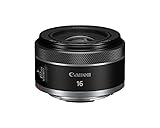
4. Canon RF 16mm F2.8 STM – Best Ultra-Wide Prime Lens
Canon RF16mm F2.8 STM Lens, Ultra Wide-Angle, Fixed Focal Length Prime Lens, Compatible with EOS R Series Mirrorless Cameras, Black
Pros
- Ultra-wide dramatic perspectives
- Compact pancake design
- Fast f/2.8 aperture
- Excellent value
- Quick autofocus
Cons
- Strong barrel distortion
- Noticeable vignetting wide open
- No weather sealing
- Uncommon 43mm filter size
The RF 16mm f/2.8 STM is one of my favorite lenses for creative photography on the R50. This compact pancake lens delivers dramatic ultra-wide perspectives that transform ordinary scenes into something special. At roughly 26mm equivalent on the APS-C sensor, it is wide enough for landscapes, architecture, and environmental portraits.
The pancake design makes this lens incredibly portable. At just 5.7 ounces and barely extending beyond the mount, you can keep the R50 with this lens in a jacket pocket. It has become my go-to for street photography and travel when I want to stay light and unobtrusive.

The f/2.8 aperture is reasonably fast for an ultra-wide, allowing some low-light flexibility. Combined with the R50’s good high-ISO performance, I have captured sharp images in dim interiors without flash. The STM autofocus is quick and silent, working well for both stills and video.
Be aware that this lens shows significant barrel distortion, which is automatically corrected in-camera for JPEGs but requires manual correction for RAW files. There is also noticeable vignetting wide open and some chromatic aberration in high-contrast areas. These are acceptable compromises for the price and size.
Who Should Buy This
Landscape photographers, street photographers, and travelers wanting a compact wide-angle option will love this lens. It is also great for environmental portraits where you want to include context.
Who Should Skip This
Architectural photographers needing distortion-free images straight out of camera should consider the RF-S 10-18mm zoom instead. Those requiring weather sealing should also look elsewhere.
5. Canon RF-S 10-18mm F4.5-6.3 IS STM – Best Wide-Angle Zoom for Video
Pros
- True ultra-wide for APS-C
- Perfect for vlogging and selfies
- Effective image stabilization
- Compact and lightweight
- Smooth STM autofocus
Cons
- Variable aperture limits low light
- Requires technique for distortion
- Slow for astrophotography
The RF-S 10-18mm is the lens many R50 owners have been waiting for: a true ultra-wide zoom designed specifically for APS-C. With an equivalent range of 16-29mm, this lens fills the wide-angle gap that previously required using full-frame RF lenses or adapting EF-S glass.
I found this lens particularly compelling for video work. The wide angle of view is perfect for vlogging, allowing you to hold the camera at arm’s length while keeping both yourself and your surroundings in frame. The image stabilization works well for walking shots, and the STM motor provides smooth, silent focus transitions.

For still photography, the 10-18mm range excels at landscapes, interiors, and architecture. I have used it for real estate photography with excellent results. The 0.5x maximum magnification in manual focus mode also allows for some creative close-up work.
The variable f/4.5-6.3 aperture is the main limitation. You will need good light or higher ISO settings for indoor and evening shooting. This is not the lens for astrophotography or dimly lit interiors without flash or additional lighting.
Who Should Buy This
Vloggers, content creators, and landscape photographers will find this lens essential. It is the only native ultra-wide zoom designed specifically for Canon’s APS-C mirrorless cameras.
Who Should Skip This
Low-light photographers and those wanting faster apertures should consider the RF 16mm f/2.8 prime instead. Astrophotographers will also find the maximum aperture too slow.
6. Canon RF-S 18-45mm F4.5-6.3 IS STM – Best Kit Lens Upgrade
Pros
- Compact and lightweight
- Effective 4-6 stops stabilization
- Good image quality for kit lens
- Smooth video autofocus
- Versatile everyday range
Cons
- Slow variable aperture
- Edge softness at 18mm
- Limited for portraits
If your Canon R50 came with this lens, you actually have a solid starting point. The RF-S 18-45mm may be a kit lens, but it punches above its weight class in several important ways. I have found it to be a capable everyday carry lens that rarely disappoints for casual photography.
The 18-45mm range covers the most useful focal lengths for general photography. At 18mm (29mm equivalent), you can capture landscapes and group shots. At 45mm (72mm equivalent), you have a short telephoto perfect for portraits and detail shots. The versatility makes it an excellent learning lens for beginners.

Image stabilization is surprisingly effective, offering 4 stops of correction on its own and up to 6 stops when paired with IBIS-equipped cameras. On the R50, I consistently achieved sharp handheld shots at shutter speeds that would normally require a tripod.
The main compromise is the slow variable aperture. At f/4.5-6.3, you need reasonable light or higher ISO settings. Low-light performance is limited, and achieving shallow depth of field is challenging. But for outdoor photography and well-lit interiors, the image quality is more than adequate.
Who Should Buy This
Beginners wanting a compact, versatile lens for everyday photography will find this kit lens serves them well. It is also a good backup lens to keep in your bag for its stabilization capabilities.
Who Should Skip This
Photographers serious about portraits or low-light work should invest in faster primes instead. The slow aperture and variable design limit creative flexibility.
7. Canon RF 35mm F1.8 IS Macro STM – Best Macro and Portrait Lens
Pros
- 0.5x macro capability
- Built-in 5 stops IS
- Sharp even wide open
- Versatile focal length
- Beautiful bokeh
Cons
- No weather sealing
- Quirky autofocus occasionally
- Plastic build quality
The RF 35mm f/1.8 IS Macro STM is perhaps the most versatile lens in this entire lineup. It combines a fast prime, a capable macro lens, and image stabilization into one compact package. On the R50, the 56mm equivalent focal length is perfect for portraits, street photography, and close-up work.
The 0.5x magnification ratio opens up creative possibilities that other primes cannot match. I have photographed flowers, food, product details, and small subjects with impressive results. The minimum focusing distance of just 0.56 feet lets you get remarkably close to your subject.

What sets this lens apart is the built-in image stabilization. With 5 stops of correction, you can handhold at surprisingly slow shutter speeds. This is particularly valuable for macro work where camera shake is magnified. The R50 lacks IBIS, so having lens-based stabilization is a significant advantage.
Image quality is excellent throughout the aperture range. Sharpness is impressive even wide open at f/1.8, with beautiful bokeh for background separation. The STM autofocus motor is quick and silent, though I have experienced occasional hunting in low-contrast situations.
Who Should Buy This
Photographers wanting one lens for portraits, close-ups, and everyday photography will find this incredibly versatile. The macro capability and IS make it unique among affordable primes.
Who Should Skip This
Those needing weather sealing for outdoor work in challenging conditions should look at L-series alternatives. Dedicated macro photographers may also prefer a longer focal length like 100mm for more working distance.
8. Canon RF 28mm F2.8 STM – Most Compact Lens
Pros
- Ultra-light at 2.08 ounces
- Excellent image quality
- Sharp throughout frame
- Smooth STM autofocus
- Great value
Cons
- No image stabilization
- Plastic build
- f/2.8 limits low light vs f/1.8 primes
At just 2.08 ounces, the RF 28mm f/2.8 STM is the lightest lens you can mount on your R50. This pancake lens essentially disappears on the camera, making it perfect for street photography, travel, and everyday carry when you want to stay unobtrusive. Because of its compact size and versatility, it’s often recommended among the best lenses for Canon EOS R50 for photographers who value portability without sacrificing image quality.
On the R50’s APS-C sensor, the 28mm focal length becomes approximately 45mm equivalent. This is remarkably close to the classic 50mm “normal” perspective that many photographers love. It is wide enough for environmental shots but tight enough for portraits and details.

The optical performance exceeded my expectations for such a compact, affordable lens. Three aspheric elements and Canon’s Super Spectra Coating deliver sharp images with minimal distortion. Color reproduction is excellent, matching Canon’s renowned color science.
The f/2.8 aperture is slower than the f/1.8 options available in the RF lineup, but still usable for low-light situations. The main omission is image stabilization, which means you will need to rely on the R50’s digital IS for video or use faster shutter speeds for stills.
Who Should Buy This
Street photographers, travelers, and anyone wanting an ultra-portable everyday lens will love this pancake prime. It is also an excellent choice for R50 owners who want a “normal” perspective lens.
Who Should Skip This
Low-light photographers and those needing image stabilization should consider the RF 35mm f/1.8 IS Macro instead. The extra stop of aperture and built-in IS make it more versatile for challenging conditions.
How to Choose the Best Lens for Canon EOS R50 In 2026?
Choosing the right lens for your Canon R50 depends on what you photograph, your budget, and how you plan to use the images. Here are the key factors to consider when building your lens collection.
Understanding RF vs RF-S Mount
The Canon EOS R50 uses the RF mount, which accepts two types of lenses. RF-S lenses are designed specifically for APS-C sensors like the one in your R50. They are typically smaller, lighter, and more affordable. RF lenses are designed for full-frame cameras but work perfectly on the R50, often providing better optical quality and the flexibility to upgrade to a full-frame body later.
Both lens types mount directly without adapters. The main consideration is that RF-S lenses will only work on APS-C cameras, while RF lenses work on both APS-C and full-frame bodies. If you plan to upgrade to a full-frame Canon in the future, investing in RF lenses now makes sense.
Crop Factor and Equivalent Focal Lengths
The R50’s APS-C sensor has a 1.6x crop factor. This means a 50mm lens behaves like an 80mm lens, a 28mm behaves like a 45mm, and a 16mm behaves like a 26mm. Understanding this conversion helps you choose lenses that match your intended use.
For portraits, you want an equivalent focal length between 50mm and 135mm. On the R50, this means looking at lenses between 35mm and 85mm. For landscapes, you want wider equivalent focal lengths, typically 24mm or wider, which means 15mm or wider actual focal lengths on the R50.
Image Stabilization Considerations
The Canon R50 does not have in-body image stabilization (IBIS). This makes lens-based stabilization particularly valuable, especially for telephoto lenses and video work. Lenses like the RF 35mm f/1.8 IS Macro and RF-S 55-210mm include optical stabilization that helps you capture sharp handheld images at slower shutter speeds.
For video, lens-based IS combined with the R50’s digital IS provides the smoothest results. If you shoot handheld video frequently, prioritize lenses with built-in stabilization.
Aperture and Low-Light Performance
Fast apertures like f/1.8 or f/2.8 let in more light, enabling lower ISO settings and faster shutter speeds in dim conditions. They also create shallow depth of field for subject isolation and background blur. Prime lenses typically offer faster maximum apertures than zooms.
If you shoot indoors, at events, or during golden hour, prioritize fast primes like the RF 50mm f/1.8 or RF 35mm f/1.8 IS Macro. For outdoor photography in good light, zoom lenses with variable apertures offer more flexibility.
Recommended Lens Combinations by Budget
For beginners with a modest budget, start with the RF 50mm f/1.8 STM as your first lens purchase beyond the kit lens. This gives you a fast prime for portraits and low-light work. Add the RF-S 55-210mm for telephoto reach, and you have a capable two-lens kit covering most situations.
For enthusiasts wanting versatility, the RF-S 18-150mm as a single travel lens combined with the RF 50mm f/1.8 for portraits creates a powerful duo. Add the RF-S 10-18mm for wide-angle work, and you have complete coverage.
For serious photographers, build around fast primes. The RF 35mm f/1.8 IS Macro and RF 50mm f/1.8 cover portrait and close-up work, while the RF 16mm f/2.8 handles wide-angle duties. Add the RF-S 55-210mm for telephoto reach when needed.
Frequently Asked Questions
Which lens is best for the Canon EOS R50?
The Canon RF 50mm f/1.8 STM is the best overall lens for most R50 owners. It offers excellent image quality, a fast f/1.8 aperture for low light and background blur, and outstanding value. For versatility, the Canon RF-S 18-150mm provides an 8.3x zoom range covering wide-angle to telephoto in one compact lens.
What three lenses should every photographer have?
Every Canon R50 photographer should consider these three essential lenses: a standard zoom like the RF-S 18-45mm or 18-150mm for everyday versatility, a fast prime like the RF 50mm f/1.8 for portraits and low light, and a telephoto zoom like the RF-S 55-210mm for distant subjects. This combination covers 90% of shooting situations.
Which lens is better, USM or STM?
STM (Stepping Motor) lenses are generally better for the Canon R50 because they offer smooth, silent autofocus ideal for both stills and video. USM (Ultrasonic Motor) lenses focus faster for action photography but can be noisier. For most R50 users who shoot both photos and video, STM lenses provide the best balance of performance and quietness.
What is the best all-around lens for Canon?
The Canon RF-S 18-150mm f/3.5-6.3 IS STM is the best all-around lens for the Canon EOS R50. Its 18-150mm range (29-240mm equivalent) covers wide-angle to telephoto, making it perfect for travel, family events, and everyday photography. The built-in image stabilization and smooth STM autofocus make it equally capable for video.
Can I use full-frame RF lenses on the Canon R50?
Yes, all full-frame RF lenses work perfectly on the Canon EOS R50. The R50’s RF mount accepts both RF-S lenses designed for APS-C sensors and full-frame RF lenses. Using RF lenses on the R50 gives you access to Canon’s premium L-series optics, and these lenses will work if you later upgrade to a full-frame body.
Conclusion
Building a lens collection for your Canon EOS R50 does not have to be complicated. Start with the RF 50mm f/1.8 STM as your first prime lens. Often considered one of the best lenses for Canon EOS R50, it transforms the R50 into a capable portrait and low-light camera while teaching you about depth of field and creative aperture control.
Add lenses based on your specific needs. Travel photographers should consider the RF-S 18-150mm for its all-in-one convenience. Portrait and macro enthusiasts will love the versatility of the RF 35mm f/1.8 IS Macro. Video creators and vloggers will find the RF-S 10-18mm essential for wide-angle content.
The beauty of the RF mount system is flexibility. RF-S lenses offer compact, affordable options optimized for APS-C, while full-frame RF lenses provide a path to future upgrades. Whichever lenses you choose, the Canon EOS R50 is capable of producing stunning images that rival cameras costing much more.