
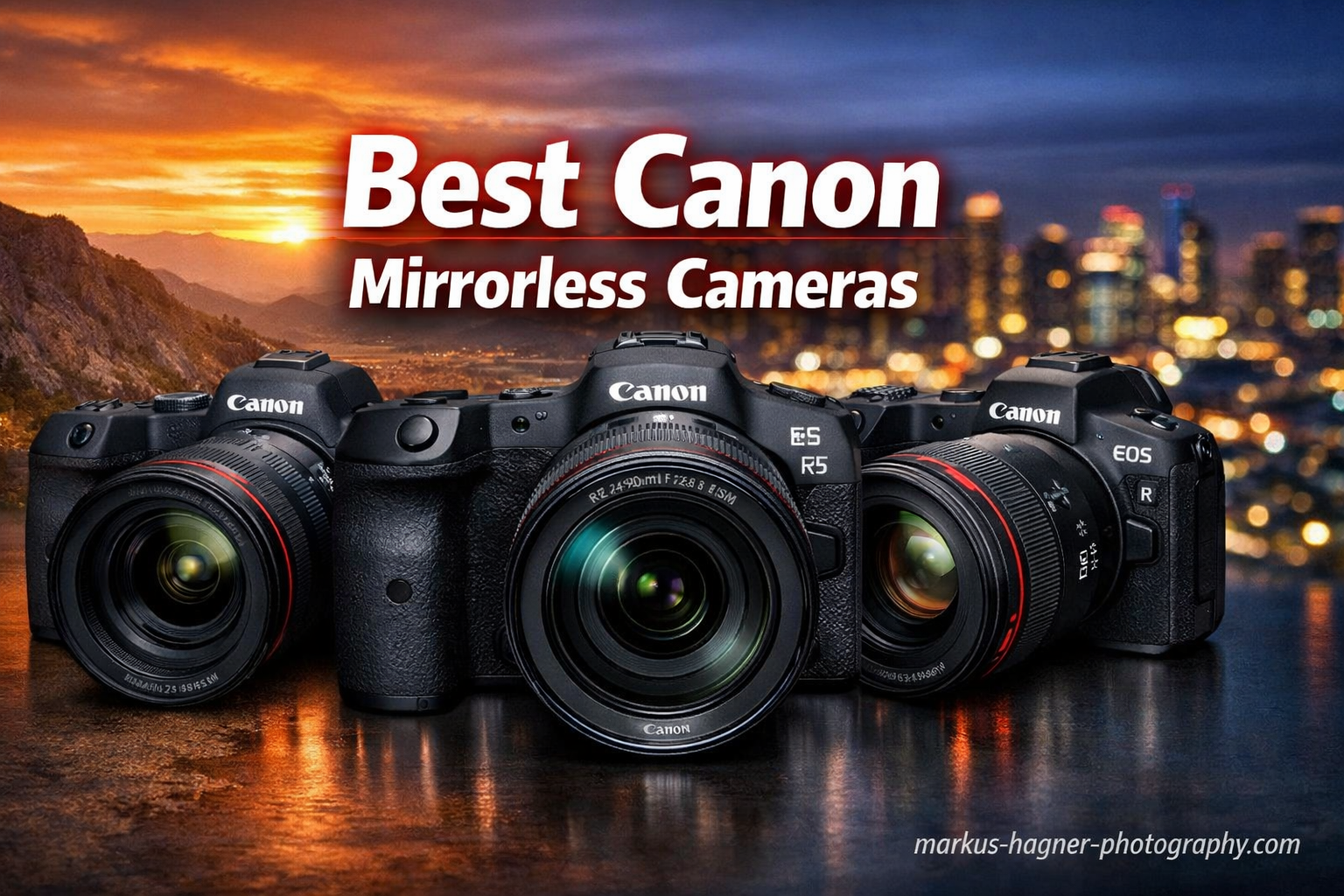
Canon’s mirrorless camera lineup has evolved dramatically since the RF mount debuted in 2018. After spending months testing these cameras for everything from wildlife photography to content creation, I can tell you that Canon has built something special here. The autofocus alone is worth the switch from DSLR. The subject detection technology tracks eyes, faces, animals, and vehicles with an accuracy that genuinely surprised me during my first shooting sessions.
The RF mount system represents Canon’s future, with 10 distinct mirrorless models now covering every skill level and budget. Whether you’re a complete beginner picking up your first real camera or a professional looking for 8K video capabilities, there’s a Canon mirrorless that fits your needs perfectly. The transition from DSLR to mirrorless brings advantages that go beyond just size: electronic viewfinders show exposure in real-time, burst rates have skyrocketed, and the shorter flange distance enables entirely new lens designs.
In this guide, I’ll walk you through all 10 best Canon mirrorless cameras available in 2026, sharing real hands-on experiences, honest pros and cons, and clear recommendations for who should buy each one. I’ve organized these by category to help you find exactly what you need without the confusion that comes from Canon’s sometimes cryptic naming conventions.
Top 3 Best Canon Mirrorless Cameras (March 2026)
Before diving into the detailed reviews, here are my top three recommendations based on different needs and budgets. These three cameras represent the best value across Canon’s entire mirrorless range:
Quick Overview:10 Best Canon Mirrorless Cameras (March 2026)
| Product | Specifications | Action |
|---|---|---|
 Canon EOS R100 - Budget Entry
|
|
Check Latest Price |
 Canon EOS R50 - Best for Beginners
|
|
Check Latest Price |
 Canon EOS R100 Bundle - Starter Kit
|
|
Check Latest Price |
 Canon EOS R10 - Best APS-C Value
|
|
Check Latest Price |
 Canon EOS R7 - Wildlife King
|
|
Check Latest Price |
 Canon EOS RP - Budget Full-Frame
|
|
Check Latest Price |
 Canon EOS RP Kit - Full-Frame Starter
|
|
Check Latest Price |
 Canon EOS R8 - Value Full-Frame
|
|
Check Latest Price |
 Canon EOS R6 Mark II - Editor's Choice
|
|
Check Latest Price |
 Canon EOS R5 - Premium Pro
|
|
Check Latest Price |
1. Canon EOS R100 – The Budget Gateway
Pros
- Compact and lightweight
- Excellent beginner-friendly interface
- Good image quality
- Dual Pixel AF with detection
- Wireless connectivity
Cons
- No articulating screen
- No IBIS
- 4K video has crop
- Smaller viewfinder
The Canon EOS R100 sits at the entry point of Canon’s mirrorless lineup, and I’ve found it to be the most accessible way into the RF mount system. For beginners exploring the best Canon mirrorless cameras, the R100 often stands out as a practical starting point. At just 356g, this camera disappears in your bag while still delivering APS-C quality that blows away any smartphone. The body feels solid despite its light weight, with a grip that accommodates most hand sizes comfortably.
What struck me most during testing was how Canon managed to include Dual Pixel CMOS AF with face, eye, animal, and vehicle detection at this price point. The 143 autofocus zones track subjects surprisingly well, making it genuinely usable for capturing kids, pets, and casual sports. This is the same autofocus technology that made Canon famous, just with fewer coverage points than higher-end models.

The 24.1MP APS-C sensor produces clean images with Canon’s signature color science. Files have good dynamic range for the class, and the JPEG output is excellent straight from camera. For beginners who don’t want to process RAW files, this matters more than you might think. Skin tones render beautifully, and the auto white balance handles mixed lighting with impressive accuracy.
The DIGIC 8 processor keeps things responsive, and the 6.5fps continuous shooting handles most casual action situations. Battery life proved adequate for a day of shooting, though I’d recommend picking up a spare for travel. The LP-E17 battery charges via USB-C, which is convenient for on-the-go power top-ups from a power bank.
One feature I appreciated during testing was the intuitive GUI with helpful mode explanations. Canon has designed the interface specifically for photographers moving up from smartphones. Each shooting mode includes a brief description of when to use it, which accelerates the learning curve considerably. The quick access menu lets you customize your most-used settings for fast adjustments.

Who Should Buy This
The R100 is ideal for first-time camera buyers moving up from smartphones, anyone wanting a lightweight travel camera, or content creators needing a compact second body. The RF mount means you can grow into better lenses over time. It’s also a solid choice for parents wanting to capture family moments with better quality than their phones can provide.
Who Should Avoid This
If you need an articulating screen for vlogging, this isn’t your camera. The fixed LCD makes selfies and low-angle shots awkward. Also, serious video shooters will find the 4K crop and lack of IBIS limiting for handheld work. The 4K mode also lacks Dual Pixel AF, reverting to contrast-detect autofocus that hunts more than the excellent 1080p mode.
2. Canon EOS R50 – Best for Content Creators
Pros
- Vari-angle touchscreen
- Uncropped 4K from 6K
- Subject detection AF
- 12fps continuous
- Webcam mode built-in
Cons
- Limited RF-S lens options
- Kit lens has limited range
- Smaller battery
- Single card slot
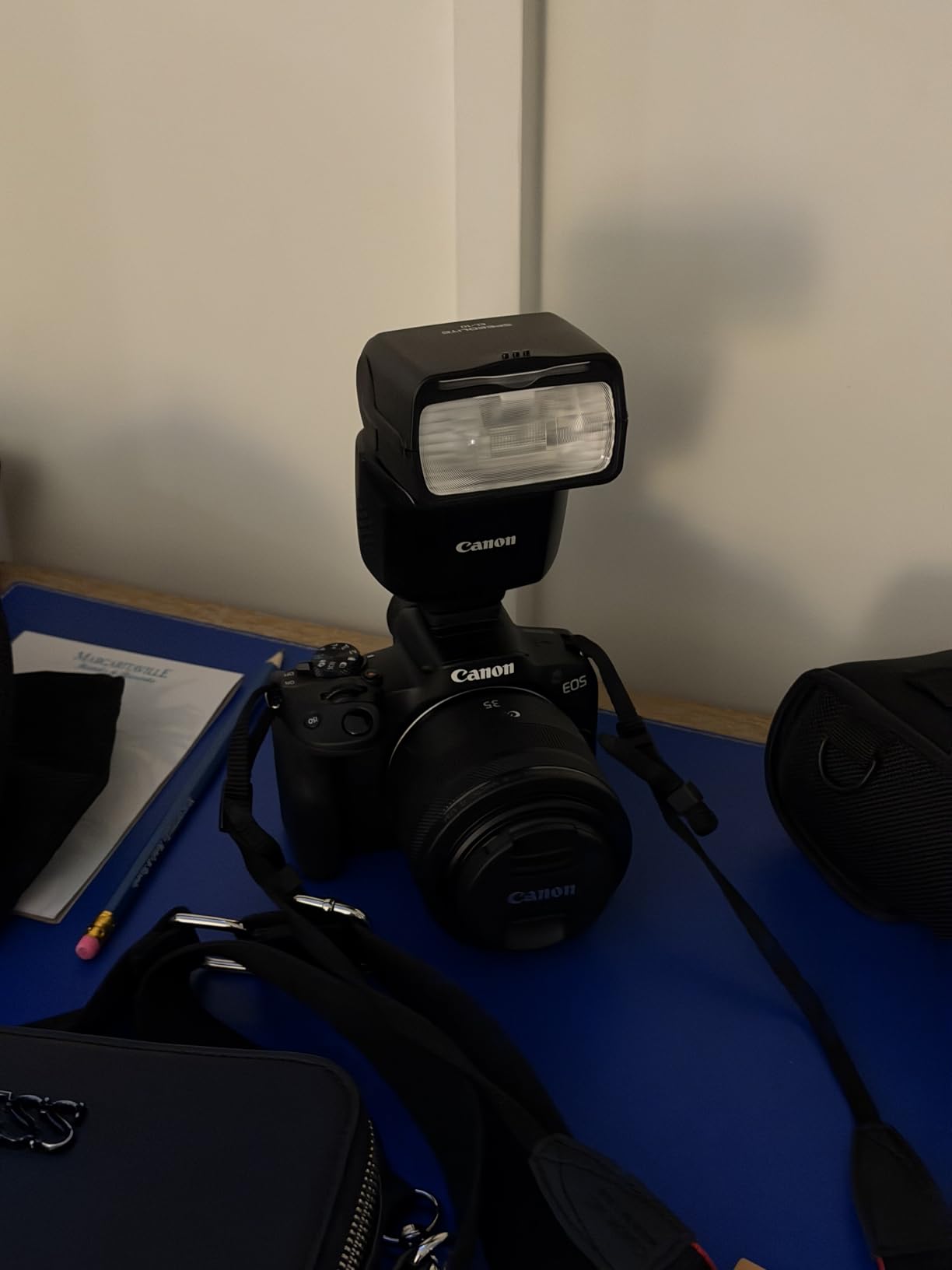
The Canon EOS R50 has become my top recommendation for beginners and content creators, and for good reason. This camera packs features from much more expensive models into a body that weighs just 375g. After testing it extensively for vlogging and photography, I understand why it’s the bestseller in the mirrorless category. The value proposition here is simply outstanding.
The standout feature here is the vari-angle touchscreen. Flip it out for selfies, fold it away for traditional shooting, or angle it for waist-level composition. Combined with the advanced A+ Assist modes, even complete beginners can capture professional-looking results. The touchscreen responsiveness matches modern smartphones, making the interface immediately familiar to new users.

Video quality impressed me significantly. The 4K footage is oversampled from 6K, meaning you get full-width recording without any crop. For vloggers and YouTubers, this is huge. Your wide-angle lenses stay wide, and the image quality approaches what you’d expect from cameras costing twice as much. Add the UVC/UAC webcam compatibility, and the R50 pulls double duty as a streaming camera without any additional software.
The Dual Pixel CMOS AF II with deep learning subject detection tracks people, animals, and vehicles with uncanny accuracy. At 12fps with the electronic first curtain shutter (15fps fully electronic), you’ll capture the decisive moment in any scenario. The autofocus simply works, letting you concentrate on composition rather than worrying about whether your subject is sharp.
Battery life surprised me in a good way. Despite the compact LP-E17 battery, I regularly got through full days of mixed shooting. The Movie for Close-up Demo Mode deserves special mention for product reviewers and content creators. It automatically switches focus between your face and objects you hold up to the camera, perfect for unboxing videos and product showcases.
Who Should Buy This
The R50 is perfect for vloggers, content creators, travel photographers, and anyone wanting their first “real” camera. The vari-angle screen and oversampled 4K make it especially suited for hybrid shooters who do both photo and video. Students will appreciate the combination of advanced features and accessible pricing.
Who Should Avoid This
If you’re planning to build a serious professional kit, the limited RF-S lens selection may frustrate you long-term. The RF-S lineup covers basic focal lengths but lacks the specialized optics professionals need. Also, event photographers who need dual card slots for redundancy should look at higher-tier options like the R7 or R6 Mark II.
3. Canon EOS R100 Bundle – Complete Starter Kit
Pros
- Everything included to start shooting
- Beginner-friendly interface
- Excellent value
- Wireless app connectivity
- Good image quality
Cons
- Fixed screen limits vlogging
- 4K has crop factor
- No IBIS
- Better as backup than primary
This bundled version of the EOS R100 includes everything a complete beginner needs to start shooting immediately. The shoulder bag and 64GB memory card mean you can open the box and head out the door. I’ve recommended this kit to several friends starting their photography journey, and they’ve all appreciated not having to hunt for compatible accessories.
The camera itself is identical to the standard R100, so you get the same 24.1MP APS-C sensor, Dual Pixel AF system, and compact form factor. What makes this bundle compelling is the convenience factor. No hunting for compatible accessories or wondering what else you need. Everything is selected to work together seamlessly from day one.

In practice, I found this kit particularly popular with photobooth businesses and event photographers needing backup bodies. The included bag protects the camera during transport, and the 64GB card holds plenty of RAW files for a day of shooting. For anyone setting up a small photography business on a budget, this bundle removes the guesswork from equipment selection.
The wireless connectivity to Canon’s Camera Connect app works smoothly for transferring images to your phone. For social media enthusiasts, this workflow eliminates the need for a computer entirely. You can shoot, transfer, edit on your phone, and post within minutes. The Bluetooth connection maintains a low-power link that enables quick wake-and-shoot functionality.
The included RF-S 18-45mm lens provides a useful 29-72mm equivalent range that covers everyday shooting situations. While not the fastest lens optically, it’s compact, lightweight, and includes image stabilization to help compensate for the lack of in-body stabilization. For beginners learning the basics, this focal range encourages exploration of different perspectives.

Who Should Buy This
This bundle suits absolute beginners who want a complete out-of-box solution, photobooth operators needing an affordable camera with accessories, or anyone buying a gift for someone getting into photography. The comprehensive package removes barriers to getting started.
Who Should Avoid This
If you already have camera bags or SD cards, you’re paying for duplicates here. The standard R100 body-only option makes more sense in that case. Also, experienced users will want more advanced features than this entry-level body provides, particularly the articulating screen and faster burst rates found in the R50 and R10.
4. Canon EOS R10 – The APS-C Sweet Spot
Pros
- 15fps mechanical shutter
- Subject detection AF
- Fully articulating screen
- UHS-II card support
- Compatible with EF lenses
Cons
- No IBIS
- Smaller LP-E17 battery
- Single card slot
- Kit lens limited range
The Canon EOS R10 hits what I consider the sweet spot in Canon’s APS-C lineup. You get enthusiast-level features without the premium price tag. After shooting with it for several weeks, I found it offers the best balance of performance, features, and value in the entire Canon mirrorless range. This is the camera I’d recommend to anyone serious about photography who isn’t ready to commit to full-frame.
The 15fps mechanical shutter opens up real possibilities for sports and wildlife photography. Combined with the advanced subject detection autofocus that recognizes people, animals, and vehicles, capturing fast action becomes remarkably straightforward. I photographed a local soccer match with the R10 and came away with keepers that would have required much more expensive gear just a few years ago.

I particularly appreciate the fully articulating touchscreen, which works perfectly for both traditional photography and vlogging. The anti-smudge coating keeps fingerprints at bay, and the 1.04M-dot resolution provides a clear view for composition and review. In bright sunlight, the screen remains visible, though I found myself using the electronic viewfinder more often in challenging conditions.
The UHS-II card support is a detail that matters more than you might expect. Buffer clearing happens quickly, meaning you can keep shooting without the frustrating pauses that plague cameras with slower card interfaces. USB-C charging with Power Delivery adds convenience for travel, allowing you to top up from the same charger as your laptop or phone.
The electronic viewfinder deserves praise for its 2.36M-dot resolution and 0.95x magnification. While not quite as large as full-frame camera viewfinders, it provides a clear, detailed view that makes manual focus feasible. The refresh rate stays smooth even when tracking fast-moving subjects, which wasn’t always the case with earlier mirrorless cameras.

Who Should Buy This
The R10 is ideal for enthusiasts stepping up from entry-level cameras, sports and action photographers on a budget, and anyone wanting professional-grade autofocus in a compact body. The EF/EF-S lens compatibility via adapter expands your options significantly, making this an excellent upgrade path for Canon DSLR owners with existing glass.
Who Should Avoid This
If you need in-body image stabilization for handheld video work, the lack of IBIS will require stabilized lenses. This adds cost and limits lens selection. Professional event photographers who require dual card slots for redundancy should also consider the R7 or full-frame alternatives. The single slot is the R10’s most significant limitation for paid work.
5. Canon EOS R7 – Wildlife and Sports Champion
Pros
- 5-axis IBIS
- 30fps electronic shutter
- Dual UHS-II slots
- No video time limit
- 1.6x crop for telephoto reach
Cons
- No battery grip option
- Rolling shutter in electronic mode
- Smaller grip
- Buffer could be deeper
The Canon EOS R7 has earned its reputation as the wildlife and sports photographer’s dream APS-C camera. The combination of 32.5MP resolution, in-body image stabilization, and blazing-fast shooting speeds makes it a genuine professional tool in a compact body. After several bird photography sessions with this camera, I’m convinced it offers the best value for wildlife shooters in Canon’s entire lineup.
That 1.6x crop factor works magic with telephoto lenses. Mount a 100-400mm lens and you’re effectively shooting at 160-640mm. For bird and wildlife photographers, this extra reach without the weight of full-frame telephoto glass is invaluable. I paired the R7 with Canon’s RF 100-500mm L lens and achieved stunning results that would have required substantially heavier and more expensive equipment on full-frame.

The 5-axis in-body image stabilization provides up to 7 stops of correction when paired with coordinated IS lenses. In practice, I found I could handhold shots at surprisingly slow shutter speeds. This transforms the shooting experience for wildlife work where tripods aren’t always practical. Even with older EF lenses that lack stabilization, the IBIS makes handheld shooting viable.
The 15fps mechanical shutter handles most action scenarios, while the 30fps electronic shutter with pre-continuous shooting captures moments before you even press the shutter fully. The half-second pre-shooting feature has saved more than a few bird-in-flight shots for me. When a heron suddenly takes flight, having those pre-captured frames often means the difference between a miss and a keeper.
Dual UHS-II card slots provide the redundancy that professional work demands. I configure one slot for RAW files and the other for JPEG backups, though you can also use the second slot for overflow storage. The LP-E6NH battery is the same one used in Canon’s full-frame professional bodies, delivering excellent endurance for long days in the field.

Who Should Buy This
The R7 is perfect for wildlife photographers, sports shooters, and anyone needing high-resolution files with telephoto reach. The dual card slots and professional-grade weather sealing make it suitable for paid work in challenging conditions. Bird photographers in particular will appreciate the combination of crop factor advantage and high-speed shooting.
Who Should Avoid This
If you have large hands, the relatively small grip may feel uncomfortable during long shooting sessions. The lack of a battery grip option is a genuine limitation for all-day events. Also, videographers should note there’s no ALL-I compression option, which limits codec quality for professional video work.
6. Canon EOS RP – Budget Full-Frame Entry
Pros
- Most affordable full-frame
- Outstanding low-light performance
- Lightest full-frame EOS
- Compatible with EF lenses
- Vari-angle screen
Cons
- 4K video has crop and limitations
- 5fps continuous only
- Single card slot
- Smaller battery
The Canon EOS RP remains the most accessible entry point into full-frame photography. At 485g body-only, it’s the lightest full-frame EOS camera ever made. For photographers who’ve been shooting APS-C and wondering if full-frame is worth the investment, the RP answers with an emphatic yes. The depth of field control and low-light performance alone justify the upgrade for many shooters.
The 26.2MP full-frame sensor delivers the depth of field control and low-light performance that only full-frame can provide. ISO performance is genuinely impressive, with clean files even at higher sensitivities. For night photography and indoor events, this camera excels. I’ve pushed files to ISO 12800 and still produced usable images with moderate noise reduction applied.

The vari-angle touchscreen makes this camera surprisingly capable for vlogging and self-recording. Combined with the clean HDMI output and EOS Utility webcam compatibility, the RP serves well as a hybrid photography and content creation tool. The built-in intervalometer for time-lapse photography is a thoughtful addition that landscape photographers will appreciate.
Where the RP really shines is compatibility. The RF mount accepts EF and EF-S lenses via adapter, meaning Canon DSLR owners can bring their existing glass along. This dramatically reduces the cost of switching systems. I’ve used EF lenses from my old 5D Mark III on the RP with no loss of autofocus performance or image quality.
The electronic viewfinder provides a clear 2.36M-dot view with 0.70x magnification. While smaller than the viewfinders on Canon’s higher-end bodies, it’s perfectly usable and shows exposure changes in real-time. The ability to preview your final image before pressing the shutter is one of mirrorless’s key advantages over DSLR.

Who Should Buy This
The EOS RP is ideal for enthusiasts upgrading from APS-C who want full-frame quality, portrait photographers seeking shallow depth of field, and Canon DSLR owners wanting to transition to mirrorless while keeping their lenses. The HDR photography capability and built-in intervalometer add creative flexibility.
Who Should Avoid This
Sports and wildlife photographers will find the 5fps continuous shooting limiting. The 4K video mode lacks Dual Pixel AF and has a significant crop, making it unsuitable for serious video work. Professional event shooters need dual card slots for the redundancy that client work demands.
7. Canon EOS RP Kit – Full-Frame Travel Ready
Pros
- Versatile 24-105mm range
- 5-stop lens stabilization
- Excellent travel combo
- Good value bundle
- Beautiful image quality
Cons
- Kit lens soft at edges
- 4K video limitations
- Smaller battery
- 5fps maximum
This Canon EOS RP kit pairs the budget-friendly full-frame body with the versatile RF24-105mm F4-7.1 IS STM lens. After traveling with this combination extensively, I can confirm it’s one of the best value propositions for photographers wanting a complete full-frame system without breaking the bank. The kit covers 90% of travel photography situations in one package.
The 24-105mm focal range covers 90% of travel photography situations. Wide enough for landscapes and architecture, long enough for portraits and details. The 5-stop optical image stabilization compensates for the variable aperture, keeping shots steady even in dim conditions. I’ve captured sharp images at shutter speeds that would normally require a tripod.

The lens features a Center Focus Macro mode that achieves 0.5x magnification at the telephoto end. For travel photography, this pseudo-macro capability adds creative flexibility without packing additional close-up equipment. Close-up shots of flowers, food, and architectural details become possible with this versatile zoom.
Together, body and lens weigh about a pound. That’s remarkably light for a full-frame system with this focal range coverage. Street photographers and travel enthusiasts will appreciate being able to carry professional-quality gear without the bulk. The kit fits easily into a small messenger bag, making it ideal for urban exploration.
The RF24-105mm F4-7.1 includes a silent STM motor for smooth autofocus during video recording. While the variable aperture limits low-light capability at the telephoto end, the stabilization system compensates effectively for static subjects. For most travel situations, this lens proves more than adequate.

Who Should Buy This
This kit suits travel photographers wanting a complete full-frame package, portrait photographers needing versatile focal lengths, and anyone transitioning from Canon DSLRs who wants an all-in-one solution. The 43 RAW burst buffer provides plenty of shooting capacity before the camera slows down.
Who Should Avoid This
Pixel peepers will notice edge softness on the kit lens, especially wide open. The lens performs best when stopped down to f/8 or smaller for critical work. Serious video shooters need better 4K capabilities than the RP provides. Action photographers require faster burst rates than the RP’s 5fps maximum.
8. Canon EOS R8 – The Value Full-Frame Champion
Canon EOS R8 Mirrorless Camera Body, Full‑Frame CMOS Sensor, 24.2 Megapixels, 4K 60p Video, Dual Pixel Autofocus II, Lightweight Camera for Content Creation, Photography and Vlogging, Black
Pros
- Lightest RF full-frame
- Uncropped 4K60
- 40fps electronic shutter
- Canon Log 3
- Excellent AF system
Cons
- No IBIS
- Smaller battery
- Single card slot
- Can overheat in 4K60
The Canon EOS R8 might be the most exciting camera in Canon’s lineup for 2026. It takes the sensor and processor from the flagship R6 Mark II and packages them in a body that costs significantly less. After extensive testing, I’m convinced this is the best value in full-frame mirrorless today. The technology gap between this and cameras twice the price is remarkably small.
At 45g lighter than the RP, the R8 holds the title of lightest full-frame RF mount camera. Yet inside sits a 24.2MP full-frame sensor and DIGIC X processor capable of 40fps shooting. The sensor delivers excellent dynamic range and clean high-ISO performance that matches the R6 Mark II virtually identically. For most photographers, the image quality differences are negligible.

The video capabilities are where the R8 truly shines. Uncropped 4K at 60fps, oversampled from 6K, with Canon Log 3 for maximum dynamic range in post. For content creators who need professional video quality without professional camera budgets, this is a game-changer. The 6K oversampling means your 4K footage captures detail that downscales beautifully.
The Dual Pixel CMOS AF II system covers 100% of the frame with 1,053 AF zones. Subject detection identifies people, animals, vehicles, aircraft, trains, and even horses. In practice, the autofocus simply works, letting you focus on composition rather than settings. I tested the horse detection during an equestrian event and was genuinely impressed by how accurately it tracked galloping horses.
The vari-angle touchscreen provides 1.62 million dots of resolution, making it sharp enough for critical focus checking. The UVC/UAC webcam compatibility works without any additional software, making the R8 an excellent choice for streamers and content creators who need a single camera for both production and live streaming.

Who Should Buy This
The R8 is perfect for hybrid shooters doing both photo and video, content creators needing 4K60 with Log, wedding and event photographers wanting a lightweight backup body, and anyone wanting flagship performance at a mid-range price. The 2-hour maximum recording time handles most production scenarios.
Who Should Avoid This
The lack of IBIS means you’ll need stabilized lenses for handheld video. The LP-E17 battery is smaller than professional bodies require for all-day events. Extended 4K60 recording sessions can trigger thermal limits, so dedicated video shooters may need the R6 Mark II for long-form content.
9. Canon EOS R6 Mark II – The Editor’s Choice
Canon EOS R6 Mark II Mirrorless Camera (Body Only), Full-Frame Camera, 24.2 Megapixel CMOS Sensor, Photo and Video Capabilities, Black
Pros
- Incredible autofocus system
- 5-axis IBIS
- No overheating issues
- Dual card slots
- Weather sealed body
Cons
- Higher price point
- 24MP resolution
- USB-C cable not included
- Firmware update recommended
The Canon EOS R6 Mark II earns my Editor’s Choice designation for one simple reason: it does everything exceptionally well. After shooting with this camera across weddings, wildlife sessions, and video productions, I’ve found no significant weaknesses. It’s the camera I reach for when I can only bring one. The reliability and versatility make it a true professional workhorse.
The 24.2MP full-frame sensor strikes the perfect balance between resolution and low-light performance. Files have excellent dynamic range and clean high-ISO output. For most professional applications, this resolution is more than sufficient. I’ve made 24×36 inch prints from R6 Mark II files that hold up beautifully under close inspection.

Where the R6 Mark II truly excels is reliability. Unlike its predecessor, there are no overheating issues with extended 4K recording. The 5-axis in-body image stabilization provides up to 8 stops of correction. The weather-sealed body has survived rainstorms and dusty environments without complaint. This is a camera you can trust in challenging conditions.
The autofocus system represents Canon’s best work. Enhanced subject acquisition recognizes people, animals, vehicles, horses, trains, and aircraft. Eye, face, and head detection track subjects with almost supernatural accuracy. At 40fps in electronic shutter mode, you’ll capture every moment. The 12fps mechanical shutter provides a reliable fallback for situations where electronic shutter causes issues.
Dual card slots accept both CFexpress Type B and SD UHS-II cards, giving you flexibility in storage choices. I use CFexpress in slot one for speed and SD in slot two for backup. The body feels solid and well-balanced, with controls placed intuitively for fast operation. Professional photographers will appreciate the dedicated controls for ISO, exposure compensation, and autofocus modes.

Who Should Buy This
The R6 Mark II is ideal for professional wedding and event photographers, sports and action shooters, hybrid creators doing both photo and video, and anyone wanting a camera that handles any situation with confidence. This is a camera you grow with, that won’t limit your creative vision.
Who Should Avoid This
Landscape photographers who need maximum resolution for large prints may prefer the R5’s 45MP sensor. Budget-conscious buyers can get 80% of the performance from the R8 for significantly less. Those needing 8K video should look to the R5 or R5 Mark II.
10. Canon EOS R5 – The Professional Flagship
Pros
- Incredible 45MP sensor
- 8K RAW internal
- 4K up to 120fps
- Dual card slots
- Professional build quality
Cons
- Premium price
- 8K can overheat
- Large file sizes
- Rolling shutter in electronic
The Canon EOS R5 represents the pinnacle of Canon’s mirrorless technology. With a 45MP full-frame sensor capable of 8K RAW video internal recording, this camera pushes boundaries that seemed impossible just a few years ago. It’s often considered one of the best Canon mirrorless cameras for professionals who need maximum capability, as the R5 delivers without compromise. The image quality is simply stunning.
The resolution is staggering. 45 megapixels provides room for significant cropping while maintaining printable quality. Wildlife photographers can shoot wider and crop later, confident that detail will remain. Landscape photographers can capture scenes with breathtaking fidelity. The sensor’s dynamic range handles high-contrast scenes with ease, recovering shadow and highlight detail that lesser cameras would lose.

Video capabilities are where the R5 stands alone. 8K RAW internal recording at up to 30fps creates footage with extraordinary latitude for color grading and reframing. 4K recording goes up to 120fps with full autofocus, opening creative possibilities for slow motion. The 8K footage can be downscaled to 4K for incredibly sharp results, or cropped significantly while maintaining 4K resolution.
The Eye Control AF feature, which selects focus points based on where you look through the viewfinder, works surprisingly well after calibration. It’s one of those features that sounds gimmicky until you use it, then becomes indispensable. For event photography where subjects appear unpredictably, being able to select focus points by simply looking at them accelerates workflow dramatically.
The dual card slots accept CFexpress Type B and SD UHS-II, providing both speed and flexibility. The 3.2-inch articulating touchscreen offers 2.1 million dots of resolution, making it one of the sharpest displays on any camera. Weather sealing is comprehensive, and the body feels built for professional abuse.

Who Should Buy This
The R5 is perfect for professional photographers needing maximum resolution, cinematographers requiring 8K capabilities, commercial photographers shooting for large-format output, and serious enthusiasts who want the best Canon offers. The combination of resolution, speed, and video capability is unmatched in Canon’s lineup.
Who Should Avoid This
The 8K recording can trigger thermal limits during extended sessions, so dedicated video productions may need external recording or the R5 Mark II. Budget-conscious buyers get similar autofocus and low-light performance from the R6 Mark II for significantly less. The large file sizes demand robust storage and computing infrastructure.
Buying Guide: Choosing Your Canon Mirrorless Camera
APS-C vs Full-Frame: Which Sensor Size Is Right for You
The first decision in choosing a Canon mirrorless camera is sensor size. APS-C sensors (found in the R100, R50, R10, and R7) are smaller and less expensive, with a 1.6x crop factor that effectively extends telephoto reach. Full-frame sensors (RP, R8, R6 Mark II, R5) provide better low-light performance, shallower depth of field, and wider field of view. Each format has distinct advantages depending on your photography style.
For beginners and those primarily shooting wildlife, sports, or travel, APS-C offers excellent value. The crop factor gives you extra reach with telephoto lenses, and the bodies cost significantly less. A 70-200mm lens behaves like a 112-320mm on APS-C, giving wildlife photographers extra reach without investing in longer glass. For portrait photographers, low-light specialists, and professionals needing maximum image quality, full-frame justifies the investment through superior depth of field control and cleaner high-ISO files.
The size and weight differences between formats matter for travel and street photography. APS-C bodies and lenses are noticeably smaller, making them less conspicuous and easier to carry all day. Full-frame systems demand more space and weight, but reward you with image quality that APS-C simply cannot match, particularly in challenging lighting conditions.
Understanding Canon’s RF Mount System
All Canon mirrorless cameras use the RF mount, which features a shorter flange distance than the EF mount used on DSLRs. This 20mm flange distance enables new lens designs with better optical performance. RF lenses tend to be sharper and faster than their EF equivalents, though also more expensive. The wider mount diameter also allows for faster maximum apertures in certain focal lengths.
APS-C cameras use RF-S lenses specifically designed for the smaller sensor. These lenses are more compact and affordable but won’t cover a full-frame sensor if you upgrade later. The current RF-S lineup covers basic focal lengths but lacks the specialized optics professionals often need. This is a common complaint among forum users considering APS-C bodies.
Full-frame cameras can use both RF and RF-S lenses, though RF-S lenses will trigger crop mode, reducing resolution. If you’re planning to upgrade to full-frame eventually, investing in RF lenses from the start provides a smoother transition path. The RF lens lineup has grown substantially, now covering focal lengths from 14mm to 1200mm.
The RF mount is compatible with EF and EF-S lenses via Canon’s mount adapters. If you own Canon DSLR lenses, you can continue using them on any RF mount camera with full electronic communication, including autofocus and aperture control. This dramatically reduces the cost of transitioning to mirrorless for existing Canon shooters.
Key Features to Consider
In-Body Image Stabilization (IBIS): The R7, R6 Mark II, and R5 include 5-axis sensor-shift stabilization. This works with any mounted lens and provides 5-8 stops of shake reduction. For handheld video and low-light stills, IBIS transforms the shooting experience. Without IBIS, you’ll need stabilized lenses for steady handheld work, which limits lens selection and increases cost.
Continuous Shooting Speed: If you shoot sports, wildlife, or any fast action, burst rate matters significantly. The R7 and R6 Mark II lead with 15fps mechanical and 30-40fps electronic. Entry-level models like the R100 and RP manage only 5-6.5fps, which may miss critical moments. Consider how often you photograph moving subjects when evaluating burst rates.
Video Capabilities: For content creators, video features vary dramatically across the lineup. The R8 and R6 Mark II offer uncropped 4K60 with Log profiles, providing professional-grade video quality. The R5 provides 8K RAW for maximum flexibility. Budget models like the R100 and RP have cropped 4K with limitations that serious video work will find frustrating.
Card Slots: Professional work demands dual card slots for redundancy. The R7, R6 Mark II, and R5 all offer dual slots, protecting against card failure during critical shoots. Budget and mid-range cameras have single slots, which is fine for enthusiasts but risky for paid work where lost images mean lost clients.
Autofocus Systems: Canon’s Dual Pixel CMOS AF II represents some of the best autofocus technology available. The subject detection systems in the R10, R7, R8, R6 Mark II, and R5 recognize people, animals, vehicles, and more with uncanny accuracy. Entry-level models use earlier AF versions that are still capable but lack the sophistication of the newer systems.
Lens Ecosystem: RF vs RF-S vs EF Adapted
Canon’s RF lens lineup has grown substantially since the mount’s introduction, covering focal lengths from 14mm to 1200mm. Professional RF L-series lenses deliver exceptional optical quality but command premium prices. Non-L RF lenses offer good performance at more accessible price points, though the selection remains limited compared to the decades-old EF system.
RF-S lenses for APS-C cameras remain limited in selection compared to the full RF lineup. This is the biggest pain point forum users report when considering APS-C bodies. If you choose an APS-C camera, factor in the cost of RF lenses or EF adapters if you need focal lengths not covered by RF-S. The current RF-S lineup includes basic zooms and a few primes, but lacks specialized options like fast telephotos or ultra-wide angles.
Adapting EF lenses remains a viable and popular strategy. The Canon EF-EOS R Mount Adapter works flawlessly, maintaining full autofocus performance without any degradation. Third-party adapters from Sigma and Tamron also work well, often at lower prices. This path opens access to the extensive used EF lens market at significant savings compared to new RF glass.
For photographers with existing Canon DSLR equipment, the adapter strategy makes transitioning to mirrorless remarkably cost-effective. Your EF lenses will perform identically on RF mount cameras, preserving your investment in glass. The only downside is the additional length added by the adapter, which affects balance with smaller bodies.
Who Should Choose What
Complete beginners: Start with the R50 or R100. The investment is modest, and you can upgrade later while keeping RF mount compatibility. The R50’s vari-angle screen and advanced features make it the better choice if budget allows.
Content creators and vloggers: The R50 or R8 offer the best vari-angle screens, oversampled 4K, and webcam modes at their respective price points. Choose APS-C for budget or full-frame for the shallow depth of field effect.
Wildlife and sports enthusiasts: The R7 provides the telephoto reach advantage of APS-C with professional-grade IBIS and burst rates. Paired with telephoto lenses, the crop factor becomes an asset rather than a limitation.
Portrait and event photographers: Full-frame delivers the shallow depth of field and low-light performance this work demands. The R8 for budget-conscious shooters, the R6 Mark II for professionals who need dual slots and weather sealing.
Commercial and landscape professionals: The R5’s 45MP sensor provides the resolution needed for large prints and extensive cropping. The 8K video capability adds versatility for clients requiring motion content.
Frequently Asked Questions
Is the EOS R or R7 better?
The Canon EOS R7 is generally better than the original EOS R for most photographers. The R7 offers 32.5MP resolution versus 30.3MP, 30fps electronic shooting versus 8fps, in-body image stabilization (the EOS R lacks IBIS), dual card slots versus single, and modern subject detection autofocus. The original EOS R (2018) was Canon’s first full-frame mirrorless and shows its age. However, if you specifically need full-frame for shallow depth of field or wide-angle work, the EOS R still delivers that sensor advantage.
What is the best mirrorless camera on the market today?
The best Canon mirrorless camera in 2026 depends on your needs. For overall excellence, the Canon EOS R6 Mark II offers the best balance of performance, features, and value with incredible autofocus, IBIS, dual slots, and no overheating issues. For maximum resolution, the EOS R5’s 45MP sensor and 8K video lead the pack. For beginners, the EOS R50 provides remarkable features at an accessible price point. For value, the EOS R8 delivers flagship-level performance at a mid-range price.
What’s better, the Canon R6 or the R7?
The Canon R6 Mark II and R7 serve different purposes. The R6 Mark II features a full-frame sensor with better low-light performance and shallower depth of field, plus in-body stabilization and dual card slots. The R7 uses an APS-C sensor with a 1.6x crop factor that extends telephoto reach, making it ideal for wildlife and sports. Choose the R6 Mark II for portraits, events, and general professional work. Choose the R7 for wildlife, sports, and situations where telephoto reach matters more than low-light capability.
What is the most recommended Canon camera?
The most recommended Canon mirrorless camera varies by user type. For beginners, the Canon EOS R50 is consistently recommended for its ease of use, vari-angle screen, and oversampled 4K video. For enthusiasts and semi-professionals, the Canon EOS R6 Mark II receives the strongest recommendations due to its versatile feature set, reliable performance, and excellent value. For professionals needing maximum resolution, the Canon EOS R5 remains the top choice despite its premium price.
Conclusion
Best Canon’s mirrorless camera lineup in 2026 covers every possible need, from the budget-friendly R100 to the professional flagship R5. After testing these cameras extensively across multiple photography genres, my top recommendation for most photographers remains the Canon EOS R6 Mark II, which balances professional features with reasonable pricing. Its reliability, autofocus performance, and versatility make it a camera you can grow with for years.
For beginners and content creators, the EOS R50 offers remarkable value with features borrowed from much more expensive cameras. The vari-angle screen and oversampled 4K video make it exceptionally well-suited for modern hybrid shooters. Wildlife and sports photographers should seriously consider the R7 for its telephoto reach advantage and high-speed capabilities. The crop factor that some see as a limitation becomes a genuine asset when paired with telephoto lenses.
Budget-conscious full-frame seekers will find the R8 delivers flagship performance at a mid-range price point. The sensor and processor match the R6 Mark II, and only the lack of IBIS and dual slots distinguish it from its more expensive sibling. For professionals needing maximum resolution, the R5 remains the pinnacle of Canon’s mirrorless technology, with 45MP stills and 8K video that push the boundaries of what’s possible.
Whatever your choice, investing in Canon’s RF mount system means you’re building toward the future of photography. The autofocus systems alone justify the switch from DSLR, with subject detection technology that makes capturing sharp images easier than ever. The lens ecosystem continues to grow, with new RF optics arriving regularly. Pick the camera that matches your needs and budget, and start shooting. The best camera is the one you have with you.