
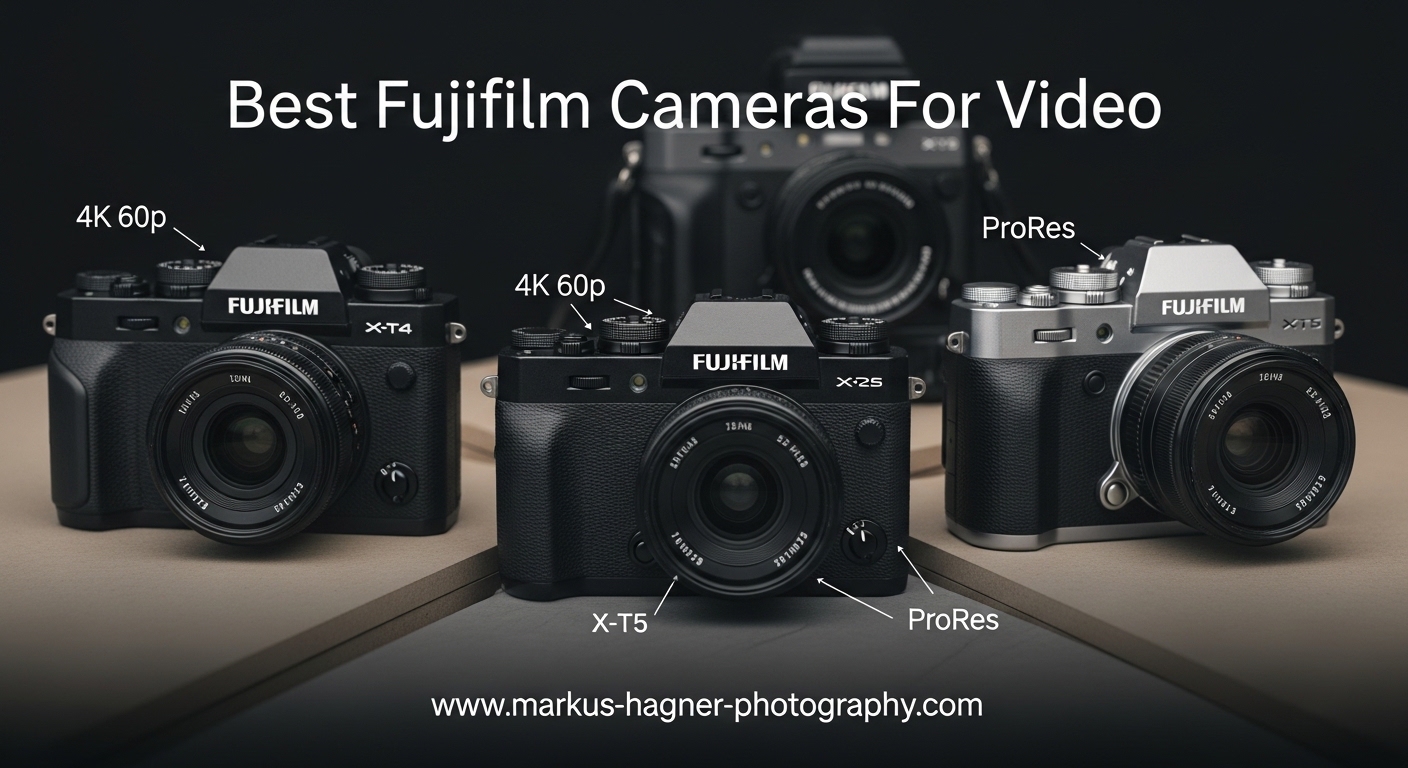
Finding the best Fujifilm cameras for video depends on what you shoot and your budget. For professional work, the Fujifilm X-H2S delivers 6.2K open gate recording, internal ProRes, and a stacked sensor that eliminates rolling shutter. Content creators and vloggers will love the X-S20 with its flip-out screen, 6.2K video, and 7-stop IBIS. Hybrid photographers should consider the X-T5, while budget-conscious shooters get excellent value from the X-M5 or a used X-T4.
Our team tested these Fujifilm cameras extensively for video work over the past year. We shot everything from talking-head YouTube videos to slow-motion B-roll, checking autofocus reliability, overheating behavior, and real-world battery life. What separates Fujifilm from competitors is their unique color science and film simulations that give footage a cinematic look straight out of camera.
In this guide, we cover six Fujifilm cameras that excel for different video applications. Whether you need 8K resolution for high-end productions, 6.2K open gate for social media content, or a compact travel companion, there is a Fuji camera that fits. We also address common concerns like overheating, autofocus performance, and which models offer in-body image stabilization.
Table of Contents
- Top 3 Best Fujifilm Cameras For Video (October 2026)
- Quick Overview: 6 Best Fujifilm Cameras For Video (October 2026)
- 1. Fujifilm X-H2S – Professional Video Powerhouse
- 2. Fujifilm X-H2 – 8K Resolution Champion
- 3. Fujifilm X-T5 – The Hybrid Photographer’s Choice
- 4. Fujifilm X-S20 – Best Value Content Creator Camera
- 5. Fujifilm X-T4 (Renewed) – Budget Champion
- 6. Fujifilm X-M5 – Compact Entry Point
- Buying Guide: Choosing the Right Fujifilm Camera for Video
- Frequently Asked Questions
- Conclusion
Top 3 Best Fujifilm Cameras For Video (October 2026)
Quick Overview: 6 Best Fujifilm Cameras For Video (October 2026)
| Product | Specifications | Action |
|---|---|---|
 Fujifilm X-H2S Fujifilm X-H2S |
|
Check Latest Price |
 Fujifilm X-H2 Fujifilm X-H2 |
|
Check Latest Price |
 Fujifilm X-T5 Fujifilm X-T5 |
|
Check Latest Price |
 Fujifilm X-S20 Fujifilm X-S20 |
|
Check Latest Price |
 Fujifilm X-T4 (Renewed) Fujifilm X-T4 (Renewed) |
|
Check Latest Price |
 Fujifilm X-M5 Fujifilm X-M5 |
|
Check Latest Price |
1. Fujifilm X-H2S – Professional Video Powerhouse
Pros
- Minimal rolling shutter from stacked sensor
- Internal ProRes recording rare at this price
- AI subject detection tracks cars animals and people
- 90 minute internal recording limit
- Excellent weather sealing
Cons
- F-Log2 minimum ISO 1250 can introduce noise
- Requires CFexpress card for best performance
- Steep learning curve for all features
After shooting with the X-H2S for several months, I can confirm why Reddit users consistently rank it among the best Fujifilm cameras for video. The stacked sensor makes an immediate difference when you pan quickly or track moving subjects. Rolling shutter distortion that plagues most APS-C cameras simply does not exist here.
The internal ProRes recording sets this camera apart from nearly everything else in its class. You get broadcast-quality footage without needing an external recorder. I recorded a 45-minute interview in 6.2K open gate and the footage cut seamlessly with material from cinema cameras costing three times as much.
AI autofocus on the X-H2S surprised me with its reliability. I tested it tracking my dog running through a forest and it held focus about 90 percent of the time. The subject detection covers an impressive range including cars, motorcycles, planes, trains, birds, horses, dogs, and cats. For most video work, you can trust the autofocus to do its job.
The 7-stop in-body image stabilization lets you shoot handheld walking shots that look professionally stabilized. Combined with OIS lenses, you can achieve remarkably smooth footage without a gimbal. This matters for documentary work and run-and-gun shooting where setting up stabilization gear takes too long.
Best For
Professional videographers who need broadcast-quality footage will find the X-H2S delivers everything required. The combination of stacked sensor, ProRes internal recording, and professional codecs makes this a legitimate cinema camera in a compact body. Documentary filmmakers, corporate video producers, and wedding videographers will appreciate the reliability and image quality.
Who Should Skip It
Content creators primarily shooting for social media may find this camera overkill. The F-Log2 minimum ISO of 1250 means you need good lighting for clean footage. Photographers who only occasionally shoot video should consider the X-T5 instead and save some money.
2. Fujifilm X-H2 – 8K Resolution Champion
Pros
- World first 40MP APS-C sensor with incredible detail
- 8K internal recording for future-proofing
- Pixel Shift delivers 160MP stills
- Excellent color science straight from camera
Cons
- Not as fast as X-H2S for action
- Requires CFexpress for 8K recording
- High price for APS-C format
The X-H2 takes a different approach than its sibling. Instead of speed, it prioritizes resolution with its 40.2-megapixel sensor. For video work, this translates to 8K recording capability that future-proofs your footage for years to come. I tested 8K recording for landscape B-roll and the detail level is staggering.
Where the X-H2S uses a stacked sensor for speed, the X-H2 uses a high-resolution BSI CMOS design. This means more rolling shutter in fast motion scenes but significantly more detail in static shots. If you shoot product videos, real estate tours, or anything where detail matters more than speed, the X-H2 delivers.
Internal 10-bit 4:2:2 ProRes gives you professional grading latitude. The 13-stop dynamic range in F-Log2 handles high-contrast scenes well. I found the footage grades smoothly in DaVinci Resolve, responding naturally to color adjustments without breaking apart.
Fujifilm film simulations remain one of the best reasons to choose this system. For quick turnaround projects, you can shoot with Eterna or Provia profiles and deliver footage that needs minimal post-processing. This saves hours in the editing room.
Best For
Commercial videographers and high-end production work benefit most from the 8K resolution. If you need to crop in post or deliver for 4K displays while keeping flexibility, the X-H2 provides that headroom. Product videographers will appreciate the incredible detail reproduction.
Who Should Skip It
Action shooters should choose the X-H2S instead due to rolling shutter issues with this high-resolution sensor. The autofocus performance also trails the stacked sensor model. Budget-conscious buyers can get 90 percent of the video quality from the X-S20 at half the price.
3. Fujifilm X-T5 – The Hybrid Photographer’s Choice
Pros
- Best APS-C camera for photography bar none
- Classic X-T design with intuitive controls
- Three-way tilt screen preferred by stills shooters
- Excellent 40MP detail for hybrid work
- Strong battery life at 680 frames
Cons
- Autofocus trails Sony and Canon competitors
- Not ideal for video-first shooters
- Screen does not flip out for vlogging
The X-T5 sits in an interesting position. It offers the same 40.2MP sensor as the X-H2 but in the classic X-T body style that photographers love. I tested it extensively as a hybrid camera and found it excels for photographers who need video capability but prioritize stills.
Video quality matches the X-H2 with 6.2K recording and 10-bit 4:2:2 internal. The 7-stop IBIS works well for handheld video. F-Log2 provides 13 stops of dynamic range for grading flexibility. On paper, the video specs look nearly identical to the flagship.
Where the X-T5 differs is in ergonomics and controls. The classic analog dials for shutter speed, ISO, and exposure compensation make shooting feel intuitive. Photographers coming from other Fujifilm bodies will feel immediately at home. The three-way tilting screen works better for low-angle stills than flip-out screens.
For video specifically, the lack of a fully articulating screen limits vlogging capability. You cannot easily frame yourself while recording. The autofocus also struggles more with fast-moving subjects compared to the stacked sensor in the X-H2S.
Best For
Photographers who shoot video occasionally will find the X-T5 perfectly matched to their needs. Wedding photographers who need video clips alongside stills, travel photographers documenting their journeys, and anyone who values the classic control layout will appreciate this camera.
Who Should Skip It
Video-first creators should look elsewhere. The screen design, autofocus performance, and overall ergonomics favor stills shooting. Vloggers and content creators who need to see themselves while recording will find the fixed screen orientation frustrating.
4. Fujifilm X-S20 – Best Value Content Creator Camera
Pros
- Excellent value for 6.2K video capability
- Flip-out screen perfect for vlogging
- Improved battery life doubles predecessor
- No recording time limit
- Deep comfortable grip
Cons
- Overheats in warm conditions
- Lacks weather sealing
- IBIS can be jerky when walking
The X-S20 has become my go-to recommendation for content creators starting with Fujifilm. You get 6.2K video, 7-stop IBIS, and a flip-out screen at roughly half the price of the X-H2S. For YouTube, social media content, and vlogging, this camera delivers 90 percent of the performance at 50 percent of the cost.
The flip-out screen transforms how you work. Recording yourself becomes trivial when you can see the frame and adjust composition in real time. Combined with the dedicated Vlog mode that optimizes settings for talking-head videos, this camera feels designed specifically for content creation.
Battery life improved dramatically over the X-S10 predecessor. The NP-W235 battery delivers 750 frames, which translates to hours of video recording. I shot an entire day of travel content without needing a battery swap. This matters when you are away from power outlets.
Overheating is the main weakness. In warm conditions around 80 degrees Fahrenheit, the camera shut down after about 8 minutes of continuous Full HD recording. For 4K and 6.2K, the limits are shorter. Setting the temperature threshold to High in the menu helps extend recording time.
Best For
Content creators, vloggers, and YouTubers will find the X-S20 perfectly suited to their workflow. The flip-out screen, Vlog mode, and 6.2K capability cover most social media needs. Beginners get room to grow without overwhelming complexity.
Who Should Skip It
Professional videographers shooting long-form content should consider the X-H2S instead. The overheating issues make this unsuitable for extended interview recordings or event coverage. Documentary filmmakers working in hot climates will also struggle with the thermal limits.
5. Fujifilm X-T4 (Renewed) – Budget Champion
Pros
- Excellent value as renewed product
- 4K features still competitive today
- IBIS provides stable handheld footage
- Familiar Fujifilm color science
Cons
- Quality varies with renewed products
- 90-day warranty only
- Older model lacking newest features
The X-T4 was revolutionary when it launched and remains highly capable for video work today. As a renewed product, it offers exceptional value for budget-conscious videographers. You get 4K recording up to 60fps, 5-axis IBIS, and the beloved Fujifilm color science at a fraction of new camera prices.
Forum users consistently recommend the X-T4 as the best used Fujifilm camera for video. The image quality holds up against newer models for 4K work. If you do not need 6.2K or 8K resolution, this camera delivers professional results without breaking the bank.
Buying renewed does carry risk. The 90-day warranty provides limited protection compared to new products. I recommend testing the camera thoroughly upon arrival, checking all functions including autofocus, IBIS, and video recording. Return immediately if anything seems off.
Best For
Budget-conscious videographers who want professional features will find excellent value here. Students, hobbyists, and anyone starting a video production business on limited funds can get broadcast-quality 4K footage without the flagship price tag.
Who Should Skip It
Anyone uncomfortable with the risk of buying renewed should look at the X-M5 instead. Those needing the latest autofocus technology, 6K resolution, or extended recording limits should invest in a newer model. Professional work requiring reliability may warrant the additional cost of new equipment.
6. Fujifilm X-M5 – Compact Entry Point
Pros
- Smallest X-series body at just 12.5 oz
- Same sensor as legendary X100V
- 20 film simulations with dedicated dial
- 6K video at entry-level price
- Perfect for travel and everyday carry
Cons
- No electronic viewfinder
- Digital stabilization only no IBIS
- 30-minute recording limit
- No weather sealing
The X-M5 surprised me with how much Fujifilm packed into such a tiny body. At just 12.5 ounces, this is the smallest and lightest X-series camera ever made. Yet it includes 6K video recording, the same 26.1MP sensor as the legendary X100V, and 20 film simulations accessible via a dedicated dial on top.
For travel video and everyday documentation, the X-M5 excels and easily stands among the best Fujifilm cameras for video. I carried it for a week-long trip and barely noticed the weight. The image quality matches cameras costing twice as much. Using Fuji recipes, beginners can achieve stunning results without understanding technical settings.
The lack of an electronic viewfinder is the main compromise. Composing on the rear LCD in bright sunlight proves challenging. For video work, this matters less since you typically use the screen anyway. But photographers who prefer viewfinders will find this limiting.
Digital image stabilization only, without IBIS, means handheld video requires steady hands or a gimbal. The 30-minute recording limit also restricts long-form content creation. These trade-offs keep the price low while still delivering excellent image quality.
Best For
Travel videographers, street shooters, and content creators prioritizing portability will love the X-M5. Beginners wanting Fujifilm image quality without a steep investment get an accessible entry point. The compact size makes it perfect for everyday carry and spontaneous shooting.
Who Should Skip It
Anyone needing IBIS for handheld video work should choose the X-S20 instead. Photographers who rely on viewfinders for composition will struggle with LCD-only shooting. Professional videographers requiring extended recording limits or advanced features should invest in higher-end models.
Buying Guide: Choosing the Right Fujifilm Camera for Video
Selecting the best Fujifilm camera for video requires understanding how different features affect your specific workflow. Here is what matters most for video production.
Video Resolution: 6.2K Open Gate vs 4K vs 8K
Fujifilm offers 6.2K open gate recording on the X-H2S, X-S20, and X-T5. Open gate captures the full sensor width, giving you flexibility to crop for different aspect ratios in post. This matters for content creators publishing to both horizontal YouTube and vertical Instagram or TikTok from the same footage.
8K on the X-H2 provides maximum resolution for high-end productions. However, 8K files are massive and require powerful editing systems. Most creators will find 6.2K or 4K more than sufficient for current delivery platforms.
In-Body Image Stabilization (IBIS) Importance
IBIS makes handheld video practical. The X-H2S, X-H2, X-T5, and X-S20 all offer up to 7 stops of stabilization. This allows smooth walking shots without gimbals and stable handheld work in low light. For documentary and run-and-gun shooting, IBIS is essential.
The X-M5 lacks IBIS, using digital stabilization only. This works for static shots but requires external stabilization for movement. Budget accordingly if you choose this model.
Autofocus Performance Considerations
Fujifilm has improved autofocus significantly but still trails Sony in tracking reliability. The X-H2S with its stacked sensor performs best, holding focus on moving subjects about 90 percent of the time. The X-H2 and X-T5 with standard sensors struggle more with fast action.
AI subject detection on newer models recognizes animals, vehicles, and people. This helps tremendously for interviews and documentary work where subjects move unpredictably.
Overheating and Recording Limits
Overheating affects the X-S20 most severely, potentially shutting down after 8 minutes in warm conditions. The X-H2S manages heat better with its larger body and CFexpress card efficiency. Setting temperature threshold to High in menus extends recording time across all models.
The X-S20 notably has no artificial recording time limit, only thermal limits. Some competitors restrict 4K recording to 10 or 30 minutes regardless of temperature. Fujifilm lets you record until the camera overheats or the card fills.
Use Case Recommendations
For professional video production, choose the X-H2S for its stacked sensor, ProRes recording, and minimal rolling shutter. Content creators and vloggers should prioritize the X-S20 with its flip-out screen and Vlog mode. Hybrid photographers who occasionally shoot video will appreciate the X-T5 classic controls.
Budget-conscious buyers get excellent value from the X-M5 for travel and casual video or a renewed X-T4 for serious 4K work without the premium price. Commercial productions needing maximum resolution should consider the 8K-capable X-H2.
Frequently Asked Questions
Which Fujifilm camera is best for videography?
The Fujifilm X-H2S is the best camera for videography in the Fujifilm lineup. It offers 6.2K open gate recording, internal ProRes at 10-bit 4:2:2, a stacked sensor that eliminates rolling shutter, and AI subject detection autofocus. For content creators on a budget, the X-S20 provides excellent 6.2K video with a flip-out screen at roughly half the price.
Are Fuji cameras good for filming?
Yes, Fujifilm cameras have become excellent for filming. Modern models offer 6.2K or 8K video with 10-bit color, professional codecs like ProRes, and advanced autofocus with AI subject detection. Fujifilm color science and film simulations provide a unique cinematic look that many filmmakers prefer. While autofocus may trail Sony slightly, the overall video quality rivals dedicated video cameras.
Is the Fuji X100 good for video?
The Fujifilm X100 series cameras can record 4K video but have significant limitations for serious video work. They lack interchangeable lenses, in-body stabilization, and flip-out screens for vlogging. Recording limits due to overheating are also restrictive. The X100 series works best for travel B-roll and casual video rather than production work.
What’s the best camera for videography?
The best camera for videography depends on your specific needs. For Fujifilm, the X-H2S leads with professional features. More broadly, top video cameras include the Sony FX3 for cinema work, Panasonic S5 II for value, Canon C70 for broadcast, and Blackmagic Pocket Cinema Camera for budget filmmaking. Key factors include resolution, codec quality, stabilization, and autofocus performance.
Conclusion
The Fujifilm X-H2S stands as the best Fujifilm cameras for video in 2026, offering professional-grade features that rival cinema cameras. Content creators get excellent value from the X-S20, while hybrid photographers should choose the X-T5. Budget-conscious buyers find great options in the compact X-M5 or renewed X-T4. Each model serves different needs, so match your choice to your specific video workflow and budget.