
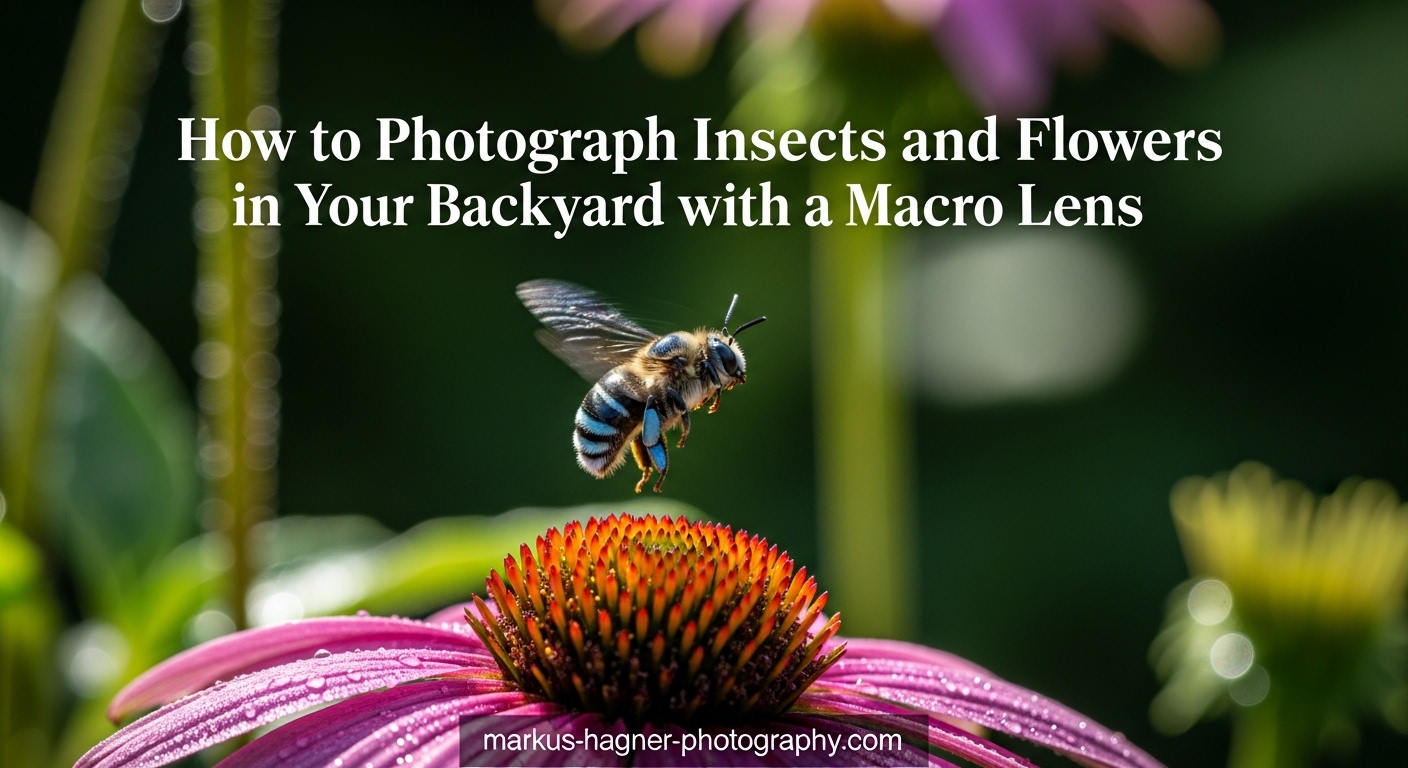
Your backyard holds an entire world most people never notice. From the iridescent wings of a bee to the delicate veins of a flower petal, macro photography reveals details invisible to the naked eye. Learning how to photograph insects and flowers in your backyard with a macro lens opens up this hidden universe right outside your door.
The single most important thing to understand about macro photography is depth of field. When you focus close with a macro lens, your depth of field becomes extremely shallow, sometimes just millimeters. You must place your focus precisely where you want sharpness, typically on the eyes of insects or the center of flowers.
In this guide, I will walk you through everything you need to start capturing stunning macro images in your own backyard. We will cover equipment choices, camera settings, techniques for approaching skittish insects, and how to set up your yard for the best results.
Essential Equipment for Backyard Macro Photography
You do not need expensive gear to start with macro photography, but the right equipment makes a significant difference. Here is what I recommend based on years of shooting in my own backyard.
Macro Lens Selection
A true macro lens provides 1:1 magnification, meaning your subject appears life-sized on your sensor. For backyard work, I strongly recommend a focal length between 90mm and 105mm. This gives you enough working distance to avoid disturbing insects while staying manageable for handheld shooting.
Shorter focal lengths like 50mm or 60mm macro lenses cost less but require you to get very close to your subject. This often scares away insects before you can frame your shot. Longer focal lengths like 150mm or 180mm offer more working distance but are heavier and harder to handhold steady.
If you are just starting and budget is tight, extension tubes behind a standard lens can provide macro-like magnification. They work well for flowers and slower-moving subjects, though the optical quality will not match a dedicated macro lens.
Tripods and Stabilization
A sturdy tripod helps tremendously for flower photography and stationary insects. Look for one that can get low to the ground since many backyard subjects live close to the soil. A center column that rotates horizontally is particularly useful for low-angle macro work.
For moving insects, a tripod often slows you down too much. Many experienced macro photographers shoot handheld for active subjects. If you go this route, image stabilization in your lens or camera body helps, but proper technique matters more.
Optional Accessories Worth Having
A remote shutter release eliminates camera shake from pressing the shutter button. For flowers on windy days, a simple plant clamp that holds the stem steady can save a shoot. A small diffuser softens harsh sunlight, reducing contrast and bringing out more detail in both insects and flowers.
Camera Settings for Sharp Macro Photos
Getting your settings right is crucial in macro photography. The margins for error are much smaller than in other genres because magnification amplifies every mistake.
Aperture for Depth of Field
Aperture is your primary tool for controlling depth of field in macro work. I typically shoot between f/8 and f/16 for insects and flowers. This range provides enough depth of field to keep your main subject sharp while still creating that beautiful background blur macro photography is known for.
Shooting wide open at f/2.8 or f/4 creates an extremely thin slice of focus, sometimes just the eyes of an insect will be sharp. While this can look artistic, it is often too shallow for most subjects. On the other end, f/22 or smaller apertures introduce diffraction that softens your entire image.
Here is a practical starting point: use f/11 as your default aperture. Adjust wider if you need more light or want less depth of field, and stop down to f/16 when you need more of your subject in focus.
Shutter Speed Considerations
Magnification amplifies camera shake, so you need faster shutter speeds than you might expect. A good rule of thumb is to use at least twice your focal length as your minimum shutter speed. With a 100mm macro lens, that means 1/200 second or faster.
For moving insects, you often need 1/500 second or faster to freeze motion. Bees in flight or butterflies landing on flowers require even higher speeds. If you cannot achieve these speeds with your aperture and ISO, consider using flash to freeze motion.
ISO and Noise Management
Keep your ISO as low as possible, ideally between 100 and 400. Macro subjects have fine details that noise can destroy. In bright daylight, ISO 100 or 200 works well. On overcast days or in shade, you may need to push to ISO 400 or 800.
Modern cameras handle higher ISOs better than ever, but in macro photography, every bit of detail matters. I would rather use a wider aperture or add light than crank up ISO beyond 800.
Focus Mode Recommendations
Autofocus struggles with macro subjects because depth of field is so shallow. Even the best AF systems often miss by a fraction, leaving your subject slightly soft. For this reason, most experienced macro photographers use manual focus.
If your camera has focus peaking, turn it on. This highlights in-focus areas in your viewfinder, making manual focus much easier. Another technique is to set your focus manually and then rock your body slightly forward and backward until the subject snaps into focus.
How to Photograph Insects in Your Backyard?
Insect photography requires a combination of technical skill and patience. The good news is that your backyard likely has more insect subjects than you realize.
Best Times of Day
Early morning is the golden time for insect macro photography. Insects are cold-blooded and become sluggish in cool temperatures. On a mild morning, you might find bees, butterflies, and other insects resting motionless on plants, warming up in the first rays of sun.
I have had the most success between 6 AM and 9 AM during warm months. The light is also beautiful at this hour, soft and directional. Late afternoon can work too, but insects are more active and harder to approach.
Overcast days are surprisingly good for macro photography. The diffused light eliminates harsh shadows, and insects seem less active in the cooler, dimmer conditions.
Approaching Insects Without Scaring Them
Movement scares insects more than anything else. When you spot a subject, approach slowly, moving in stages rather than one continuous motion. Take a step, pause for a few seconds, then take another step.
Shadows alarm insects even more than movement. Always be aware of where your shadow falls. If your shadow crosses the insect, it will likely fly or jump away before you can react. Position yourself so the sun is behind you, lighting your subject while keeping your shadow away.
Silence helps too. Some insects seem sensitive to vibrations, so walk softly and avoid crunching through dry leaves or twigs. Move like a predator stalking prey, slow and deliberate.
Dealing With Moving Subjects
Active insects present the biggest challenge in macro photography. For these subjects, I switch to continuous autofocus and burst mode. Fire off several frames as the insect moves, increasing your chances of getting one sharp shot.
Another strategy is to anticipate where insects will land. If you notice bees visiting the same flowers repeatedly, set up nearby and wait. Pre-focus on the flower, then fire when a bee lands. This technique works especially well for pollinators.
Understanding Insect Behavior
Spiders make excellent macro subjects because they rarely move. A spider in its web will usually stay put while you compose your shot. Ladybugs move slowly and are easy to follow. Butterflies are challenging but predictable, they often return to the same perches.
Learning about your backyard subjects pays dividends. Spend time watching before you start shooting. Notice which plants attract which insects, what times they are most active, and how they behave when approached.
Techniques for Flower Macro Photography
Flowers make wonderful macro subjects because they stay still, at least until the wind picks up. Here is how to create stunning flower close-ups in your backyard.
Composition Approaches
Get low and shoot at flower level rather than looking down. This perspective shows flowers as insects see them and creates more engaging images. Look for interesting angles, a single petal backlit by sun, the spiral pattern of a daisy center, or water droplets after rain.
The center of a flower often has the most visual interest. Focus on the stamens and pistils, which have intricate textures and patterns. For wider shots, use the rule of thirds and place your flower off-center for a more dynamic composition.
Dealing With Wind
Wind is the enemy of flower macro photography. Even a gentle breeze moves flowers enough to blur your shot at high magnification. Early morning is often calmer than afternoon, another reason to shoot at dawn.
If wind is unavoidable, try these techniques. First, use a faster shutter speed to freeze motion. Second, create a windbreak with your body or a reflector. Third, use a plant clamp to hold the flower steady. Fourth, embrace the motion and use a slower shutter for intentional blur, which can look artistic.
Background Selection
Your background can make or break a macro image. Look for clean, uncluttered backgrounds that separate your subject from distractions. Moving your camera just a few inches can completely change what appears behind your subject.
Darker backgrounds make flowers pop. Position yourself so distant foliage or shadow falls behind your subject. The shallow depth of field will render this as a smooth blur, creating natural contrast with your sharp subject.
Focus Techniques for Flowers
For single flowers, focus on the center or the most interesting part of the bloom. For multiple flowers, decide which one is your main subject and make sure that one is the sharpest element in the frame.
Focus stacking is an advanced technique that combines multiple images taken at slightly different focus points. This allows you to get an entire flower sharp from front to back, impossible with a single shot at macro magnifications. Many cameras now have focus stacking built in, or you can combine images in post-processing.
Setting Up Your Backyard for Macro Photography
With some planning, you can transform your backyard into a macro photography paradise. Here are strategies I have used to attract subjects and create better shooting opportunities.
Attracting Insects to Your Yard
Plant flowers that attract pollinators. Native plants work best because local insects have evolved with them. Even a small patch of flowering plants can draw in bees, butterflies, and other photogenic insects.
One trick I learned from other macro photographers is the sugar water method. Mix one part sugar with four parts water and spray it on flowers where you want to shoot. Bees and other pollinators will quickly find the sweet spots and return repeatedly. This gives you predictable subjects and lets you set up your shot in advance.
Creating Perching Spots
Butterflies and dragonflies like to perch on prominent spots where they can survey their territory. Place sticks or plant stakes in sunny locations at various heights. These become natural landing spots where you can pre-focus and wait.
Flat rocks in sunny spots attract butterflies that like to bask. A small dish of wet sand or mud draws butterflies that gather minerals, an activity called puddling.
Best Locations in Your Yard
Look for areas with good light and interesting backgrounds. A flower bed against a fence or hedge usually provides better backgrounds than flowers in open lawn. The edge of a garden, where cultivated plants meet wilder growth, often has the most insect diversity.
South-facing spots get more sun and attract more insects throughout the day. However, they can also have harsh light. East-facing areas get gentle morning light, perfect for those prime early morning hours.
Seasonal Considerations
Spring brings early blooms and emerging insects. Look for spring bulbs, early wildflowers, and the first bees and butterflies of the year. Summer is peak season with the most insect activity and flowers in full bloom.
Fall offers late-season subjects like asters, goldenrod, and migrating butterflies. Even winter has opportunities, frost patterns on dead leaves, dried seed heads, and overwintering insects hiding in plant debris.
Common Mistakes to Avoid in Macro Photography
After years of macro photography, I have made every mistake possible. Here are the most common ones and how to avoid them.
Rushing the Approach
Patience is the most important skill in macro photography, especially with insects. Rushing toward a subject almost always results in it flying or jumping away. Move slowly, pause frequently, and accept that some subjects will escape no matter how careful you are.
Choosing the Wrong Aperture
Many beginners shoot wide open for maximum background blur, then wonder why their subject is not sharp. At macro distances, f/2.8 gives you almost no depth of field. Start at f/11 and adjust from there based on your subject and creative goals.
Ignoring the Background
It is easy to focus entirely on your subject and forget about everything else in the frame. Bright spots, sticks, or other distractions in the background ruin otherwise good macro photos. Always check your background before pressing the shutter.
Camera Shake Issues
Magnification magnifies camera shake along with your subject. Even small movements blur your image. Use faster shutter speeds than you think you need, brace yourself against something solid, and practice proper handholding technique.
Frequently Asked Questions
What macro lens is best for flowers and bugs?
A 90mm to 105mm macro lens is ideal for backyard insect and flower photography. This focal length gives you enough working distance to avoid disturbing insects while remaining manageable for handheld shooting. Look for a lens with 1:1 magnification capability and image stabilization if your budget allows.
How do I photograph insects without scaring them away?
Move extremely slowly, pausing frequently rather than approaching in one continuous motion. Always be aware of your shadow, never let it cross your subject. Early morning is best because insects are sluggish in cool temperatures. Position yourself so the sun lights your subject while your shadow stays behind you.
What aperture should I use for macro photography?
Start with f/11 as your default aperture for macro photography. This provides enough depth of field to keep your main subject sharp while maintaining pleasing background blur. Use f/8 if you need more light or want less depth of field, and f/16 when you need more of your subject in focus. Avoid f/22 or smaller as diffraction softens your image.
Do I need a flash for backyard macro photography?
Flash is not required but is extremely helpful for macro photography. It provides the light needed to use smaller apertures and faster shutter speeds simultaneously. Flash also freezes motion, which is crucial for moving insects. Many macro photographers use a diffused speedlight on a bracket for natural-looking results.
Conclusion
Learning how to photograph insects and flowers in your backyard with a macro lens takes patience and practice, but the rewards are incredible. You already have everything you need right outside your door: fascinating subjects, beautiful light, and endless opportunities to improve your skills.
Start with the basics: a suitable macro lens, proper camera settings around f/11 and 1/200 second or faster, and the patience to approach slowly. Shoot early in the morning when light is soft and insects are calm. Set up your backyard to attract subjects, and do not be discouraged when shots do not work out.
Every experienced macro photographer has thousands of missed shots for every keeper. The key is to keep practicing, keep learning about your subjects, and keep exploring the tiny world in your own backyard.