
Have you ever looked at a photo and noticed that straight lines appear curved? That building edge that should be perfectly vertical looks like it is bowing outward. Or the horizon seems to pinch inward at the center. This is lens distortion, one of the most common optical characteristics you will encounter in photography.
Lens distortion affects almost every image you capture to some degree. Understanding what causes it and how to work with it transforms frustration into creative control. Whether you shoot architecture, portraits, or landscapes, knowing the difference between barrel and pincushion distortion helps you choose the right lens and correct problems when they arise.
In this guide, I will explain exactly what lens distortion is, break down the key differences between barrel and pincushion distortion, show you which lenses are most affected, and share practical methods for correction in 2026. I will also explore when you might want to embrace distortion rather than fight it.
What Is Lens Distortion?
Lens distortion is an optical aberration that causes straight lines in your scene to appear curved in the final image. It occurs when a lens design produces different magnification levels across the image field. The center of the frame may magnify subjects at one rate while the edges magnify at a different rate, causing geometric inaccuracies.
This is not the same as perspective distortion, which happens when you position your camera too close to a subject or tilt it upward. Perspective distortion relates to camera position and angle. Optical lens distortion is purely a characteristic of the lens itself, independent of how you hold or position your camera.
Think of it this way. A theoretically perfect rectilinear lens would render all straight lines as perfectly straight from edge to edge. Real lenses rarely achieve this ideal. Most introduce some degree of curvilinear distortion where those straight lines bend either outward or inward depending on the optical design.
How Lens Distortion Works at the Optical Level
Distortion occurs in the radial dimension from the optical axis. The optical axis is an imaginary line running through the center of the lens. Light rays passing through the center of the lens follow a relatively straight path. Rays passing through the outer elements of the lens may bend at slightly different angles.
When the magnification varies with the distance from the optical axis, you get distortion. If magnification decreases as you move away from the center, straight lines bow outward. This is barrel distortion. If magnification increases toward the edges, straight lines bow inward. This is pincushion distortion.
The amount of distortion typically correlates with focal length and lens design complexity. Simpler lens designs and more extreme focal lengths tend to show stronger distortion characteristics. High-quality lenses with more elements and sophisticated optical designs can minimize but rarely eliminate distortion entirely.
Why Understanding Distortion Matters for Photographers
For architectural photographers, lens distortion can make buildings look like they are warping. Interior photographers struggle when door frames and walls appear curved instead of straight. Product photographers need accurate geometry for catalog and commercial work.
Even portrait photographers deal with distortion effects. Wide-angle lenses at the edges of the frame can stretch facial features unnaturally. Understanding how your lenses behave helps you make better decisions about composition and lens selection.
The good news is that distortion is highly correctable in modern post-processing software. Lightroom, Photoshop, and other editors include lens profiles that can automatically straighten those curved lines. Understanding what you are seeing helps you know when correction is necessary and when you might want to leave it alone.
Understanding Barrel Distortion
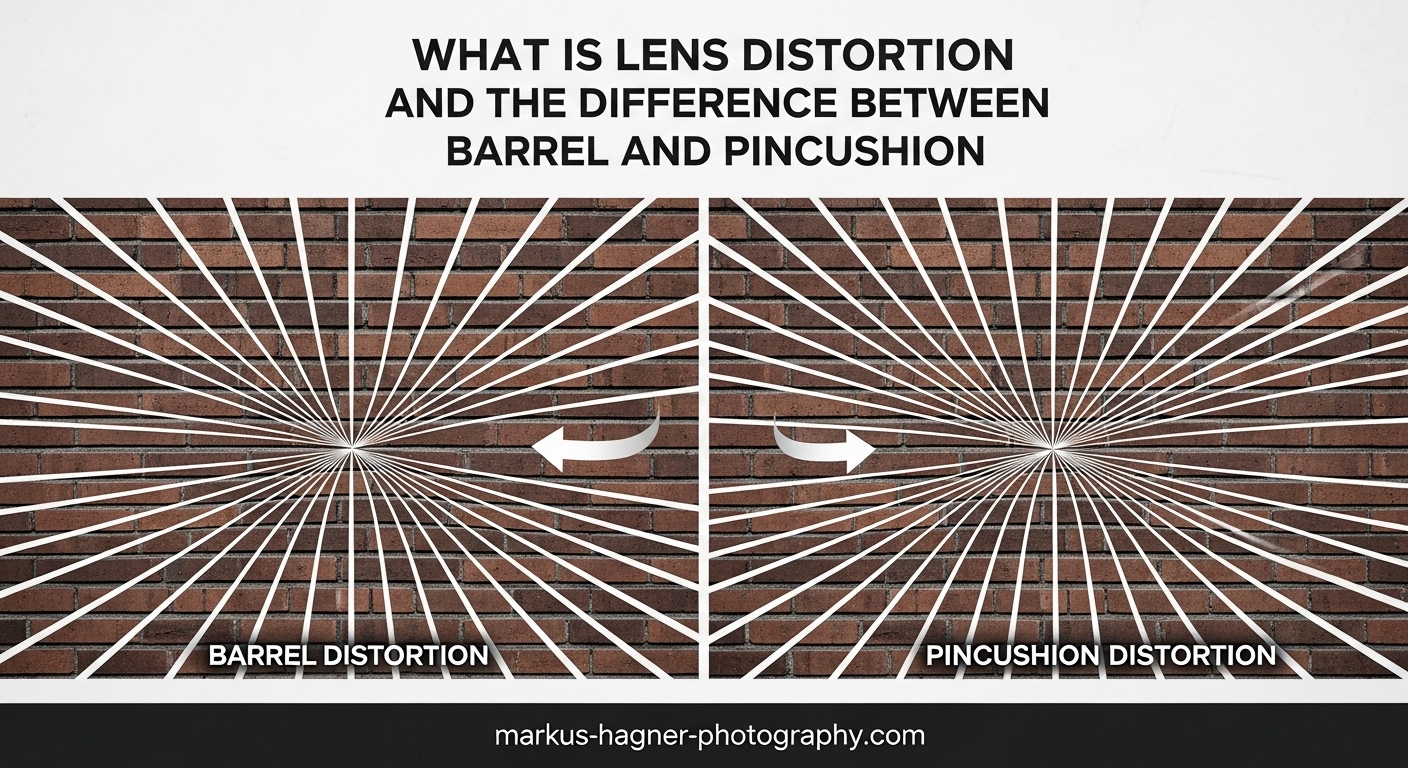
Barrel distortion occurs when straight lines in your image bow outward, creating a visual effect that resembles the rounded bulge of a wooden barrel. Lines that should be straight curve away from the center of the frame. The edges of your photo appear to stretch outward while the center remains relatively normal.
This type of distortion creates what photographers sometimes call the fisheye effect, though true fisheye lenses take this to an extreme. With barrel distortion, a square building might look slightly rounded at the edges. A straight horizon line curves upward at both ends. Grid patterns appear to bulge outward from the middle.
Which Lenses Produce Barrel Distortion
Barrel distortion is most common in wide-angle lenses. Any lens with a focal length wider than about 35mm on a full-frame sensor typically shows some degree of barrel distortion. The wider you go, the more pronounced the effect becomes.
Zoom lenses often exhibit barrel distortion at their widest focal length setting. A 24-70mm zoom might show noticeable barrel distortion at 24mm but transition toward neutral or even pincushion distortion as you zoom toward 70mm. This is why you often see photographers zoom in slightly when shooting architecture with a zoom lens.
Prime wide-angle lenses vary in their distortion characteristics based on optical design. Some modern wide primes from major manufacturers control barrel distortion exceptionally well through complex optical designs. Older designs and budget lenses typically show stronger barrel distortion that requires correction.
Real-World Examples of Barrel Distortion
Imagine photographing a tall building from street level with a 16mm wide-angle lens. The vertical lines of the building should remain parallel and straight. Instead, they curve outward as they rise, making the structure appear to bulge. This is barrel distortion in action.
Group photos shot with wide-angle lenses show another common example. People positioned at the edges of the frame may appear slightly stretched or distorted compared to those in the center. Their faces can look wider, bodies elongated. The effect becomes more pronounced the closer you are to your subjects.
Interior shots often reveal barrel distortion clearly. Straight door frames, window frames, and ceiling lines that should be perfectly linear curve outward. A rectangular room can look like it is bulging at the walls. For real estate photographers, this creates a constant battle for accuracy.
What Causes Barrel Distortion
Barrel distortion results from decreased magnification at the edges of the image field compared to the center. Light rays passing through the outer portions of the lens get bent at angles that reduce their effective magnification. The result is an image that appears to balloon outward.
Wide-angle lens designs face inherent challenges in projecting their broad field of view onto a flat sensor. The light from the edges of the scene arrives at more extreme angles. Designers must make optical compromises that often result in some degree of barrel distortion.
Lens elements near the aperture can also contribute to barrel distortion depending on their shape and positioning. Retrofocus designs used for wide-angle lenses on SLR and mirrorless cameras introduce additional complexity that can increase distortion compared to simpler symmetric designs.
Understanding Pincushion Distortion
Pincushion distortion is the opposite of barrel distortion. Straight lines bow inward toward the center of the frame rather than outward. The visual effect resembles what happens when you press your finger into a pincushion. The edges pinch together while the center bulges slightly forward.
With pincushion distortion, a square object appears slightly pinched at the center. The top and bottom edges curve inward. The left and right edges also curve inward. A grid pattern looks like it is being squeezed from the corners toward the middle.
This type of distortion is generally less visually distracting than barrel distortion at moderate levels. However, it can still cause problems for architectural and product photography where geometric accuracy matters. Straight lines must remain straight regardless of their position in the frame.
Which Lenses Produce Pincushion Distortion
Pincushion distortion typically appears in telephoto lenses and longer focal lengths. Lenses above 85mm on a full-frame sensor commonly show some degree of pincushion distortion. The longer the focal length, the more likely you are to see this inward curving effect.
Zoom lenses often exhibit pincushion distortion at their longest focal length. That same 24-70mm zoom that showed barrel distortion at 24mm might show mild pincushion distortion at 70mm. The distortion characteristics shift as you move through the focal range.
Telephoto prime lenses vary in their distortion characteristics based on design priorities. Portrait lenses like 85mm and 135mm primes from major manufacturers often control pincushion distortion well. Budget telephoto lenses and older designs typically show more pronounced inward curving.
Real-World Examples of Pincushion Distortion
Consider photographing a rectangular painting or artwork with a 200mm telephoto lens. The frame should appear as a perfect rectangle. With pincushion distortion, the sides curve slightly inward, making the rectangle look pinched. For art documentation, this creates accuracy problems.
Portrait photographers shooting with telephoto lenses may notice pincushion distortion affecting background elements. Straight lines in the background like door frames or horizon lines can appear to curve inward. While subtle, this can affect the overall feel of an image.
Wildlife photographers using long telephoto lenses sometimes encounter pincushion distortion when photographing subjects with linear elements. A bird perched on a straight branch might show the branch curving slightly inward. Background elements like tree trunks can exhibit similar pinching.
What Causes Pincushion Distortion
Pincushion distortion results from increased magnification at the edges of the image field compared to the center. Light rays passing through the outer portions of the lens get bent at angles that increase their effective magnification. The image appears to pinch inward toward the center.
Telephoto lens designs inherently compress perspective and project distant subjects onto the sensor. The optical designs that achieve this compression can introduce pincushion distortion as a side effect. The longer the focal length, the more challenging it becomes to maintain uniform magnification across the frame.
Some lens designs intentionally trade slight pincushion distortion for other optical improvements. A designer might accept mild inward curving to improve corner sharpness or reduce other aberrations. Understanding these design tradeoffs helps explain why different lenses exhibit different distortion characteristics.
Key Differences Between Barrel and Pincushion Distortion
The fundamental difference between barrel and pincushion distortion comes down to the direction of the curve. Barrel distortion curves outward, away from the optical axis. Pincushion distortion curves inward, toward the optical axis. One expands the edges, the other contracts them.
You can quickly identify which type of distortion you are seeing by examining straight lines near the edges of your frame. If they bow outward like a smile or a barrel shape, you have barrel distortion. If they bow inward like a frown or a pinched cushion, you have pincushion distortion.
Visual Pattern Comparison
With barrel distortion, imagine drawing a square on your image. The sides of that square would bulge outward. The corners would spread wider than a true right angle. The center would appear compressed relative to the edges.
With pincushion distortion, that same square would pinch inward at the sides. The corners would pull closer together. The center would appear expanded relative to the edges. The overall shape resembles a concave pillow.
Both types of distortion are radial, meaning they occur symmetrically around the optical axis. The center of your frame typically shows the least distortion. The corners show the most. This radial pattern helps distinguish optical distortion from perspective effects.
Focal Length Relationship
The relationship between focal length and distortion type follows a predictable pattern. Wide-angle lenses with short focal lengths tend toward barrel distortion. Normal focal lengths around 50mm tend to show minimal distortion. Telephoto lenses with long focal lengths tend toward pincushion distortion.
Zoom lenses demonstrate this relationship clearly. At their widest setting, most zooms show barrel distortion. As you zoom toward the middle of their range, distortion typically decreases and may pass through a neutral point. At the telephoto end, pincushion distortion often appears.
Some zoom lenses are designed with a specific focal length where distortion is minimized. A 24-70mm lens might be optimized for minimal distortion around 35mm or 50mm. Shooting at this sweet spot gives you the most geometrically accurate results.
Lens Type Comparison
Wide-angle primes show barrel distortion to varying degrees based on their optical design and price point. Premium wide primes from Canon, Nikon, Sony, and Sigma often control barrel distortion exceptionally well. Budget wide primes typically show stronger barrel distortion.
Standard primes around 50mm generally exhibit minimal distortion. These lenses approximate human vision and can achieve nearly rectilinear rendering. They are excellent choices when geometric accuracy is critical.
Telephoto primes show pincushion distortion at longer focal lengths. 135mm and 200mm primes may show mild inward curving. Super telephoto lenses like 400mm and 600mm primes can exhibit more pronounced pincushion distortion without correction.
Zoom lenses cover both distortion types depending on focal length setting. A typical standard zoom like 24-70mm or 24-105mm might show barrel distortion at 24mm, minimal distortion around 50mm, and mild pincushion at 70mm or 105mm.
Quick Identification Guide
Here is a simple method to identify distortion type in your images. Find a straight line in your photo that extends from edge to edge. Building edges, horizons, and door frames work well. Look at how that line curves.
If the line curves outward like the edge of a barrel, you have barrel distortion. This is most common in wide-angle shots. If the line curves inward like the shape of a pincushion, you have pincushion distortion. This is most common in telephoto shots.
If the line shows an S-curve pattern, curving outward at some points and inward at others, you may have mustache distortion. This complex distortion type is less common but occurs in some lens designs.
Other Types of Lens Distortion
While barrel and pincushion distortion are the two primary types, photographers should be aware of other distortion variations that can appear in their images. These additional types are less common but understanding them helps you diagnose what you are seeing in your photos.
Mustache Distortion (Wavy Distortion)
Mustache distortion, also called wavy distortion or complex distortion, combines characteristics of both barrel and pincushion distortion. Straight lines show an S-curve pattern rather than a simple outward or inward bow. The line might curve outward near the center but then curve inward as it approaches the corners.
This distortion type gets its name because the pattern resembles the shape of a mustache. It is more difficult to correct than simple barrel or pincushion distortion because standard correction profiles may not fully address the complex curving pattern.
Some zoom lenses exhibit mustache distortion at specific focal lengths. The distortion characteristics may shift from barrel to pincushion within the same focal length, creating the wavy pattern. Budget wide-angle lenses are the most common culprits.
Anamorphic Distortion
Anamorphic lenses introduce a unique distortion characteristic related to their squeeze ratio. These specialty lenses squeeze a wide field of view onto a standard sensor, then the image is stretched during post-processing or projection. The distortion patterns differ from spherical lenses.
Anamorphic lenses can show barrel or pincushion distortion like spherical lenses. However, the distortion may behave differently in the horizontal and vertical dimensions. This creates distinctive optical characteristics that cinematographers often prize for their unique visual feel.
Photographers rarely use anamorphic lenses, but understanding their distortion characteristics is valuable if you work in hybrid photo-video roles or are interested in the anamorphic look for creative projects.
Field Curvature
Field curvature is related to distortion but is technically a different optical phenomenon. Instead of straight lines curving, the plane of focus curves. The center of the image may be in focus at a different distance than the edges. This can create the impression of distortion in out-of-focus areas.
Wide-angle lenses often exhibit some field curvature. When you focus on a subject in the center, the edges may be slightly soft because they are actually at a different focal plane. Stopping down the aperture helps by increasing depth of field across the curved plane.
When to Embrace Distortion Creatively?
Most discussions of lens distortion focus on how to fix it. But distortion is not always a problem to solve. Sometimes it is a creative tool to use. Understanding when to embrace distortion opens up artistic possibilities that technically perfect lenses cannot provide.
Artistic Applications of Barrel Distortion
Barrel distortion can add energy and dynamism to environmental portraits. The slight outward curving at the edges creates a sense of expansion and presence. Subjects appear larger than life, surrounded by an environment that seems to embrace them.
Action and sports photographers sometimes use wide-angle barrel distortion intentionally. A skater shot with a 16mm lens has more impact when the curved lines emphasize movement and energy. The distortion becomes part of the visual language of the image.
Music photographers embrace wide-angle distortion for live performance shots. The exaggerated perspective and curved lines capture the energy and chaos of concerts. The distortion communicates excitement in a way that a corrected image cannot.
When Distortion Adds Character
Some photographers specifically seek out vintage lenses precisely because of their optical imperfections. The distortion characteristics of older lens designs create images with distinctive character. Technically perfect but clinically sterile is not always the goal.
Street photographers often appreciate the unique rendering of specific lenses, distortion included. The way a particular lens renders lines becomes part of the photographer’s signature style. Consistency in lens choice creates visual coherence across a body of work.
Fine art photographers may use distortion as a compositional element. Curved lines can guide the eye, create tension, or suggest emotions that straight lines cannot. The conscious choice to use distortion transforms a technical characteristic into an expressive tool.
Genre-Specific Creative Uses
In landscape photography, barrel distortion at the edges can emphasize the vastness of a scene. The curved horizon line might suggest the curve of the earth. While technically inaccurate, the effect can be emotionally powerful.
Wedding photographers sometimes use wide-angle distortion for reception and dance floor shots. The energy and movement of the event are captured more effectively when the lens adds its own dynamic character. Perfectly corrected images might feel too formal for the occasion.
Travel photography often benefits from the character of distortion. Environmental portraits in exotic locations gain impact when the surrounding architecture curves and bends. The distortion places viewers inside the experience rather than observing from a distance.
How to Correct Lens Distortion?
When distortion is not serving your creative vision, modern software makes correction straightforward. The key is knowing what tools are available and when to use them. Most corrections happen in post-processing, though some cameras offer in-camera correction as well.
Lightroom and Adobe Camera Raw
Adobe Lightroom and Camera Raw include built-in lens profiles for thousands of popular lenses. When you enable lens profile corrections, the software automatically applies the appropriate distortion correction for your specific lens model.
To enable lens profile corrections in Lightroom, navigate to the Develop module and open the Lens Corrections panel. Check the Enable Profile Corrections box. Lightroom will attempt to identify your lens from the metadata and apply the matching profile.
If Lightroom does not recognize your lens automatically, you can manually select the make and model from the dropdown menus. The correction will remove barrel or pincushion distortion based on the lens profile data.
Manual Distortion Correction
When lens profiles are not available or do not produce perfect results, manual correction gives you precise control. In Lightroom, the Manual tab in Lens Corrections includes a Distortion slider. Drag left to correct barrel distortion or right to correct pincushion distortion.
The key to manual correction is having a reference line in your image. Find something that should be straight and adjust the slider until it appears correctly. Zoom in to check the edges of your frame where distortion is most visible.
Photoshop offers similar manual controls through the Lens Correction filter. Filter then Lens Correction opens a dialog with distortion controls plus a grid overlay to help you align straight lines. The grid makes it easier to judge when correction is complete.
When Correction Is Necessary
Architectural and interior photography almost always require distortion correction. Clients expect straight lines and accurate geometry. The amount of correction needed depends on your lens and how critical geometric accuracy is for the final use.
Product photography similarly demands geometric accuracy for catalog and commercial work. Distorted products look unprofessional and can misrepresent actual dimensions. Lens correction is standard practice in commercial product workflows.
Portrait photography typically needs less aggressive correction. Slight distortion is often invisible when straight lines are not prominent in the frame. However, group shots with people at the edges may benefit from correction to avoid unflattering stretching.
Correction Trade-offs to Consider
Lens correction is not free of consequences. When you correct distortion, the software stretches and compresses different areas of your image to straighten lines. This can reduce sharpness slightly at the edges and corners where the most correction is applied.
Correction also changes the effective field of view. A corrected wide-angle image has slightly less coverage at the edges than the uncorrected version. You lose some of what the lens actually captured. For most purposes this is acceptable, but it is worth understanding.
In-camera JPEG corrections apply the same profiles automatically. Shooting raw gives you the option to adjust or disable correction. Shooting JPEG with correction baked in gives you less flexibility but streamlines your workflow.
Frequently Asked Questions
What is barrel and pincushion distortion?
Barrel distortion causes straight lines to bow outward like a barrel shape and typically occurs in wide-angle lenses. Pincushion distortion causes straight lines to bow inward toward the center and typically occurs in telephoto lenses. Both are optical aberrations resulting from uneven magnification across the image field.
Is pincushion distortion the opposite of barrel distortion?
Yes, pincushion distortion is the opposite of barrel distortion. Barrel distortion curves lines outward while pincushion distortion curves lines inward. They result from opposite magnification patterns at the edges of the image field compared to the center.
What are the four types of distortion?
The four main types of lens distortion are barrel distortion (outward curving), pincushion distortion (inward curving), mustache distortion (complex S-curve pattern combining both), and perspective distortion (caused by camera position rather than lens optics).
What are the two types of lens distortion?
The two primary types of optical lens distortion are barrel distortion and pincushion distortion. Barrel distortion makes straight lines curve outward and occurs mainly in wide-angle lenses. Pincushion distortion makes straight lines curve inward and occurs mainly in telephoto lenses.
What causes barrel distortion?
Barrel distortion is caused by decreased magnification at the edges of the image compared to the center. This occurs when light rays passing through the outer elements of a lens bend at angles that reduce their effective magnification. Wide-angle lens designs are most susceptible to this optical characteristic.
Conclusion
Lens distortion is an inherent characteristic of optical design that affects nearly every photograph you take. Barrel distortion curves lines outward and appears most often in wide-angle lenses. Pincushion distortion curves lines inward and appears most often in telephoto lenses. Understanding these two types helps you identify what you are seeing and decide whether correction is needed.
The key is knowing when distortion matters and when it does not. For architecture, products, and commercial work, correction is usually essential. For portraits, street photography, and creative projects, distortion can be a feature rather than a flaw. Modern software makes correction easy when you need it, but do not assume every image requires it.
My advice is to test your lenses and learn their distortion characteristics. Shoot a grid or building with straight lines at different focal lengths. See where your lenses exhibit barrel and pincushion distortion. This knowledge helps you make informed decisions about lens selection and correction in your 2026 photography workflow.