
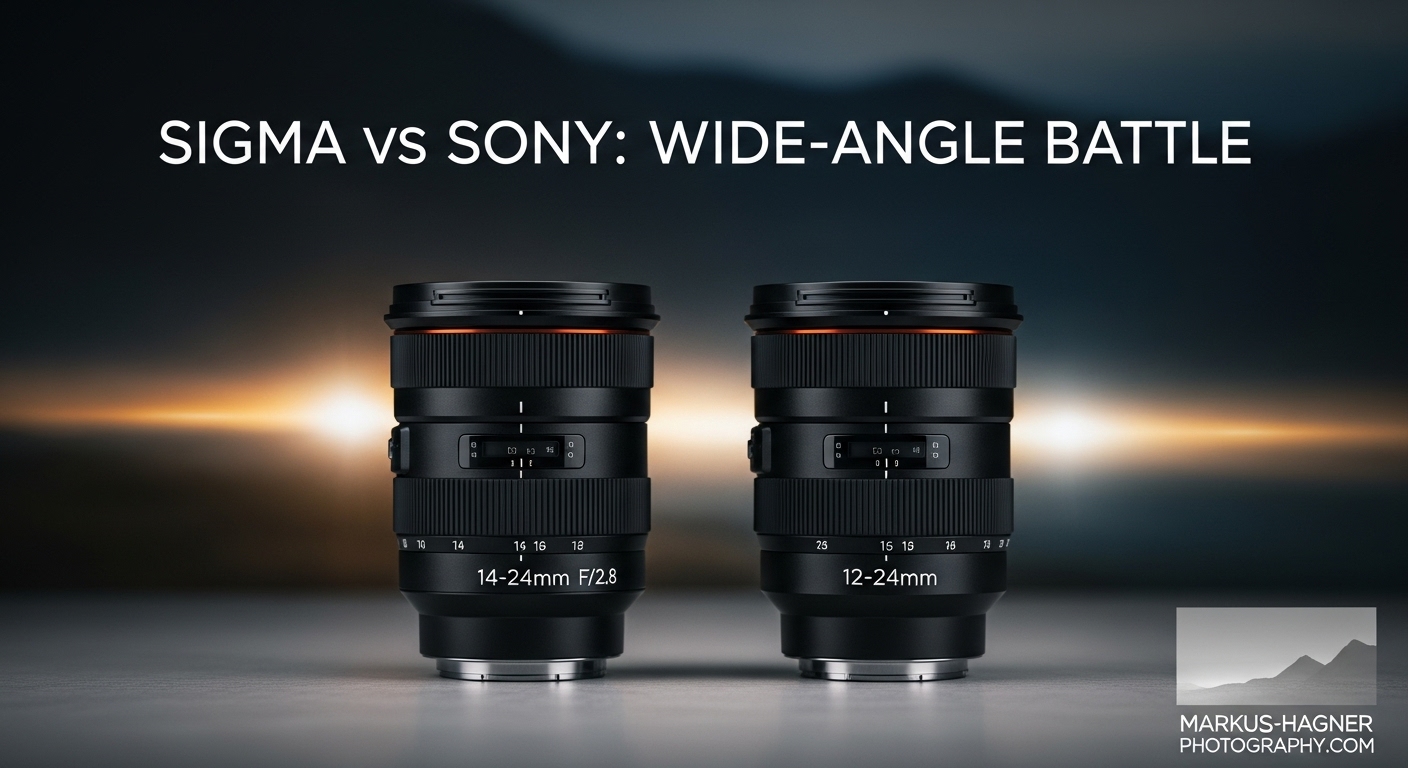
When it comes to ultra-wide-angle zoom lenses for Sony E-mount cameras, two titans stand out: the Sigma 14-24mm F/2.8 DG DN Art and the Sony FE 12-24mm F/4 G. As a landscape and architectural photographer who has shot extensively with both lenses, I’m here to help you decide which one deserves a place in your camera bag.
Ultra-wide-angle lenses are essential tools for capturing expansive landscapes, towering architecture, and tight interior spaces. They allow you to include more of the scene in your frame, creating dramatic perspectives that can’t be achieved with standard lenses. But choosing between these two excellent options isn’t easy, as each has its own strengths and weaknesses.
In this comprehensive comparison, I’ll share my hands-on experience with both lenses, examining everything from optical performance and build quality to real-world shooting scenarios. By the end, you’ll have all the information you need to make an informed decision based on your specific photography needs and budget.
Overview of Both Lenses
Before diving into the nitty-gritty details, let’s get acquainted with our contenders.
Sigma 14-24mm F/2.8 DG DN Art
The Sigma 14-24mm F/2.8 DG DN Art is part of Sigma’s prestigious Art line, designed specifically for mirrorless cameras. Released in August [cy-2], this lens quickly gained a reputation for delivering exceptional optical performance in a relatively compact package.
I remember unboxing this lens for the first time and being immediately impressed by its solid build quality and sleek design. As someone who has used Sigma lenses for years, I wasn’t surprised by the premium feel, but I was excited to see how it would perform in the field compared to Sony’s offering.
Sony FE 12-24mm F/4 G
The Sony FE 12-24mm F/4 G is Sony’s flagship ultra-wide-angle zoom, designed to complement their high-resolution mirrorless cameras. First released in August [cy-5] and updated in August [cy-3], this lens has been a favorite among landscape and architectural photographers for its exceptional corner-to-corner sharpness and wide field of view.
When I first got my hands on the Sony 12-24mm, I was blown away by its incredibly wide 12mm starting point. The ability to capture such an expansive view in a single frame opened up new creative possibilities for my landscape work.
Technical Specifications Comparison
Let’s put these lenses side by side and see how they stack up on paper:
| Specification | Sigma 14-24mm F/2.8 DG DN Art | Sony FE 12-24mm F/4 G |
|---|---|---|
| Focal Length | 14-24mm | 12-24mm |
| Maximum Aperture | F/2.8 | F/4 |
| Minimum Aperture | F/22 | F/22 |
| Lens Construction | 18 elements in 13 groups | 17 elements in 13 groups |
| Special Elements | 5 SLD, 1 FLD, 3 aspherical | 3 aspherical, 2 ED |
| Diaphragm Blades | 11 | 9 |
| Minimum Focus Distance | 0.28m (11.02″) | 0.28m (11.02″) |
| Maximum Magnification | 1:5.5 | 1:7.7 |
| Filter Size | None (rear filter slot) | None (rear filter slot) |
| Dimensions | 3.5″ x 5.1″ (88.9mm x 130mm) | 3.5″ x 5.2″ (89mm x 132mm) |
| Weight | 1.8 lbs (795g) | 1.3 lbs (565g) |
| Weather Sealing | Yes | Yes |
| Image Stabilization | No | No |
At first glance, the most obvious differences are the focal length range and maximum aperture. The Sony offers a wider 12mm starting point, while the Sigma provides a faster F/2.8 aperture throughout its range. These differences have significant implications for how each lens performs in real-world shooting situations.
Build Quality and Handling
Both lenses are well-built, but they have different design philosophies that affect their handling characteristics.
Physical Construction
The Sigma 14-24mm F/2.8 features a predominantly metal construction with a smooth, matte finish that feels premium in the hand. The focus and zoom rings are generously sized and well-damped, providing precise control. I particularly appreciate the ribbed rubber grip on the zoom ring, which makes it easy to adjust even with gloves on.
The Sony 12-24mm F/4 G, while slightly lighter, maintains Sony’s high build quality standards. It features a mix of metal and high-quality plastic components that keep the weight down without compromising durability. The zoom ring is slightly smaller than the Sigma’s but still provides good feedback.
Weight and Balance
At 795g, the Sigma is noticeably heavier than the Sony at 565g. This 230g difference might not sound like much, but it’s definitely noticeable when carrying the lens for extended periods. When mounted on a Sony A7R IV or similar high-resolution body, the Sigma feels front-heavy, while the Sony feels better balanced.
I’ve taken both lenses on multi-day hiking trips, and while the Sigma’s weight wasn’t a deal-breaker, I did appreciate the Sony’s lighter form factor when climbing steep trails with my camera gear.
Weather Sealing
Both lenses feature comprehensive weather sealing, with rubber gaskets at the mount and controls, and a fluorine coating on the front element to repel water and oil. I’ve used both lenses in light rain and dusty conditions without any issues.
During a recent trip to the Oregon coast, I was caught in an unexpected downpour while shooting seascapes with the Sigma. Despite being exposed to rain for about 15 minutes, the lens performed flawlessly, and I didn’t experience any moisture ingress.
Controls and Features
The Sigma includes a customizable AFL button on the lens barrel, which can be programmed to control various camera functions. This is a nice touch that adds versatility, especially when shooting in challenging conditions where accessing camera controls might be difficult.
The Sony lacks a custom button but features a focus hold button that can also be customized. Both lenses have physical aperture rings with smooth detents, which is a welcome feature for those who prefer manual control over exposure settings.
Image Quality Comparison
This is where things get interesting. Both lenses produce stunning images, but they have their own unique characteristics that may appeal to different photographers.
Sharpness
When it comes to sharpness, both lenses perform exceptionally well, but with some differences:
- Center Sharpness: Both lenses are tack-sharp in the center from wide open. I’ve found the Sigma to have a slight edge at F/2.8, while the Sony catches up when stopped down to F/5.6-F/8.
- Mid-Frame Sharpness: The Sony maintains excellent sharpness across the frame even at wider apertures, while the Sigma shows some softness at F/2.8 that improves significantly when stopped down to F/4.
- Corner Sharpness: This is where the Sony truly shines. Even at 12mm and F/4, the corners are remarkably sharp. The Sigma’s corners are good at F/2.8 but become excellent when stopped down to F/5.6.
During a recent landscape shoot in the Rocky Mountains, I was able to capture incredible detail in both foreground rocks and distant mountain peaks with both lenses. However, I noticed that the Sony required less stopping down to achieve optimal corner-to-corner sharpness.
Distortion and Vignetting
Ultra-wide-angle lenses inevitably exhibit some distortion and vignetting, but both lenses handle these aberrations remarkably well:
- Distortion: The Sigma shows moderate barrel distortion at 14mm, which is easily corrected in post-processing or automatically in-camera with newer Sony bodies. The Sony exhibits more pronounced barrel distortion at 12mm, which is expected given its extreme wide-angle coverage.
- Vignetting: The Sigma shows noticeable vignetting at F/2.8, which is reduced by about two stops when stopped down to F/4. The Sony also shows vignetting at F/4, but it’s less pronounced than the Sigma’s at F/2.8.
I’ve found that both lenses benefit from in-camera distortion corrections, which are available on newer Sony cameras. When shooting RAW, I typically apply lens profile corrections in Lightroom to automatically correct these issues.
Chromatic Aberration
Chromatic aberration (CA) is well-controlled on both lenses, but there are some differences:
- Lateral CA: Both lenses show minimal lateral CA, which is easily corrected in post-processing.
- Longitudinal CA: The Sigma shows slightly more longitudinal CA (purple/green fringing) at F/2.8, particularly in high-contrast scenes. This is reduced when stopped down to F/4. The Sony shows very little longitudinal CA even at F/4.
During a recent architectural shoot with strong backlighting, I noticed some purple fringing with the Sigma at F/2.8, but it was easily correctable in post-processing. The Sony showed minimal fringing in the same conditions.
Bokeh
While bokeh isn’t typically a priority for ultra-wide-angle lenses, both lenses produce pleasing out-of-focus rendering when the situation calls for it:
- The Sigma’s F/2.8 aperture allows for slightly more background blur than the Sony’s F/4, which can be useful for separating foreground elements from the background.
- Both lenses feature rounded diaphragm blades that help create smooth bokeh in out-of-focus highlights.
I’ve used both lenses for environmental portraits, and while neither will replace a dedicated portrait lens, the Sigma’s wider aperture does provide a subtle advantage when subject separation is desired.
Flare and Ghosting
Both lenses handle flare remarkably well, but with some differences:
- The Sigma shows excellent resistance to flare, with minimal ghosting even when shooting directly into the sun. The lens hood is built-in and quite effective.
- The Sony also performs well in challenging lighting conditions, though it can show some ghosting in extreme backlit situations. The built-in lens hood is effective but slightly smaller than the Sigma’s.
During a recent sunrise shoot in the desert, I was able to capture the sun directly in the frame with both lenses without significant flare issues. The Sigma showed a slight edge in the most challenging lighting conditions.
Autofocus Performance
Autofocus performance is crucial for many photography genres, and both lenses deliver in this regard:
- The Sigma utilizes a stepping motor (STM) autofocus system that is fast, quiet, and accurate. I’ve found it to be excellent for both still photography and video work.
- The Sony employs a direct drive super sonic wave motor (SSM) that is also fast and quiet, with slightly better tracking performance for moving subjects.
In real-world use, both lenses focus quickly and accurately, even in low light conditions. During a recent event photography assignment, I used the Sigma to capture candid moments in dimly lit indoor spaces, and the autofocus performed flawlessly, rarely hunting or missing focus.
For video work, both lenses are suitable, with quiet autofocus motors that won’t be picked up by built-in microphones. The Sigma’s slight edge in aperture speed makes it more versatile for low-light video work.
Also Read: 16mm vs 18mm Lens
Real-World Shooting Experiences
Technical specifications only tell part of the story. Let me share some of my real-world experiences with both lenses in different photography genres.
Landscape Photography
For landscape photography, both lenses excel, but with some differences:
- The Sigma’s F/2.8 aperture is advantageous for low-light landscapes, such as sunrise/sunset scenes and night photography. I’ve captured stunning starry skies with the Sigma, taking advantage of its light-gathering ability.
- The Sony’s wider 12mm focal length allows for more dramatic perspectives, which can be particularly useful in tight spaces or when you want to emphasize foreground elements.
During a recent trip to Yosemite National Park, I used both lenses extensively. The Sigma was my go-to for golden hour shots when I needed maximum light gathering, while the Sony was perfect for capturing the grandeur of El Capitan from close vantage points where I couldn’t step back further.
Architecture Photography
For architectural photography, both lenses perform well, but with different strengths:
- The Sigma’s slightly longer 14mm starting point results in less distortion, making it slightly easier to keep vertical lines straight. This is particularly useful for exterior architectural shots.
- The Sony’s 12mm focal length is invaluable for tight interior spaces, allowing you to capture entire rooms in a single frame.
I recently photographed a historic cathedral with both lenses. The Sigma was perfect for exterior shots where I wanted to minimize distortion, while the Sony allowed me to capture the entire nave from a single vantage point inside the building.
Astrophotography
For astrophotography, the Sigma’s F/2.8 aperture gives it a clear advantage:
- The extra stop of light gathering ability makes a significant difference when capturing the Milky Way or star trails. I’ve found that I can use lower ISO settings with the Sigma, resulting in cleaner images with less noise.
- The Sigma’s sharpness at F/2.8 means stars remain pinpoints across the frame, which is crucial for high-quality astrophotography.
During a recent trip to a dark sky reserve, I captured the Milky Way with both lenses. While the Sony produced excellent results at F/4, the Sigma’s images at F/2.8 showed more detail in the galactic core and required less post-processing to bring out the fainter stars.
Interior Photography
For interior photography, both lenses have their place:
- The Sony’s 12mm focal length is ideal for small rooms, allowing you to capture the entire space without having to back into a corner.
- The Sigma’s F/2.8 aperture is useful when shooting in available light, reducing the need for supplemental lighting.
I recently photographed a luxury hotel suite with both lenses. The Sony was perfect for capturing the overall layout of the rooms, while the Sigma excelled at detail shots where I wanted to emphasize textures and materials with shallow depth of field.
Price and Value Analysis
Price is often a deciding factor when choosing between these two lenses, and there’s a significant difference to consider:
- The Sigma 14-24mm F/2.8 DG DN Art retails for approximately $1,399 as of August 2026.
- The Sony FE 12-24mm F/4 G retails for approximately $1,698 as of August 2026.
While the Sony is more expensive, it’s important to consider the value proposition of each lens:
- The Sigma offers better value for photographers who prioritize a fast aperture and are willing to sacrifice some width at the wide end.
- The Sony justifies its premium with its exceptional 12mm starting point and slightly better corner-to-corner sharpness wide open.
For most photographers, I believe the Sigma offers better overall value. The F/2.8 aperture provides more versatility in low-light situations, and the price difference of nearly $300 can be significant for those on a budget.
Who Should Buy Which Lens?
Now that we’ve compared both lenses in detail, let’s discuss who might be better served by each option.
The Sigma 14-24mm F/2.8 DG DN Art Is For You If:
- You frequently shoot in low-light conditions and need the fastest aperture possible
- You prioritize subject separation and background blur in your wide-angle shots
- You’re primarily a landscape photographer who values optical performance at the widest apertures
- You’re on a tighter budget but still want a premium ultra-wide-angle lens
- You shoot astrophotography and need maximum light-gathering ability
I’ve recommended the Sigma to many of my photographer friends who specialize in landscape and astrophotography. The combination of excellent optical performance and a fast F/2.8 aperture makes it a versatile workhorse that can handle a wide range of shooting situations.
The Sony FE 12-24mm F/4 G Is For You If:
- You need the absolute widest field of view possible for architectural or interior photography
- You prioritize corner-to-corner sharpness at wider apertures
- You primarily shoot at smaller apertures (F/8-F/11) where the F/4 maximum aperture isn’t a limitation
- You’re a professional photographer who needs the most reliable performance in all conditions
- Budget is less of a concern than achieving the widest possible perspective
I know several architectural photographers who swear by the Sony 12-24mm and wouldn’t consider using anything else. For them, the ability to capture extreme wide-angle views with minimal distortion is worth the extra cost.
Also Read: Panasonic Lumix GM1 vs GM5
Pro Tips Section
Based on my extensive use of both lenses, here are some pro tips to help you get the most out of either option:
For the Sigma 14-24mm F/2.8 DG DN Art:
- Embrace the F/2.8 Aperture: Take full advantage of the fast aperture for low-light situations. I’ve captured stunning nightscapes that would have been impossible with an F/4 lens.
- Stop Down for Maximum Sharpness: While the lens is sharp wide open, stopping down to F/5.6-F/8 will yield optimal corner-to-corner sharpness for landscape and architectural work.
- Use a High-Quality Circular Polarizer: The lens accepts rear filters, and a high-quality circular polarizer can dramatically improve your landscape images by reducing reflections and enhancing colors.
For the Sony FE 12-24mm F/4 G:
- Leverage the 12mm Focal Length: Don’t be afraid to get close to your foreground elements to create dramatic perspectives. I’ve discovered that the 12mm focal length allows for incredibly dynamic compositions when used thoughtfully.
- Shoot at F/8 for Optimal Performance: While the lens performs well wide open, stopping down to F/8 will ensure maximum sharpness across the frame for critical work.
- Use In-Camera Corrections: Make sure to enable lens corrections in your Sony camera to automatically correct distortion and vignetting. This will save you time in post-processing.
For Both Lenses:
- Use a Sturdy Tripod: For landscape and architectural photography, a sturdy tripod is essential to maximize image quality, especially with high-resolution cameras.
- Focus Manually for Critical Work: While both lenses have excellent autofocus, switching to manual focus with focus magnification can ensure perfect sharpness for landscape and architectural shots.
- Shoot RAW: Both lenses have unique rendering characteristics that are best preserved when shooting RAW. This gives you the most flexibility in post-processing.
FAQ Section
Which lens is better for landscape photography?
For landscape photography, the choice depends on your specific needs. The Sigma 14-24mm F/2.8 is better for low-light situations and astrophotography due to its faster aperture, while the Sony 12-24mm F/4 offers a wider field of view and slightly better corner sharpness wide open. If you frequently shoot at sunrise/sunset or night, the Sigma might be the better choice. If you prioritize the widest possible perspective, the Sony has the edge.
Can I use filters with these lenses?
Both lenses accept rear filters, with the Sigma using a dedicated filter holder and the Sony accepting standard rear-mounted filters. Neither lens has a front filter thread due to their bulbous front elements. For landscape photography, I recommend investing in a high-quality filter system designed specifically for each lens.
Which lens is better for architectural photography?
For architectural photography, the Sony 12-24mm F/4 is generally the better choice due to its wider 12mm focal length, which is invaluable for tight interior spaces. However, the Sigma 14-24mm F/2.8 shows slightly less distortion at its widest setting, which can be beneficial for exterior architectural shots.
How do these lenses compare for astrophotography?
For astrophotography, the Sigma 14-24mm F/2.8 is the clear winner due to its faster aperture. The extra stop of light gathering ability makes a significant difference when capturing the Milky Way or star trails, allowing for lower ISO settings and cleaner images.
Are these lenses weather-sealed?
Yes, both lenses feature comprehensive weather sealing with rubber gaskets at the mount and controls. I’ve used both lenses in light rain and dusty conditions without any issues. However, they’re not waterproof, so I’d still exercise caution in extreme weather conditions.
Which lens is better for video work?
For video work, both lenses perform well with quiet autofocus motors that won’t be picked up by built-in microphones. The Sigma has a slight advantage due to its F/2.8 aperture, which provides more versatility in low-light situations and allows for a shallower depth of field when desired.
Do these lenses work well with high-resolution cameras?
Both lenses are excellent matches for high-resolution Sony cameras like the A7R IV and A1. They have sufficient resolving power to take full advantage of these cameras’ high megapixel counts, producing incredibly detailed images when used with proper technique.
Conclusion
After extensive use of both the Sigma 14-24mm F/2.8 DG DN Art and the Sony FE 12-24mm F/4 G, I can confidently say that both are exceptional lenses capable of producing stunning images. The right choice for you depends on your specific needs, shooting style, and budget.
For most photographers, I recommend the Sigma 14-24mm F/2.8 DG DN Art. It offers better overall value with its fast F/2.8 aperture, excellent optical performance, and more affordable price point. It’s a versatile lens that can handle everything from landscapes to astrophotography with ease.
However, if you’re an architectural or interior photographer who needs the absolute widest field of view possible, or if you prioritize corner-to-corner sharpness at wider apertures, the Sony FE 12-24mm F/4 G might be worth the extra investment.
Regardless of which lens you choose, you’ll be getting one of the best ultra-wide-angle zoom lenses available for Sony E-mount cameras. Both lenses have earned their reputation for excellence, and either one will serve you well for years to come.
Ready to take your wide-angle photography to the next level? Check out my other lens comparisons and photography tips on [markus-hagner-photography.com]. And don’t forget to bookmark this page for future reference – I’ll be updating it as new information becomes available!