
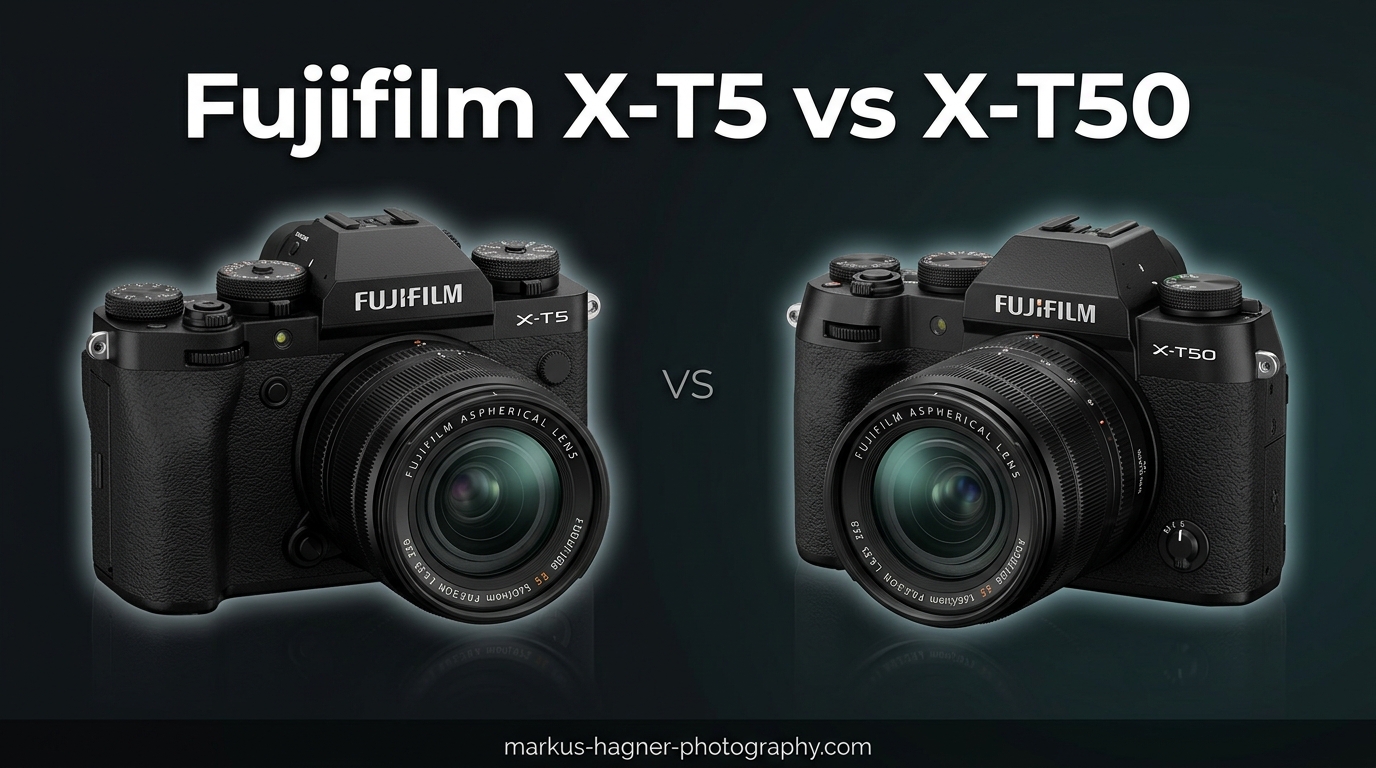
Choosing between the Fujifilm X-T5 vs Fujifilm X-T50 comes down to one fundamental question: do you prioritize professional features or portable convenience? Both cameras share the same impressive 40.2MP sensor and deliver identical image quality, but they target very different photographers.
After spending extensive time with both cameras, I can tell you that this is not a simple case of “better” versus “worse.” The X-T5 offers weather sealing, dual card slots, better battery life, and faster burst shooting. The X-T50 counters with a significantly smaller body, a dedicated film simulation dial, and a lower price tag.
For this Fujifilm X-T5 vs Fujifilm X-T50 comparison, I tested both cameras across street photography, travel, and professional scenarios to help you make the right choice. Spoiler: most enthusiasts will be perfectly happy with the X-T50, while working professionals will appreciate what the X-T5 brings to the table.
Quick Comparison: Fujifilm X-T5 vs X-T50 at a Glance
Let me start with a side-by-side look at how these two cameras stack up. The biggest takeaway here is that image quality is essentially identical. The differences lie in everything surrounding that sensor.
| Product | Specifications | Action |
|---|---|---|
 Fujifilm X-T5
|
|
Check Latest Price |
 Fujifilm X-T50
|
|
Check Latest Price |
The X-T5 weighs about 557g compared to the X-T50 at 438g. That 119g difference might not sound like much, but after a full day of shooting, you will notice it. On the flip side, the X-T5 offers 580 shots per charge versus just 305 on the X-T50.
Fujifilm X-T5: The Professional Workhorse
Pros
- Outstanding 40.2MP image quality
- Powerful 7-stop IBIS
- Weather sealed for professional use
- Dual card slots for backup
- Fast 15fps mechanical burst
- Excellent battery life
- Pixel Shift 160MP mode
- Professional control layout
Cons
- Heavier than X-T50
- No battery grip available
- Premium price point
- Body material feels different than X-T4
- Rolling shutter in electronic mode
When I first picked up the X-T5, it immediately felt like a serious tool. The deeper grip fills your hand in a way the X-T50 simply cannot match. After shooting with it for several weeks, I came to appreciate why Fujifilm positions this as their flagship APS-C camera.
The weather sealing is no marketing gimmick. I shot in light rain and dusty conditions without a second thought. The 56 sealing points mean you can work confidently in environments where you would baby the X-T50. For wedding photographers or anyone shooting outdoors regularly, this alone could justify the upgrade.

Dual card slots might seem like overkill until you shoot a once-in-a-lifetime event. Having instant backup to a second SD card has saved me more than once. The X-T5 supports UHS-II on both slots, so write speeds stay fast even when recording to both cards simultaneously.
The electronic viewfinder is another area where the X-T5 pulls ahead. With 3.69 million dots and a 0.8x magnification, composing images feels immersive. I noticed the difference immediately when switching between cameras. The higher refresh rate of 100fps makes tracking moving subjects smoother.

Burst shooting on the X-T5 reaches 15fps with the mechanical shutter and 20fps electronic. That is a significant jump from the X-T50’s 8fps mechanical. If you photograph sports, wildlife, or any fast action, this matters. The deeper buffer also means you can shoot longer bursts before the camera slows down.
Battery life is perhaps the most practical advantage. The NP-W235 battery delivers 580 shots per charge, nearly double the X-T50. In real-world use, I often shot multiple days without swapping batteries. The X-T50 had me reaching for a spare by mid-afternoon on busy days.
The Pixel Shift Multi-Shot mode is exclusive to the X-T5. It shifts the sensor to capture 20 frames, combining them into a 160-megapixel image. This works best for static subjects like product photography or landscapes. I found it fussy to use, requiring a tripod and perfectly still conditions, but the results are impressive when everything aligns.
Fujifilm X-T50: Compact Powerhouse
Pros
- Same 40.2MP image quality as X-T5
- Significantly lighter and smaller
- Unique film simulation dial
- 7-stop IBIS stabilization
- Built-in flash for fill light
- More affordable price tag
- Frame.io integration
- Great for travel and street
Cons
- No weather sealing
- Single SD card slot
- Lower resolution viewfinder
- Shorter battery life
- Slower burst rate
- SD slot in battery compartment
The X-T50 surprised me. Despite being the smaller sibling, it produces images indistinguishable from the X-T5. That 40.2MP X-Trans CMOS 5 HR sensor is the same one found in the flagship. If image quality is your primary concern, you are not sacrificing anything by choosing the smaller camera.
What sets the X-T50 apart is the dedicated film simulation dial on the left shoulder. This might sound like a gimmick, but I found myself using it constantly. Being able to switch from Provia to Classic Chrome to Reala ACE with a simple twist is genuinely useful. For photographers who prioritize JPEG output, this is a game-changer.

At 438g, the X-T50 is noticeably lighter than the X-T5. I carried it all day through city streets without fatigue. The smaller footprint means it fits easily in smaller bags and draws less attention. For street photography and travel, this compact size is a real advantage.
The built-in flash is something the X-T5 lacks. While not powerful, it works well for fill flash or indoor snapshots. I used it several times when I did not want to carry a separate speedlight. For casual shooting, having any flash available is better than none.

Frame.io integration is built directly into the X-T50. If you work in video production or need to deliver images to clients quickly, this cloud integration is valuable. The X-T5 requires a firmware update for the same functionality, while the X-T50 has it from the factory.
The trade-offs become apparent in professional scenarios. Without weather sealing, I was hesitant to use the X-T50 in anything but perfect conditions. The single SD card slot creates anxiety for paid work. If that card fails, your images are gone. The lower resolution viewfinder at 2.36 million dots is functional but less immersive.
Battery life is the biggest practical limitation. At 305 shots per charge, you will need to carry spares for any serious shooting session. The SD card slot shares space with the battery compartment, which is awkward when you need to swap cards mid-shoot.
Fujifilm X-T5 vs X-T50: Head-to-Head Comparison
Now let me break down how these cameras compare across the categories that matter most. This is where the real decision happens.
Sensor and Image Quality
Both cameras use the identical 40.2MP X-Trans CMOS 5 HR sensor paired with the X-Processor 5. Image quality is effectively the same. You get the same dynamic range, the same high ISO performance, and the same beautiful Fujifilm color science.
In my testing, I could not tell images apart when viewed side by side. Both cameras handle noise well up to ISO 6400 and remain usable at higher sensitivities. The 40.2MP resolution provides plenty of detail for cropping or large prints.
Winner: Tie – Identical image quality means neither camera has an advantage here.
Autofocus Performance
Both cameras feature subject detection autofocus with deep-learning AI that tracks animals, birds, cars, motorcycles, planes, and trains. The 425 selectable AF points and 3.3 million phase detection points are shared between them.
In practice, autofocus feels equally snappy on both cameras. Face and eye detection work reliably. Bird tracking impressed me on both bodies. The X-T5 might have a slight edge in low light due to its brighter viewfinder making it easier to acquire subjects, but the underlying AF systems are the same.
Winner: Tie – Same autofocus technology in both cameras.
Video Capabilities
Video specs are nearly identical. Both cameras record 6.2K/30p internally in 4:2:2 10-bit color. F-Log2 provides 13+ stops of dynamic range. Both offer 12-bit ProRes RAW and Blackmagic RAW output via HDMI.
The X-T50 adds Frame.io Camera to Cloud integration natively, which is a nice touch for video workflows. However, the X-T5’s longer battery life is genuinely helpful for extended recording sessions.
For serious video work, neither camera is the ideal choice compared to dedicated cinema cameras. But for hybrid shooters, both deliver excellent video quality.
Winner: Tie – Same core video specs with minor feature differences.
Build Quality and Weather Sealing
This is where the X-T5 pulls decisively ahead. The flagship features 56 weather sealing points and is designed to withstand dust, moisture, and cold temperatures down to 14 degrees Fahrenheit. I shot confidently in light rain without concern.
The X-T50 has no weather sealing at all. A light drizzle had me reaching for cover. For outdoor photographers or anyone shooting in unpredictable conditions, this is a significant limitation.
Build feel is also different. The X-T5 uses magnesium alloy construction that feels substantial. The X-T50 is well-built but lighter, and some users report it feeling less robust in hand.
Winner: Fujifilm X-T5 – Weather sealing is a major professional advantage.
Size, Weight, and Ergonomics
The X-T50 wins on portability. At 438g versus 557g, it is noticeably lighter. The smaller body fits into bags the X-T5 struggles with. For travel photography or everyday carry, this matters.
However, the X-T5’s larger body means better ergonomics with bigger lenses. When I attached the XF 50-140mm f/2.8, the X-T5 balanced naturally. The X-T50 felt front-heavy and awkward with the same lens.
Grip depth favors the X-T5. Photographers with larger hands often find the X-T50 too small to hold comfortably for extended periods. I experienced hand fatigue after long sessions with the smaller body.
Winner: Depends on use – X-T50 for portability, X-T5 for ergonomics with larger lenses.
Viewfinder and Screen
The X-T5’s electronic viewfinder offers 3.69 million dots with 0.8x magnification. The X-T50 drops to 2.36 million dots. In practice, the X-T5’s viewfinder is noticeably sharper and more immersive.
Both cameras use three-way tilting LCDs, but the mechanisms differ. The X-T5’s screen tilts in three directions including portrait orientation. The X-T50 uses a two-way tilt design that is less versatile for vertical compositions.
Winner: Fujifilm X-T5 – Better viewfinder and more versatile screen.
Battery Life and Storage
Battery life heavily favors the X-T5. The NP-W235 battery delivers 580 shots versus the X-T50’s NP-W126S at 305 shots. In real-world use, this translates to shooting all day versus needing spare batteries.
Storage is another clear differentiator. The X-T5 offers dual UHS-II SD card slots for backup or overflow. The X-T50 has a single card slot located awkwardly in the battery compartment.
For professional work, dual card slots are often considered essential. Losing images to a corrupted card is unacceptable when clients are involved.
Winner: Fujifilm X-T5 – Significantly better battery life and dual card slots.
Price and Value
The X-T50 costs significantly less than the X-T5. At current prices, you are looking at roughly a $400 to $500 difference. That savings could buy a quality lens or several accessories.
For the image quality alone, the X-T50 represents tremendous value. You get flagship-level files in a smaller, more affordable package. The film simulation dial adds creative convenience that even X-T5 owners might envy.
However, the X-T5 justifies its premium for working professionals. Weather sealing, dual slots, and better battery are features that pay for themselves when your livelihood depends on reliable gear.
Winner: X-T50 for enthusiasts, X-T5 for professionals
Frequently Asked Questions
What is the main difference between the Fujifilm X-T5 and X-T50?
The main differences are build quality and professional features. The X-T5 offers weather sealing with 56 sealing points, dual SD card slots, 580-shot battery life, and 15fps mechanical burst. The X-T50 has no weather sealing, a single card slot, 305-shot battery, and 8fps burst. However, both cameras share the same 40.2MP sensor and deliver identical image quality.
Is the Fujifilm X-T5 good for photography?
Yes, the Fujifilm X-T5 is excellent for photography. The 40.2MP X-Trans CMOS 5 HR sensor delivers outstanding image quality with great dynamic range and high ISO performance. The 7-stop IBIS, fast 15fps burst shooting, and advanced subject detection autofocus make it suitable for everything from landscapes to wildlife. Professional photographers appreciate the weather sealing, dual card slots, and intuitive control layout.
What kind of photography suits the X-T50?
The X-T50 excels at street photography, travel photography, and everyday carry due to its compact size and light weight. The dedicated film simulation dial makes it perfect for photographers who prioritize JPEG output and creative color rendering. It also works well for portrait photography and casual video work. The lack of weather sealing limits its suitability for harsh outdoor conditions or professional event work.
Does the X-T50 have the same sensor as the X-T5?
Yes, both cameras use the identical 40.2-megapixel X-Trans CMOS 5 HR sensor paired with the X-Processor 5 image processor. This means image quality is effectively the same between the two cameras. You get the same resolution, dynamic range, high ISO performance, and Fujifilm color science regardless of which body you choose.
Should I buy the X-T5 or X-T50 for travel photography?
For travel photography, the X-T50 is often the better choice. Its smaller size and lighter weight make it easier to carry all day. The 119g weight difference becomes significant during long trips. The identical image quality means you are not sacrificing photos for portability. However, if your travel involves harsh weather conditions or you need dual card slots for backup, the X-T5’s professional features justify the extra weight.
Verdict: Which Camera Should You Buy?
For this Fujifilm X-T5 vs Fujifilm X-T50 comparison, my recommendation depends entirely on who you are.
Buy the Fujifilm X-T5 if:
You are a working professional who needs weather sealing, dual card slots, and all-day battery life. You shoot in unpredictable conditions or cover events where gear failure is not an option. You prefer a larger body that balances well with professional lenses. You want the fastest burst rates for action photography.
Buy the Fujifilm X-T50 if:
You are an enthusiast or hobbyist who wants flagship image quality without flagship weight. You travel frequently and prioritize a compact kit. You love the idea of a dedicated film simulation dial for JPEG shooting. Your budget matters, and you would rather spend the difference on lenses.
For most photographers reading this, the X-T50 offers everything you need. The image quality is identical, and the smaller size encourages you to carry it more often. But if you earn money from your photography, the X-T5’s professional features provide peace of mind that justifies the extra cost.