
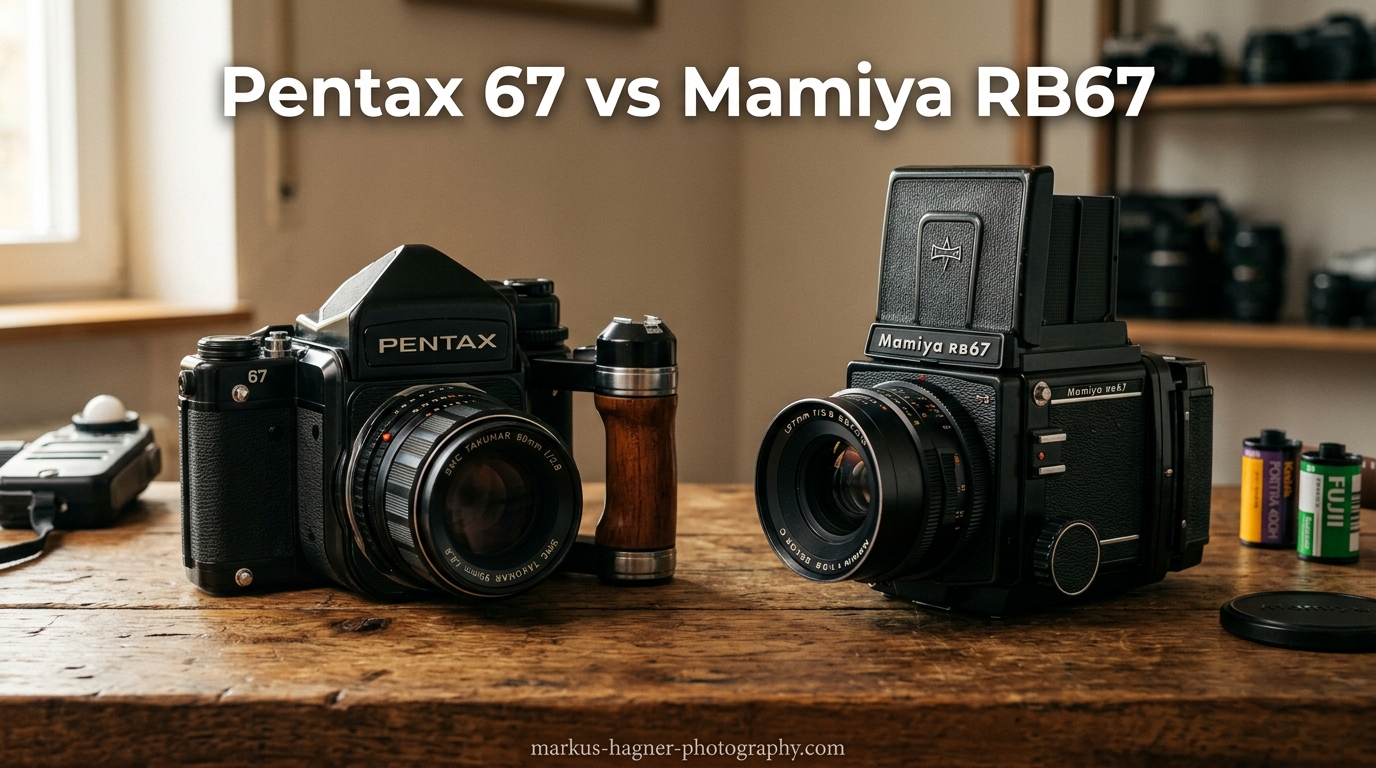
The 6×7 medium format has long held a special place in film photography. That massive negative gives you detail and tonality that 35mm simply cannot match. When photographers decide to step up to this format, two names dominate the conversation: Pentax 67 and Mamiya RB67.
I have spent considerable time researching both systems, analyzing user experiences from forums, and understanding what makes each camera tick. The Pentax 67 vs Mamiya RB67 debate has raged for decades, and for good reason. These cameras represent two fundamentally different approaches to the same goal.
Quick verdict: The Pentax 67 excels as a fast, intuitive SLR-style camera ideal for handheld portraits and general shooting with shutter speeds up to 1/1000s. The Mamiya RB67 is a modular, studio-focused system with interchangeable backs, rotating back, and leaf shutter lenses enabling full flash sync at all speeds. Perfect for deliberate, tripod-based work including close-up and macro photography.
Pentax 67 vs Mamiya RB67: Quick Comparison
Before diving deep, here is how these two legendary medium format cameras stack up against each other.
| Product | Specifications | Action |
|---|---|---|
 Pentax Medium Format System
|
|
Check Current Prices |
 Mamiya Medium Format System
|
|
Check Current Prices |
Pentax 67: The SLR Approach to Medium Format
Pros
- SLR-style handling familiar to 35mm shooters
- Shutter speeds up to 1/1000s
- Wider lens selection available
- More ergonomic for handheld work
- Fast operation for portraits
Cons
- Mirror slap at slow shutter speeds
- Flash sync only 1/30s
- Limited close focus capability
- Frozen advance lever issues reported
- Heavy for extended carry
The Pentax 67 takes everything photographers love about 35mm SLRs and scales it up for the 6×7 format. Looking through the viewfinder feels immediately familiar if you have shot with any Pentax 35mm camera. The ergonomics just work.
What makes the Pentax 67 special is how it bridges the gap between medium format quality and 35mm handling. You can actually handhold this camera. The rubberized wooden grip fits naturally in your hand, and the shutter release falls right under your finger. Many photographers report shooting handheld at 1/125s and faster without issues.
The focal plane shutter gives you speeds from 1/30s to 1/1000s. That top speed matters more than you might think for outdoor portrait work. However, the trade-off is a flash sync speed of only 1/30s. Studio photographers using strobes will find this limiting.
Mirror Slap and Vibration
Let me address the elephant in the room: mirror slap. The Pentax 67 has a massive mirror, and when it flips up, you feel it. At shutter speeds of 1/60s and slower, this vibration can affect image sharpness. Many photographers use mirror lock-up or a sturdy tripod to compensate.
Real-world experience suggests this is manageable. One long-term user reported never having problems even without mirror lockup when using a heavy-duty Bogen tripod. The key is technique and understanding your equipment.
Lens Selection and Quality
Pentax 67 lenses are legendary for their rendering characteristics. The 105mm f/2.4 is perhaps the most celebrated, producing skin tones that photographers consistently praise. The shallow depth of field wide open creates that classic medium format look.
Available focal lengths range from 35mm to 1000mm, covering virtually any shooting situation. The 45mm gives you roughly a 24mm equivalent in 35mm terms, perfect for landscapes. The 135mm macro was compared favorably against Hasselblad lenses by professional users.
Reliability Concerns
Common issues reported by users include frozen advance levers. One owner reported experiencing this problem on three different Pentax 67 bodies, including a brand new P67II that required a $350 repair. However, other users report 12+ years of trouble-free professional use.
The lesson here is to buy from reputable sellers and budget for potential service. These are mechanical cameras, and like any vintage equipment, they benefit from regular maintenance.
Mamiya RB67: The Modular Studio Workhorse
Pros
- Leaf shutter syncs flash at all speeds
- Interchangeable film backs
- Rotating back for orientation changes
- Bellows focusing for close-ups
- Built like a tank
Cons
- Bulky and boxy form factor
- Slow operation with separate shutter cocking
- Maximum shutter only 1/400s
- Easy to accidentally double expose
- Heavy and awkward to hold
The Mamiya RB67 represents a completely different philosophy. Instead of a traditional SLR design, you get a modular system where virtually everything comes apart. Film back, viewfinder, lens, even the focusing screen. This modularity gives you options the Pentax simply cannot match.
The RB in RB67 stands for Rotating Back. With a simple lever, you can switch between landscape and portrait orientation without rotating the entire camera. This feature alone makes the Mamiya invaluable for studio work where quick orientation changes matter.
Bellows focusing is another game-changer. Every RB67 lens focuses via a built-in bellows, meaning you get closer focusing than most other medium format systems. Macro photographers love this capability. No extension tubes needed for many close-up applications.
Leaf Shutter Advantages
Unlike the Pentax with its focal plane shutter, the Mamiya uses leaf shutters built into each lens. This design choice has massive implications for flash photography. You can sync flash at any shutter speed, not just 1/30s.
For studio work with strobes, this is huge. You can shoot at 1/400s and still get full flash sync. Outdoor portrait photographers using fill flash will appreciate this flexibility. The trade-off is a maximum shutter speed of only 1/400s compared to the Pentax’s 1/1000s.
The Weight and Bulk Factor
Users consistently describe the RB67 as heavy, cumbersome, and awkward. One owner put it bluntly: it is essentially a big heavy box that they fumble around with a lot. The form factor does not lend itself to handheld shooting the way the Pentax does.
However, that heft has an unexpected benefit. The weight forces you to slow down and really study your composition before pressing the shutter. It becomes a sort of self-editing mechanism. Many photographers find this deliberateness improves their work.
Common RB67 Problems
Despite appearances, the RB67 is not waterproof or weather-sealed. Some users assume the robust build means weather resistance, but that is not the case. The rotating back mechanism can develop play over time, and light leaks around the bellows are possible if not maintained.
The separate shutter cocking and film advance means you must remember two steps for each shot. Forget one, and you might accidentally double expose. New users report this learning curve, but it becomes second nature with practice.
Pentax 67 vs Mamiya RB67: Head-to-Head Comparison
Shutter Mechanism and Flash Sync
The fundamental difference between these cameras comes down to shutter design. Pentax uses a focal plane shutter like most 35mm SLRs, giving speeds from 1/30s to 1/1000s but flash sync only at 1/30s. Mamiya puts leaf shutters in each lens, limiting top speed to 1/400s but enabling flash sync at every speed.
For available light photography, the Pentax wins with its higher maximum shutter speed. For studio work with flash, the Mamiya is superior. There is no wrong answer here, just different tools for different jobs.
Viewfinder Experience
The Pentax offers an eye-level prism finder that feels natural to anyone coming from 35mm SLRs. You hold the camera up to your eye and compose. Simple and intuitive. The viewfinder image is bright and not reversed.
The Mamiya gives you options. The waist-level finder shows a reversed image that takes getting used to, but many photographers prefer this for tripod work. An eye-level prism is available, adding weight but providing that familiar viewing experience. The choice is yours.
Portability and Ergonomics
This is where opinions diverge sharply. The Pentax 67 weighs roughly 2.7kg with a prism and standard lens. Heavy, but manageable. The Mamiya RB67 tips the scales around 3kg in similar configuration. The weight difference is not massive.
The real difference is in how that weight is distributed. The Pentax feels like a large 35mm camera. The grip makes sense. You can carry it on a strap for hours. The Mamiya is a box with no natural holding position. Extended handheld shooting becomes uncomfortable quickly.
Forum users who have owned both often describe the Pentax as the camera they actually want to carry, while the Mamiya stays in the studio.
Use Case Recommendations
Portrait Photography: Both excel, but differently. The Pentax 67 with its 105mm lens produces stunning skin tones and works beautifully for environmental portraits where you move with your subject. The Mamiya’s slower pace suits formal studio portraits where you have time to perfect every element.
Landscape Photography: The Pentax 67 wins for field work. Lighter, faster to set up, and the higher shutter speeds help with moving subjects like foliage. The Mamiya works for landscapes, but you will want a sturdy tripod and patience.
Studio Work: The Mamiya RB67 is the clear winner here. Interchangeable backs let you shoot different film stocks mid-session. The rotating back speeds up workflow. Leaf shutter flash sync at any speed opens creative possibilities. The Pentax works, but the Mamiya was designed for this.
Macro and Close-Up: The Mamiya’s bellows focusing gives it a significant advantage. You can focus much closer without additional accessories. The Pentax requires extension tubes for serious macro work, and even then cannot match the Mamiya’s flexibility.
Which System Holds Value Better
Both cameras have maintained steady value in the used market. The Mamiya system potentially holds slight value advantage due to its modular nature. You can upgrade individual components rather than replacing the entire camera. Lens prices remain reasonable for both systems, though specific focal lengths can command premium prices.
Who Should Choose Which Camera
After analyzing hundreds of user experiences and technical specifications, clear patterns emerge for who should choose which system.
Choose the Pentax 67 If:
You want a camera that feels like a large 35mm SLR. The handling makes sense immediately. You plan to shoot handheld frequently or carry the camera for extended periods. Portrait photography in natural light is your primary focus. You need shutter speeds faster than 1/400s for available light work.
The Pentax 67 suits photographers who want to shoot more spontaneously within the medium format world. It is the working photographer’s camera, reliable and intuitive.
Choose the Mamiya RB67 If:
Studio work dominates your photography. You need interchangeable film backs for different emulsions. Flash photography at high shutter speeds matters to you. Macro and close-up work is important. You prefer a deliberate, slow approach to image-making.
The Mamiya RB67 rewards patience and planning. It is the craftsman’s camera, built for situations where you have time to think through every decision.
Frequently Asked Questions
What are common RB67 problems?
Common Mamiya RB67 problems include light leaks around the bellows if not properly maintained, play developing in the rotating back mechanism over time, and the learning curve of separate shutter cocking and film advance leading to accidental double exposures. The camera is not waterproof despite its robust appearance. Regular maintenance from qualified technicians helps prevent most issues.
What makes the Pentax 6X7 special?
The Pentax 67 is special because it brings familiar 35mm SLR handling to the 6×7 medium format. Its ergonomic design with wooden grip allows comfortable handheld shooting, something rare in medium format. The lens selection produces distinctive rendering, particularly the 105mm f/2.4 for portraits. Shutter speeds reach 1/1000s, enabling available light work that other medium format cameras struggle with.
How many shots do you get on Pentax 67?
The Pentax 67 produces 10 shots per roll of 120 film in the 6x7cm format. This is the same for the Mamiya RB67 and any other 6×7 format camera. The large negative size means fewer frames per roll compared to smaller formats, but each frame contains significantly more detail and tonal information.
Which camera is better for handheld shooting, Pentax 67 or Mamiya RB67?
The Pentax 67 is significantly better for handheld shooting. Its SLR-style ergonomics, natural grip, and balanced weight distribution make it comfortable to hold and operate. The Mamiya RB67’s boxy design lacks a natural holding position, making extended handheld work difficult. For handheld portrait work, the Pentax wins decisively.
My Recommendation
For most photographers entering medium format, the Pentax 67 vs Mamiya RB67 decision comes down to shooting style. If you want to carry your camera and shoot spontaneously, get the Pentax. If you work primarily in a controlled environment and value modularity, the Mamiya is your tool.
Some photographers eventually end up owning both. They use the Pentax for location portraits and the Mamiya for studio work. As one user put it: having both has been perfect. The systems complement rather than compete.