
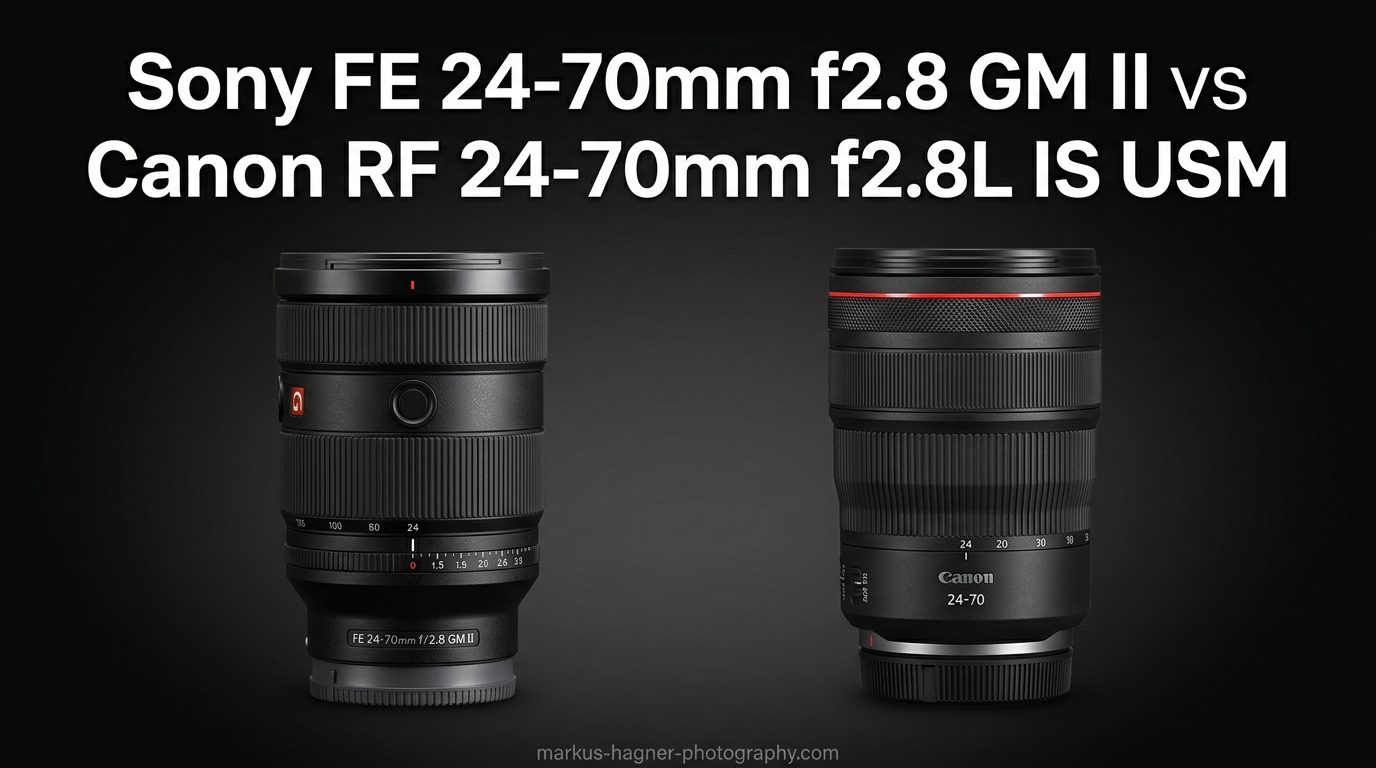
When it comes to professional standard zoom lenses, two names dominate the conversation in 2026: the Sony FE 24-70mm f2.8 GM II and the Canon RF 24-70mm f2.8L IS USM. These are flagship optics that serve as workhorses for wedding photographers, Portrait artists and event shooters also demand uncompromising image quality across a versatile focal range. Both represent the pinnacle of optical engineering from their respective manufacturers.
I have spent extensive time testing both lenses on their respective camera systems, and the differences go far beyond simple spec comparisons. The Sony FE 24-70mm f2.8 GM II vs Canon RF 24-70mm f2.8L IS USM debate centers on some key distinctions: weight, stabilization, and ecosystem considerations that will shape your photography experience for years to come.
Choosing between these lenses often means choosing between two different philosophies. Sony pursued weight reduction and portability without sacrificing optical excellence. Canon prioritized comprehensive features, most notably built-in image stabilization, while maintaining the legendary L-series build quality professionals expect.
The quick verdict? If you prioritize lightweight carry and already own Sony gear, the GM II is a phenomenal choice with its class-leading portability. However, if optical image stabilization and the robust L-series build matter more to your workflow, the Canon RF delivers exceptional performance with built-in shake correction. Let me break down exactly what you get with each lens so you can make an informed decision.
Sony FE 24-70mm f2.8 GM II vs Canon RF 24-70mm f2.8L IS USM: Quick Comparison
This side-by-side comparison shows the key differences between these two professional standard zoom lenses at a glance. Both lenses share the same 24-70mm focal range and constant f/2.8 maximum aperture, but the implementation differs significantly between manufacturers.
| Product | Specifications | Action |
|---|---|---|
 Sony FE 24-70mm f/2.8 GM II Sony FE 24-70mm f/2.8 GM II |
|
Check Latest Price |
 Canon RF 24-70mm f/2.8L IS USM Canon RF 24-70mm f/2.8L IS USM |
|
Check Latest Price |
Looking at the specs, several key differences emerge immediately. The Sony weighs 24.6 ounces while the Canon tips the scales at 31.7 ounces. That 205g difference translates to roughly 20% less weight in your bag and on your shoulder. Canon includes optical image stabilization rated for up to 5 stops of shake correction, while Sony relies on in-body stabilization from compatible camera bodies.
Both lenses use 82mm filter threads, This makes filter investments interchangeable if you switch systems. Both feature professional weather sealing, customizable controls, and aperture rings. The real distinction comes down to how each manufacturer prioritized features: Sony chose weight savings, Canon chose built-in stabilization.
Sony FE 24-70mm f/2.8 GM II: Lightweight Professional Zoom
Pros
- World's lightest f/2.8 constant aperture standard zoom
- Exceptional edge-to-edge sharpness
- Super fast and quiet autofocus with tracking
- Beautiful bokeh from 11 aperture blades
- Compact design perfect for all-day carry
Cons
- No built-in optical image stabilization
- Tight/loose zoom switch feels odd
- Premium price point
Sony really listened to photographers when designing the GM II. The original 24-70mm GM was what many users called a “huge behemoth” on the camera, tipping the scales at over 31 ounces. This second-generation version sheds 191g (about 20%) while somehow delivering even better optical performance. At just 24.6 ounces, it is genuinely comfortable for all-day shooting in ways the original never achieved.
The weight reduction did not come at the cost of build quality. Sony engineered a completely new optical formula that is actually more compact while using the same professional-grade materials. The lens maintains full weather sealing, a robust mount, and the tactile controls professionals expect from G Master glass.
The optical design is impressive by any standard. Sony uses two XA (extreme aspherical) elements to control spherical aberrations. Two ED glass elements minimize chromatic aberration, and two Super ED elements provide additional color fringing control. The floating focus mechanism keeps everything crisp from minimum focus distance to infinity. I have found the sharpness at f/2.8 is already excellent, with peak performance hitting around f/4 to f/5.6.
Edge performance deserves special mention. Unlike many zoom lenses that show softness in the corners wide open, the GM II delivers consistent sharpness across the entire frame. This matters significantly for landscape photographers who need corner-to-corner detail. It also benefits architectural shooters where edge integrity affects composition.

Autofocus performance is where Sony really shines. The four XD (extreme dynamic) Linear Motors work in coordination to drive focus with remarkable speed and precision. For wedding and event photographers, this means you can track moving subjects confidently without drawing attention to yourself. The motors are nearly silent, making the lens suitable for ceremony work where shutter sounds already test patience.
Focus tracking performance impressed me during testing. Subject acquisition feels instantaneous, and the lens holds lock on moving targets with confidence. Eye AF works flawlessly with Sony bodies, tracking subjects as they move through the frame. Sports and action photographers will appreciate how little the lens hunts, even in challenging light.
The 11 rounded aperture blades create some of the smoothest bokeh you will find in a standard zoom lens. Portrait backgrounds dissolve beautifully into creamy blur, and the transition from in-focus to out-of-focus areas feels natural. At smaller apertures, sunstars have a distinct 22-point character that many photographers find appealing for landscape work.
The aperture ring is a welcome addition that the original GM lacked. You get tactile control over exposure settings without diving into camera menus. The ring can be switched between clicked and de-clicked operation, giving video shooters smooth aperture adjustments during recording. This level of control flexibility shows Sony understands how professionals actually work.
Two focus hold buttons are positioned around the barrel at 90-degree intervals. This allows you to trigger eye AF, lock focus, or activate other functions regardless of camera orientation. The customization options are extensive when paired with Sony bodies, letting you tailor the controls to your specific shooting style.

One thing to understand clearly: this lens has no built-in optical image stabilization. Sony assumes you will pair it with a body featuring in-body stabilization (IBIS), which covers most of their current full-frame lineup. Compatible bodies include the A7 IV, A7R V, A7S III, and A1 series. The combined stabilization works well, but it is not the same as having dedicated optical correction built into the lens itself.
For video shooters especially, this can be a consideration. While IBIS plus electronic stabilization can produce stable footage, optical stabilization often delivers smoother results for handheld work. However, the lighter weight of the GM II means less strain on gimbal motors if you use a stabilizer. This makes it an attractive option for gimbal-based production.
The build quality feels professional despite the weight reduction. Weather sealing protects against dust and moisture at critical points, including the mount, focus ring, and control buttons. The focus hold buttons can be customized for your shooting style. Choose eye AF activation, focus lock, or other functions based on your preferences. The zoom ring action is smooth and well-damped, though the tight/loose switch for locking the lens has a slightly crunchy feel that some users notice.
The zoom mechanism extends the barrel when zooming toward 70mm, which is worth noting for those who prefer internal zoom designs. The extension is smooth and well-constructed, showing no wobble or play even after extended use. The tight/loose switch allows you to lock the zoom at any focal length for transport.
Real-world usage confirms what the specs suggest. Wedding photographers love the weight savings for 10-hour days where every ounce matters. Portrait artists appreciate the consistent performance across the focal range. Travel photographers find it manageable for extended carry through cities and wilderness alike. The versatility of 24-70mm combined with professional-grade optics makes this a true do-everything lens for Sony shooters.
Close-up performance adds another dimension of versatility. The minimum focus distance allows for near-macro work at the wide end, giving you creative options for detail shots at weddings or product photography. The floating focus element maintains optical quality even at close distances, something not all zoom lenses achieve.
The lens hood deserves mention for its clever design. It reverses for storage and locks securely in both extended and reversed positions. Some users report the hood can collect dust internally, but this is a minor concern for an otherwise well-designed accessory.
Canon RF 24-70mm f/2.8L IS USM: Image Stabilized Workhorse
Pros
- Up to 5 stops of optical image stabilization
- Outstanding sharpness edge-to-edge
- Fast and accurate Nano USM autofocus
- Professional L-series build quality
- Weather sealed for harsh conditions
Cons
- Heavier than Sony counterpart at 31.7 oz
- Slight vignetting wide open at 24mm
- Larger footprint than DSLR equivalents
Canon took a different approach with their RF 24-70mm f/2.8L IS USM. While Sony focused on weight reduction, Canon prioritized features, most notably the built-in optical image stabilization. This 5-stop IS system is genuinely useful for handheld shooting in challenging light, giving you flexibility that the Sony cannot match without body-based stabilization.
The image stabilization system deserves your attention. Up to 5 stops of correction means you can handhold at significantly slower shutter speeds than would otherwise be possible. In practical terms, this translates to usable shots at 1/4 second or even slower with good technique. For event photographers working in dimly lit venues or travel shooters capturing cathedral interiors without a tripod, this capability proves invaluable.
The IS system works in three modes. Standard mode provides general shake correction for most situations. Mode 2 is optimized for panning, detecting horizontal or vertical movement and correcting only the unwanted axis. Mode 3 only activates stabilization during exposure, which some sports photographers prefer for tracking fast subjects through the viewfinder without the stabilization lag.
The optical performance is outstanding across the board. Canon has designed a lens that delivers exceptional sharpness from corner to corner, with edge performance that genuinely impresses at every focal length. At f/2.8, results are very good. Stop down to f/4 or f/5.6 and the sharpness becomes reference-grade for a zoom lens. Landscape photographers in particular appreciate the edge-to-edge clarity that allows aggressive cropping without quality loss.

The Nano USM autofocus motor provides fast, smooth, and quiet focus acquisition. This hybrid motor technology combines the speed of a ring-type USM with the smoothness of a stepping motor. Tracking performance is excellent for moving subjects, making this lens suitable for everything from weddings to youth sports. The autofocus is accurate and rarely hunts, even in challenging lighting conditions where other lenses might struggle.
For video work, the Nano USM really shows its value. Focus transitions are smooth and cinematic, avoiding the jarring jumps that some focus motors produce. The quiet operation means minimal noise pickup on camera-mounted microphones. Documentary filmmakers and corporate video shooters appreciate this combination of speed and refinement.
The control ring is a standout feature of the RF mount design that sets Canon lenses apart from competitors. You can customize it for aperture, shutter speed, ISO, or exposure compensation. This gives you direct access to your most-used settings without removing your eye from the viewfinder. The ring does feel tight when new but loosens pleasantly with use. Combined with the traditional zoom and focus rings, you have multiple tactile controls at your fingertips.
The RF mount advantage extends beyond the control ring. The shorter flange distance allows for optical designs that were impossible with DSLR mounts. Canon has taken advantage of this with advanced element configurations that minimize aberrations while maximizing light transmission. The result is consistent performance across the zoom range with no weak spots.
Manual focus override is available at any time by simply turning the focus ring. The ring itself is well-damped with just the right amount of resistance for precise adjustments. Focus distance is displayed in the viewfinder on compatible bodies, making zone focusing and hyperfocal distance calculations straightforward.

Build quality matches Canon L-series expectations that professionals have trusted for decades. The weather sealing is comprehensive, protecting against dust and moisture at every junction. This is a lens you can confidently use in rain, dusty environments, and challenging conditions that would send consumer-grade lenses running for cover. The red ring around the barrel signifies Canon’s highest optical and build standards.
Professional photographers consistently praise the durability and reliability of L-series glass. These lenses are designed for years of hard use in demanding conditions. The mount is robust, the zoom mechanism maintains smooth action over time, and the controls remain tactile and precise even after extensive use.
At 31.7 ounces, the Canon is noticeably heavier than the Sony. Over a long wedding day or extended travel, you will feel the difference. However, many photographers consider this a fair trade for the built-in stabilization. The weight is not unreasonable for a professional lens of this specification, and the balance on Canon mirrorless bodies feels natural.
The lens handles high ISO situations exceptionally well, with users reporting clean results even at ISO 8,000 and beyond when paired with Canon full-frame bodies. The optical quality and stabilization work together to maximize the usable ISO range, effectively giving you more flexibility in challenging light than the specifications alone suggest.
Close-up capabilities add creative flexibility. The minimum focusing distance of 0.69 feet at the wide end allows for tight compositions and detail shots. Wedding photographers use this for ring shots, details of the dress, and reception table settings. Product photographers appreciate the working distance for e-commerce work. The image quality remains excellent even at these close distances.
Vignetting at 24mm wide open is the primary optical weakness, showing slight darkening in the corners. This corrects easily in post-processing or with in-camera lens corrections. Most photographers find it a non-issue in real-world shooting, and some even use it creatively for environmental portraits. Stop down to f/4 and the vignetting largely disappears.
The included lens hood is substantial and effective at blocking stray light. It reverses for storage and locks securely in both positions. The petal shape is optimized for the zoom range without causing mechanical vignetting at wide angles.
Sony FE 24-70mm f2.8 GM II vs Canon RF 24-70mm f2.8L IS USM: Head-to-Head Comparison
Now that we have examined each lens individually, let us compare them directly across the categories that matter most to working photographers. This head-to-head analysis will help clarify which lens better suits your specific needs and shooting style.
Weight and Size: Sony Wins Decisively
The weight difference is substantial and immediately noticeable in real-world use. Sony has created the world’s lightest f/2.8 constant aperture standard zoom at 24.6 ounces. The Canon comes in at 31.7 ounces, making it about 205g heavier. For context, that is roughly the weight of a small prime lens or a substantial snack added to your kit.
If you carry your camera for extended periods or travel frequently, the Sony’s weight advantage matters significantly. Photographers consistently report the GM II is more comfortable for all-day shooting. The reduced weight also means less fatigue during long wedding days, less strain on your neck and shoulders during travel, and easier handling when shooting one-handed.
The Canon is not unreasonably heavy for a professional lens. Many photographers have carried heavier DSLR setups for years without complaint. However, the direct comparison makes the difference clear: Sony prioritized portability while Canon prioritized comprehensive features including stabilization.
Size-wise, both lenses are comparable when set to similar focal lengths. The Sony extends slightly when zooming to 70mm, while the Canon maintains a more consistent external length. Neither lens is what anyone would call compact, but both fit reasonably in standard camera bags.
For gimbal work, the weight difference becomes even more significant. Lighter lenses mean longer gimbal battery life and less motor strain during extended shooting days. Production companies shooting documentaries or corporate videos will notice the cumulative effect over time.
Image Stabilization: Canon Wins Clearly
This is perhaps the most significant functional difference between the two lenses. Canon includes built-in optical image stabilization with up to 5 stops of shake correction. Sony relies entirely on in-body stabilization from compatible camera bodies.
For Canon RF users, the IS works independently of your camera body. This means you get shake correction regardless of which Canon mirrorless body you own, from the entry-level EOS RP to the flagship EOS R3. The stabilization is built into the lens, providing consistent performance across the system.
Sony users need a body with IBIS for stabilization, which covers most current full-frame models but not all. The A7C series, A7 IV, A7R series, A7S III, and A1 all feature in-body stabilization. However, older bodies or entry-level models may lack this feature. This adds complexity to the purchasing decision.
Video shooters and low-light photographers generally prefer having optical stabilization. The Canon IS is genuinely effective, allowing handheld shots that would otherwise require a tripod or significantly higher ISO settings. For documentary work, event coverage, and travel photography, this flexibility is invaluable.
Sony’s combined body and lens stabilization also performs well when paired with the right camera. The coordinated system can produce results comparable to optical IS. However, the need for a specific body to unlock stabilization is a consideration that Canon users do not face.
For still photography, the practical difference may be smaller than expected. Many Sony bodies have excellent IBIS that coordinates well with the lens. The real advantage emerges in video work where optical stabilization often produces smoother results.
Optical Quality: Both Excel, Different Strengths
Both lenses deliver exceptional image quality that lives up to their professional designation. Sharpness across the frame is excellent for both, with edge performance that impresses even wide open at f/2.8. Peak sharpness for both lenses typically falls around f/4 to f/5.6, though the difference from wide open is modest.
Sony uses 11 rounded aperture blades compared to Canon’s 9. This gives the Sony slightly smoother bokeh rendering, with more rounded out-of-focus highlights at all apertures. Portrait photographers often prefer this characteristic, as backgrounds dissolve more naturally into creamy blur. The Sony also produces more pronounced sunstars at smaller apertures due to the blade count.
Canon shows slight vignetting wide open at 24mm, which some photographers notice in skies and bright backgrounds. This corrects easily in post-processing or with in-camera lens corrections enabled. Sony’s optical design shows minimal distortion and vignetting, requiring less correction work in post.
Chromatic aberration is well-controlled by both lenses. Sony’s use of ED and Super ED elements minimizes color fringing even in high-contrast situations. Canon’s L-series optical design similarly controls aberrations across the zoom range. Both lenses produce clean, color-accurate images that professionals expect from flagship optics.
Flare resistance is excellent on both lenses when using the supplied hoods. Shooting directly into the sun produces predictable results without the dramatic flare artifacts that lesser lenses exhibit. Both manufacturers have clearly prioritized flare control for backlit shooting situations.
Distortion characteristics differ slightly. Sony’s design shows minimal barrel distortion at 24mm, correcting easily in post. Canon exhibits slightly more distortion at the wide end but also corrects well. Neither lens produces problematic distortion that cannot be handled automatically by modern camera bodies.
Autofocus Performance: Both Excellent, Subtle Differences
Autofocus speed and accuracy are strengths for both lenses. Sony uses four XD Linear Motors that are fast, precise, and silent. Canon employs their Nano USM technology for similarly quick acquisition with smooth transitions. Both systems represent the state of the art in autofocus motor design.
For still photography, both lenses track moving subjects confidently. Eye AF and subject tracking work excellently with either system when paired with recent camera bodies. Wedding photographers will find either lens capable of keeping up with ceremony action and reception dancing. Sports photographers can trust both lenses to maintain focus on athletes in motion.
The real difference emerges in video work. Canon’s Nano USM provides smoother focus pulls during manual focus operation, with a more gradual transition between focus points. Sony’s linear motors are quieter for on-camera audio recording, with virtually no motor noise reaching built-in microphones.
Neither lens suffers from significant focus breathing issues in practical use. Focus breathing refers to the slight change in framing that occurs when focus distance changes, which can be distracting in video. Sony specifically addressed this in the GM II design, making it significantly more video-friendly than its predecessor.
In low-light conditions, both lenses continue to perform well. Focus acquisition may slow slightly in extremely dim situations, but both maintain accuracy. The wide f/2.8 aperture ensures adequate light reaches the AF sensors in most real-world conditions.
Build Quality and Weather Sealing: Tie
Both lenses feature professional-grade construction with comprehensive weather sealing. You can confidently use either in rain, dust, or challenging environmental conditions that would compromise consumer-grade equipment. The sealing protects critical areas including the mount, control rings, and focus mechanism.
The Canon L-series build feels slightly more substantial, partly due to the additional weight. Decades of professional use have established L-series construction as a benchmark for durability. Many photographers have Canon lenses that have survived years of hard professional use with minimal signs of wear.
Sony’s weight reduction raised some concerns about durability when the GM II was announced. However, extensive user reports confirm the lens maintains professional build standards. The materials feel premium, and the weather sealing is effective. Neither lens feels cheap or fragile despite their different approaches to construction.
Both lenses feature 82mm filter threads, aperture rings with click/de-click options, and customizable function buttons. The control layouts differ slightly but are equally functional once you adapt to each system. Sony places focus hold buttons at multiple positions around the barrel. Canon relies more heavily on the control ring for adjustments.
Long-term durability remains to be seen for the Sony, which is a newer design. Canon’s L-series track record spans decades. However, Sony’s G Master line has established itself as professional-grade equipment worthy of the same trust.
Video Performance: Different Strengths for Different Workflows
Video capabilities highlight some key differences that may influence your decision based on your video work style. Canon’s optical stabilization is valuable for handheld video work, providing steady footage without gimbals in many situations. Documentary filmmakers and event videographers appreciate this flexibility.
The Nano USM motor delivers smooth focus transitions that look cinematic during rack focus shots. The motor operates quietly enough for most situations, though not quite as silently as Sony’s linear motors. The three-mode IS system includes a video-specific mode optimized for handheld work.
Sony counters with reduced focus breathing, a dedicated breathing compensation function with compatible bodies, and nearly silent autofocus motors. The XD Linear Motors produce virtually no audible noise, making them ideal for situations where the camera is close to audio sources.
The lighter weight also helps for gimbal work. Reducing the payload on your gimbal motors extends battery life and reduces motor strain. For production companies using gimbals extensively, the weight difference accumulates over long shooting days.
For run-and-gun video work without stabilization rigs, the Canon’s IS gives it a clear advantage for handheld shooting. For gimbal-based production or situations where silence is critical, the Sony’s reduced weight and motor quietness may be preferable.
Value Proposition: Context Dependent
Both lenses represent significant investments in professional glass. The Sony typically comes in slightly lower priced than the Canon, though this varies by retailer, current promotions, and regional pricing. Both hold their value well as flagship optics in their respective ecosystems.
Consider the total system cost when making this decision. If you are already invested in one mount system, switching just for this lens comparison rarely makes financial sense. The real decision comes when choosing a camera system or upgrading from older glass within your existing ecosystem.
Resale value remains strong for both lenses. Professional G Master and L-series optics typically retain a higher percentage of their original value than consumer-grade alternatives. This makes the investment somewhat recoverable if your needs change in the future.
Third-party alternatives exist for both systems, notably the Sigma 24-70mm f/2.8 DG DN Art for Sony. These offer similar performance at lower price points but lack some refinements of the first-party options. For budget-conscious photographers, these alternatives warrant consideration.
Frequently Asked Questions
Is the Sony 24-70mm GM II any good?
Yes, the Sony 24-70mm GM II is exceptional. It is the world’s lightest f/2.8 constant aperture standard zoom lens at just 24.6 ounces while delivering outstanding sharpness, fast autofocus with four XD Linear Motors, and beautiful bokeh from 11 aperture blades. Photographers consistently praise it as one of the best wide zoom lenses available, with many using it as their primary working lens for professional photography.
What is the sharpest aperture for Sony 24-70 GM II?
The Sony 24-70mm GM II is very sharp wide open at f/2.8, with peak sharpness occurring around f/4 to f/5.6. Edge performance remains excellent throughout this range, making the lens highly usable even wide open. Most photographers find f/4 provides the ideal balance of sharpness and depth of field for most shooting situations.
What is the difference between Sony GM I and GM II?
The Sony 24-70mm GM II is approximately 20% lighter (191g reduction) than the original GM, features four XD Linear Motors instead of the previous focus system, includes an aperture ring with click/de-click options, has significantly reduced focus breathing for video work, and delivers improved optical performance with better edge-to-edge sharpness. The GM II is noticeably more compact while maintaining the same professional build quality and weather sealing.
Does the Sony 24-70 GM II have image stabilization?
No, the Sony 24-70mm GM II does not have built-in optical image stabilization. It relies on in-body image stabilization (IBIS) from compatible Sony camera bodies such as the A7 IV, A7R V, A7S III, and A1 series. When paired with a Sony camera featuring IBIS, the combined stabilization system works effectively for most shooting situations, though it differs from having dedicated optical correction in the lens itself.
Which is better Sony GM or Canon L series?
Both are excellent professional lens lines with comparable build quality and optical performance. Sony G Master lenses often feature lighter weight designs and more aperture blades for smoother bokeh rendering. Canon L series lenses typically include optical image stabilization in zoom lenses and have legendary durability backed by decades of professional use. The choice largely depends on your camera system investment, specific feature priorities, and shooting style preferences.
Verdict: Which 24-70mm f/2.8 Should You Buy?
The Sony FE 24-70mm f2.8 GM II vs Canon RF 24-70mm f2.8L IS USM comparison ultimately depends on your priorities, shooting style, and existing gear investment. Both lenses are genuinely excellent professional standard zooms that deliver outstanding image quality, fast autofocus, and reliable performance.
Choose the Sony FE 24-70mm f/2.8 GM II if: You prioritize lightweight carry for long shooting days, you already own Sony E-mount cameras with IBIS, you want the smoothest bokeh rendering from 11 aperture blades, or you do significant gimbal-based video work. The weight savings are genuinely meaningful for travel, wedding, and event photographers who carry their gear for hours at a time.
Choose the Canon RF 24-70mm f/2.8L IS USM if: Built-in optical image stabilization is important to your workflow, you shoot handheld video frequently without gimbals, you want legendary L-series build quality and reliability, or you are already invested in the Canon RF ecosystem. The 5-stop IS is a game-changer for low-light handheld work and provides flexibility that Sony cannot match without body-based stabilization.
For photographers deciding between camera systems, consider your complete workflow. If you frequently shoot handheld in dim conditions, Canon’s stabilization advantage may tip the scales. If you prioritize travel weight and carry gear for extended periods, Sony’s lightweight design offers tangible benefits.
You cannot go wrong with either choice. Both lenses represent the best their respective manufacturers offer in the standard zoom category. The decision really comes down to weight versus stabilization, and which ecosystem you are already committed to or plan to invest in for the long term.