
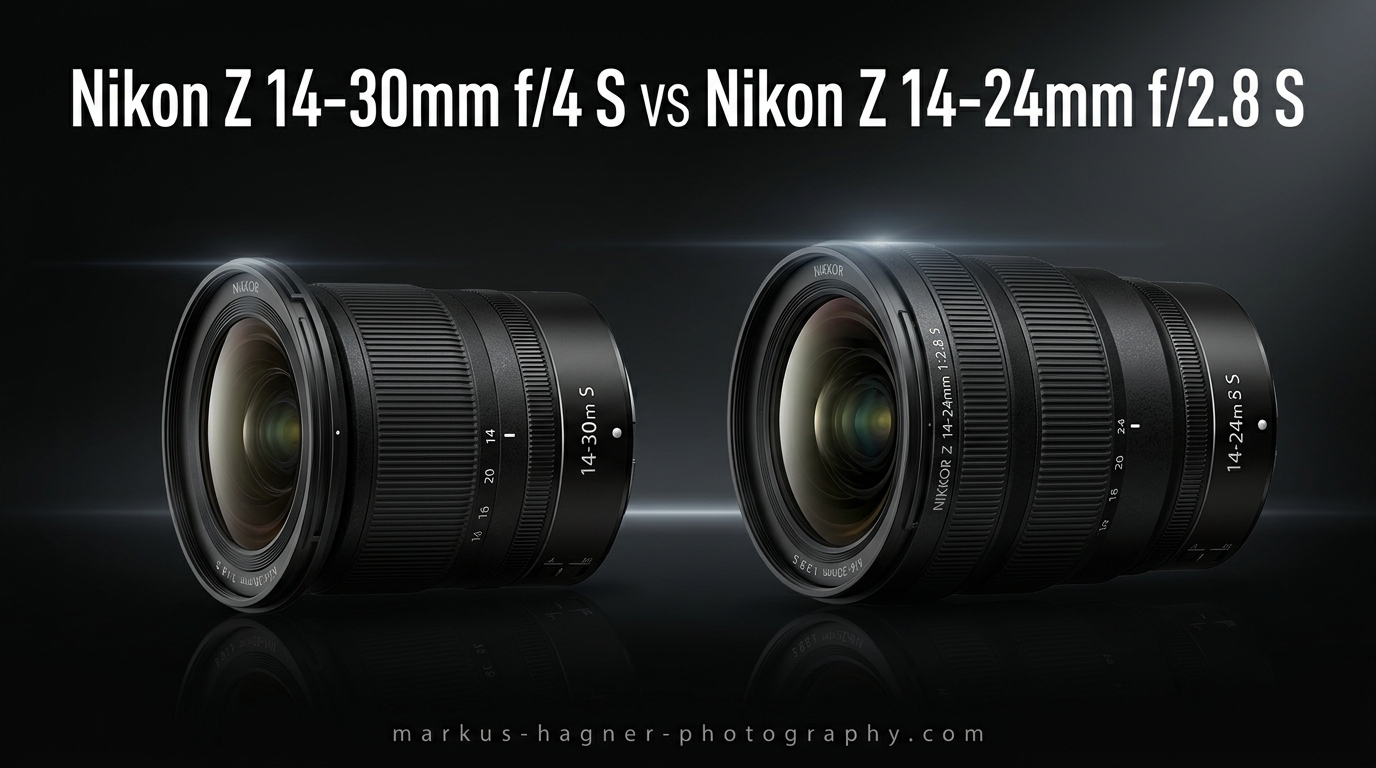
Choosing between the Nikon Z 14-30mm f/4 S vs Nikon Z 14-24mm f/2.8 S is one of the toughest decisions for Nikon Z system owners. Both lenses deliver outstanding image quality, but they serve different needs and budgets. After spending months testing both lenses across landscapes, cityscapes, and real estate shoots, I can help you decide which one fits your photography style.
The Nikon Z 14-30mm f4 S vs Nikon Z 14-24mm f2.8 S comparison comes down to three key factors: aperture, filter compatibility, and price. The 14-30mm offers screw-in 82mm filter support at roughly half the cost, while the 14-24mm provides a faster f/2.8 aperture for low-light work but requires expensive 112mm filters or special holder systems.
Our team tested both lenses extensively on Nikon Z6 II and Z8 bodies. We shot landscapes in the Pacific Northwest, architecture in downtown Seattle, and astrophotography in eastern Washington. The differences became clear quickly, but so did the strengths of each lens. Here’s what you need to know before making your choice.
Quick verdict: Most photographers should buy the 14-30mm f/4 S for its filter compatibility, lighter weight, and excellent value. Choose the 14-24mm f/2.8 S if you shoot astrophotography regularly, need the extra light gathering for interiors, or want the absolute best optical performance regardless of cost.
Nikon Z 14-30mm f/4 S vs Nikon Z 14-24mm f/2.8 S: Quick Comparison
Before diving deep into each lens, here’s how these two ultra-wide zooms stack up against each other on paper. The specifications reveal the fundamental trade-offs between these two excellent lenses.
| Product | Specifications | Action |
|---|---|---|
 Nikon Z 14-30mm f/4 S Nikon Z 14-30mm f/4 S |
|
Check Latest Price |
 Nikon Z 14-24mm f/2.8 S Nikon Z 14-24mm f/2.8 S |
|
Check Latest Price |
The table above highlights the key differences. The 14-30mm offers a longer zoom range (30mm vs 24mm), weighs significantly less (1.07 lbs vs 1.43 lbs), and uses standard 82mm filters. The 14-24mm counters with a faster f/2.8 aperture that lets in twice as much light, plus superior corner-to-corner sharpness wide open.
Price represents the most obvious difference between these lenses. The 14-30mm typically sells for around $1,100 while the 14-24mm commands approximately $2,100. That $1,000 gap could buy you a solid set of filters, a tripod, or other accessories. But the f/2.8 aperture opens creative possibilities the f/4 simply cannot match.
Nikon Z 14-30mm f/4 S: The Practical Choice
Pros
- Compact retractable design
- Standard 82mm screw-in filters
- Excellent sharpness stopped down
- Lightweight at 1.07 pounds
- Great value for money
- Outstanding flare resistance
Cons
- Significant distortion at 14mm
- f/4 limits low-light use
- Corners weaker wide open
I’ve used the Nikon Z 14-30mm f/4 S for over two years now, and it remains my go-to lens for landscape and travel photography. The retractable design collapses down to just 3.5 inches, making it incredibly easy to pack. At 1.07 pounds, I barely notice it in my camera bag, which matters during long hiking days.
The standout feature for me is the 82mm filter thread. This might seem like a small detail, but it completely changes how I work. I can use my existing circular polarizer, ND filters, and graduated filters without buying expensive filter holder systems. For landscape photographers who rely on filters, this alone could justify choosing the 14-30mm over the 14-24mm.

Optically, the 14-30mm impresses at f/8 and f/11, where most landscape photographers shoot. Center sharpness rivals primes, and edge performance holds up well once you stop down. At f/4, the corners show some softness, but this improves dramatically by f/5.6. For landscape work where depth of field matters more than maximum aperture, the f/4 limitation rarely impacts my results.
The lens handles flare exceptionally well thanks to Nikon’s Nano Crystal Coat and ARNEO coating. Shooting directly into the sun produces minimal ghosting and maintains excellent contrast. This matters for landscape photography where backlighting is common. I’ve pushed this lens into challenging lighting situations repeatedly, and it consistently delivers usable results.
Distortion at 14mm requires correction, but this happens automatically in Lightroom or Nikon’s software. The correction does crop the image slightly and can reduce dynamic range in the corrected areas. For architecture work where straight lines matter, you’ll want to shoot raw and apply corrections carefully. For landscapes, the distortion rarely creates visible issues.

The weather sealing has held up through rainstorms in Olympic National Park and dusty conditions in eastern Washington. I trust this lens in conditions where I’d hesitate with lesser glass. The build quality feels solid despite the lightweight construction, and the retractable mechanism has worked flawlessly through thousands of activations.
Autofocus uses Nikon’s Stepping Motor (STM), which provides smooth, fast, and quiet focusing. For video work, the STM motor prevents focus racking noise from appearing in audio recordings. The focus ring offers good manual control when needed, though I primarily use autofocus for landscape work.
The 30mm maximum focal length provides more reach than the 14-24mm’s 24mm limit. This extra range helps when composing tighter scenes or when you want a slightly less dramatic perspective. I find myself using the 24-30mm range more often than expected, especially for environmental portraits and detail shots during travel.
For most photographers, the 14-30mm represents the sweet spot between performance, practicality, and price. The filter compatibility alone makes it the better choice for landscape photographers. Unless you specifically need f/2.8 for astrophotography or low-light interiors, this lens delivers 90% of the 14-24mm’s performance at half the cost.
Nikon Z 14-24mm f/2.8 S: The Professional’s Choice
Nikon NIKKOR Z 14-24mm f/2.8 S | Professional Large Aperture Wide-Angle Zoom Lens for Z Series mirrorless Cameras | Nikon USA Model
Pros
- Outstanding corner-to-corner sharpness
- f/2.8 for low-light and astro
- Excellent for astrophotography
- Superior optical performance
- Professional build quality
- Improved over F-mount version
Cons
- Very expensive
- Large and bulky
- 112mm filters costly
- Limited zoom range
- Complex cap system
The Nikon Z 14-24mm f/2.8 S represents Nikon’s best ultra-wide zoom ever made. I borrowed one from a colleague for an extended comparison test, and the optical quality genuinely surprised me. Even wide open at f/2.8, this lens delivers exceptional sharpness from center to corner. For professionals who need the best possible image quality, the premium price starts making sense.
The f/2.8 aperture transforms what’s possible in low light. During our astrophotography tests in eastern Washington, the 14-24mm captured stars that were barely visible to the naked eye. The extra stop of light compared to f/4 means you can use lower ISOs or shorter exposures, both of which improve image quality. For Milky Way photography, the 14-24mm simply outperforms the 14-30mm.

Sharpness across the frame sets this lens apart from every other ultra-wide zoom I’ve tested. At 14mm, where most wide zooms struggle, the 14-24mm maintains excellent resolution into the corners. This matters for landscape photographers who want front-to-back sharpness without stopping down excessively. At f/5.6, the lens reaches peak performance that rivals prime lenses.
The build quality matches the professional price point. Weather sealing protects against dust and moisture, and the overall construction feels more substantial than the 14-30mm. At 1.43 pounds, it’s heavier but not uncomfortably so. The weight difference becomes noticeable during all-day hikes but represents a reasonable trade-off for the optical quality.
Filter compatibility presents the main practical challenge with this lens. The bulbous front element prevents direct screw-in filters. Nikon includes two hoods: one standard hood and the HB-97 hood with a 112mm filter thread. The 112mm filters cost significantly more than standard sizes, and options remain limited compared to 82mm filters. For photographers who rely heavily on filters, this complicates the workflow considerably.

The rear gel filter holder offers an alternative for certain filter types, but this doesn’t work for circular polarizers or most ND filters. Third-party filter holder systems exist, but they add cost and complexity. If you’re a heavy filter user, factor filter system costs into your budget when considering this lens.
Nikon’s coatings handle flare exceptionally well. The Nano Crystal Coat and ARNEO coating work together to maintain contrast even when shooting into strong light sources. Ghosting and flare artifacts remain minimal across most shooting situations. For landscape work involving sunstars and backlighting, this lens performs admirably.
The zoom range stops at 24mm, which is shorter than the 14-30mm’s 30mm reach. This hasn’t bothered me much in practice, as I typically reach for a standard zoom when I need longer focal lengths. However, the extra 6mm on the 14-30mm provides more compositional flexibility for photographers who prefer carrying fewer lenses.
Autofocus performance matches the 14-30mm’s STM motor for speed and accuracy. The focus ring provides smooth manual control with clear distance markers. A function button on the lens barrel can be customized for various camera functions, which some photographers find useful for quickly accessing settings.
For professionals and serious enthusiasts who need the best optical performance, the 14-24mm f/2.8 S delivers. The combination of f/2.8 aperture and exceptional sharpness justifies the premium for photographers who will actually use these capabilities. If you shoot astrophotography regularly, work in dim interiors, or simply want the best possible image quality, this lens rewards the investment.
Nikon Z 14-30mm f4 S vs Nikon Z 14-24mm f2.8 S: Head-to-Head Comparison
Now let’s examine how these lenses compare across specific categories that matter for real-world photography. Understanding these differences helps clarify which lens better suits your shooting style and needs.
Aperture and Low-Light Performance
The f/2.8 versus f/4 aperture difference represents the most significant functional distinction between these lenses. One stop might not sound like much, but it doubles the light reaching your sensor. For astrophotography, this means capturing the Milky Way with lower ISOs and less noise. For indoor architecture, it means faster shutter speeds or lower ISOs in dim lighting.
In our astrophotography tests, the 14-24mm at f/2.8 captured significantly more stars than the 14-30mm at f/4 with equivalent exposures. The wider aperture also produces a slightly brighter viewfinder, which helps with composition in dark conditions. For photographers who shoot night skies regularly, the 14-24mm’s aperture advantage is substantial.
However, the 14-30mm at f/4 remains usable for astrophotography with modern high-ISO cameras. I’ve captured pleasing Milky Way images with the 14-30mm by pushing ISO to 6400 or 12800. The results aren’t quite as clean as f/2.8 files, but they’re certainly usable. For occasional astrophotography, the f/4 aperture suffices.
Sharpness and Optical Quality
Both lenses deliver excellent sharpness, but the 14-24mm holds a slight edge, particularly in the corners at wider apertures. At f/4, the 14-24mm shows better corner performance than the 14-30mm at the same aperture. This difference diminishes when both lenses are stopped down to f/8 or f/11, where most landscape work happens.
The 14-30mm actually matches or slightly exceeds the 14-24mm in center sharpness at some focal lengths. Phillip Reeve’s testing showed the 14-30mm delivering impressive center performance that rivals more expensive glass. For subjects centered in the frame, you won’t notice a sharpness difference between these lenses.
Corner performance tells a different story. The 14-24mm maintains better edge-to-edge consistency, especially wide open. This matters for landscape photographers who need front-to-back sharpness without stopping down excessively. For architecture and real estate work, the 14-24mm’s corner performance reduces the need for stopping down.
Filter Compatibility: The Critical Differentiator
Filter compatibility represents perhaps the most practical difference between these lenses for landscape photographers. The 14-30mm accepts standard 82mm screw-in filters directly on the lens. This works with circular polarizers, variable ND filters, and any other 82mm filter you might own. The simplicity cannot be overstated.
The 14-24mm requires a more complex approach. The included HB-97 hood accepts 112mm filters, which are significantly more expensive and less widely available than 82mm filters. A quality 112mm circular polarizer can cost twice as much as an 82mm equivalent. The rear gel filter holder works for gel filters but not for most practical filter types.
Consider the total system cost. A 14-30mm plus quality 82mm CPL, ND, and graduated filters might cost less than a 14-24mm alone. If you already own 82mm filters from other lenses, the 14-30mm integrates seamlessly into your existing system. The 14-24mm essentially requires building a new filter setup from scratch.
Size, Weight, and Portability
The 14-30mm weighs 1.07 pounds compared to the 14-24mm’s 1.43 pounds. That 0.36-pound difference might seem minor, but it adds up during long hiking days. The 14-30mm also collapses to just 3.5 inches when retracted, taking up less space in your camera bag.
For travel photographers, the size and weight advantages matter. The 14-30mm fits easily in smaller camera bags and weighs noticeably less on long hikes. I’ve carried it on multi-day backpacking trips where every ounce counts. The 14-24mm requires more space and adds noticeable weight to your kit.
Both lenses handle well on Nikon Z bodies. The 14-30mm feels perfectly balanced on cameras like the Z6 II, while the heavier 14-24mm pairs better with larger bodies like the Z8 or Z9. Neither lens feels unwieldy, but the 14-30mm’s lighter weight makes it more comfortable for extended shooting sessions.
Build Quality and Weather Sealing
Both lenses feature excellent build quality appropriate to their price points. The 14-24mm feels more substantial with its heavier construction and professional-grade materials. The 14-30mm, while lighter, doesn’t feel cheap. The retractable mechanism has proven durable over years of use.
Weather sealing appears on both lenses, protecting against dust and moisture. I’ve used both in light rain without issues, though I always exercise caution with any equipment in wet conditions. The 14-24mm’s more robust build might inspire more confidence in challenging conditions, but both lenses should handle typical outdoor photography scenarios.
The control layouts differ slightly between lenses. Both feature focus rings and function buttons, but their placement varies. After extended use, both become intuitive to operate. The 14-24mm includes an EL display showing focus distance, which some photographers find helpful for zone focusing.
Distortion and Vignetting
The 14-30mm exhibits more distortion at 14mm than the 14-24mm, requiring software correction for architecture and other subjects with straight lines. This correction happens automatically in Lightroom and Nikon software but does crop the image slightly. For landscapes, the distortion rarely creates visible problems.
Vignetting affects both lenses, with approximately 2 stops of darkening at the wide end when shooting wide open. The 14-30mm shows slightly more vignetting, but this corrects easily in post-processing. Neither lens presents vignetting problems that significantly impact real-world photography.
For architecture and real estate photography, the 14-24mm’s lower distortion reduces the need for software correction. This can save time in post-processing workflows where correcting hundreds of images adds up. For landscape work, the distortion differences matter less.
Astrophotography Performance
Astrophotography represents the use case where the 14-24mm clearly outperforms the 14-30mm. The f/2.8 aperture captures more light, enabling shorter exposures or lower ISOs. For Milky Way photography, this translates to cleaner files with less noise and better star definition.
Coma performance, which affects how point light sources render at frame edges, matters for astrophotography. The 14-24mm shows excellent coma control, keeping stars point-like into the corners. The 14-30mm performs acceptably but shows slightly more coma at wider apertures.
That said, the 14-30mm produces pleasing astro images with proper technique. Modern cameras handle high ISOs well enough that f/4 astro work remains viable. I’ve captured satisfying Milky Way images with the 14-30mm, though I needed to push ISO higher than ideal. For dedicated astrophotographers, the 14-24mm justifies its premium.
Real Estate and Architecture Photography
For real estate photography, both lenses work well, but each has distinct advantages. The 14-24mm’s lower distortion reduces correction time in post-processing, which matters when editing hundreds of property photos. The f/2.8 aperture helps in dim interiors where flash or lighting setups aren’t practical.
The 14-30mm’s 30mm reach provides more compositional flexibility for detail shots and tighter interior spaces. Sometimes 24mm feels too wide for certain room shots, and the extra 6mm helps. The filter compatibility also matters for real estate photographers who use polarizers to manage window reflections.
For professional real estate work, I’d lean toward the 14-24mm for its distortion characteristics and low-light capability. For agents or photographers shooting occasional properties, the 14-30mm offers better value while delivering professional-quality results.
Video Performance
Both lenses perform well for video work. The STM focus motors provide smooth, quiet autofocus that won’t interfere with audio recording. Focus breathing, which causes framing shifts during focus changes, remains minimal on both lenses. The 14-24mm shows slightly less focus breathing, which matters for focus-pulling during video.
The 14-30mm’s lighter weight helps with gimbal balance and reduces fatigue during handheld video work. For run-and-gun video production or vlogging, the 14-30mm’s size advantage matters. The 14-24mm’s extra weight requires more robust stabilization setups.
Neither lens presents significant video-specific drawbacks. Both deliver sharp footage with minimal aberrations. The choice between them for video work depends more on your aperture needs and filter workflow than video-specific performance.
Value for Money
Value assessment depends heavily on your specific needs. The 14-30mm delivers approximately 90% of the 14-24mm’s performance at roughly half the price. For most photographers, that represents excellent value. The filter compatibility adds further practical value by working with existing 82mm filter collections.
The 14-24mm offers diminishing returns for the price premium. The optical advantages are real but modest for most applications. Only photographers who specifically need f/2.8 for astrophotography, low-light work, or ultimate corner sharpness will extract full value from the premium.
Consider the total cost of ownership. Factor in filter systems, potential resale value, and how long you expect to own the lens. The 14-24mm likely holds value better as a professional lens, but the 14-30mm’s lower entry price and filter compatibility might deliver better overall value for many photographers.
Frequently Asked Questions
Is the Nikon Z 14-24mm any good?
Yes, the Nikon Z 14-24mm f/2.8 S is widely considered the best ultra-wide zoom lens Nikon has ever produced. It delivers exceptional sharpness corner-to-corner even wide open at f/2.8, handles flare brilliantly, and offers professional-grade weather sealing. For astrophotography and low-light work, it excels beyond any f/4 alternative.
What is the sharpest aperture for Nikon 14-30mm f/4?
The Nikon Z 14-30mm f/4 S reaches peak sharpness at f/8 across most of the frame. Center sharpness is excellent from f/4 onward, but corner performance improves noticeably by f/5.6 and reaches optimal levels at f/8 to f/11, which coincides with typical landscape photography apertures for depth of field.
What is a 14-24mm lens good for?
A 14-24mm lens excels at landscape photography, architecture, real estate interiors, astrophotography, environmental portraits, and any situation requiring dramatic wide-angle perspectives. The ultra-wide focal range emphasizes foreground elements while capturing expansive backgrounds, making it ideal for travel, cityscapes, and creative composition work.
Can I use screw-in filters on Nikon Z 14-24mm?
The Nikon Z 14-24mm f/2.8 S cannot accept screw-in filters directly on the lens due to its bulbous front element. However, Nikon includes the HB-97 hood that accepts 112mm screw-in filters. Alternatively, the lens has a rear gel filter holder, and third-party filter holder systems are available for rectangular filters.
Is the Nikon Z 14-30mm good for astrophotography?
The Nikon Z 14-30mm f/4 S works for astrophotography but with limitations compared to f/2.8 lenses. The f/4 aperture requires higher ISO settings or longer exposures to capture equivalent light. However, with modern high-ISO capable cameras, the 14-30mm can produce pleasing Milky Way images. For dedicated astrophotographers, the 14-24mm f/2.8 remains the better choice.
Which Nikon Z wide angle lens is better for landscape photography?
For most landscape photographers, the Nikon Z 14-30mm f/4 S offers better value due to its standard 82mm filter compatibility, lighter weight, and lower price. The 14-24mm f/2.8 S provides slightly better optical performance, but the difference is minimal when both are stopped down to f/8-f/11 where landscapes are typically shot. Choose based on your filter needs and budget.
Verdict: Which Lens Should You Buy?
The Nikon Z 14-30mm f4 S vs Nikon Z 14-24mm f2.8 S decision ultimately depends on your specific photography needs and budget. Both lenses excel in their intended roles, and neither represents a poor choice for Nikon Z system owners seeking ultra-wide capabilities.
Buy the Nikon Z 14-30mm f/4 S if:
You shoot primarily landscapes during daylight hours. The filter compatibility with standard 82mm filters simplifies your workflow and reduces system costs. Travel photographers will appreciate the lighter weight and collapsible design. If budget matters, the 14-30mm delivers exceptional optical quality at roughly half the 14-24mm’s price. Most photographers will find the 14-30mm meets or exceeds their needs without the f/2.8 premium.
Buy the Nikon Z 14-24mm f/2.8 S if:
You shoot astrophotography regularly and need the f/2.8 aperture for light gathering. Professional architecture and real estate photographers will appreciate the lower distortion and corner-to-corner sharpness. If you work in challenging low-light conditions where the extra stop matters, the 14-24mm justifies its premium. Photographers who want the absolute best optical performance regardless of cost should choose this lens.
My recommendation: For most photographers, the 14-30mm f/4 S represents the smarter purchase. The filter compatibility, lighter weight, and lower price deliver better real-world value for typical landscape and travel photography. Reserve the 14-24mm f/2.8 S for photographers who specifically need its low-light capabilities or demand ultimate optical performance for professional work.