
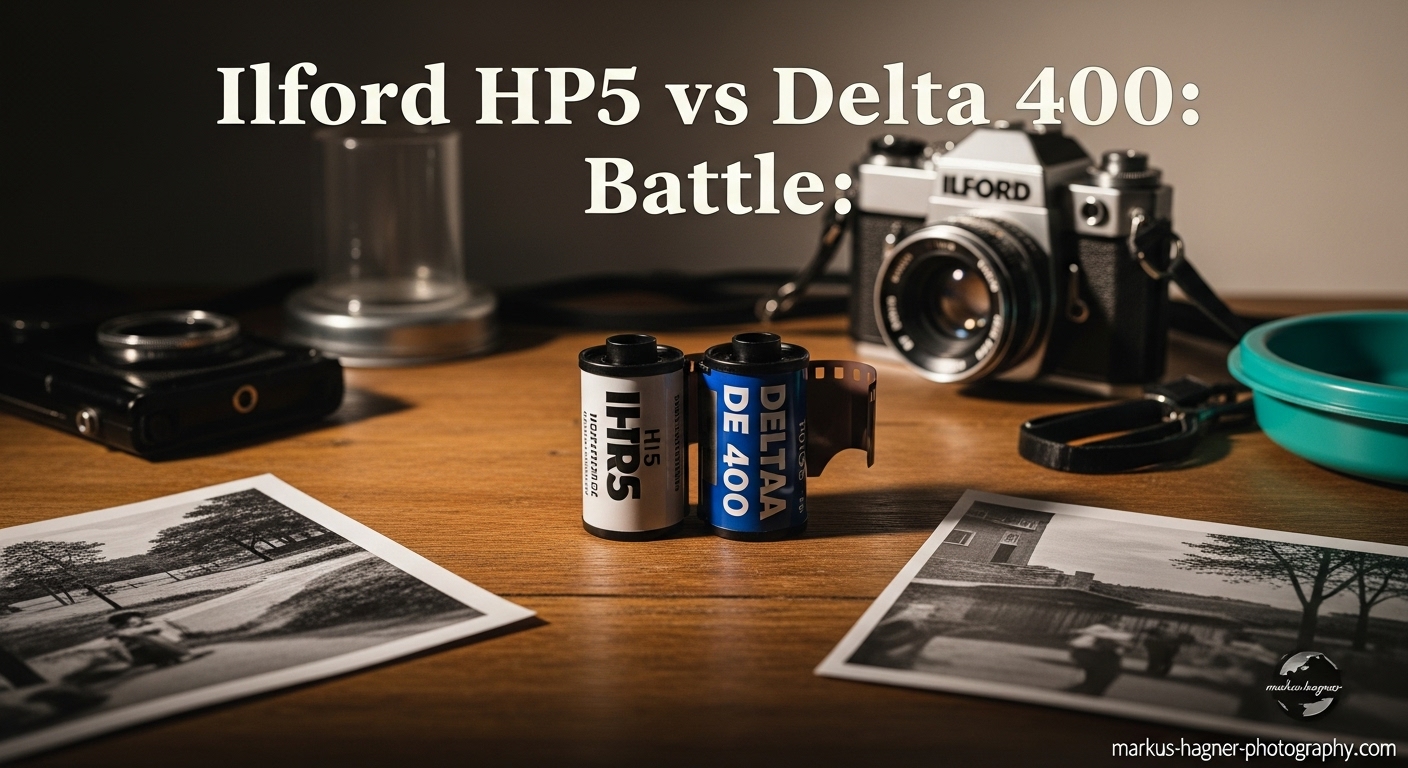
Hey there, fellow film photography enthusiasts! I’m excited to dive into one of the most debated topics in the analog photography world: Ilford HP5 Plus versus Delta 400. As someone who has shot countless rolls of both films over the years, I’m here to share my firsthand experience and insights to help you understand which of these iconic black and white films might be the better choice for your photography.
When I first started exploring these films, I was amazed at how differently they performed despite sharing the same ISO 400 rating. I’ve shot everything from portraits to street photography with both films, and I’ve discovered that each has its own unique personality and strengths that cater to different shooting styles and preferences.
A Brief History of These Iconic Films
Before we dive into the nitty-gritty details, let me give you a quick overview of where these films fit in Ilford’s history.
Ilford HP5 Plus has been around for decades, with its origins tracing back to the 1970s. It’s part of Ilford’s traditional grain film lineup and has earned a reputation as a workhorse film that’s reliable, versatile, and forgiving. I remember when I first started shooting film—HP5 Plus was one of the first films I tried, and I was immediately impressed by its flexibility and the classic look it produced.
Ilford Delta 400, on the other hand, is a relative newcomer, introduced in the 1990s as part of Ilford’s Delta series of films. It uses what’s called “tabular grain” technology, which was a significant advancement in film emulsion at the time. When I first tried Delta 400, I was blown away by its fine grain and sharpness, which set it apart from more traditional films like HP5 Plus.
Both films have evolved over the years, with improvements to their emulsions, but they’ve maintained their core characteristics that photographers have come to love.
Key Specifications at a Glance
To give you a quick overview, here’s how these two films stack up in terms of key specifications:
| Feature | Ilford HP5 Plus | Ilford Delta 400 |
|---|---|---|
| Film Type | Traditional grain | Tabular grain (T-grain) |
| ISO Rating | 400 | 400 |
| Grain Structure | Medium grain, classic appearance | Fine grain, modern appearance |
| Sharpness | Good | Excellent |
| Pushing Capability | Excellent (up to EI 3200) | Good (up to EI 1600) |
| Pulling Capability | Good (down to EI 200) | Good (down to EI 200) |
| Tonal Range | Wide, with rich midtones | Wide, with excellent highlight detail |
| Contrast | Medium to high | Medium |
| Formats Available | 35mm, 120, sheet film | 35mm, 120, sheet film |
Now, let’s dive deeper into each of these aspects to see how they translate to real-world performance.
Grain Structure and Sharpness: The Visual Signature
One of the most noticeable differences between these two films is their grain structure and sharpness, which gives each its distinctive visual signature.
Ilford HP5 Plus uses traditional grain technology, resulting in a more pronounced grain structure that many photographers find appealing for its classic look. When I first started shooting HP5 Plus, I was immediately drawn to this grain—it has a certain character that reminds me of the iconic black and white photographs from the mid-20th century. The grain is more noticeable, especially in larger prints, but it has a pleasing, organic quality that adds texture and depth to images.
Ilford Delta 400, on the other hand, uses tabular grain technology, which produces much finer grain that is less apparent in the final image. I discovered that when I want a cleaner, more modern look with excellent sharpness, Delta 400 is my go-to choice. The grain is so fine that it’s barely noticeable in smaller prints, and even in larger prints, it has a more subtle, refined appearance compared to HP5 Plus.
In terms of sharpness, Delta 400 has a clear advantage due to its tabular grain structure. I’ve found that when I need maximum sharpness and detail, especially in landscape or architectural photography, Delta 400 delivers consistently excellent results. HP5 Plus is certainly sharp enough for most applications, but it doesn’t quite match the crispness of Delta 400.
Tonal Range and Contrast: Capturing the Light
Both films offer excellent tonal range, but they render tones differently, which can significantly impact the final look of your images.
Ilford HP5 Plus has a beautiful tonal range with rich, detailed midtones that I find particularly appealing for portrait work. When I shoot portraits with HP5 Plus, I’m always impressed by how it renders skin tones with a natural, smooth quality. The contrast is generally medium to high, depending on how you develop it, which can create dramatic images with deep blacks and bright whites.
Ilford Delta 400 also offers an excellent tonal range, but with a different character. I’ve found that Delta 400 excels at retaining detail in the highlights, which makes it a great choice for high-contrast scenes. The contrast is generally more moderate compared to HP5 Plus, resulting in a more gradual transition from shadows to highlights. This can be particularly useful in scenes with challenging lighting conditions.
I remember shooting a landscape at sunset with both films side by side. With HP5 Plus, I got a more dramatic image with deep shadows and bright highlights, while Delta 400 captured more subtle tonal variations, particularly in the bright sky. Neither was necessarily better—they just offered different interpretations of the same scene.
Pushing and Pulling Capabilities: Flexibility in Challenging Light
One of the great advantages of shooting black and white film is the ability to push or pull the film to adapt to different lighting conditions. Both HP5 Plus and Delta 400 offer good flexibility in this regard, but with some differences.
Ilford HP5 Plus is renowned for its pushing capabilities. I’ve pushed HP5 Plus to EI 800, 1600, and even 3200 with excellent results. When I discovered how well HP5 Plus holds up when pushed, it opened up a whole new world of low-light photography for me. Even at EI 3200, while the grain becomes more pronounced, it retains a surprising amount of detail and tonal range. The grain structure, when pushed, has a gritty, authentic quality that many photographers find appealing.
Ilford Delta 400 can also be pushed, but not as aggressively as HP5 Plus. I’ve found that pushing Delta 400 to EI 800 works well, and even EI 1600 can produce usable results, but beyond that, the image quality deteriorates more quickly compared to HP5 Plus. When pushed, Delta 400 maintains its fine grain structure better than HP5 Plus, but it loses some of the tonal range and detail that make it special.
For pulling, both films perform well down to EI 200. I’ve pulled both films in bright, contrasty situations, and they both retain excellent detail in the highlights while opening up the shadows. HP5 Plus tends to maintain more of its characteristic look when pulled, while Delta 400 becomes even finer in grain and slightly lower in contrast.
Development Considerations: Getting the Most Out of Your Film
How you develop these films can significantly impact the final results, and each film responds differently to various developers and development techniques.
Ilford HP5 Plus is quite forgiving when it comes to development. I’ve developed HP5 Plus in a variety of developers, including Ilford’s own ID-11, D-76, HC-110, and even Rodinal. Each developer brings out different qualities in the film. For instance, I’ve found that ID-11 or D-76 produces a more balanced result with good sharpness and moderate grain, while Rodinal enhances the grain structure for a more classic, gritty look.
Ilford Delta 400 is more sensitive to developer choice. I’ve discovered that it performs best with finer-grain developers like ID-11, D-76, or Ilford’s Microphen. When I use these developers, Delta 400 produces exceptionally fine grain and excellent sharpness. With more aggressive developers like Rodinal, the grain becomes more pronounced, which can be desirable if you’re looking for a different aesthetic, but it somewhat defeats the purpose of shooting a tabular grain film.
Development time and agitation also play a crucial role. I’ve found that HP5 Plus is more forgiving of variations in development time and agitation technique, while Delta 400 requires more precise control to achieve optimal results. This isn’t to say that Delta 400 is difficult to develop—it just requires a bit more attention to detail.
Real-World Shooting Experiences
Numbers and technical specifications are one thing, but how do these films actually perform in real-world shooting situations? Let me share some of my experiences with both films.
Street Photography
I’ve shot countless rolls of both films on the streets, and each has its strengths. HP5 Plus, with its classic look and forgiving nature, is my go-to when I want that timeless street photography aesthetic. I remember shooting in a bustling market with HP5 Plus pushed to EI 800, and the results were stunning—gritty yet detailed, with a mood that perfectly captured the energy of the place.
Delta 400, on the other hand, is my choice when I want cleaner, sharper street images with more subtle tonal variations. I’ve shot urban landscapes with Delta 400 that captured incredible detail in both shadows and highlights, resulting in images that have a more modern, refined look.
Portrait Photography
For portraits, I find myself reaching for HP5 Plus more often. There’s something about the way it renders skin tones with its rich midtones that I find particularly appealing. I’ve shot portraits with HP5 Plus that have a timeless quality, reminiscent of classic portraits from the film era.
That said, Delta 400 can produce beautiful portraits as well, especially when you want a more contemporary look with finer detail. I’ve used Delta 400 for environmental portraits where I needed to capture both the subject and their surroundings with excellent clarity.
Landscape Photography
In landscape photography, I find that Delta 400 often has the edge due to its finer grain and excellent sharpness. I’ve shot landscapes with Delta 400 that captured incredible detail, from the texture of rocks in the foreground to the subtle variations in the sky.
HP5 Plus can also produce stunning landscapes, especially when you’re going for a more dramatic, high-contrast look. I’ve shot seascapes with HP5 Plus that had a powerful, moody quality that perfectly matched the stormy conditions.
Sample Image Comparisons
I’ve taken both films out in various shooting scenarios to see how they perform in real-world conditions. Here are my observations:
Bright, Sunny Conditions
In bright, sunny conditions, both films perform well, but with different characteristics. HP5 Plus tends to produce images with more contrast and a classic look, with deeper shadows and brighter highlights. I’ve shot landscapes on sunny days with HP5 Plus that have a dramatic, almost graphic quality.
Delta 400, in the same conditions, produces images with more subtle tonal variations and finer detail. I’ve found that it retains more detail in both highlights and shadows, resulting in a more balanced image that often requires less post-processing.
Overcast Conditions
In overcast conditions, HP5 Plus can sometimes produce flatter images if not developed properly. However, I’ve discovered that with the right development (sometimes with slightly increased development time), HP5 Plus can produce beautiful, moody images with rich tonality even in flat light.
Delta 400 tends to handle overcast conditions more gracefully straight out of the box, producing images with good contrast and excellent detail. I’ve shot cityscapes on overcast days with Delta 400 that had a beautiful, luminous quality despite the lack of direct sunlight.
Low-Light Conditions
This is where HP5 Plus really shines. I’ve shot in dimly lit interiors and at dusk with HP5 Plus pushed to EI 1600, and the results have been consistently impressive. The grain becomes more pronounced, but it has a character that adds to the mood of the image rather than detracting from it.
Delta 400 can also perform well in low light, especially when pushed to EI 800. I’ve found that it maintains its fine grain structure better than HP5 Plus when pushed, but it doesn’t quite match the HP5 Plus’s ability to retain detail and tonal range at higher ISOs.
Also Read: Canon EOS 1N vs EOS 3
Pros and Cons: At a Glance
Ilford HP5 Plus
Pros:
- Classic, timeless look with appealing grain structure
- Excellent pushing capabilities (up to EI 3200)
- Forgiving of development variations
- Rich midtones, great for portraits
- Generally more affordable than Delta 400
- Proven reliability over decades of use
Cons:
- More pronounced grain structure
- Less sharp than Delta 400
- Can lose highlight detail if overdeveloped
- More traditional look may not suit all subjects
Ilford Delta 400
Pros:
- Fine grain structure for a cleaner look
- Excellent sharpness and detail
- Great highlight retention
- More modern, versatile appearance
- Consistent results with proper development
- Performs well in a variety of lighting conditions
Cons:
- Less forgiving of development variations
- More expensive than HP5 Plus
- Limited pushing capabilities compared to HP5 Plus
- Can look too “clean” for some subjects
- Requires more precise exposure for optimal results
Who Should Use Which Film?
Based on my extensive experience with both films, here’s my recommendation on who might be better served by each film:
Ilford HP5 Plus is Perfect For:
- Photographers who love a classic, timeless black and white aesthetic
- Those who frequently shoot in low light and need to push their film
- Portrait photographers looking for rich midtones and pleasing skin tones
- Street photographers who want a gritty, documentary look
- Those on a tighter budget
- Beginners who want a forgiving film to learn with
Ilford Delta 400 is Perfect For:
- Photographers who prefer a cleaner, more modern look
- Those who need maximum sharpness and fine detail
- Landscape and architectural photographers
- Those who shoot in high-contrast situations and need good highlight retention
- Photographers with more experience in film development
- Those who want to make larger prints with minimal grain
Also Read: Panasonic G9 vs GH5
Final Verdict: Which Film Reigns Supreme?
After shooting countless rolls of both films, I can confidently say that there’s no clear “winner” in the HP5 Plus vs Delta 400 debate. The better film depends entirely on your personal aesthetic preferences and shooting style.
If you’re drawn to the classic, timeless look of traditional black and white photography with its characteristic grain and rich midtones, Ilford HP5 Plus is an excellent choice that has stood the test of time for good reason. It’s a versatile, forgiving film that can produce stunning results in a wide range of conditions.
However, if you prefer a cleaner, more modern look with excellent sharpness and fine grain, Ilford Delta 400 is the way to go. It’s a technically superior film in terms of grain structure and sharpness, and it excels in situations where you need to capture a wide tonal range with good detail retention.
Personally, I keep both films in my fridge and choose between them based on the specific requirements of each shoot. HP5 Plus comes with me when I’m going for a classic, moody look or when I anticipate needing to push the film, while Delta 400 is my choice when I need maximum sharpness and a cleaner aesthetic.
FAQ: Your Questions Answered
Which film is better for beginners?
I generally recommend HP5 Plus for beginners because it’s more forgiving of exposure and development variations. Its classic look is also appealing to those just starting their film photography journey.
Can I develop both films with the same developer?
Yes, both films can be developed with the same developers, such as ID-11 or D-76. However, they may require slightly different development times for optimal results.
Which film scans better?
Delta 400 generally scans better due to its finer grain structure, which can result in cleaner digital files. HP5 Plus can also scan well, but its more pronounced grain can be more challenging for some scanners.
Are these films still worth shooting in 2026?
Absolutely! Both films offer unique characteristics that digital photography can’t fully replicate. They’re excellent choices for photographers who appreciate the tactile experience of film and the distinctive look it provides.
Which film is better for pushing?
HP5 Plus is definitely better for pushing, with excellent results even at EI 3200. Delta 400 can be pushed to EI 800 or EI 1600, but it doesn’t maintain its quality as well at higher ISOs.
Pro Photography Tips for Getting the Most Out of Your Film
Whether you choose HP5 Plus or Delta 400, here are some tips I’ve learned over the years to help you get the best results:
- Expose for the shadows: Both films have good exposure latitude, but I’ve found that exposing for the shadows and developing for the highlights gives the best results.
- Use a reliable light meter: While both films are forgiving, accurate exposure is key to getting the most out of them. I always carry a handheld light meter when shooting with these films.
- Experiment with different developers: Each film responds differently to various developers. I encourage you to experiment to find the combination that gives you the look you’re after.
- Keep development notes: I keep detailed notes of my development times, temperatures, and agitation techniques. This has helped me refine my process and achieve more consistent results.
- Store your film properly: Both films benefit from proper storage. I keep my unexposed film in the refrigerator and exposed film in a cool, dry place until I’m ready to develop it.
- Try different formats: Both films are available in 35mm, 120, and sheet film formats. I’ve enjoyed shooting both films in different formats, and each offers a unique experience.
- Don’t be afraid to push: Both films can be pushed, and doing so can open up new creative possibilities. I’ve discovered some of my favorite looks by pushing these films.
Final Thoughts
I hope this in-depth comparison has helped you understand the strengths and weaknesses of both Ilford HP5 Plus and Delta 400. Both are exceptional films that can produce stunning images in the right hands.
Remember, the best film is the one that matches your personal vision and aesthetic preferences. I encourage you to try both films (if you haven’t already) and see which one resonates with you more. Many photographers, myself included, find room for both in their photography toolkit.
Don’t forget to bookmark this page for future reference, as I’ll be updating it with new insights and sample images as I continue to shoot with both films.
Happy shooting, and I’d love to hear about your experiences with either film in the comments below!