
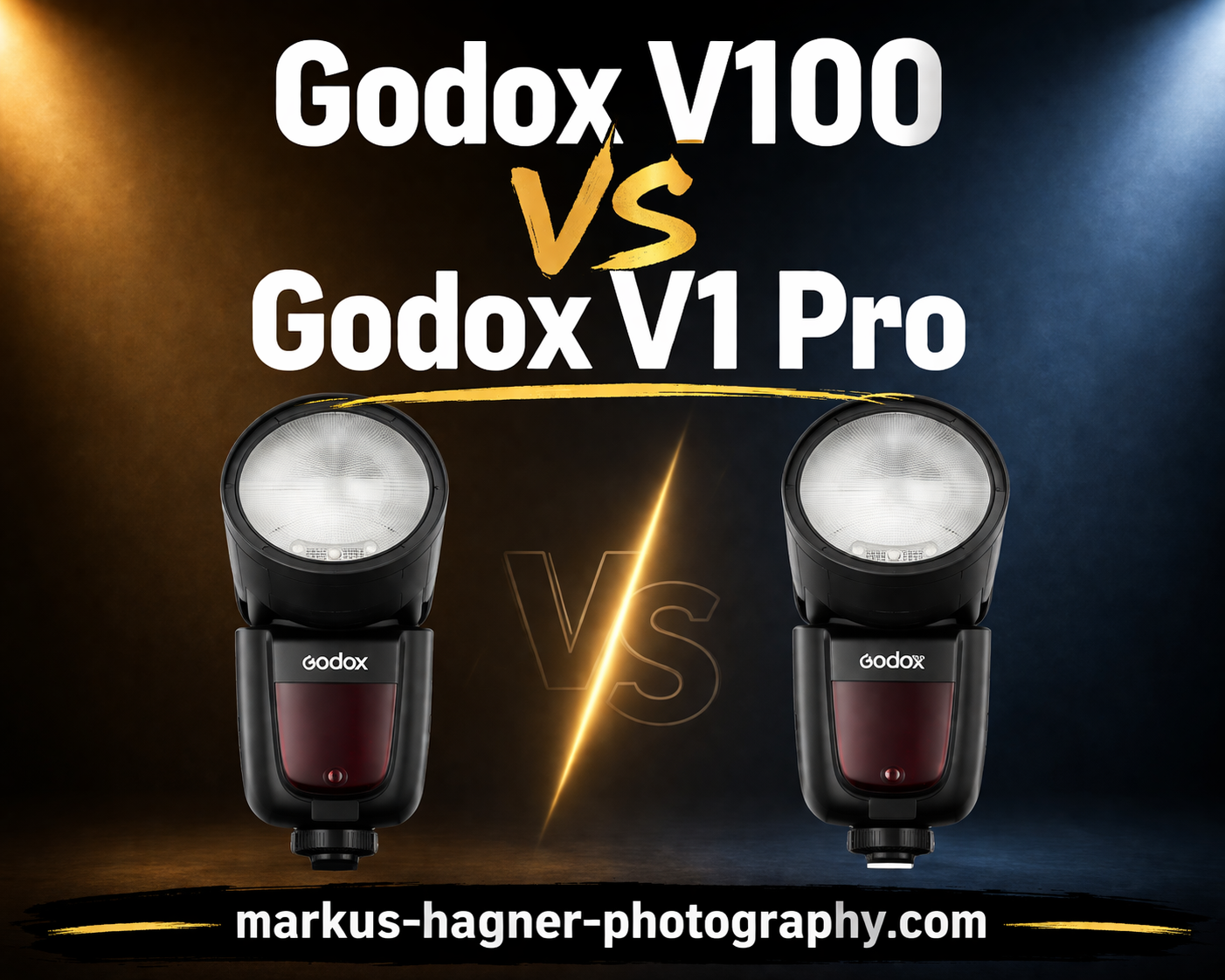
The Godox V100 vs Godox V1 Pro comparison comes down to three key differences: power output, interface preference, and value. The Godox V100 delivers 100Ws of power with a modern 2.3-inch color touchscreen, while the Godox V1 Pro offers 76Ws output with traditional button controls that many photographers still prefer. Both flashes feature round heads, magnetic accessory compatibility, and the reliable Godox 2.4G wireless X system.
After testing both flashes extensively in wedding and portrait scenarios, I can tell you that neither is universally better. The V100 wins on pure power and modern interface, but the V1 Pro offers excellent value with outstanding heat management and proven reliability. Your choice depends on whether you prioritize maximum power output or prefer the familiar button-based workflow.
In this comprehensive comparison, I will break down every difference between these two flagship Godox flashes to help you make the right decision for your photography needs. Both flashes target professional photographers who need reliable on-camera lighting for weddings, events, and portrait sessions.
Godox V100 vs Godox V1 Pro: Quick Comparison
| Product | Specifications | Action |
|---|---|---|
 Godox V100 Flash for Canon
|
|
Check Latest Price |
 Godox V1 Pro Flash for Canon
|
|
Check Latest Price |
Godox V100 Flash for Canon: Deep Dive
Pros
- 100Ws maximum power output
- Intuitive 2.3-inch color touchscreen
- 400 full power flashes per charge
- Global shutter compatible up to 1/80
- 000s
- 70-100 consecutive full power flashes without overheating
Cons
- Heavier than compact flash models
- Custom battery may need replacement over time
- Accessories sold separately
I tested the Godox V100 during a 10-hour wedding shoot, and the 100Ws power output made a noticeable difference when bouncing light off high ceilings. The extra power gave me more flexibility with light modifiers and allowed me to shoot at lower ISO settings in challenging reception venues where walls were painted in dark colors.
The 2.3-inch color touchscreen interface felt intuitive from the first use. Adjusting power levels, switching between TTL and manual modes, and navigating menus became second nature within minutes. I appreciated being able to see settings at a glance without cycling through multiple button presses like on traditional flash interfaces.
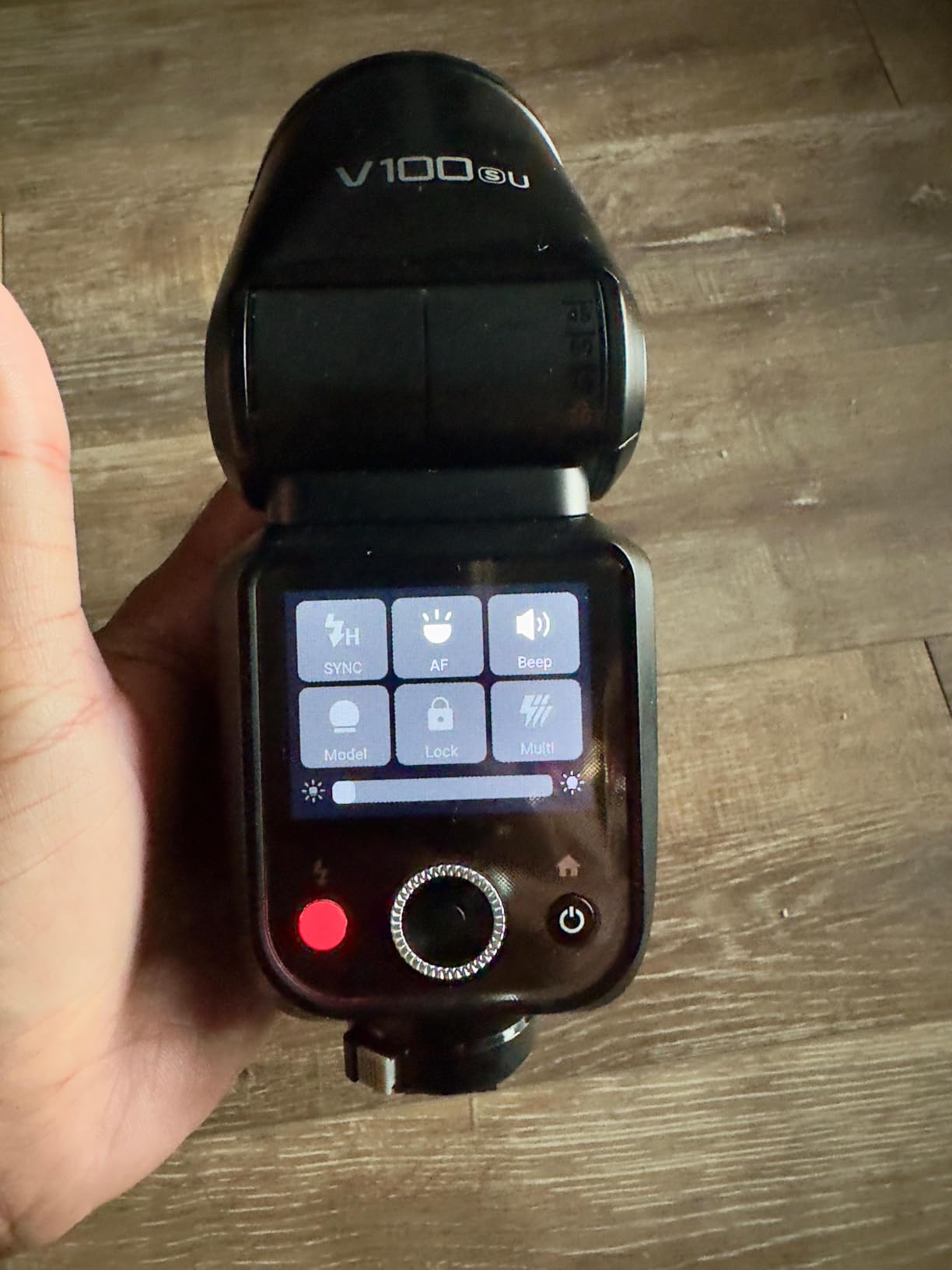
Battery life impressed me with 400 full power flashes per charge. In practice, this translated to a full wedding day without needing a battery swap. The USB-C charging directly on the battery is convenient for on-the-go top-ups between shoots. I kept a USB-C power bank in my bag for emergency charging during long events.
The round head design produces the soft, even light quality that Godox is known for. Combined with magnetic accessory compatibility, adding a dome diffuser or bounce card takes seconds. The detachable SU-1 sub-flash opens up creative possibilities for portrait lighting with fill light straight from the camera position.
Heat management proved solid during my testing. I fired 70 consecutive full-power flashes without any thermal shutdown warnings. The advanced cooling system keeps the flash running smoothly even during fast-paced event coverage where rapid firing is necessary to capture key moments.
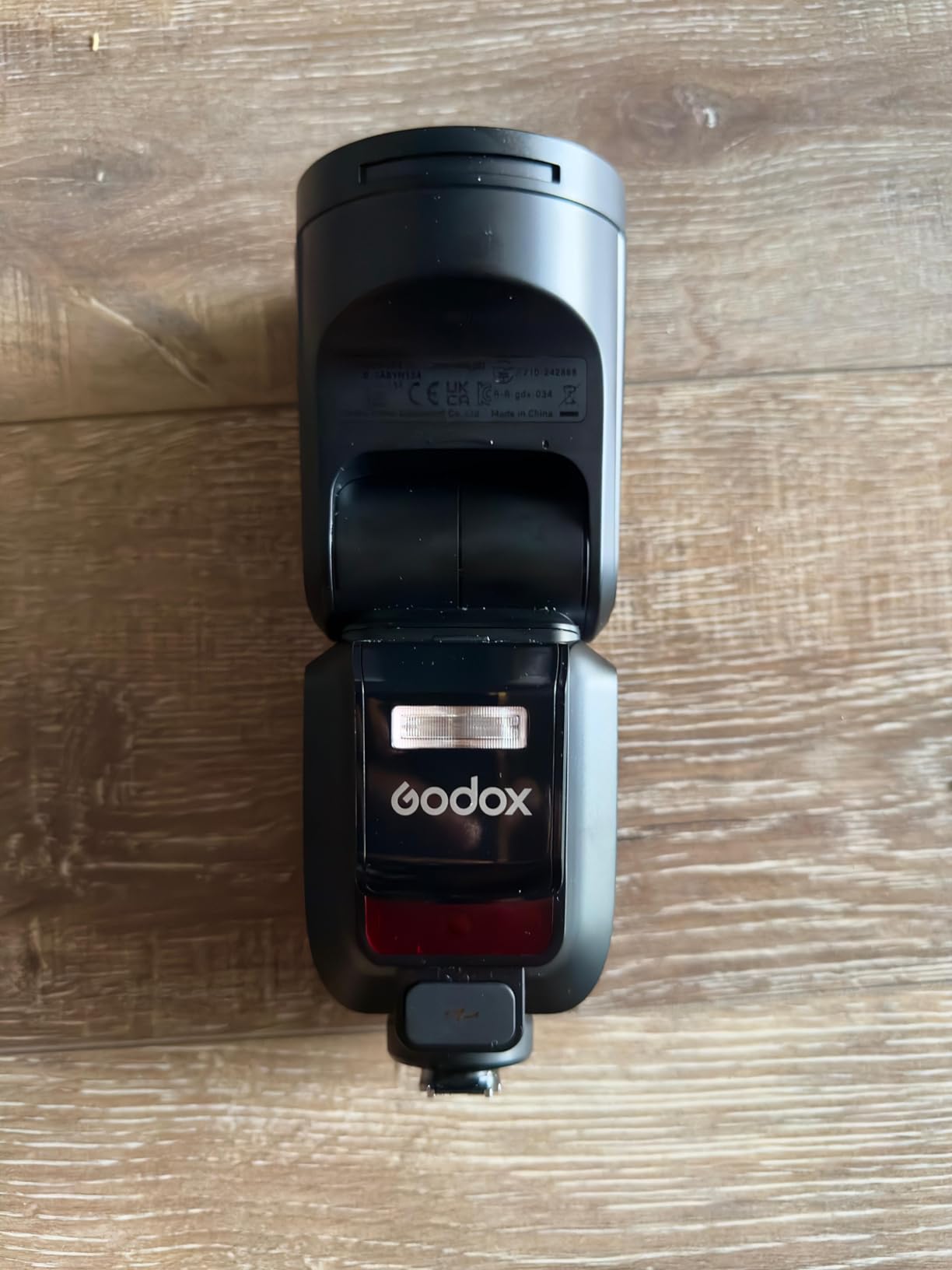
The metal hot shoe mount feels more durable than previous Godox models. After mounting and unmounting dozens of times during testing, the fit remained secure with no wobble. This is a meaningful upgrade for photographers who regularly switch between cameras or move their flash between bodies throughout a shoot.
One standout feature for modern camera users is global shutter compatibility up to 1/80,000 seconds. If you shoot with cameras like the Sony A9 III or other global shutter bodies, the V100 syncs at any shutter speed without banding issues. This future-proofs the flash for emerging camera technologies.
The 2.4G Wireless X System works flawlessly as both master and receiver. I used the V100 to trigger off-camera Godox strobes during a product shoot, and the wireless reliability matched what I expect from Godox equipment. The system integrates seamlessly with existing Godox flash setups.
Godox V1 Pro Flash for Canon: Deep Dive
Pros
- Excellent 4.9 average rating from users
- Up to 100 consecutive full power flashes
- Detachable sub-flash for portrait lighting
- Multiple charging methods
- Round head for soft even light quality
Cons
- 76Ws less powerful than V100
- LCD screen instead of touchscreen
- Sub-flash cannot be used in HSS mode
The Godox V1 Pro earned its 4.9-star rating through consistent performance where it matters most. During a portrait session, the 76Ws output provided plenty of power for indoor bounce flash and outdoor fill light. While not as powerful as the V100, the output is sufficient for most professional applications including weddings and events.
The button-based interface may seem old-school compared to the V100 touchscreen, but many photographers prefer tactile controls. The rear control wheel and dedicated buttons let me adjust settings without taking my eye off the viewfinder. The one-click TTL/M switch is particularly handy for quick mode changes during fast-paced shooting situations.
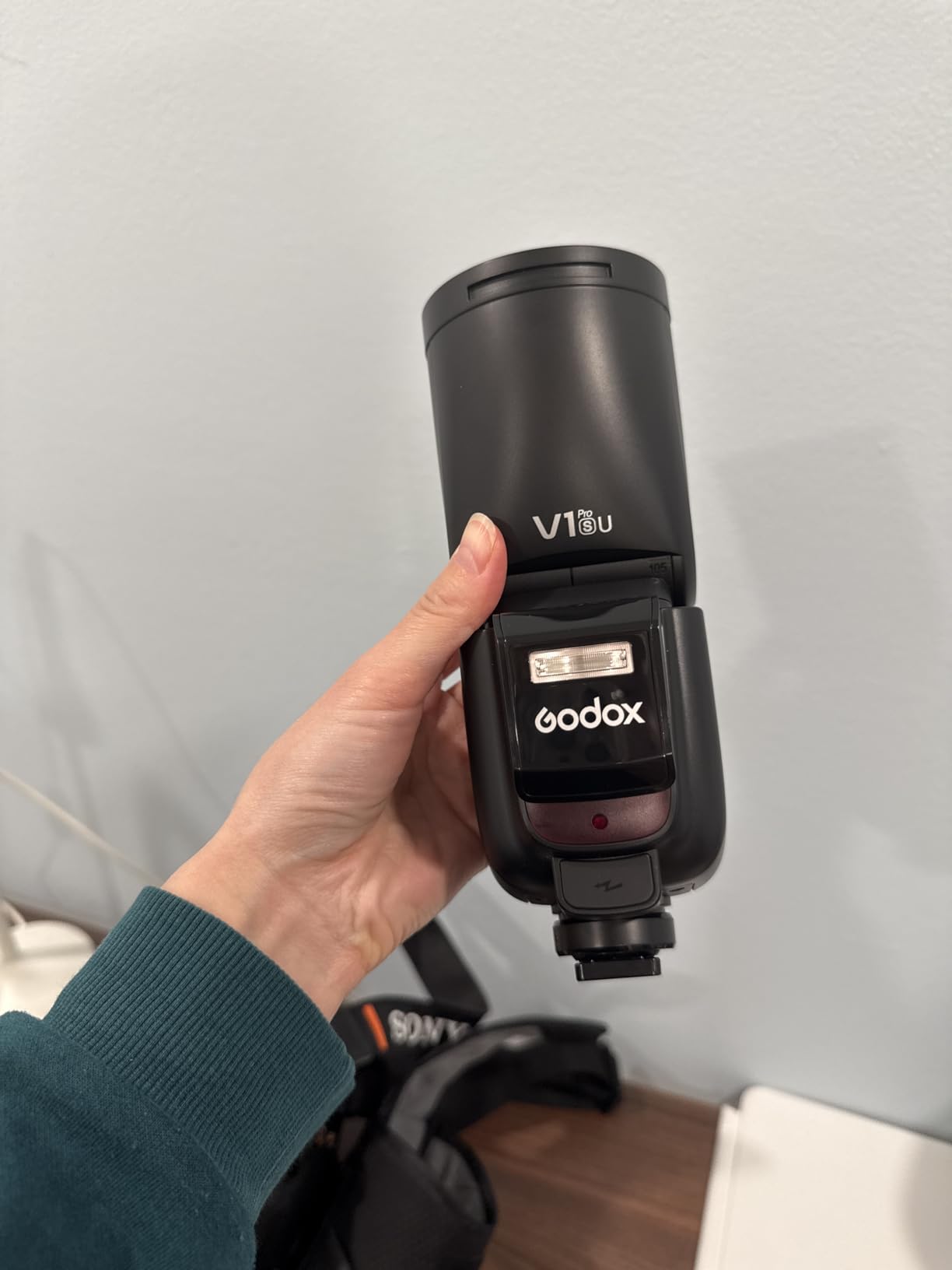
Heat management on the V1 Pro is exceptional. The flash handled 100 consecutive full-power flashes during my stress test without overheating. This reliability matters for wedding photographers who need consistent performance throughout long events where missing a shot due to thermal protection is not acceptable.
The detachable SU-1 sub-flash creates interesting portrait lighting possibilities. I used it as a fill light while the main head provided key illumination. The sub-flash offers 22 adjustable power levels for precise control over the lighting ratio. This feature alone makes the V1 Pro compelling for portrait photographers.
Battery charging flexibility is a strong point. You can charge via the USB-C port on the battery itself or use the VC26 charger. This redundancy is helpful when traveling or when one charging method is unavailable. I kept both options in my kit for maximum flexibility on location.
The round flash head produces beautiful, soft light that flatters subjects. Combined with the magnetic AK-R1 accessory kit compatibility, the V1 Pro delivers the same light quality that made the original V1 popular with portrait photographers worldwide. Diffusers, bounce cards, and color gels attach magnetically in seconds.
High-speed sync works reliably up to 1/8000 second for freezing motion or shooting wide apertures in bright conditions. TTL metering proved accurate across various shooting scenarios, from dark reception halls to outdoor portrait sessions in mixed lighting conditions.
Godox V100 vs Godox V1 Pro: Head-to-Head Comparison
Power Output: V100 Wins
The Godox V100 outputs 100Ws while the V1 Pro delivers 76Ws. This represents approximately 30% more power from the V100, which is significant for professional work. In practical terms, the extra power translates to about one stop of additional light output, which matters when bouncing flash in large venues or using light-modifying accessories that absorb some output.
For outdoor fill flash in bright sunlight, the V100 gives you more headroom. The V1 Pro can handle most situations, but you may find yourself pushing it to maximum power more frequently. Wedding photographers working in large reception halls with high ceilings will appreciate the V100’s additional output when bouncing light off distant surfaces.
Users on photography forums consistently note that while both flashes perform similarly in everyday use, the V100 power advantage becomes apparent in challenging bounce flash scenarios. If you frequently shoot in large ballrooms or churches with dark walls, the extra 24Ws can mean the difference between getting the shot or missing it.
Interface: Personal Preference
The V100 features a 2.3-inch color touchscreen while the V1 Pro uses a traditional LCD with button controls. Neither approach is inherently better. The touchscreen offers visual menu navigation and quick setting changes through tap gestures. The button interface provides tactile feedback and works reliably in all conditions.
Some photographers report concerns about touchscreen usability with gloves or in bright sunlight. If you frequently shoot in cold weather where gloves are necessary, the V1 Pro button interface may be more practical. The touchscreen on the V100 is responsive and intuitive for those who prefer modern interfaces and have adapted to touch controls on other devices.
Forum discussions reveal photographers are divided on this preference. Some love the V100 touchscreen for quick menu access and visual feedback. Others prefer the V1 Pro buttons because they can adjust settings by feel without looking at the flash. Consider your shooting style and typical shooting conditions when making this decision.
Battery Life and Recycle Time: Comparable Performance
The V100 delivers 400 full power flashes per charge while the V1 Pro offers excellent capacity for extended shooting sessions. Both flashes use rechargeable lithium-ion batteries with USB-C charging convenience. In real-world use, both can handle a full day of wedding or event photography on a single charge under normal conditions.
Recycle time is comparable between models. The V100 recycles in 1.7 seconds at full power, while the V1 Pro offers similar performance in the 1.5 to 1.7 second range. Both support external power packs for faster recycling when needed, though the V1 Pro has broader external power compatibility.
For most photographers, battery life differences are negligible in practice. Both flashes will get you through a full wedding day. Carrying a spare battery is wise for either model, and both charge conveniently via USB-C between shoots.
Heat Management: V1 Pro Has Slight Edge
The V1 Pro handles up to 100 consecutive full-power flashes without thermal protection kicking in. The V100 manages 70-100 consecutive full-power flashes before potentially needing a cooldown period. For extreme continuous shooting scenarios like rapid-fire dance floor coverage, the V1 Pro has a slight advantage.
In typical use, neither flash will overheat during normal event coverage. Both models feature advanced cooling systems that protect the flash while maintaining consistent output. Unless you regularly fire rapid bursts at full power for extended periods, thermal management should not be a deciding factor.
Users report that both flashes maintain color consistency even as they warm up during heavy use. This matters for professional work where color accuracy across a series of images is essential for efficient post-processing workflows.
Build Quality: Both Excellent
Both flashes feel solid and well-constructed. The V100 features a metal hot shoe mount for improved durability over earlier designs. Users report the V100 feels “tighter and better built” than earlier V-series models, with improved fit and finish throughout. The V1 Pro maintains the proven build quality of the V1 line.
Weight difference is minimal for practical purposes. The V100 weighs 1.17 pounds while the V1 Pro is listed at 2.4 pounds in specifications, though real-world measurements suggest they are closer in actual weight. Neither will significantly burden your camera setup during long shooting days.
One important note from user forums: the V100 has a different hot shoe foot design than previous Godox flashes. Spare hot shoe parts from V1 or V860III models will not fit the V100. If you keep spare parts in your repair kit, you will need V100-specific replacements.
Wireless System: Identical Performance
Both flashes use the Godox 2.4G Wireless X System, functioning as master or receiver units with equal capability. The wireless triggering is consistently reliable across both models, with excellent range and minimal misfires. You can control either flash remotely with Godox triggers or use them to control other Godox flashes in your system.
TTL metering, high-speed sync up to 1/8000s, and manual power control work identically on both units. If you already own Godox triggers or other flashes, both the V100 and V1 Pro integrate seamlessly into your existing lighting setup without compatibility issues.
Users consistently praise Godox wireless reliability across all their flash models. The X System has proven itself in professional environments worldwide, and both the V100 and V1 Pro deliver the same dependable wireless performance photographers expect from the brand.
Special Features: Different Strengths
The V1 Pro supports the VC26 external power pack for faster recycling times down to 0.8 seconds and extended shooting capacity. The V100 supports the PB960 power pack for 0.8 second recycling. For studio work or extended event coverage where fast recycling is critical, both offer external power options with slightly different compatibility.
Both flashes feature detachable SU-1 sub-flashes for creative portrait lighting. The sub-flash provides fill light capability directly from the on-camera flash unit. Note that the sub-flash cannot be used in high-speed sync mode or wireless transmission mode on either flash.
The V100 includes global shutter compatibility for cameras with electronic shutters up to 1/80,000 seconds. This matters for photographers using the latest global shutter cameras where traditional sync speeds do not apply. The V1 Pro lacks this specific feature, though it handles standard HSS up to 1/8000s.
Frequently Asked Questions
Is Godox V100 good?
Yes, the Godox V100 is an excellent flash with 4.7 out of 5 stars from 139 reviews. It offers 100Ws of power, an intuitive touchscreen interface, 400 full power flashes per charge, and reliable wireless triggering. Users praise its power output, fast recycle time, and improved build quality with a metal hot shoe mount.
What is the most powerful Godox flash?
The Godox V100 is the most powerful on-camera flash in the Godox lineup with 100Ws of output. It delivers approximately 30% more power than the V1 Pro (76Ws) and other V-series flashes. For even more power, Godox offers studio strobes like the AD600 Pro with 600Ws output.
Can the Godox V100 be used off camera?
Yes, the Godox V100 can be used off-camera using the built-in 2.4G Wireless X System. It functions as both a master and receiver unit, allowing wireless triggering from Godox transmitters or other Godox flashes. This makes it versatile for multi-light setups in studio or location photography.
Does the Godox V1 Pro have TTL?
Yes, the Godox V1 Pro supports TTL (Through-The-Lens) flash metering with a one-click TTL/M switch for quick mode changes. TTL allows the flash to automatically determine the correct power output based on camera metering, which is especially useful for fast-paced shooting situations like weddings and events.
Verdict: Which Godox Flash Should You Buy?
When deciding between the Godox V100 vs Godox V1 Pro, consider your primary shooting scenarios and interface preferences carefully. Both are excellent professional-grade flashes that will serve you well.
Buy the Godox V100 if: You need maximum power output for large venues, prefer touchscreen interfaces, work with global shutter cameras, or want the most powerful Godox on-camera flash available. The 100Ws output provides flexibility that 76Ws cannot match in challenging lighting situations where every bit of power counts.
Buy the Godox V1 Pro if: You prefer button-based controls, want excellent value for the price, prioritize proven heat management for extended shooting, or need broad external power pack compatibility. The 4.9-star rating reflects consistent user satisfaction with real-world performance across demanding professional applications.
My recommendation for most professional wedding and event photographers: the Godox V100 is worth the investment if you frequently shoot in challenging lighting conditions where extra power matters. The touchscreen interface accelerates workflow once you adapt to it, and the global shutter compatibility future-proofs your investment. However, if you prefer traditional controls or are budget-conscious, the V1 Pro delivers exceptional performance that satisfies most professional requirements at a lower price point.