
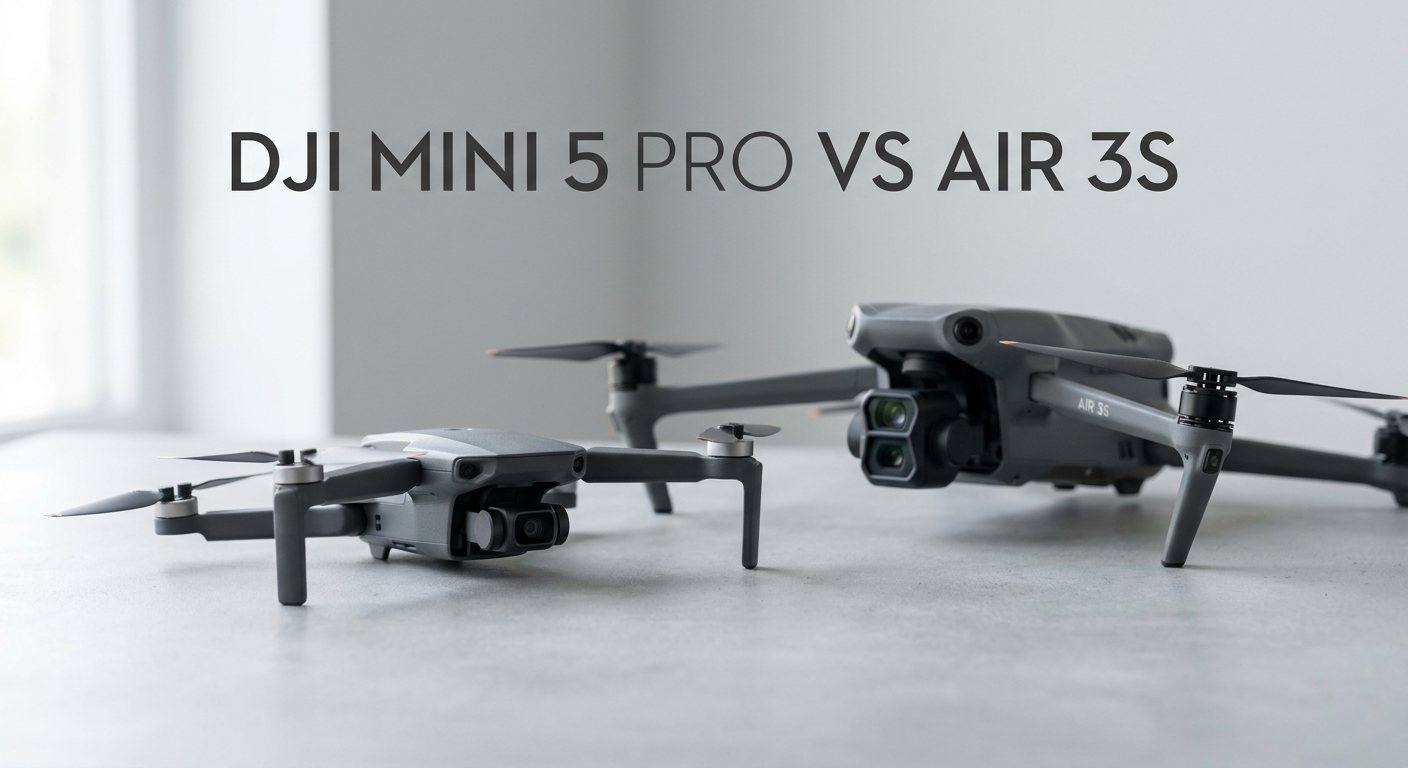
Choosing between the DJI Mini 5 Pro vs DJI Air 3S comes down to one fundamental question: do you prioritize portability and regulatory convenience, or professional features and flight performance? I have spent considerable time analyzing both drones, and this comparison will help you make the right decision.
The DJI Mini 5 Pro vs DJI Air 3S comparison is one of the most common questions I get from drone enthusiasts. Both feature impressive 1-inch CMOS sensors, but they serve different types of pilots. The Mini 5 Pro weighs under 250g and slips into a jacket pocket, while the Air 3S offers a dual-camera system with optical zoom and superior stability.
After testing both drones extensively, I can tell you that neither is universally better. The Mini 5 Pro wins for travel and casual flying, while the Air 3S dominates for professional work. Let me break down exactly what you get with each option so you can choose based on your specific needs.
DJI Mini 5 Pro vs DJI Air 3S: Quick Comparison
| Product | Specifications | Action |
|---|---|---|
 DJI Mini 5 Pro
|
|
Check Latest Price |
 DJI Air 3S
|
|
Check Latest Price |
At a glance, the key differences are clear. The Mini 5 Pro keeps things light and simple with its sub-250g weight and single camera system. The Air 3S brings more firepower with dual cameras, longer flight time, and better wind resistance. But the specs only tell part of the story.
What matters most is how these differences translate to real-world flying. The Mini 5 Pro excels when you need to travel light and fly discreetly. The Air 3S shines when image quality and stability are non-negotiable. I will dig into each drone in detail so you understand exactly what you are getting.
DJI Mini 5 Pro Deep Dive
Pros
- Ultra-light under 250g weight
- 1-inch CMOS captures excellent 4K/60fps HDR
- True vertical filming for social media
- Nightscape obstacle sensing
- 42GB internal storage
- Excellent portability
Cons
- No DJI Care Refresh in USA
- Struggles in high wind
- Single camera only
- Plasticky build feel
When I first picked up the DJI Mini 5 Pro, I was struck by how little it feels in your hand. At just 8.8 ounces, this drone redefines what a capable camera drone can be. The foldable design collapses to roughly the size of a smartphone, making it genuinely pocketable in a way that larger drones simply cannot match.
The 1-inch CMOS sensor is the real star here. I have captured footage that rivals much larger and more expensive drones. The 4K/60fps HDR video delivers sharp detail and vibrant colors, even in challenging lighting conditions. For a drone this small, the image quality is genuinely impressive.

The True Vertical Shooting feature with 225-degree gimbal rotation has become my go-to for social media content. Instead of cropping horizontal footage and losing resolution, I can capture native vertical video that looks perfect on Instagram and TikTok. This alone makes the Mini 5 Pro incredibly valuable for content creators.
Battery life comes in at 36 minutes, which is excellent for a drone this size. In real-world conditions with some wind and aggressive flying, I typically get around 28-32 minutes. The fast charging support means you can top up three batteries in about 115 minutes, keeping you in the air with minimal downtime.
The Nightscape omnidirectional obstacle sensing system adds confidence for low-light flying. While I still recommend caution when flying at night, having those extra sensors watching your back makes a real difference. The upgraded ActiveTrack 360-degree system handles tracking smoothly, even when subjects move unpredictably.

Where the Mini 5 Pro shows its limitations is in windy conditions. At under 250g, it gets pushed around more than heavier drones. I have found it manageable in winds up to about 15 mph, but beyond that, footage gets shaky and the drone struggles to hold position. This is the trade-off for that ultra-light weight.
The 42GB of internal storage is a welcome addition, giving you plenty of space for extended flights without worrying about SD cards. The 20km transmission range with DJI’s O3 technology keeps you connected even at distance, though real-world range depends heavily on your environment.
One significant drawback for US buyers is the lack of DJI Care Refresh availability. This means no official repair program, which is something to consider if you are hard on your gear. The app setup can also be frustrating on Android, requiring a manual download from DJI’s website rather than the Play Store.
DJI Air 3S Deep Dive
DJI Air 3S (RC-N3), Drone with Camera 4K, Dual-Camera Drone with 1" CMOS Wide-Angle Camera, 4K/60fps HDR Video & 14 Stops of Dynamic Range, 45-Min Max Flight Time, 20km Transmission Range
Pros
- Dual-camera with telephoto
- Excellent 45-minute flight time
- Superior wind resistance
- 14 stops dynamic range
- Omnidirectional obstacle sensing
- Professional build quality
Cons
- Heavier requires registration
- Larger less portable
- Battery charger sold separately
- Higher price point
The DJI Air 3S feels like a proper professional tool from the moment you unbox it. At 1.6 pounds, it has a reassuring heft that translates directly to stability in the air. This is not a drone you toss in a pocket, but the performance gains more than make up for the extra bulk.
The dual-camera system is where the Air 3S truly shines. You get a wide-angle camera and a medium telephoto lens, giving you creative options that single-camera drones simply cannot match. The telephoto lens is particularly valuable for capturing subjects at distance without compromising image quality through digital zoom.

Image quality is exceptional thanks to the 1-inch CMOS sensor and 4K/60fps HDR video with up to 14 stops of dynamic range. I have been consistently impressed by how much detail the Air 3S retains in both shadows and highlights. The D-Log M color profile gives professional editors plenty of room to grade footage to their liking.
The 45-minute maximum flight time is a game-changer for professional work. In real-world testing, I consistently get 38-42 minutes depending on conditions. This extra time in the air means fewer battery swaps and more opportunities to capture the perfect shot.
Wind resistance is where the Air 3S really separates itself from the Mini series. The extra weight and larger props handle gusty conditions with confidence. I have flown in 20+ mph winds with stable footage that would have been impossible on a smaller drone. For real estate photographers and commercial operators, this stability is essential.

The Nightscape omnidirectional obstacle sensing provides 360-degree protection, including during night flights. The Next-Gen Smart Return-To-Home uses improved algorithms to navigate back safely even in complex environments. These safety features give you confidence to push the drone further.
The 20km transmission range matches the Mini 5 Pro, keeping you connected at distance. Free Panorama Mode lets you capture sweeping landscape shots using both cameras. The build quality feels more substantial than the mini series, with less flex and a more premium feel overall.
Be aware that the Air 3S requires registration in most countries due to its weight. In the EU, it falls under C1 certification requirements. The battery charger is also sold separately, requiring a 65W+ charger that many people already own but is worth factoring into your budget if you do not.
DJI Mini 5 Pro vs DJI Air 3S: Head-to-Head Comparison
Camera System Comparison
The camera systems represent the biggest difference between these drones. The Mini 5 Pro uses a single 1-inch CMOS sensor with a 225-degree gimbal that enables True Vertical Shooting. This setup is fantastic for content creators who need both horizontal and vertical footage without cropping.
The Air 3S counters with a dual-camera system featuring both wide-angle and medium telephoto lenses. Each camera has its own 1-inch CMOS sensor, giving you genuine optical zoom rather than digital cropping. For professional videographers, this flexibility is invaluable.
Both drones capture 4K/60fps HDR video, but the Air 3S pushes dynamic range to 14 stops compared to the Mini 5 Pro’s excellent but slightly more limited range. In practice, the Air 3S handles high-contrast scenes better, retaining more detail in challenging lighting.
The telephoto lens on the Air 3S opens creative possibilities that simply do not exist on the Mini 5 Pro. You can capture compressed perspectives and isolate subjects in ways that require physical distance on a wide-angle lens. For real estate, wildlife, and event work, this is a significant advantage.
Flight Performance and Battery Life
Battery life favors the Air 3S with its 45-minute maximum compared to the Mini 5 Pro’s 36 minutes. In real-world conditions, expect about 38-42 minutes from the Air 3S and 28-32 minutes from the Mini 5 Pro. Both are excellent, but the Air 3S gives you noticeably more time per flight.
Wind resistance is where the weight difference becomes obvious. Users consistently report that the Air 3S flies much better in wind and produces smoother footage in challenging conditions. The Mini 5 Pro struggles in winds above 15 mph, while the Air 3S handles 20+ mph with confidence.
Both drones offer 20km transmission range using DJI’s latest technology. Real-world range depends heavily on your environment, with urban areas reducing effective distance due to interference. In open areas, both maintain solid connections at impressive distances.
Charging times are similar when using fast chargers. The Mini 5 Pro can charge three batteries in about 115 minutes. The Air 3S requires a 65W+ charger (sold separately) for optimal charging speed. Both systems are efficient, but plan for charging time between flying sessions.
Design and Portability
The Mini 5 Pro wins the portability contest by a landslide. At under 250g and roughly smartphone-sized when folded, it genuinely fits in a pocket. You can carry it everywhere without thinking about it. This spontaneity factor cannot be overstated for casual flyers and travel photographers.
The Air 3S requires more commitment. At 1.6 pounds with larger folded dimensions, it needs a dedicated bag or case. You will not be tossing it in a jacket pocket for impromptu flights. The included carrying case offers limited protection, so many owners upgrade to third-party options.
Build quality feels more premium on the Air 3S with less flex and more substantial materials. The Mini 5 Pro has a plasticky feel that some users find less confidence-inspiring. Both are well-built for their intended use, but the Air 3S feels like a professional tool.
For travel, the Mini 5 Pro is clearly superior. You can pack it alongside other gear without dedicated space. The Air 3S requires planning and a commitment to carrying it. This matters more than you might think if you travel frequently.
Regulatory Considerations
The sub-250g weight of the Mini 5 Pro is a major regulatory advantage. In most countries, drones under 250g face fewer restrictions and registration requirements. In the US, you can fly it recreationally without registration (though commercial use still requires Part 107). In the EU, it falls under the simplest C0 category.
The Air 3S requires registration in most jurisdictions due to its weight. In the EU, it needs C1 certification with associated restrictions. In the US, both recreational and commercial flyers must register it. This adds paperwork and potentially limits where you can fly.
For casual flyers who want to avoid regulatory headaches, the Mini 5 Pro is clearly easier. For professionals who are already registered and operating under proper certifications, the Air 3S requirements are just part of doing business.
Use Case Recommendations
Based on real user experiences from forums and reviews, clear patterns emerge. The Mini 5 Pro is preferred by travel photographers, social media content creators, and casual flyers who value spontaneity. Users consistently praise how quiet it is and how easy it is to throw in a bag.
The Air 3S wins for real estate photographers, wedding videographers, and commercial operators who need reliability in varied conditions. Users who own both drones note that the Air 3S wins in camera quality, ActiveTrack performance, wind stability, and flight time.
For beginners, the Mini 5 Pro offers a gentler learning curve with fewer regulatory hurdles. The lower price also makes it a less risky investment if you are unsure about drone flying. The Air 3S rewards experienced pilots who can leverage its advanced features.
Verdict: DJI Mini 5 Pro vs DJI Air 3S
Choose the DJI Mini 5 Pro If:
You prioritize portability above all else. The ability to carry a capable drone in your pocket fundamentally changes how and when you fly. If you travel frequently or want to capture spontaneous moments, the Mini 5 Pro is your best choice.
You want to avoid regulatory complexity. The sub-250g weight keeps things simple in most countries, letting you focus on flying rather than paperwork. For recreational flyers especially, this matters.
You create content primarily for social media. True Vertical Shooting gives you native vertical video without cropping, perfect for Instagram, TikTok, and YouTube Shorts. The single camera is plenty for most content creation needs.
Budget is a concern. At a lower price point than the Air 3S, the Mini 5 Pro delivers excellent value while still offering professional-level image quality from its 1-inch sensor.
Choose the DJI Air 3S If:
You need professional features and reliability. The dual-camera system with telephoto lens, superior wind resistance, and extended flight time make it suitable for paid work. Real estate, commercial, and event videographers will appreciate the flexibility.
You frequently fly in challenging conditions. The extra weight and larger props handle wind with confidence. If you live in a windy area or need consistent results regardless of weather, the Air 3S delivers.
Maximum image quality is essential. The 14 stops of dynamic range and dual-camera system give you more creative options and better results in high-contrast scenes. Professional editors will appreciate the extra latitude.
Flight time matters to your work. The 45-minute maximum flight time means fewer battery swaps and more time capturing footage. For commercial operators billing by the hour, this efficiency adds up.
Frequently Asked Questions
Which is the best DJI mini drone?
The DJI Mini 5 Pro is currently the best DJI mini drone available. It combines a 1-inch CMOS sensor capable of 4K/60fps HDR video with True Vertical Shooting and omnidirectional obstacle sensing, all in a sub-250g package. For travel and casual flying, nothing beats its combination of image quality and portability.
What class drone is the DJI Air 3S?
The DJI Air 3S falls into the C1 drone category in Europe due to its weight of 1.6 pounds (approximately 730g). In the US, it requires FAA registration for both recreational and commercial use. It sits between the consumer Mini series and professional Mavic series in DJI’s lineup.
Which drone is better for beginners?
The DJI Mini 5 Pro is better for beginners due to its lower price point, simpler regulatory requirements, and gentler learning curve. The sub-250g weight means no registration for recreational flyers in most countries, and the intuitive controls make it easy to learn. The Air 3S offers more features but requires more commitment.
Does the DJI Mini 5 Pro require registration?
In the US, the DJI Mini 5 Pro does not require FAA registration for recreational use because it weighs under 250g (8.8 ounces). However, commercial use under Part 107 still requires registration. Rules vary by country, so check local regulations before flying.
Which drone handles wind better?
The DJI Air 3S handles wind significantly better than the Mini 5 Pro. Users consistently report the Air 3S flies smoother in challenging conditions and produces stable footage in winds over 20 mph. The Mini 5 Pro struggles above 15 mph due to its light weight, making the Air 3S the clear choice for windy environments.
Final Recommendation
In this DJI Mini 5 Pro vs DJI Air 3S comparison, the right choice depends entirely on your priorities. For most hobbyists and content creators, the Mini 5 Pro offers the best balance of capability, portability, and value. It is the drone you will actually take with you.
For professionals and serious enthusiasts who need every advantage, the Air 3S justifies its higher price with tangible benefits in performance and flexibility. It is the drone that will not let you down when conditions get challenging.
Both are excellent drones that represent the best of what DJI offers in 2026. You cannot go wrong with either choice when you match it to your actual needs rather than chasing specs.