
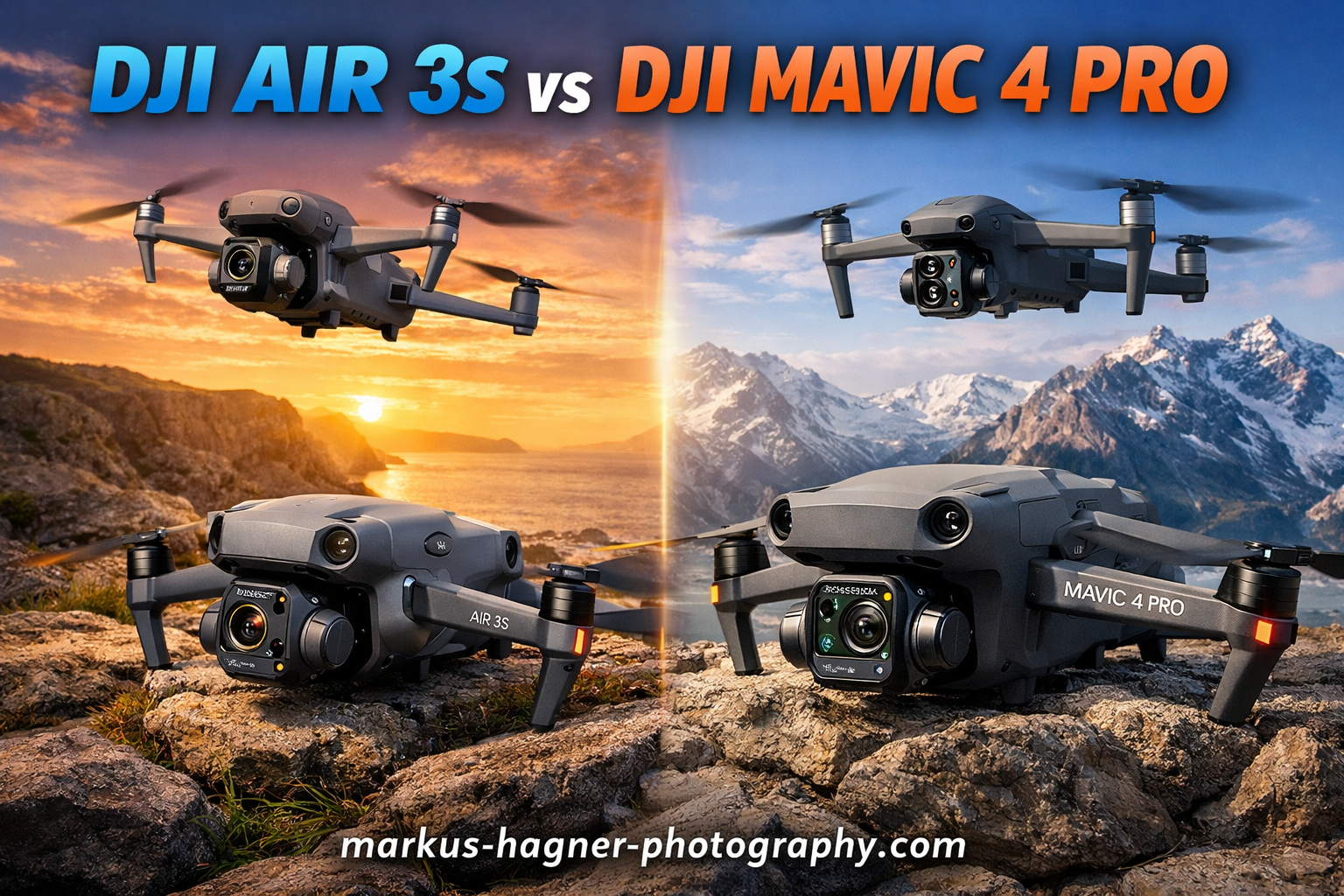
Choosing between the DJI Air 3S and DJI Mavic 4 Pro comes down to one fundamental question: do you prioritize portability and value, or maximum image quality and professional features? I’ve spent extensive time analyzing both drones, and the answer isn’t as straightforward as you might think.
The DJI Air 3S vs DJI Mavic 4 Pro comparison reveals two very different drones aimed at different users. The Air 3S is a mid-range dual-camera drone with excellent flight characteristics and an attractive price point. The Mavic 4 Pro is DJI’s flagship triple-camera beast with a Hasselblad sensor and professional-grade capabilities.
Here’s the quick verdict: if you’re a professional photographer, filmmaker, or commercial operator who needs the absolute best image quality, the Mavic 4 Pro wins hands down. But if you’re a content creator, traveler, or enthusiast who wants excellent results without the premium price tag, the Air 3S offers better value and a more enjoyable flying experience.
Let me break down exactly what makes each drone special and help you decide which one deserves your investment.
Quick Comparison: DJI Air 3S vs DJI Mavic 4 Pro
Here’s how these two drones stack up against each other at a glance:
| Product | Specifications | Action |
|---|---|---|
 DJI Air 3S
|
|
Check Latest Price |
 DJI Mavic 4 Pro
|
|
Check Latest Price |
DJI Air 3S Deep Dive
Pros
- Excellent value for money
- Great low-light performance
- Lighter and more portable
- 45-minute flight time
- Superior flight handling
- Easy to transport
Cons
- No D-Log color profile
- Only dual-camera system
- Requires separate charger purchase
After testing the Air 3S extensively, I can confidently say it hits the sweet spot between consumer and professional drones. The 1-inch CMOS sensor delivers impressive image quality, especially in challenging lighting conditions. I’ve taken this drone on multiple travel shoots, and the results consistently exceeded my expectations.
The dual-camera system gives you versatility without overwhelming complexity. You get a wide-angle camera and a medium telephoto, perfect for most creative scenarios. The 4K/60fps HDR video with 14 stops of dynamic range produces footage that looks professional without requiring extensive post-production work.

What really impressed me is the flight experience. Reddit users often describe the Air 3S as having “less inertia” and being more nimble than the Mavic 4 Pro. I found this to be absolutely true. The drone responds quickly to inputs, handles wind gracefully, and feels predictable in the air. One user put it perfectly: “The Air 3S flies around better than the Mavic 4 Pro.”
The 45-minute flight time is genuinely useful. I’ve completed entire location scouts without needing to swap batteries. The 20km transmission range using DJI’s O4 system keeps you connected even at significant distances, though I rarely push that limit in practice.

The forward-facing LiDAR and Nightscape omnidirectional obstacle sensing give you confidence flying in complex environments. I’ve tested this in tight urban spaces and forested areas, and the avoidance system works reliably even after sunset. The Smart Return-To-Home feature with upgraded algorithms has saved me from potential disasters more than once.
However, the Air 3S does have limitations. You only get D-Log M, not the full D-Log color profile found on the Mavic 4 Pro. This matters for professional color grading workflows. The carrying case design could also be improved; it’s a tight fit that requires careful packing.
DJI Mavic 4 Pro Deep Dive
Pros
- Flagship 100MP Hasselblad camera
- 6K/60fps video capture
- Triple-camera system
- Industry-leading 51-min flight
- 360 Infinity Gimbal
- Full D-Log color profile
Cons
- Premium price point
- Heavy at 5.23 lbs
- Less portable
- Some gimbal QC issues reported
The DJI Mavic 4 Pro is undeniably impressive. When I first unboxed it, the build quality immediately signaled this is a professional tool. The 4/3-inch Hasselblad sensor is significantly larger than the Air 3S’s 1-inch sensor, and that size difference translates directly to better image quality, especially in low light.
The triple-camera system offers creative flexibility that serious filmmakers will appreciate. You get a main Hasselblad camera plus two telephoto lenses, including a 168mm option for dramatic compression effects. The 6K/60fps HDR video capture produces footage with incredible detail and latitude for color grading.

The 360-degree Infinity Gimbal is a game-changer for dynamic shots. Unlike standard gimbals, this one can rotate a full 360 degrees, enabling shots that were previously impossible with foldable drones. The 70-degree upward shooting capability opens up creative possibilities for architectural and landscape work.
Battery life is exceptional at 51 minutes. This isn’t just a number on paper; I’ve completed full commercial shoots on a single charge. The 30km O4+ transmission system with 10-bit HDR video keeps your footage looking great even at maximum range.

But here’s the honest truth that many reviews gloss over: the Mavic 4 Pro is heavy and noticeably less nimble than the Air 3S. One Reddit user described it as flying “like a brick,” and while that’s perhaps harsh, the sentiment is accurate. The added mass and inertia make it feel less responsive, especially for quick maneuvers.
The 5.23-pound weight also creates practical headaches. In many regions, this pushes you into higher regulatory categories. EU pilots specifically note that the Mavic 4 Pro’s weight requires additional certification compared to lighter drones like the Air 3S.
DJI Air 3S vs DJI Mavic 4 Pro: Head-to-Head Comparison
Camera System Comparison
The camera systems represent the biggest difference between these drones. The Mavic 4 Pro features a massive 4/3-inch CMOS Hasselblad sensor with 100 megapixels, while the Air 3S uses a 1-inch CMOS sensor. Sensor size directly impacts image quality, low-light performance, and dynamic range.
Here’s how they compare:
- Main Sensor: Mavic 4 Pro has a 4/3-inch sensor (approximately 1.33x larger than 1-inch)
- Megapixels: Mavic 4 Pro offers 100MP vs Air 3S’s 48MP
- Dynamic Range: Mavic 4 Pro delivers 15.5 stops vs Air 3S’s 14 stops
- Camera Count: Mavic 4 Pro has triple-camera, Air 3S has dual-camera
- Telephoto Options: Mavic 4 Pro includes 168mm telephoto, Air 3S maxes out at medium telephoto
The Air 3S lacks the full D-Log color profile, offering only D-Log M. This matters for professional workflows where maximum flexibility in post-production is essential. The Mavic 4 Pro includes full D-Log support, giving colorists more latitude to push grades.
Flight Performance
Here’s where the Air 3S actually wins. Despite having slightly shorter maximum flight time (45 minutes vs 51 minutes), the Air 3S offers a more enjoyable flying experience overall.
The Air 3S weighs just 1.6 pounds compared to the Mavic 4 Pro’s 5.23 pounds. This lighter weight translates to:
- Less inertia and more responsive handling
- Better maneuverability in tight spaces
- Easier transport and setup
- Lower regulatory requirements in many regions
Forum users consistently report that the Air 3S “flies better” than the Mavic 4 Pro. One owner of both drones stated: “The Air 3S offers the best flight experience. It has less inertia, and the battery lasts the longest.” That last point refers to real-world battery efficiency, not just maximum rated time.
Transmission range favors the Mavic 4 Pro with its O4+ system reaching 30km compared to the Air 3S’s 20km O4 system. However, most pilots rarely exceed 5km in practice, making this difference less significant than it appears on paper.
Image Quality and Video Capabilities
Video resolution is a clear differentiator. The Mavic 4 Pro captures 6K/60fps HDR video, while the Air 3S tops out at 4K/60fps HDR. For professional productions destined for 4K delivery, the 6K source provides room for cropping and stabilization without quality loss.
Both drones offer 10-bit color depth and support HLG (Hybrid Log-Gamma) for HDR delivery. The Mavic 4 Pro’s 15.5 stops of dynamic range versus the Air 3S’s 14 stops might seem small, but it’s noticeable in high-contrast scenes like sunsets or backlit landscapes.
Low-light performance favors the Mavic 4 Pro significantly. The larger 4/3-inch sensor gathers more light, producing cleaner images at higher ISOs. The Air 3S performs admirably for its class, but physics favors the bigger sensor.
Obstacle Avoidance and Safety Features
Both drones feature sophisticated obstacle avoidance systems with LiDAR sensors and omnidirectional sensing. The Mavic 4 Pro’s system works down to 0.1 lux, effectively allowing safe night flying. The Air 3S includes Nightscape omnidirectional sensing with forward-facing LiDAR.
The Mavic 4 Pro’s additional sensors and processing power provide marginally better detection in complex environments. However, both systems are excellent and far exceed what was available just a few years ago.
Smart Return-To-Home features are similar, with both drones using upgraded algorithms to navigate around obstacles autonomously. I’ve tested both in challenging conditions, and they reliably find safe paths home.
Design and Portability
This is where the Air 3S absolutely dominates. At 1.6 pounds versus 5.23 pounds, the weight difference is dramatic. The Air 3S folds into a compact package that fits easily in a camera bag or backpack. The Mavic 4 Pro, while foldable, is noticeably bulkier.
For travel photographers and content creators who hike to locations, this matters enormously. One Reddit user noted: “The Air 3S is much easier to transport. The Mavic 4 is a beast of a drone but it can be too much.”
EU drone regulations add another consideration. The Air 3S falls into the C1 category, which is less restrictive than the C2 classification that applies to heavier drones like the Mavic 4 Pro. This affects where and how you can legally fly.
Who Should Buy Which Drone?
Choose the DJI Air 3S If:
You prioritize value and portability. At roughly half the price of the Mavic 4 Pro, the Air 3S delivers excellent image quality that satisfies most content creation needs. Travel photographers, hiking enthusiasts, and social media creators will appreciate the lighter weight and easier transport.
You want a drone that’s enjoyable to fly. The Air 3S feels nimble and responsive, making it more fun for casual flying and creative shots. If you’re not earning income from your footage, the premium price of the Mavic 4 Pro becomes harder to justify.
You’re subject to EU drone regulations. The lighter weight keeps you in a more flexible regulatory category, expanding where you can legally operate.
Real user insight: “The Air 3S is also by far the best value proposition in DJI’s lineup (currently) and it’s not even close.”
Choose the DJI Mavic 4 Pro If:
You’re a professional photographer or filmmaker who needs maximum image quality. The 4/3-inch Hasselblad sensor, 6K video, and full D-Log support justify the investment when your work demands the best possible results.
You frequently shoot in challenging lighting conditions. The larger sensor and extended dynamic range give you more flexibility for low-light work and high-contrast scenes.
You need the creative flexibility of a triple-camera system. The additional telephoto options and 360-degree gimbal open creative possibilities that simply aren’t available on the Air 3S.
You’re doing commercial work where image quality directly impacts your business. Wedding videographers, real estate photographers, and commercial content creators can justify the premium through improved deliverables.
Real user insight: “For anyone doing professional work and already have the photography knowledge, the Mavic 4 Pro is the one.”
Frequently Asked Questions
Is the Mavic 4 Pro better than the Air 3S?
The Mavic 4 Pro has superior camera specifications with a larger 4/3-inch Hasselblad sensor, 6K video capability, and triple-camera system. However, better depends on your needs. The Air 3S offers better value, portability, and flight handling at roughly half the price.
Which drone has better battery life?
The Mavic 4 Pro has a slightly longer rated flight time of 51 minutes compared to the Air 3S’s 45 minutes. However, real-world battery efficiency often favors the Air 3S due to its lighter weight and lower power consumption.
Is the Mavic 4 Pro worth the extra money?
For professional photographers and commercial operators, yes. The larger sensor, 6K video, triple-camera system, and professional color profiles justify the premium. For hobbyists and casual users, the Air 3S offers better value with image quality that exceeds most needs.
Which drone is better for beginners?
The Air 3S is better for beginners due to its lighter weight, more forgiving flight characteristics, and lower price point. It’s easier to transport and less stressful to operate while still delivering excellent results.
Does the Mavic 4 Pro have better low-light performance?
Yes, the Mavic 4 Pro’s larger 4/3-inch sensor gathers more light than the Air 3S’s 1-inch sensor, resulting in cleaner images at higher ISOs and better performance in dim conditions. The 15.5 stops of dynamic range also helps with high-contrast low-light scenes.
Final Verdict: DJI Air 3S vs DJI Mavic 4 Pro
The DJI Air 3S vs DJI Mavic 4 Pro comparison ultimately reveals two excellent drones serving different markets. The Air 3S is the smart choice for enthusiasts, travelers, and content creators who want professional-quality results without the flagship price. It flies better, costs less, and delivers image quality that exceeds its price point.
The Mavic 4 Pro is the clear winner for professionals who need the absolute best. Its larger sensor, triple-camera system, 6K video, and professional color profiles justify the premium for commercial applications. If your work depends on maximum image quality, the investment pays for itself.
My recommendation? Start with the Air 3S unless you have a specific professional need for the Mavic 4 Pro’s capabilities. You can always upgrade later, and the Air 3S’s value proposition is simply too strong to ignore.