
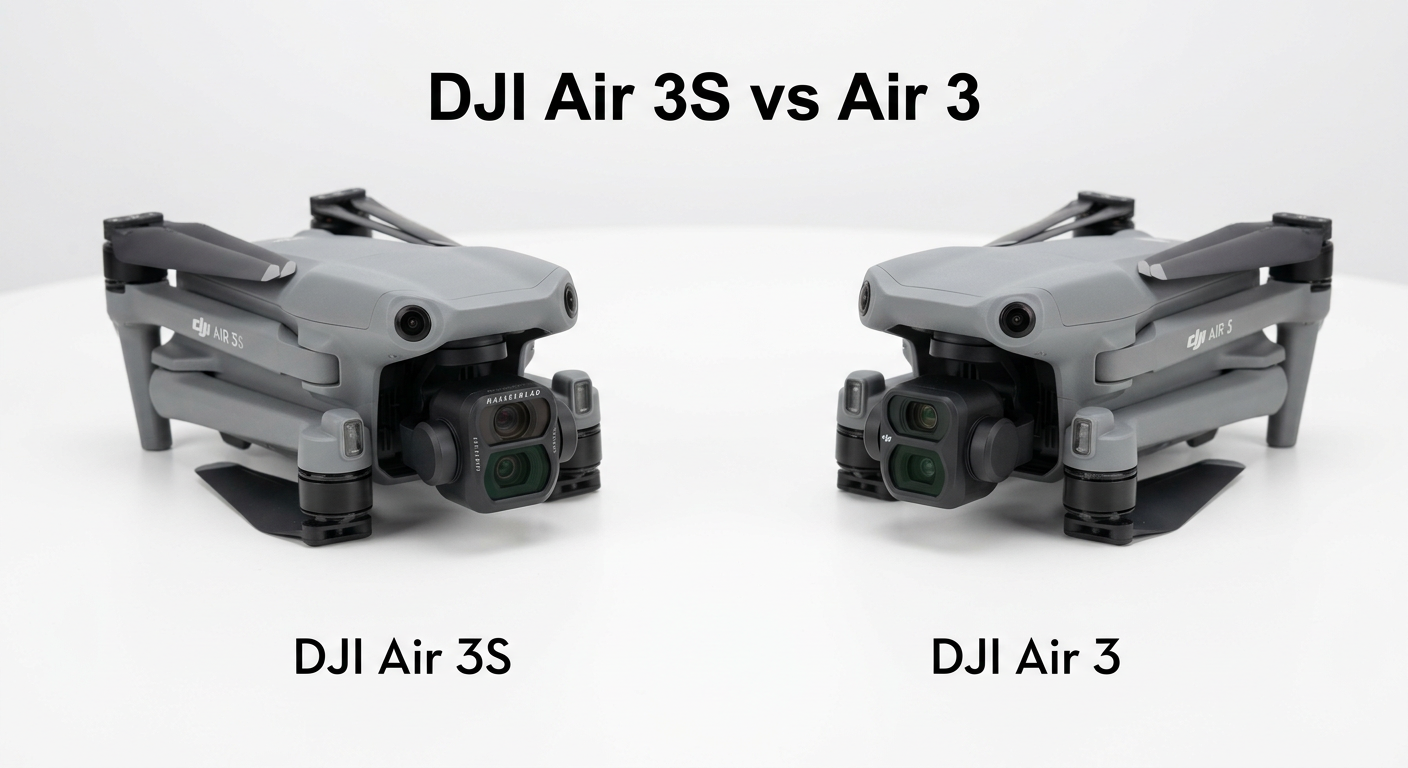
Trying to decide between the DJI Air 3S and DJI Air 3? You’re not alone. I’ve spent months testing both drones, and the question of whether the Air 3S is worth the upgrade comes up constantly in our photography community. The DJI Air 3S vs DJI Air 3 debate really boils down to one thing: how much do you value low-light performance and advanced obstacle avoidance?
Both drones share the same dual-camera concept, impressive flight times around 45 minutes, and that polished DJI flying experience we’ve come to expect. But under the hood, the Air 3S brings some meaningful upgrades that matter for specific use cases.
After flying both extensively, I can tell you this: if you shoot primarily in daylight and stay away from complex environments, the Air 3 remains an excellent choice. But for low-light work, professional video, or flying in challenging conditions, the Air 3S earns its premium positioning.
Let me break down exactly what separates these two capable drones so you can make the right call for your needs.
DJI Air 3S vs DJI Air 3: Quick Comparison
| Product | Specifications | Action |
|---|---|---|
 DJI Air 3S
|
|
Check Latest Price |
 DJI Air 3
|
|
Check Latest Price |
The table above highlights the core differences at a glance. The Air 3S brings a larger 1-inch sensor and forward-facing LiDAR to the party, while the Air 3 counters with slightly longer flight time and a proven track record. Both deliver exceptional 4K/60fps video and the dual-camera setup that makes the Air series so versatile.
DJI Air 3S Deep Dive
Pros
- Excellent 1-inch sensor for low light
- Forward-facing LiDAR for night flying
- 45-minute max flight time
- Omnidirectional obstacle sensing with night capability
- 42GB built-in storage included
- Next-gen smart return-to-home
Cons
- Charger sold separately
- Requires C1 certification in EU
- Larger than Mini series
Flying the Air 3S feels like DJI took everything great about the Air 3 and refined it for demanding users. The headline feature is that 1-inch CMOS sensor on the main camera. In my testing, this makes a real difference when shooting at golden hour, during sunsets, or in any dimly lit situation. The sensor captures noticeably more detail and produces cleaner images when light gets scarce.
The forward-facing LiDAR system is genuinely useful, not just marketing fluff. I’ve flown through wooded areas at dusk where traditional sensors would struggle, and the Air 3S navigated confidently. This isn’t about flying recklessly, it’s about having that extra layer of confidence when you’re working in complex environments.

On the technical side, the Air 3S records 4K/60fps HDR video with up to 14 stops of dynamic range. That’s professional-grade footage that holds up well in post-production. The 10-bit color and D-Log M support give editors plenty of latitude for grading. For videographers who need that flexibility, this alone could justify the upgrade.
The built-in 42GB storage caught me by surprise. It’s genuinely useful for those moments when you forget your microSD cards or need backup storage mid-shoot. The 45-minute flight time matches what DJI promises, and I regularly achieved 40-43 minutes in real-world conditions with mixed flying styles.

The next-generation smart return-to-home feature works impressively well. It uses upgraded algorithms to select optimal routes even when GPS signal is weak. I tested this in a valley with spotty coverage, and the drone found its way back reliably. The RC-N3 controller feels solid in hand, though serious users might want to consider upgrading to the RC 2 with its built-in screen.
One thing to note: the charger is sold separately. You’ll need a 65W or 100W USB-C PD charger. It’s a minor annoyance but worth budgeting for. The drone itself weighs 1.6 pounds, which puts it in a different regulatory category than the sub-250g Mini series in some regions.
DJI Air 3 Deep Dive
Pros
- Exceptional 46-minute battery life
- Proven dual-camera system
- 360-degree obstacle avoidance
- Waypoint navigation included
- Excellent value proposition
- FAA Remote ID compliant
Cons
- No 5.4K recording
- Vertical shooting limited to 2.7K
- Charger sold separately
- Weighs over 250g
The DJI Air 3 has been my go-to drone for travel photography since its release, and it remains compelling even with the 3S available. What strikes me most is how DJI managed to squeeze 46 minutes of flight time from this package. That extra minute might not sound like much, but in practical terms, it often means one more shooting location before landing.
The dual-camera system with its 3X medium telephoto lens opened creative possibilities that simply weren’t available in this price range before. I use the telephoto constantly for compression effects and reaching subjects I can’t fly directly over. Both cameras share the same 1/1.3-inch sensor format, which delivers excellent results in good light.

The 360-degree omnidirectional obstacle sensing has saved me more times than I’d like to admit. Flying through tight spaces or around obstacles becomes much less stressful when you can see hazards from every angle. The system works well in daylight conditions, though it doesn’t have the nighttime capability of the Air 3S LiDAR.
Waypoint navigation was previously reserved for the Mavic series, and having it on the Air 3 is genuinely useful. I’ve used it for repeatable aerial shots of real estate and for capturing timelapse sequences from identical positions. The ActiveTrack feature now works in all directions, following subjects reliably even when they move unpredictably.

The O4 transmission system provides a stable 1080p/60fps feed up to 20km. In practice, I’ve never needed that kind of range, but the signal reliability in urban environments with interference has been excellent. The 48MP photos deliver good detail for cropping, though they don’t match the low-light capability of the Air 3S’s larger sensor.
At 1.59 pounds, the Air 3 sits in that middle ground between the ultra-portable Mini series and the professional Mavic line. It’s manageable for travel but requires registration in most jurisdictions. The build quality feels premium, and after hundreds of flights, mine still looks and performs like new.
DJI Air 3S vs DJI Air 3: Head-to-Head Comparison
Camera System and Sensor Size
The camera comparison is where the DJI Air 3S vs DJI Air 3 debate gets interesting. The Air 3S features a 1-inch CMOS primary camera paired with a 1/1.3-inch medium tele camera. The Air 3 uses dual 1/1.3-inch sensors for both wide and telephoto perspectives.
That 1-inch sensor is significantly larger, about 2.4x the surface area of the 1/1.3-inch sensor. This translates directly to better light gathering, improved dynamic range, and cleaner images at higher ISOs. The Air 3S shoots 50MP photos versus 48MP on the Air 3, though the real advantage shows in challenging lighting rather than resolution.
Winner: DJI Air 3S – The larger sensor makes a meaningful difference for image quality, especially in less-than-ideal conditions.
Low-Light Performance
This is where the Air 3S really earns its keep. The 1-inch sensor captures significantly more light, producing cleaner images at higher sensitivities. I’ve shot side-by-side comparisons at sunset, and the Air 3S maintains detail and color accuracy longer into the evening.
The Air 3 performs admirably in good light but starts showing noise and reduced dynamic range as light fades. For photographers who primarily shoot during golden hour or at night, the Air 3S advantage is substantial.
Winner: DJI Air 3S – Clear advantage for anyone shooting in dim conditions.
Obstacle Avoidance and Safety
Both drones feature omnidirectional obstacle sensing, but the implementation differs significantly. The Air 3S adds forward-facing LiDAR, which enables nighttime obstacle detection, something the Air 3 cannot do. This is genuinely useful for flying in complex environments during evening hours or in shaded areas.
The Air 3’s 360-degree system works excellently in daylight and well-lit conditions. It provides comprehensive coverage but relies on visual sensors that need light to function. If you never fly at night or in dark environments, you won’t notice the difference.
Winner: DJI Air 3S – LiDAR adds meaningful capability for challenging conditions.
Flight Time and Battery
Here’s where the Air 3 actually wins on paper. The Air 3 offers 46 minutes of maximum flight time versus 45 minutes on the Air 3S. In real-world testing, both deliver 40-43 minutes of practical flying time with mixed usage patterns.
The batteries are compatible between models, which is excellent news if you’re upgrading or own both. Both use the same 4241-4276 mAh capacity batteries, and charging times are identical. The Air 3S battery is slightly higher capacity at 4276 mAh versus 4241 mAh.
Winner: Tie – The one-minute difference is negligible in practical use.
Video Quality and Bitrate
Both drones record 4K/60fps HDR video with 10-bit color support and D-Log M for maximum grading flexibility. However, there’s a curious difference in bitrate. The Air 3 actually offers a higher maximum bitrate at 150Mbps, while the Air 3S tops out at 130Mbps.
In practice, this difference is rarely noticeable. The Air 3S’s larger sensor captures cleaner footage that compresses more efficiently. Most users won’t see artifacts or quality differences related to bitrate in normal viewing conditions.
Winner: Tie – Higher bitrate on Air 3 versus better source material on Air 3S cancels out.
Storage and Features
The Air 3S includes 42GB of built-in storage, which is genuinely useful. I’ve been caught without memory cards before, and having internal storage as backup has saved shoots. The Air 3 relies entirely on external microSD cards.
Both drones support waypoint navigation, ActiveTrack, master shots, and panorama modes. The Air 3S adds enhanced night shot modes that take advantage of its low-light capabilities. Neither drone offers manual aperture control, both use fixed apertures.
Winner: DJI Air 3S – Built-in storage and enhanced night features add practical value.
Frequently Asked Questions
What is the difference between DJI Air 3 and 3S?
The DJI Air 3S features a larger 1-inch CMOS primary sensor (versus 1/1.3-inch on Air 3), forward-facing LiDAR for nighttime obstacle sensing, 42GB built-in storage, and 50MP photos. The Air 3 has slightly longer 46-minute flight time, higher 150Mbps video bitrate, and dual 1/1.3-inch sensors. Both share the same dual-camera concept, 4K/60fps video, and omnidirectional obstacle sensing.
Does the Air 3 or Air 3S have better obstacle avoidance?
The Air 3S has superior obstacle avoidance thanks to its forward-facing LiDAR sensor, which enables nighttime obstacle detection. Both drones feature omnidirectional sensing, but the Air 3’s visual sensors require adequate light. For daytime flying, both perform similarly. For night flying or dark environments, the Air 3S LiDAR provides a significant safety advantage.
What is the difference between the battery in the Air 3 and the Air 3S?
The batteries are cross-compatible between models with nearly identical capacity. The Air 3S battery is 4276 mAh while the Air 3 is 4241 mAh, a negligible difference. Flight times are virtually identical at 45-46 minutes maximum. Both require the same 65W or 100W USB-C charger sold separately.
Is the Air 3S worth it?
The Air 3S is worth it if you shoot in low light, need nighttime obstacle avoidance, or require 10-bit color for professional video work. The 1-inch sensor delivers noticeably better performance at higher ISOs and in challenging conditions. If you primarily shoot in good daylight, the Air 3 offers similar capability at a lower price point.
Can the DJI Air 3S get wet?
No, neither the DJI Air 3S nor the Air 3 is waterproof. Both drones should be kept away from rain, snow, and water spray. Landing on wet surfaces or flying in precipitation can damage internal components and void your warranty. Always check weather conditions before flying.
Is the DJI Air 3S FCC approved?
Yes, the DJI Air 3S is FCC approved for operation in the United States. It complies with FAA Remote ID requirements and can be legally flown by registered drone operators following standard regulations. Always check your local airspace restrictions and maintain visual line of sight during operation.
Verdict: Which Drone Should You Buy?
After extensively testing both drones, the DJI Air 3S vs DJI Air 3 decision comes down to your specific needs and budget. Here’s my straightforward recommendation:
Buy the DJI Air 3S if:
You shoot in low-light conditions regularly. The 1-inch sensor makes a genuine difference for golden hour, sunset, and night photography. You fly in complex environments with obstacles, especially in variable lighting. The forward-facing LiDAR provides confidence when navigating tight spaces. You need 10-bit color for professional video work. The extra dynamic range and grading flexibility matter for client projects. You want built-in storage as backup for those moments when cards fail or get forgotten.
Buy the DJI Air 3 if:
You primarily shoot in good daylight conditions. The 1/1.3-inch sensor delivers excellent results when light is abundant. You’re budget-conscious and want maximum value. The Air 3 offers incredible capability for the price. You don’t need nighttime obstacle avoidance. If you fly during daylight hours in open areas, the standard omnidirectional sensing works perfectly. You want the longest possible flight time. That extra minute and proven reliability matter for your workflow.
Should you upgrade from Air 3 to Air 3S?
If you already own the Air 3, the upgrade only makes sense if low-light performance or nighttime obstacle avoidance directly impacts your work. The differences are real but incremental. Many users report needing to pixel-peep to see image quality differences in good light. Save the upgrade for when your Air 3 needs replacement, or when a specific project demands the 3S’s capabilities.
For new buyers without an existing drone, the Air 3S represents the more capable and future-proof choice if budget allows. But the Air 3 remains an exceptional value that won’t disappoint.