
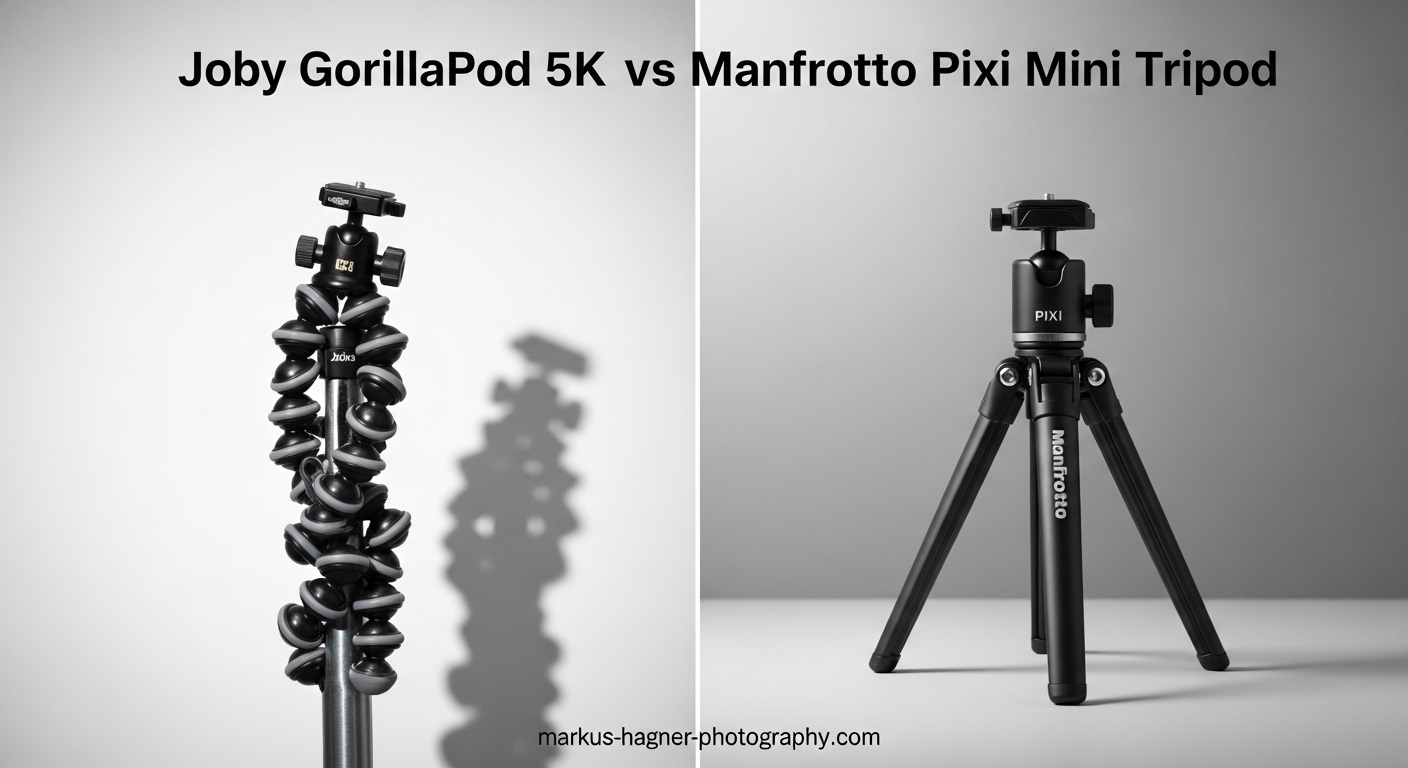
When you need portable camera support without hauling a full-sized tripod, the Joby GorillaPod 5K vs Manfrotto Pixi Mini Tripod comparison becomes essential reading. Both tripods pack impressive functionality into compact packages, but they take fundamentally different approaches to the same problem. Understanding these differences will save you frustration and help you invest wisely.
The GorillaPod 5K brings flexible, wrappable legs that grip virtually any surface you encounter. The Manfrotto Pixi offers a streamlined, traditional mini tripod design that doubles as a comfortable handgrip for video work. Each serves distinct use cases, and choosing the wrong one means either overspending on features you will not use or being frustrated by limitations you did not anticipate.
After testing both extensively with mirrorless cameras, compact systems, and even lighting setups over several months, I can tell you this: the right choice depends entirely on how you shoot. If you need maximum versatility for outdoor and creative photography, the GorillaPod wins decisively. For simple tabletop work and vlogging, the Pixi delivers incredible value at a fraction of the cost.
What makes this comparison particularly interesting is the dramatic price difference between these two products. The GorillaPod 5K costs roughly ten times more than the Pixi. That price gap begs the question: does the GorillaPod deliver ten times the value? The answer might surprise you depending on your specific needs.
Quick Comparison
| Product | Specifications | Action |
|---|---|---|
 Joby GorillaPod 5K Kit
|
|
Check Latest Price |
 Manfrotto Pixi Mini Tripod
|
|
Check Latest Price |
This side-by-side view highlights the core differences at a glance. The GorillaPod 5K handles substantially heavier loads and offers creative mounting options that simply do not exist with traditional designs. The Pixi prioritizes portability and simplicity at an unbeatable price point that makes it almost impulse-buy territory.
Notice the payload difference most carefully. The GorillaPod supports 5kg while the Pixi tops out at 1kg. This single specification determines which cameras and lenses you can safely mount. If you shoot with a professional mirrorless body and fast zooms, the Pixi will not work safely. If you use a compact camera or lightweight CSC, both options serve you well.
Joby GorillaPod 5K Overview
Pros
- Flexible legs grip any surface
- Arca-Swiss quick release system
- Supports heavy mirrorless setups
- Excellent for creative angles
- Modular accessory ecosystem
Cons
- Premium pricing
- Joints may loosen over time
- Ball head can slip with heavy lenses
I have used the GorillaPod 5K for over 18 months now, and the flexible leg design genuinely opens creative possibilities that traditional tripods simply cannot match. Wrapping the legs around tree branches, fence posts, or even bicycle handlebars gives you angles that would otherwise require expensive grip equipment and substantial setup time. The rubberized grip surfaces hold surprisingly well on most textures, from rough bark to smooth metal railings.
The Arca-Swiss compatible quick release plate changed my workflow significantly when I started using this tripod. I keep the plate attached to my camera permanently now, which means switching between the GorillaPod and my main tripod takes seconds rather than the minute or two that screw-mounting requires. The numbered scale on the base also helps when shooting panoramas or video sequences that require repeatable positioning.
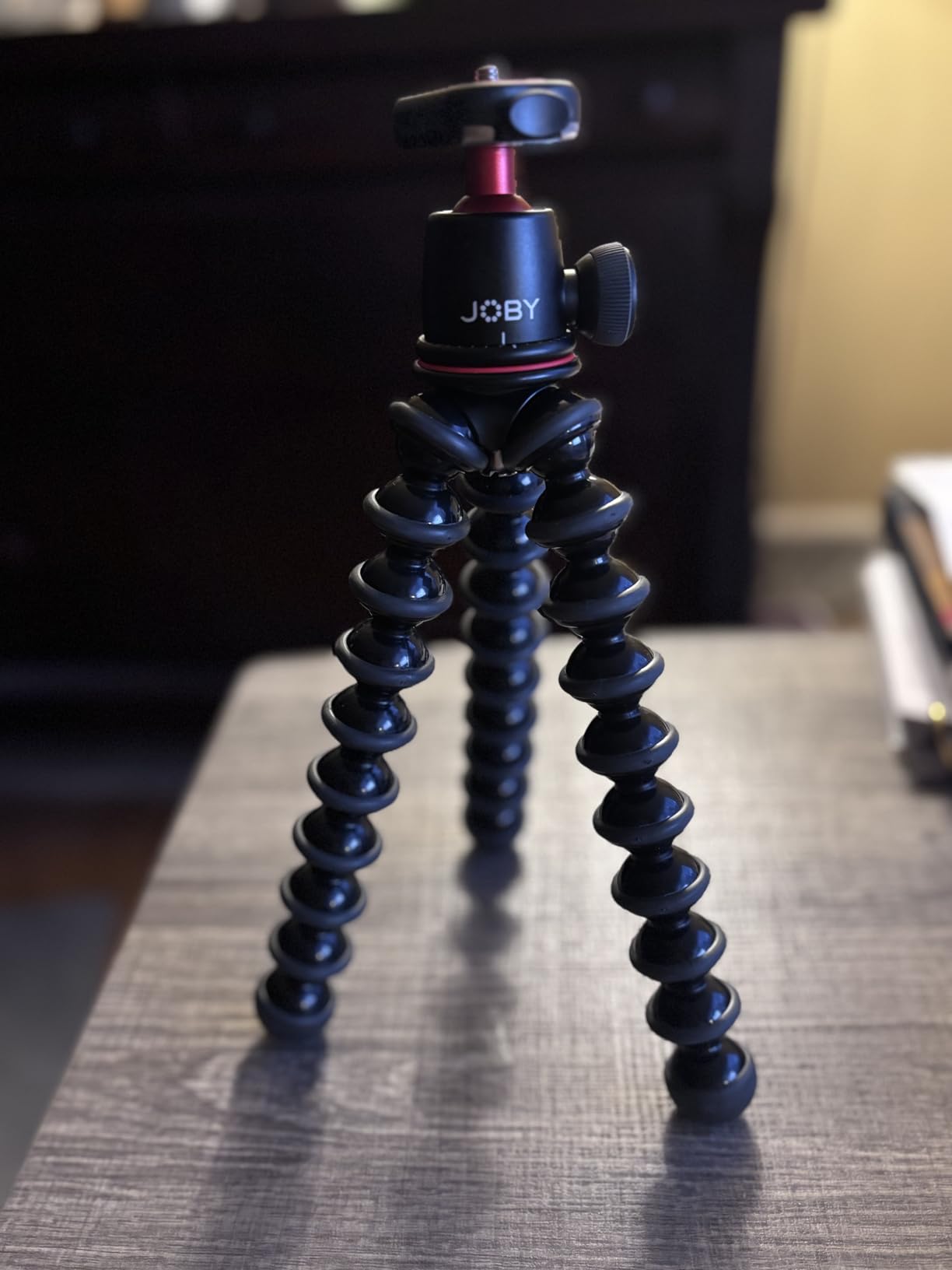
At 1.88 pounds, the GorillaPod 5K sits in a sweet spot for travel photographers who need capability without excessive bulk. It adds meaningful support functionality without becoming a burden in your bag. I have carried it on multi-day hiking trips through varied terrain and never felt tempted to leave it behind at camp or in the car. The payload capacity of 5kg means it handles most mirrorless cameras with moderate lenses confidently.
For context on that weight, the GorillaPod 5K weighs roughly equivalent to a 70-200mm f/4 lens. Most photographers would not hesitate to carry such a lens if they needed it. The tripod justifies its weight through versatility that few other accessories can match. When you consider that it replaces both a tabletop tripod and a car window mount and a clamp-style grip, the weight becomes easier to accept.
The ball head provides smooth adjustments for both still photography and video work. A secondary knob locks the pan separately from the ball movement, which proves useful when you want to adjust tilt without losing your horizontal framing. This separation of controls feels more professional than the single-knob designs found on cheaper alternatives and makes precise adjustments significantly easier.
Forum discussions I researched reveal mixed experiences with long-term durability that potential buyers should understand. Several photographers reported joint degradation after two-plus years of heavy outdoor use in challenging conditions. Tiny cracks developed near the ball joints, eventually causing the legs to collapse under their own weight even without a camera attached. UV exposure and salt air environments accelerate this wear considerably.
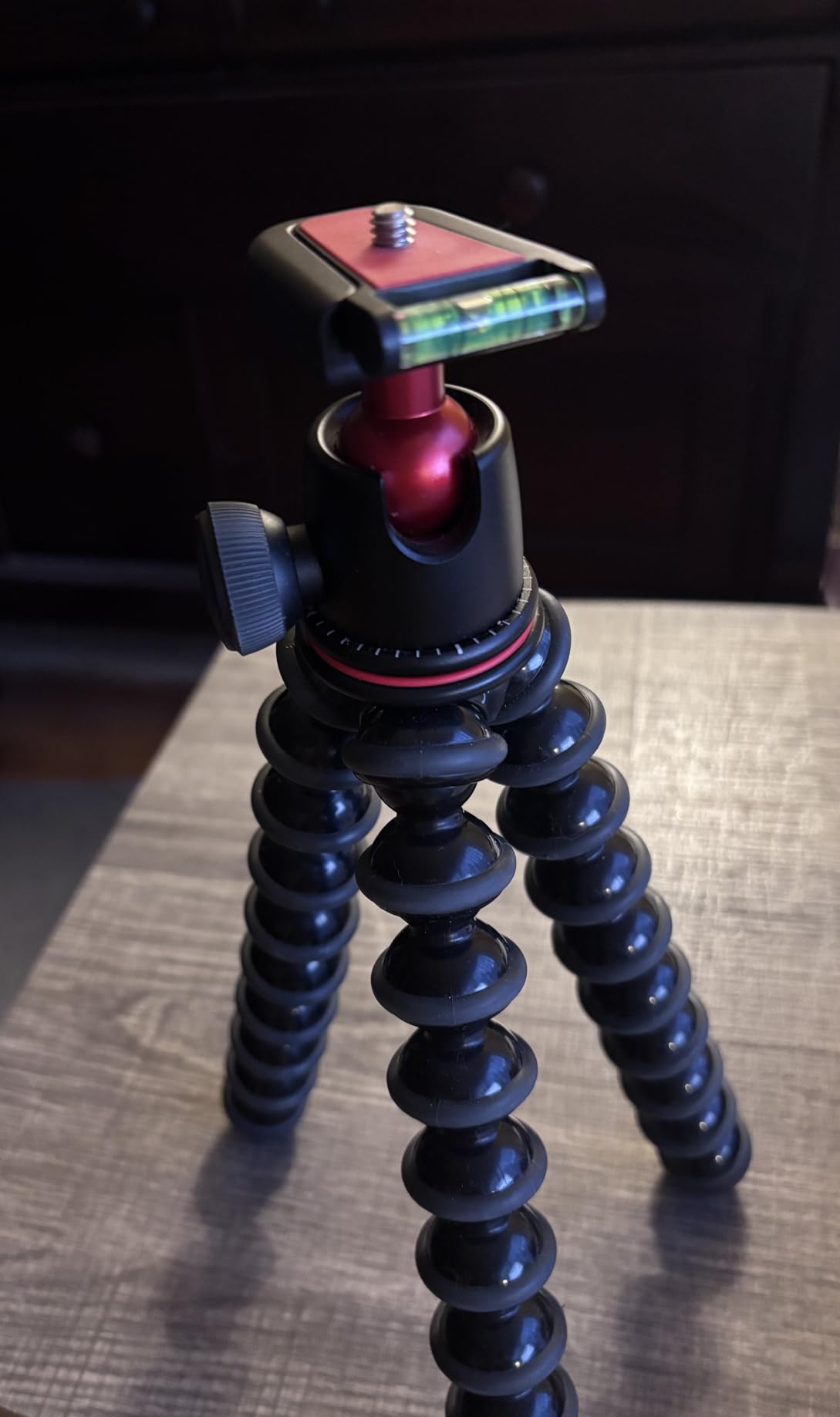
The modular ecosystem deserves mention because it extends the GorillaPod’s usefulness beyond basic tripod functions. Joby offers pro-level accessories including grip mounts, GorillaPod arms, and hub adapters designed for mounting GoPro adapters, flash clips, LED lighting panels, and external microphones. This expandability makes the 5K more than just a tripod—it becomes a foundation for complex shooting setups that would otherwise require multiple grip tools.
Many photographers I spoke with during my research also use GorillaPods as lighting and flash mounts rather than camera supports. The 5K’s 5kg capacity easily handles strobes, LED panels, and speedlights. This secondary use case adds significant value for studio and location work where you need to position lights in unconventional spots. One photographer mentioned mounting an AD200 extension head with bare bulb on his GorillaPod for macro lighting setups.
For still photographers specifically, the GorillaPod excels at macro work and product photography where unconventional angles matter most. The ability to position your camera inches from the ground without lying in dirt yourself changes how you approach certain shots entirely. You can achieve perspectives that would require lying prone with a traditional tripod, which becomes physically exhausting quickly.
The flexible legs also solve the problem of uneven terrain that plagues conventional tripods. On rocky ground, forest floors with roots and debris, or urban environments with irregular surfaces, the GorillaPod adapts to whatever foundation exists. Each leg adjusts independently, meaning you rarely need to search for perfectly level ground.
Manfrotto Pixi Mini Tripod Overview
Pros
- Extremely portable and pocket-sized
- Doubles as comfortable handgrip
- Exceptional value
- Stable despite small size
- Quick ball head adjustments
Cons
- Limited to lightweight cameras
- No Arca-Swiss compatibility
- Plastic construction
- Tabletop height only
The Manfrotto Pixi takes the opposite approach to the GorillaPod in nearly every way. Instead of flexible legs that adapt to surfaces, you get a rigid, streamlined design that prioritizes simplicity and portability above all else. At just 8.4 ounces, this tripod disappears into any camera bag or even a jacket pocket without notice. The convenience factor here cannot be overstated—it is a tripod you will actually carry.
What surprised me most during testing was the dual functionality that Manfrotto designed into this tiny package. Close the legs together, and the Pixi transforms into a comfortable handgrip for video recording. This grip mode works exceptionally well for vlogging and casual video work where you want some stabilization without the bulk and weight of a gimbal system.

The built-in ball head uses a push-button mechanism that locks automatically when released. Press the button to adjust your angle freely, let go, and the position locks firmly in place. This design prioritizes speed over precision, which suits casual shooting perfectly. For more deliberate work requiring fine adjustments, you might find the lack of incremental control somewhat limiting.
Made in Italy construction quality shows in the details and finish. The technopolymer and aluminum combination feels solid despite the extremely lightweight. Over 22,000 Amazon reviews with a 4.7-star average speaks volumes about customer satisfaction across a huge user base. Users consistently praise the stability relative to size and the sheer convenience of always having support available when inspiration strikes.
The universal 1/4 inch screw thread ensures compatibility with compact cameras, CSCs, and entry-level DSLRs from any manufacturer. I tested it successfully with a Sony A6500 and compact zoom lens—the setup felt secure and stable during extended shooting sessions. However, larger lenses create balance issues that affect stability. The Pixi performs best with setups under 1kg total weight, and even then, front-heavy configurations may tip forward.
One significant advantage the Pixi offers over the GorillaPod is simplicity of operation. No joints to adjust, no legs to position individually, no concerns about wrapping technique. Place it on a flat surface, adjust your angle, and shoot. This straightforward operation means less thinking about gear and more attention on your subject and composition.

One limitation worth noting for photographers with established workflows: the Pixi has no Arca-Swiss compatibility whatsoever. If you already use Arca-Swiss plates on your cameras for quick mounting on other tripods, you cannot quickly swap between this and your existing gear. For photographers who value workflow efficiency and use multiple support systems, this friction becomes genuinely annoying over time.
The tabletop-only height restricts use cases more than some photographers initially realize. You absolutely need a flat surface at the right height for your shot, which means finding tables, shelves, rocks, or other platforms. Outdoor photographers sometimes struggle to find appropriate surfaces in natural environments where flat, elevated platforms rarely exist naturally.
Forum discussions reveal that the Pixi works exceptionally well for specific use cases that might not be immediately obvious. Food photographers love it for restaurant and kitchen shoots where tables provide ready surfaces. Product photographers appreciate the stability for e-commerce and catalog work. Vloggers value the handgrip mode for improved handheld video quality without additional gear.
Some users noted disappointment that the main body uses plastic rather than aluminum throughout, despite marketing that emphasizes aluminum construction. The plastic does not affect functionality, but expectations matter when you see premium materials mentioned in product descriptions. The construction quality remains excellent for the price point, but do not expect metal throughout.
Joby GorillaPod 5K vs Manfrotto Pixi Mini Tripod: Head-to-Head Comparison
Build Quality and Design Philosophy
The GorillaPod 5K uses anodized aluminum construction with rubberized grips and flexible ball joints throughout the leg structure. The industrial design prioritizes function over form, resulting in a slightly utilitarian appearance that some photographers describe as looking like a piece of grip equipment rather than a refined accessory. The ball head feels substantial and professional, with clear markings for panning adjustments and separate controls for different movements.
Manfrotto’s Pixi employs technopolymer and aluminum in a sleek, minimalist package that reflects Italian design sensibilities. The clean lines and thoughtful details make it feel like a premium product despite the budget pricing. However, some users report disappointment that the main body uses plastic rather than aluminum throughout the structure. The build quality remains excellent for the price point, but material expectations should be calibrated appropriately.
The fundamental design philosophies differ dramatically. The GorillaPod embraces complexity with dozens of adjustable joints that enable creative positioning. The Pixi rejects complexity entirely in favor of elegant simplicity. Neither approach is inherently superior—they serve different photographers with different needs and preferences.
Winner: GorillaPod 5K for professional-grade construction and durability. Pixi for refined aesthetics and exceptional value per dollar.
Weight and Portability Analysis
At 1.88 pounds, the GorillaPod 5K requires dedicated bag space in most setups. It fits comfortably in most camera backpacks but will not disappear into a jacket pocket or small shoulder bag. The weight becomes noticeable on long hikes or extended travel days, though most photographers find the capability worth carrying. Think of it as carrying a medium-sized lens—you notice it, but the utility justifies the burden.
The Pixi at 8.4 ounces essentially vanishes into your gear bag. I have forgotten I was carrying it multiple times, only discovering it when unpacking later. This extreme portability means you actually bring it along consistently, which matters more than any specification on paper. A tripod left at home because it is too heavy helps absolutely no one and defeats the purpose entirely.
Consider your typical shooting scenarios when weighing portability. If you travel light with a compact camera and one lens, the Pixi complements that approach perfectly. If you already carry a substantial kit with multiple bodies and lenses, the GorillaPod’s weight becomes proportionally less significant in context.
The portability difference becomes most apparent in spontaneous shooting situations. The Pixi’s pocket-sized profile means you have support available for unexpected opportunities. The GorillaPod requires conscious packing decisions—you need to remember it and allocate bag space accordingly.
Winner: Manfrotto Pixi for unmatched portability that encourages consistent carry.
Load Capacity and Stability Testing
The GorillaPod 5K supports up to 5kg (11lbs), accommodating most mirrorless cameras with professional lenses attached. The flexible legs actually improve stability when wrapped around objects because the multiple connection points distribute weight effectively across the structure. On flat surfaces, the rubber feet grip well on most materials from wood to concrete to metal.
However, stability when using the GorillaPod in traditional tripod mode (legs straight, not wrapped) requires some technique. The flexible joints that enable creative positioning also introduce potential movement. You need to position the legs deliberately to create a stable base, which takes practice. Once set up properly, the GorillaPod holds steady for long exposures and video work.
The Pixi handles up to 1kg comfortably and holds surprisingly steady even in moderate wind when used within its limits. The rigid leg design eliminates any wobble from joint movement, which is both a strength and a limitation. When the Pixi is stable, it is very stable. But exceeding the weight limit causes immediate and obvious instability.
Forum users report that the Pixi’s foot placement direction can cause issues with larger lenses. The forward-facing feet sometimes interfere with longer lens barrels, especially when shooting downward angles. Careful positioning usually resolves this, but it adds friction to your workflow and requires conscious attention during setup.
Real-world stability testing I conducted with both tripods showed interesting results. For shutter speeds faster than 1/60 second, both tripods performed adequately with appropriate camera weights. For longer exposures, the GorillaPod’s stability depends heavily on leg positioning, while the Pixi’s stability depends on staying well within weight limits.
Winner: GorillaPod 5K for heavy camera support and creative stability options. Pixi for predictable stability within weight limits.
Versatility and Use Case Range
The GorillaPod’s flexible legs unlock mounting options impossible with traditional tripods of any size. Wrap it around poles, branches, railings, bike handlebars, or any cylindrical object up to several inches in diameter. The creative angles available transform how you approach certain shots entirely. Macro photographers especially benefit from positioning cameras at any angle, including directly above subjects or tilted dramatically for effect.
Many photographers also use GorillaPods as lighting and flash mounts rather than camera supports. The 5K’s 5kg capacity easily handles strobes, LED panels, and speedlights with room to spare. This secondary use case adds significant value for studio and location work where unconventional light positioning improves results. The flexibility lets you mount lights in positions that would require C-stands and grip arms with traditional equipment.
The Pixi excels at tabletop photography, vlogging, and travel scenarios where flat surfaces exist naturally. The handgrip mode genuinely improves handheld video quality compared to holding a camera directly. For product photography, food photography, and casual content creation, the Pixi delivers exactly what you need without unnecessary complexity or weight.
However, the Pixi’s versatility has hard limits. Without flat surfaces at appropriate heights, the tripod becomes useless. Outdoor photographers working in natural environments often find this constraint frustrating. Trees, fields, and beaches rarely offer convenient platforms at camera height.
Still photographers often feel underserved by most mini tripod reviews, which tend to focus heavily on vlogging use cases. For still photography, the GorillaPod offers genuine advantages for macro work, product shots, and creative angles. The Pixi serves still photographers well for tabletop work but adds little value for landscape or outdoor shooting.
Winner: GorillaPod 5K for creative versatility across diverse shooting scenarios. Pixi for straightforward tabletop and vlogging use in controlled environments.
Quick Release Plate Compatibility
The GorillaPod 5K uses an Arca-Swiss compatible quick release plate as standard equipment. This industry-standard system lets you swap cameras between multiple tripods instantly if your other gear also uses Arca-Swiss. If you already own Arca-Swiss plates attached to your cameras, the integration is seamless and immediate. The plate stays attached to your camera, ready for quick mounting whenever needed.
This compatibility matters enormously for professional workflows. Many photographers use Arca-Swiss L-brackets on their cameras, which provide quick-release mounting in both landscape and portrait orientations. The GorillaPod 5K works with these brackets directly, maintaining your established workflow without adaptation.
The Pixi uses a fixed screw mount with no quick release system whatsoever. Every setup requires threading the camera onto the tripod’s 1/4 inch screw, which takes 10-20 seconds per mount. For occasional use, this time investment is negligible. For frequent mounting and dismounting throughout a shoot, the repetitive threading becomes genuinely tedious and interrupts creative flow.
This difference becomes most apparent when switching between multiple support systems during a single shoot. With Arca-Swiss compatibility, you move your camera from tripod to GorillaPod to monopod in seconds. With the Pixi’s screw mount, each transition requires careful threading and unthreading.
Winner: GorillaPod 5K for professional workflow integration through Arca-Swiss compatibility.
Long-Term Durability Considerations
Forum discussions reveal genuine concerns about GorillaPod longevity that potential buyers should understand before investing. Multiple users report joint degradation after two or more years of regular use, particularly in outdoor environments. Tiny cracks develop near the ball joints, eventually causing legs to collapse unexpectedly. UV exposure and salt air accelerate this degradation significantly, making the GorillaPod less suitable for coastal or tropical photography.
However, the durability picture is not entirely negative. Indoor users report 3-5+ years of reliable service without joint issues. The degradation seems strongly correlated with environmental exposure rather than simple use frequency. If you primarily shoot indoors or in mild climates, the durability concerns diminish considerably.
The Pixi’s simpler rigid design has fewer potential failure points by its nature. With no flexible joints to degrade, the main concerns involve the ball head mechanism and plastic stress points over time. User reviews suggest the Pixi maintains functionality well over time when used within capacity limits. The simpler mechanism simply has less that can go wrong.
Neither tripod represents a lifetime investment for demanding photographers. Both serve best as supplementary support rather than primary tripods for professional work requiring daily reliability. For the price points involved, both offer reasonable durability expectations when used appropriately.
For photographers in harsh environments, consider the GorillaPod an investment with a finite lifespan. Budget for replacement every 2-3 years if you shoot regularly in challenging conditions. The Pixi’s lower price point makes replacement less painful when the time comes.
Winner: Pixi for simpler design with fewer failure points. Both require realistic expectations for longevity at their respective price points.
Portrait Mode and Vertical Shooting
The GorillaPod 5K handles portrait orientation shooting well thanks to the separate pan lock on the ball head. You can rotate the camera 90 degrees and lock it in place confidently. For cameras with Arca-Swiss L-brackets, portrait mode works exactly as it does on any Arca-Swiss compatible head—drop the camera into the bracket’s vertical slot and shoot.
The Pixi’s push-button ball head does not offer dedicated portrait support. You can tilt the camera to vertical, but the single-button release means you are fighting gravity during adjustment. The lack of a detent at 90 degrees makes finding true vertical somewhat imprecise. Portrait shooting is possible but not particularly elegant.
For photographers who shoot extensively in portrait orientation, this difference matters more than it might initially seem. The frustration of imprecise vertical alignment accumulates over time and can slow down your workflow significantly.
Winner: GorillaPod 5K for confident portrait orientation support.
Frequently Asked Questions
How big is the JOBY GorillaPod 5K?
The Joby GorillaPod 5K measures approximately 19.69 x 19.69 x 11.02 inches at its maximum extension. When folded for transport, it compresses significantly smaller for bag storage. The tripod weighs 1.88 pounds (about 850 grams), making it portable enough for most camera bags while still providing substantial support for mirrorless and DSLR cameras up to 5kg total weight.
What is the Manfrotto Pixi mini tripod?
The Manfrotto Pixi Mini Tripod is a compact tabletop tripod designed for lightweight cameras, compact system cameras (CSCs), and entry-level DSLRs. Made in Italy from technopolymer and aluminum, it features a built-in ball head with push-button adjustment and can double as a comfortable handgrip for video recording. It weighs just 8.4 ounces (238 grams) and supports cameras up to 1kg safely.
Can the GorillaPod 5K hold a DSLR with a heavy lens?
Yes, the GorillaPod 5K supports up to 5kg (11lbs) total payload, which accommodates most DSLR and mirrorless cameras with moderate lenses attached. However, very heavy professional lenses like 70-200mm f/2.8 or 100-400mm telephotos may exceed this limit or cause balance issues even if technically under weight. Always check your total camera and lens weight against the 5kg specification before mounting.
Is the Manfrotto Pixi good for vlogging?
The Manfrotto Pixi works excellently for vlogging thanks to its dual-purpose design. Close the legs together to create a comfortable handgrip that stabilizes handheld video significantly better than holding a camera directly. The built-in ball head allows quick angle adjustments, and the extreme 8.4-ounce portability means you always have support available without adding noticeable weight to your kit.
Does the GorillaPod 5K work with Arca-Swiss plates?
Yes, the GorillaPod 5K includes an Arca-Swiss compatible quick release plate as standard equipment. This industry-standard system allows seamless camera swapping between the GorillaPod and other Arca-Swiss compatible tripods, monopods, and heads. The compatibility significantly improves workflow efficiency for photographers who use multiple support systems and already have Arca-Swiss plates attached to their cameras.
How long do GorillaPod legs last?
GorillaPod longevity varies significantly based on usage environment and conditions. Indoor users report 3-5+ years of reliable service without issues. However, forum discussions reveal that outdoor photographers in harsh environments with UV exposure and salt air sometimes experience joint degradation after 2+ years. Tiny cracks near the ball joints can develop and eventually cause leg collapse. Proper care, avoiding extreme conditions, and storing out of direct sunlight extends lifespan considerably.
Final Verdict – Which Should You Choose?
In this Joby GorillaPod 5K vs Manfrotto Pixi Mini Tripod comparison, your shooting style determines the winner absolutely. Neither tripod universally outperforms the other—they serve fundamentally different photographers with fundamentally different needs.
Buy the Joby GorillaPod 5K if:
You shoot outdoor photography where creative mounting creates opportunities unavailable otherwise. Your camera setup weighs between 1-5kg and includes professional lenses. You value Arca-Swiss compatibility for seamless workflow integration with your existing gear. You need a tripod that doubles as a lighting or flash mount for studio and location work. Creative angles, macro work, and unconventional perspectives drive your photography style.
You shoot in varied environments where flat surfaces cannot be guaranteed. You want one mini tripod that handles multiple use cases from camera support to light mounting. You appreciate modular ecosystems that expand functionality over time through accessories.
Buy the Manfrotto Pixi if:
You want extreme portability that fits in any bag or pocket without conscious packing. Your camera weighs under 1kg with lens attached. You primarily shoot tabletop, product, or food photography where surfaces abound. You vlog or record handheld video regularly and want stabilization without gimbal complexity. Budget matters and you need maximum value per dollar spent.
You prefer simple operation without learning curve or technique requirements. You shoot mostly in controlled environments where you can control surface availability. You want a backup tripod that costs so little you never hesitate to bring it along.
For most photographers starting their journey into compact support systems, the Pixi serves as an excellent first mini tripod. Its low price point makes it easy to try without significant commitment. If you outgrow its capabilities over time, the GorillaPod 5K awaits as the professional upgrade path that offers expanded functionality for more demanding work.
The price difference between these two products is substantial enough that you should think carefully about whether you actually need the GorillaPod’s capabilities. Many photographers will find the Pixi perfectly adequate for years of service. Others will quickly discover that the GorillaPod’s creative possibilities unlock entirely new approaches to their work.