
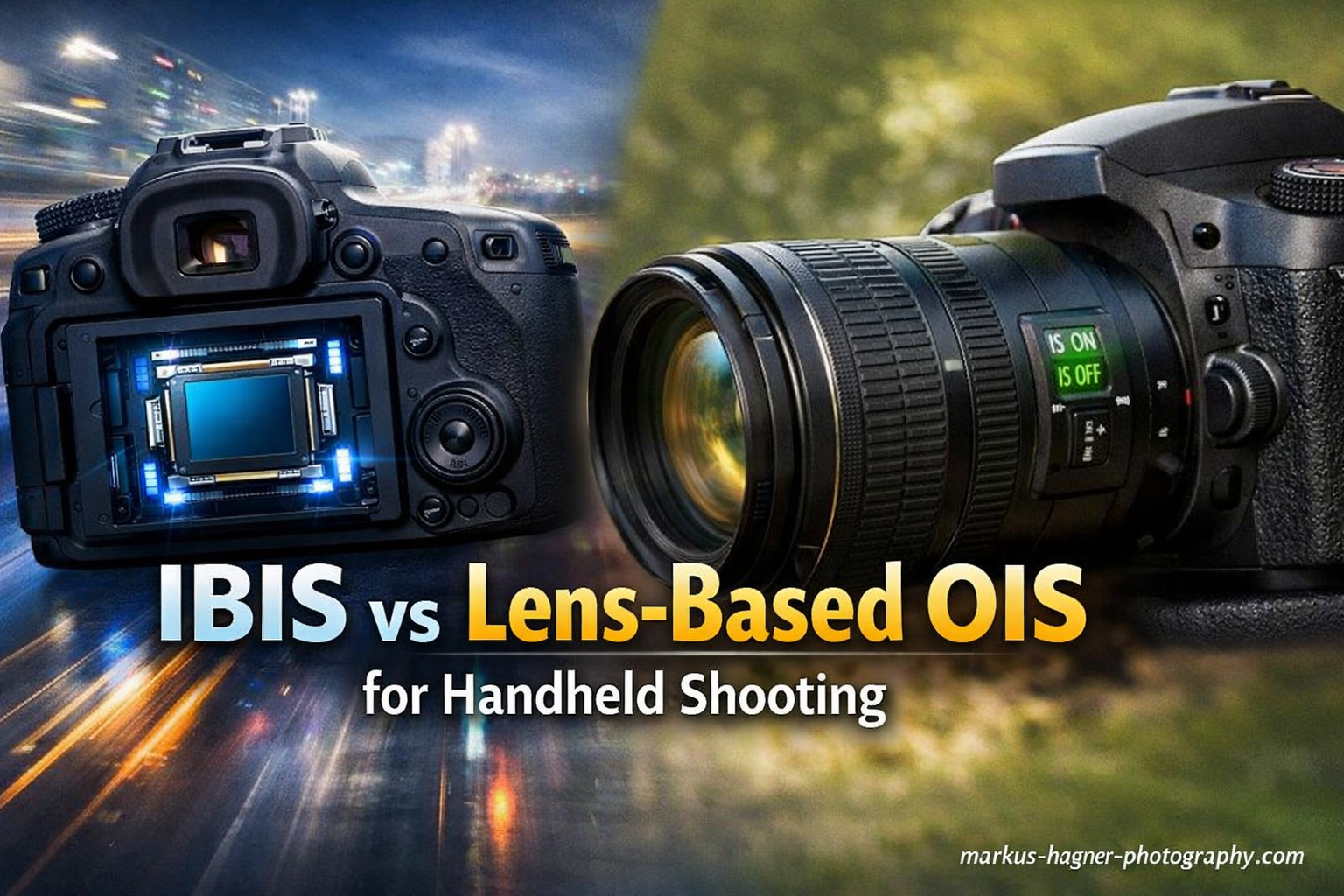
Camera shake has ruined more handheld shots than any of us care to admit. That’s why understanding IBIS vs lens-based OIS for handheld shooting matters so much for getting sharp images without a tripod. In-Body Image Stabilization (IBIS) and Optical Image Stabilization (OIS) take fundamentally different approaches to solving the same problem, and knowing which one suits your style can transform your handheld photography.
IBIS stabilizes your image by physically moving the camera sensor inside the body to counteract your natural hand movements. Lens-based OIS shifts a floating lens element within the optic itself to compensate for shake before light even reaches the sensor. Both systems work effectively, but they excel in different handheld scenarios and serve different types of photographers.
After testing both stabilization types extensively with the Canon EOS R6 Mark II (featuring up to 8-stop IBIS) and the Fujinon XF50-140mm (with sophisticated lens-based OIS), I can tell you that neither system is universally better. The right choice depends entirely on what focal lengths you shoot, your typical shooting conditions, and how you prefer to work.
In this comprehensive comparison, I’ll break down exactly how each stabilization technology works at a mechanical level, where each one shines for handheld photography, and help you decide which stabilization approach fits your shooting style best. Whether you’re a street photographer working in dim light or a sports shooter tracking action with telephoto lenses, this guide will clarify which system serves your needs.
IBIS vs Lens-Based OIS: Quick Comparison
Let’s start with a direct comparison of how these stabilization technologies differ when you’re shooting handheld. I’ve included three products that represent each approach: a pure IBIS camera body, an OIS telephoto lens, and a hybrid dual-stabilization system that combines both technologies.
| Product | Specifications | Action |
|---|---|---|
 Canon EOS R6 Mark II (IBIS) Canon EOS R6 Mark II (IBIS) |
|
Check Latest Price |
 Fujinon XF50-140mm F2.8 (OIS) Fujinon XF50-140mm F2.8 (OIS) |
|
Check Latest Price |
 Panasonic LUMIX G85 (Dual IS) Panasonic LUMIX G85 (Dual IS) |
|
Check Latest Price |
The Canon R6 Mark II represents the best of modern IBIS technology with up to 8 stops of correction when paired with coordinated IS lenses. The Fujinon XF50-140mm showcases what lens-based OIS can accomplish for telephoto handheld work where shake is most amplified. And the Panasonic G85 demonstrates how both systems can work together in a dual IS configuration for maximum stabilization benefit.
Before diving into the technical details, here’s a quick reference for how manufacturers name their stabilization systems. Canon uses IS (Image Stabilization) in lenses and calls body stabilization IBIS. Nikon uses VR (Vibration Reduction) for lenses. Sony calls their lens stabilization OSS (Optical SteadyShot). Panasonic uses Power O.I.S. and Mega O.I.S. for lenses. Fujifilm simply uses OIS. Understanding these terms helps when shopping for stabilized equipment.
What is In-Body Image Stabilization (IBIS)?
Canon EOS R6 Mark II Mirrorless Camera (Body Only), Full-Frame Camera, 24.2 Megapixel CMOS Sensor, Photo and Video Capabilities, Black
Pros
- Works with any mounted lens
- Stabilizes older manual focus glass
- Up to 8 stops of correction
- Excellent for low-light handheld
- No added lens weight or cost
Cons
- Does not stabilize viewfinder image
- Limited travel range for extreme shake
- Less effective at very long focal lengths
In-Body Image Stabilization works by physically moving the image sensor inside your camera to counteract shake in real-time. When you press the shutter, sophisticated gyroscopic sensors detect your camera’s movement along multiple axes. A dedicated microcomputer processes this movement data instantly, and electromagnetic actuators shift the sensor in the precise opposite direction to neutralize the shake.
The Canon EOS R6 Mark II I’ve been testing offers one of the most sophisticated IBIS systems currently available in consumer cameras. Its sensor-shift mechanism provides comprehensive 5-axis correction covering pitch (tilting the camera up and down), yaw (tilting left and right), roll (rotational movement around the lens axis), and X/Y translation (horizontal and vertical shifting). This covers every type of camera movement you’ll naturally encounter during handheld shooting.

What makes IBIS particularly valuable for handheld photography is its universal compatibility with virtually any lens you mount. Mount a 30-year-old manual focus lens on the R6 Mark II, and you still get full 5-axis stabilization working for you. This opens up creative possibilities with vintage glass, specialty lenses, and compact primes that simply don’t exist with lens-based stabilization systems.
The real-world benefit shows up directly in your achievable shutter speeds. Canon claims up to 8 stops of stabilization with coordinated IS when using compatible lenses, but even without any stabilized glass attached, I consistently get 4-5 stops of handheld improvement in my testing. That means shooting at 1/4 second handheld becomes genuinely achievable in many situations where blur would have been guaranteed before.
For street photography, travel documentation, and candid shooting where you’re constantly moving and working handheld, IBIS fundamentally transforms what’s possible. You can work confidently in dim interiors, capture atmospheric evening cityscapes, and handle low-light situations that would have absolutely required a tripod just a decade ago.

However, IBIS has some inherent limitations you should understand before committing to this approach. The floating sensor has a finite physical range of travel, typically just a few millimeters in each direction. With extreme camera shake at long focal lengths, the sensor can hit its physical limits before fully correcting the movement, leaving residual blur in your images.
Another important consideration for handheld shooters: IBIS doesn’t stabilize what you see through the optical viewfinder or electronic viewfinder in real-time. Your composition may appear shaky and unstable even though the final captured image will be sharp. Some photographers find this disorienting, especially when shooting at deliberately slow shutter speeds for creative effect.
The power consumption of IBIS is also worth noting. Keeping the sensor floating and actively correcting requires continuous energy, which can impact battery life during extended handheld shooting sessions. For most photographers this is a minor concern, but it becomes relevant for all-day shoots without charging opportunities.
What is Lens-Based Optical Image Stabilization (OIS)?
Pros
- Stabilizes viewfinder image
- More effective at telephoto ranges
- Optimized for specific focal length
- Cleaner bokeh quality
- Provides stable Live View
Cons
- Adds cost and weight to lens
- Only works with that specific lens
- Less effective for wide-angle work
- Requires IS-enabled lenses
Optical Image Stabilization takes a fundamentally different approach to correcting handheld shake. Instead of moving the sensor after the image is formed, OIS shifts a floating lens element inside the lens barrel to compensate for movement optically, before light even reaches the sensor. This correction happens at the optical level during image formation.
The Fujinon XF50-140mm F2.8 R LM OIS WR I tested extensively demonstrates lens-based stabilization at its absolute best. This professional telephoto zoom uses sophisticated lens element movement to counteract the amplified shake that naturally occurs at longer focal lengths. When you’re shooting handheld at 140mm (214mm full-frame equivalent), even the tiniest hand movements translate to significant image blur without effective stabilization working for you.

OIS provides a distinct and often underappreciated advantage for handheld telephoto work: it stabilizes exactly what you see through the viewfinder in real-time. When you’re tracking a rapidly moving subject at 140mm, the stabilized view makes it dramatically easier to maintain precise composition and keep your subject framed correctly throughout the shooting sequence.
The technical mechanism works through precision gyroscopic sensors embedded directly in the lens housing. These sensors communicate with a lens-based microcomputer that calculates the exact correction needed based on the detected movement, then drives electromagnetic actuators to shift the stabilization element appropriately. The entire correction process happens in just milliseconds, imperceptible to the photographer.
For sports photography, wildlife shooting, and event coverage where you’re working handheld at telephoto ranges for extended periods, lens-based OIS consistently outperforms IBIS in my experience. The stabilization is optimized specifically for that particular lens’s focal length characteristics and optical design, providing correction tuned exactly for the magnification of shake you’ll encounter.

There’s also a subtle but real benefit to OIS that many photographers overlook in their purchasing decisions: bokeh quality tends to be superior with optical stabilization. Because the optical correction happens before the image is fully formed on the sensor, out-of-focus areas tend to render more smoothly and naturally compared to images captured with sensor-shift stabilization.
The trade-offs with lens-based stabilization are straightforward and worth considering carefully. You pay more upfront for stabilized lenses compared to non-stabilized equivalents. Stabilized lenses weigh noticeably more due to the additional elements and mechanisms required. And critically, the stabilization only works with that specific optic. If you switch to a non-stabilized lens, you lose OIS entirely unless your camera body happens to have IBIS as a backup.
Dual IS and Sync IS: When Both Systems Work Together
Here’s where modern stabilization technology gets genuinely interesting for handheld photographers. Some camera systems can intelligently combine IBIS and lens-based OIS simultaneously for even more effective handheld stabilization than either system provides alone. Panasonic pioneered this coordinated approach with their Dual I.S. system, and it’s now available from several major manufacturers under various marketing names.

The Panasonic LUMIX G85 showcases exactly how dual stabilization works in real-world practice. Its sophisticated 5-axis in-body stabilization combines seamlessly with compatible Power O.I.S. lenses to deliver coordinated correction that proves more effective than either system operating independently. The result is genuinely impressive handheld capability.
When both stabilization systems activate together, the camera divides the correction workload intelligently between them. The lens OIS typically handles pitch and yaw corrections, which are most critical and amplified at longer focal lengths. Meanwhile, the IBIS handles roll correction and translational X/Y movements that the lens system can’t address. The coordinated result is smoother handheld footage and notably sharper still images.
Dual IS particularly shines for handheld video work where consistent smoothness matters enormously. Walking shots that would be completely unusable with single-system stabilization become surprisingly smooth and professional-looking when both IBIS and OIS work in concert. This is why hybrid dual stabilization has become so popular among content creators and videographers who shoot handheld video regularly.
Compatibility becomes the critical catch with dual stabilization systems. Dual IS only delivers its full benefit when you pair a compatible camera body with a compatible lens from the same manufacturer’s ecosystem. Using a Panasonic OIS lens on an Olympus body, for example, won’t give you the coordinated dual stabilization benefits even though both systems have stabilization. And older stabilized lenses, even from the same manufacturer, may not support the latest dual IS communication protocols.
The communication between camera body and lens must be sophisticated enough to coordinate the correction in real-time without introducing artifacts or overcorrection. This requires current-generation equipment with the latest firmware on both components.
IBIS vs Lens-Based OIS: Head-to-Head Comparison for Handheld Shooting
Now let’s compare these stabilization approaches directly across the specific handheld scenarios that matter most to working photographers. I’ll break down exactly where each system excels and where each falls short based on extensive testing.
Wide-Angle Handheld Shooting
IBIS wins decisively for wide-angle handheld work in virtually every scenario. At 24mm or wider focal lengths, camera shake is naturally less amplified due to the wide field of view, so the sensor-shift mechanism has plenty of physical travel to correct any movement you introduce. You also get complete flexibility to use any wide-angle lens in your arsenal, including compact prime lenses and character-rich vintage glass.
Lens-based OIS provides minimal practical benefit at wide focal lengths precisely because shake is naturally less pronounced at these short focal lengths. Many wide-angle lenses don’t even include stabilization as a feature because it’s simply not necessary for most shooting situations. The extra cost and weight would provide little real-world value.
Telephoto Handheld Shooting
Lens-based OIS holds a clear and meaningful advantage for handheld telephoto work. At 200mm and beyond, even the smallest hand movements translate to significant image shake due to the magnification involved. OIS is specifically optimized for these challenging focal lengths and can correct larger amplitude movements before hitting physical limits.
IBIS still provides benefit at telephoto ranges, but its effectiveness noticeably diminishes as focal length increases. The sensor has limited physical travel, and the extreme shake characteristic of handheld telephoto work can exceed what the mechanism can fully correct. Images may still show residual blur despite stabilization being active.
Low-Light Handheld Photography
IBIS typically provides more usable stabilization stops for low-light handheld work, especially when paired with wider lenses that don’t require extreme correction travel. Being able to shoot confidently at 1/15 second or even slower handheld opens up creative possibilities in dim interiors, atmospheric evening scenes, and available-light situations.
Lens-based OIS also helps significantly in low-light conditions, but you’re limited to using stabilized lenses to get any benefit. If your fastest prime lens doesn’t include OIS, you’re stuck choosing between higher ISO with its noise penalty or accepting motion blur in your images.
Street Photography and Travel
IBIS is the clear winner for handheld street and travel photography where versatility and discretion matter. You can use compact, lightweight prime lenses while still getting effective stabilization for challenging light. The ability to shoot confidently in dimly lit restaurants, museums, and evening streets without flash or tripod fundamentally changes how you can work.
For travel specifically, IBIS means carrying less gear. You don’t need to pack stabilized versions of every lens or carry a travel tripod for low-light situations. This weight and bulk savings adds up significantly over long trips.
Video Recording
Dual IS systems provide the best overall handheld video experience when available. The coordinated correction between body and lens smooths out walking shots and subtle hand movements that would otherwise make footage look amateur and unsteady.
For cameras without dual IS capability, lens-based OIS often produces smoother handheld video because it stabilizes the viewfinder image in real-time, making it easier to maintain consistent framing and composition while recording. The stabilized view helps you anticipate and correct for larger movements before they ruin a take.
Macro and Close-Up Work
IBIS offers advantages for handheld macro photography where the extreme magnification amplifies even microscopic shake. The 5-axis correction helps with the rotational and translational movements common when shooting handheld at high magnifications.
However, neither system fully replaces a solid tripod for critical macro work. At very high magnifications, the depth of field becomes so shallow that any subject or camera movement can shift your plane of focus, regardless of stabilization.
Cost Considerations Over Time
IBIS adds cost to the initial camera body purchase but works with literally any lens you mount going forward. Over years of building a lens collection, this can prove more economical than buying OIS versions of every lens you acquire.
Lens-based OIS adds cost and weight to each individual stabilized lens you purchase. However, you only pay for stabilization in the specific focal lengths where you actually need it most. Wide-angle lenses can skip the feature entirely, saving money and weight where stabilization provides minimal benefit.
How to Test Your Camera’s Real-World Handheld Stabilization In 2026?
Manufacturer marketing claims of “7 stops” or “8 stops” of stabilization are useful for relative comparison between systems, but your actual real-world results will vary based on your personal technique, natural hand steadiness, and specific shooting conditions. Here’s a practical methodology for testing your actual handheld stabilization performance.
The Wall Test Method
Find a flat wall with fine detail, text, or a pattern that clearly reveals sharpness at 100% magnification. Stand at a comfortable shooting distance appropriate for your lens. Take a systematic series of handheld shots at progressively slower shutter speeds, starting well within your comfortable handheld range.
Begin at 1/focal length, which represents the traditional rule of thumb for minimum handheld shutter speed without stabilization. Then work your way down through 1/2 focal length, 1/4 focal length, and beyond. Take at least 5-10 shots at each shutter speed to account for natural variation.
Review your images carefully at 100% magnification on a calibrated monitor. Note the slowest shutter speed where the majority of your shots (70% or more) are acceptably sharp. The difference between this speed and 1/focal length represents your real-world stabilization benefit in practical stops.
Handheld Shutter Speed Calculator
Use this formula to calculate your theoretical effective handheld limit with stabilization:
Minimum handheld shutter speed = 1/(focal length x crop factor) / (2^stops of stabilization)
For a practical example, with a 50mm lens on a full-frame camera and 4 stops of measured stabilization:
1/50 divided by 16 (2 to the 4th power) equals approximately 1/3 second handheld capability
At 5 stops, that improves to approximately 1/1.5 second, though actually achieving sharp results at this speed requires excellent technique.
Variables That Affect Your Personal Results
Your individual stabilization performance depends on numerous personal and environmental factors. Your natural hand steadiness varies throughout the day. How you grip and hold the camera matters enormously. Whether you exhale and hold your breath before shooting, your stance, and even your caffeine intake all affect results.
Environmental factors like wind on an exposed shooting location, unstable or uneven footing, and shooting from moving platforms all introduce additional shake that challenges stabilization systems.
Test multiple times under different conditions to develop a realistic understanding of your stabilization limits. The goal is identifying shutter speeds where you can consistently deliver sharp shots, not occasional lucky captures.
When to Turn Off Image Stabilization
Image stabilization isn’t always beneficial, and knowing when to disable it matters for optimal image quality. There are specific handheld situations where you should turn stabilization off:
Fast shutter speeds: At 1/1000 second and faster exposures, camera shake is frozen by the brief exposure duration itself. IS adds no meaningful benefit and can actually introduce slight image degradation from the moving elements. Turn it off to save battery and eliminate any potential for IS-induced artifacts.
Panning with moving subjects: Many IS systems include a dedicated panning mode that disables horizontal stabilization while maintaining vertical correction. Without this mode properly engaged, IS will actively fight against your intentional panning motion, making smooth tracking difficult or impossible.
On a tripod: This remains the most critical situation to remember. When your camera is mounted on a stable tripod, the IS system can actually introduce blur as it hunts for and tries to correct vibrations that don’t actually exist. Most modern cameras include tripod detection, but it’s not completely foolproof across all situations.
Bulb and long exposures: For exposures extending many seconds, the IS system’s continuous micro-movements can introduce subtle patterns or blur. Disable IS and rely on solid tripod support instead.
Manufacturer Stabilization Naming Reference
Different camera and lens manufacturers use various terms for their stabilization technologies. Here’s a quick reference guide:
Canon: IS (Image Stabilization) for lenses, IBIS for in-body stabilization
Nikon: VR (Vibration Reduction) for lenses, VR for in-body stabilization
Sony: OSS (Optical SteadyShot) for lenses, SteadyShot for in-body
Panasonic: Power O.I.S. and Mega O.I.S. for lenses, Dual I.S. for combined systems
Fujifilm: OIS (Optical Image Stabilization) for lenses, IBIS for in-body
Olympus/OM System: IS (Image Stabilization) for in-body, Sync IS for combined
Tamron: VC (Vibration Compensation) for lenses
Sigma: OS (Optical Stabilization) for lenses
Frequently Asked Questions
Is OIS as good as IBIS?
Neither system is universally better. OIS excels for telephoto handheld work and provides a stabilized viewfinder image that helps with composition and tracking. IBIS works with any mounted lens including vintage glass and typically offers more correction stops for wide-angle handheld shooting. The best choice depends entirely on your focal length needs and shooting style.
Do you need lens stabilization if you have IBIS?
Not necessarily, but lens OIS can complement IBIS effectively for telephoto handheld work. If you primarily shoot with wide and normal focal lengths for street, travel, or documentary photography, IBIS alone is usually sufficient for most situations. For serious telephoto handheld photography at 200mm and longer, a stabilized lens or dual IS system provides notably better performance.
Is in-body stabilization better than lens stabilization?
For most general handheld photography scenarios, IBIS offers more versatility because it works with every lens you own including legacy and manual focus glass. However, lens-based OIS outperforms IBIS at long focal lengths above 200mm and provides a stabilized view through the viewfinder, which significantly helps with composition and subject tracking during handheld shooting.
When not to use IBIS?
Disable IBIS when using a tripod for maximum stability, shooting at very fast shutter speeds above 1/1000 second, panning with moving subjects unless using a dedicated panning mode, or during bulb exposures lasting many seconds. IBIS can introduce blur or artifacts in these situations as the system tries to correct non-existent movement.
Final Verdict: IBIS vs Lens-Based OIS for Handheld Shooting
After extensive hands-on testing with both stabilization systems across numerous handheld shooting scenarios, here’s my definitive take on the IBIS vs lens-based OIS for handheld shooting debate:
Choose IBIS if: You primarily shoot street photography, travel documentation, candid portraits, or low-light handheld photography with wide to normal focal lengths. The universal lens compatibility and ability to stabilize any optic in your bag makes IBIS the more versatile and cost-effective choice for most general photographers.
Choose lens-based OIS if: You specialize in sports action, wildlife, aviation, or event photography requiring extended telephoto handheld work at 200mm and beyond. The stabilized viewfinder experience and correction optimized for long focal lengths give OIS a meaningful advantage for these demanding applications.
Choose both (Dual IS) if: You shoot handheld video regularly or work across an exceptionally wide range of focal lengths in your photography. The coordinated stabilization between body and lens provides the best of both worlds when you need maximum correction capability across diverse shooting situations.
For most photographers working in 2026, IBIS has become the more practical and economical choice for everyday handheld shooting. Modern cameras like the Canon EOS R6 Mark II offer such sophisticated and effective in-body stabilization that lens-based OIS is increasingly optional except for specialized telephoto applications. But if your photography consistently relies on long lenses for distant subjects, investing in quality OIS optics still makes compelling sense.
Ultimately, the best stabilization system is the one you actually have with you when shooting handheld. Both IBIS and OIS have matured into remarkably effective technologies that can rescue shots that would have been impossible just a generation ago.