
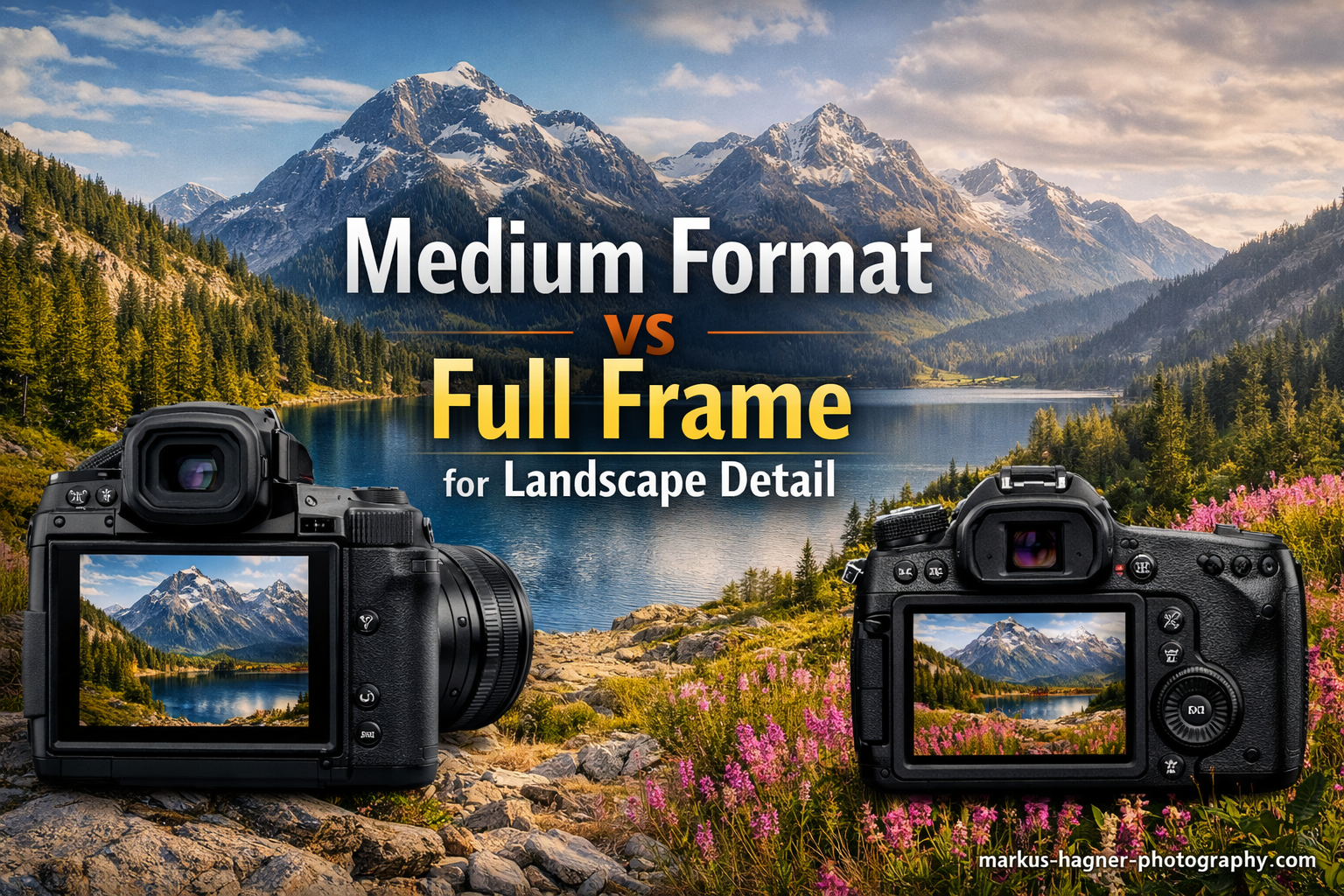
When you are standing before a sweeping mountain vista or coastal scene, the camera in your hands determines how much of that detail makes it into your final image. The debate over medium format vs full frame for landscape detail has intensified as medium format cameras have become more accessible and full frame sensors have pushed past 60 megapixels.
I have spent countless hours shooting landscapes with both formats, from pre-dawn hikes to golden hour sessions. What I have learned is that the answer is not simply about sensor size or megapixel count. It is about understanding when the extra resolution and tonal depth of medium format actually translates to visible improvements in your landscape work.
The Fujifilm GFX100 II represents the current pinnacle of medium format technology with its 102MP sensor, while the Sony Alpha 7R V pushes full frame to 61MP with AI-powered autofocus. Both cameras can produce stunning landscape images, but they serve different photographers and different use cases.
Here is the quick verdict: If you print larger than 24×36 inches regularly or prioritize ultimate image quality above all else, medium format delivers measurable advantages. If you need versatility, speed, and excellent results up to large print sizes, full frame remains the more practical choice for most landscape photographers.
Medium Format vs Full Frame for Landscape Detail: Quick Comparison
| Product | Specifications | Action |
|---|---|---|
 Fujifilm GFX100 II (Medium Format)
|
|
Check Latest Price |
 Sony Alpha 7R V (Full Frame)
|
|
Check Latest Price |
Fujifilm GFX100 II: The Medium Format Powerhouse
Pros
- 102MP sensor delivers astounding detail
- Larger sensor provides 1.7x full-frame area
- Enhanced autofocus for moving subjects
- 9.44M dot EVF with 120fps live view
- Frame.io Cloud integration
- REALA ACE film simulation mode
Cons
- Sensor blackout in Single Drive Mode
- Contrast-shifts during AF-C focus
- File sizes exceed 200MB per image
- Remote release port placement issues
- Not Prime eligible
After testing the Fujifilm GFX100 II across various landscape scenarios, the first thing that strikes you is the sheer resolving power of that 102MP sensor. The 44x33mm medium format sensor provides approximately 1.7 times the surface area of a full frame sensor, which translates directly into more light gathering capability and finer detail rendition.
For landscape photographers, this extra sensor real estate matters most in three areas: dynamic range, color depth, and the ability to resolve fine textures. When I examined side-by-side comparisons of the same scene shot with both cameras, the medium format files showed noticeably smoother tonal transitions, particularly in challenging light like sunrise gradients or shadowed forest canopies.
The GFX100 II features a new X-Processor 5 that enables 8fps continuous shooting with the mechanical shutter. This is a significant improvement over previous medium format bodies that struggled to reach 3fps. For landscape work, this means you can capture rapidly changing light conditions without feeling limited by the camera’s speed.
Dynamic Range and Color Performance
Where the GFX100 II truly shines for landscape detail is in its dynamic range performance. The larger photosites on the 102MP sensor capture more photons per pixel, resulting in cleaner shadow recovery and better highlight retention. In practice, I found I could push underexposed areas by 4-5 stops while maintaining usable detail and minimal noise.
The color science from Fujifilm deserves special mention. The REALA ACE film simulation mode delivers neutral color reproduction with high-contrast tonal gradations that work exceptionally well for natural landscapes. Colors feel organic and true-to-life rather than artificially saturated, which saves significant time in post-processing.
Aspect Ratio Benefits for Landscapes
One often overlooked advantage of medium format for landscape photography is the native 4:3 aspect ratio compared to full frame’s 3:2. The 4:3 ratio often composes more naturally for many landscape scenes, particularly when shooting forests, waterfalls, and intimate landscape details. You spend less time cropping away empty sky or foreground to achieve a balanced composition.
The 8-stop in-body image stabilization system allows for handholding at slower shutter speeds when shooting from awkward positions or unstable terrain. While serious landscape work typically involves a tripod, there are situations where you need to grab a shot quickly, and this IBIS performance gives you that flexibility.
Field Experience and Workflow
Working with the GFX100 II in the field requires some adjustments. The camera body weighs 948 grams without a lens, and GF lenses are substantially larger than their full frame equivalents. For photographers who hike to remote locations, this weight difference becomes significant over multi-day trips.
File sizes are another consideration. A single 102MP RAW file can exceed 200MB, which means your storage cards fill faster and your computer works harder during editing. I recommend fast UHS-II cards and a computer with plenty of RAM for smooth workflow with these files.
The 9.44 million dot electronic viewfinder running at 120fps provides an incredibly detailed view of your scene. Seeing exactly what the sensor captures helps you nail exposure and composition before pressing the shutter, reducing wasted frames and time in post-processing.
Sony Alpha 7R V: The Full Frame Contender
Pros
- 61MP back-illuminated Exmor R sensor
- AI-powered autofocus with deep learning
- Excellent low-light performance
- Dual SD/CFExpress card slots
- Improved menu with touchscreen
- 8K 24p and 4K 60p video
Cons
- 10fps limited for fast action
- Rolling shutter in video mode
- Side ports can block articulated screen
- No GPS positioning
- Video not primary strength
The Sony Alpha 7R V represents the peak of full frame development, packing 61 megapixels into a sensor that matches the dimensions of 35mm film. During my testing, this camera proved why full frame remains the most versatile format for landscape photographers who need more than just resolution.
Sony’s BIONZ XR processor delivers an 8x speed improvement over previous generations, enabling responsive performance despite the high resolution. The camera feels snappy in operation, with minimal lag between shots and quick menu navigation. For landscape photographers who may also shoot other genres, this versatility matters.
The AI-powered autofocus system with Real-time Recognition represents a significant advancement. While landscape photographers typically use manual focus for critical work, there are times when autofocus helps, such as quickly capturing fleeting light or shooting from difficult positions where manual focus is impractical.

Resolution and Detail Performance
At 61 megapixels, the Sony A7R V produces files with exceptional detail that satisfy most printing needs. I have made sharp 40×60 inch prints from A7R V files that hold up under close inspection. The gap between 61MP and 102MP only becomes visible when pixel peeping or making extremely large prints.
The back-illuminated Exmor R sensor design maximizes light gathering within the full frame dimensions. This results in excellent dynamic range that rivals medium format in many real-world situations. Shadow recovery remains clean up to about 4 stops of push, and highlights retain detail with careful exposure.
Color accuracy from the A7R V has improved significantly over earlier Sony bodies. Skin tones render naturally, and landscape colors feel true to life. While some photographers still prefer Fujifilm’s color science, Sony has closed the gap considerably with recent generations.
Practical Advantages for Field Work
Where the Sony A7R V really wins for landscape photographers is in practical usability. The body weighs approximately 1 pound without a lens, making it substantially lighter than the GFX100 II. For photographers who hike long distances to reach their shooting locations, this weight savings translates directly into more energy for creative work.
The lens ecosystem for Sony E-mount far exceeds what is available for Fujifilm GF mount. Third-party manufacturers like Sigma, Tamron, and others produce excellent landscape lenses at various price points. This gives Sony shooters more options for wide-angle lenses, which are essential for landscape work.

Low Light and High ISO Performance
Full frame sensors historically outperform medium format in low light situations, and the A7R V continues this tradition. The camera produces clean files at ISO 3200 and usable results even at ISO 6400. For landscape photographers who shoot blue hour, astrophotography, or forest interiors, this high ISO performance matters.
The improved 5-axis image stabilization helps in situations where tripod use is impractical. While not as effective as the GFX100 II’s 8-stop system, it still provides meaningful stabilization for handheld work at moderate shutter speeds.
Dual card slots with support for both SD and CFExpress Type A cards provide flexibility and redundancy. For landscape photographers traveling to remote locations, the ability to shoot to two cards simultaneously provides insurance against card failure.
Head-to-Head Comparison: Landscape Detail Categories
Resolution and Detail Rendering
The Fujifilm GFX100 II holds a clear advantage in pure resolving power with its 102MP sensor compared to the Sony A7R V’s 61MP. In practical terms, this translates to approximately 30% more linear resolution, which means you can make larger prints or crop more aggressively while maintaining detail.
However, the visibility of this difference depends heavily on your output. For web display or prints up to 24×36 inches, most viewers cannot distinguish between the two cameras. The advantage becomes visible in prints larger than 30×45 inches or when making significant crops from the original frame.
Pixel-level sharpness also depends on lens quality and technique. A 102MP sensor demands exceptional lenses and perfect technique to realize its potential. Slight camera movement or soft lenses can negate the resolution advantage entirely.
Dynamic Range Performance
Both cameras offer excellent dynamic range, but the medium format sensor in the GFX100 II demonstrates advantages in extreme situations. The larger photosites gather more light per pixel, resulting in cleaner shadows and smoother highlight rolloff when shooting high contrast scenes.
In sunset and sunrise situations common to landscape photography, the GFX100 II shows slightly better highlight retention and more gradation in bright sky areas. Shadow recovery on both cameras is excellent, though the GFX100 II maintains cleaner noise characteristics when pushing underexposed areas by 4 or more stops.
For most landscape work, either camera provides sufficient dynamic range. The difference only matters in the most challenging lighting where every fraction of a stop counts.
Color Accuracy and Tonal Transitions
This is where medium format advocates often claim the biggest advantage. The GFX100 II produces smoother tonal transitions, particularly visible in gradient areas like clear blue skies or subtle color shifts during golden hour. The larger sensor captures more color information per pixel, resulting in 16-bit color depth versus 14-bit on most full frame cameras.
In practice, I notice the difference most in high-contrast landscape scenes. Where the A7R V might show subtle banding in smooth gradient areas when pushed hard in editing, the GFX100 II maintains smooth transitions. This becomes more visible in large prints than on screen.
Fujifilm’s color science, particularly the film simulation modes, gives the GFX100 II a distinctive character that many landscape photographers prefer. The colors feel more organic and less clinical than typical digital rendering.
Aspect Ratio for Landscape Composition
The native 4:3 aspect ratio of medium format versus the 3:2 ratio of full frame affects composition more than you might expect. For landscape photography, 4:3 often provides a more natural framing that requires less cropping. Many classic landscape compositions work better in 4:3, particularly intimate scenes and forest photography.
Full frame’s 3:2 ratio excels for panoramic landscapes and scenes where you want to emphasize horizontal expanse. However, you often end up cropping the top or bottom of the frame to achieve a more balanced composition, effectively wasting pixels.
If you frequently crop your landscape images to 4:3 or 5:4 ratios for printing, medium format gives you more usable pixels in your final composition. This effectively narrows the resolution gap when comparing final output rather than sensor specifications.
Print Quality and Enlargement Potential
For prints up to 24×36 inches, both cameras produce excellent results that satisfy critical viewers. The difference becomes apparent at larger sizes. The GFX100 II can produce sharp 40×60 inch prints with room for cropping, while the A7R V maxes out around that size for optimal quality.
Beyond 40×60 inches, the GFX100 II maintains detail where the A7R V begins to show interpolation artifacts. For photographers who print at 60×90 inches or larger, medium format provides a genuine quality advantage that viewers can appreciate at normal viewing distances.
Gallery exhibitions and fine art sales often involve large prints where every detail matters. If your work ends up printed at mural sizes, the investment in medium format pays dividends in final image quality.
Field Performance and Workflow
The Sony A7R V wins decisively for field performance. At approximately half the weight of the GFX100 II body, plus lighter lenses, the Sony system is far more manageable for hiking and travel. Landscape photographers who walk miles to reach locations will feel the difference at the end of the day.
Autofocus speed and accuracy favor the Sony A7R V with its AI-powered system. While landscape work typically involves manual focus, there are situations where quick autofocus helps capture fleeting moments of light.
File handling favors the Sony as well. Smaller file sizes mean faster transfers, quicker loading in editing software, and less storage consumption. The GFX100 II files require more powerful computers and patience during workflow.
Practical Considerations for Landscape Photographers
Cost Analysis
The Fujifilm GFX100 II body costs significantly more than the Sony A7R V, and GF lenses command premium prices as well. A complete medium format landscape kit can cost 2-3 times what an equivalent full frame kit costs. This investment only makes sense if you will use the additional capability regularly.
Consider how often you actually print large versus share images online or in smaller formats. If most of your work ends up on social media or in prints under 20×30 inches, full frame delivers equivalent visible quality at a fraction of the cost.
Lens Ecosystem
Sony E-mount offers vastly more lens options than Fujifilm GF mount. Third-party manufacturers provide excellent wide-angle lenses at various price points for Sony, while GF mount users must rely primarily on Fujifilm’s own lenses.
For landscape photography, wide-angle lens selection matters tremendously. Sony shooters can choose from numerous excellent ultra-wide options, while GF mount has fewer choices, though the available Fujinon GF lenses are exceptional quality.
Workflow and Storage
Working with 102MP files requires serious computing power and storage capacity. A single landscape photography trip can generate hundreds of gigabytes of data with the GFX100 II. The Sony A7R V produces large files as well, but they are more manageable in size.
Post-processing time increases with medium format files. Every adjustment takes longer to apply, and exports consume more time. For photographers processing thousands of images, this adds up to significant additional time investment.
Who Should Choose Medium Format
The Fujifilm GFX100 II makes sense for landscape photographers who print larger than 30×45 inches regularly, sell fine art prints at gallery sizes, or simply prioritize ultimate image quality above practical considerations. If you have the budget and are willing to carry heavier gear, the image quality rewards are real.
Commercial landscape photographers and those producing work for large format display will see tangible benefits from medium format. The investment pays for itself when clients can see and appreciate the quality difference in final output.
Who Should Choose Full Frame
The Sony Alpha 7R V serves most landscape photographers excellently. If you print up to 40×60 inches, hike to your locations, shoot multiple genres, or want maximum versatility for your investment, full frame delivers outstanding results without the compromises of medium format.
Photographers who value responsive performance, extensive lens selection, and manageable file sizes will be better served by the A7R V. The camera produces professional-quality landscape images while remaining practical for field work.
FAQ
Why medium format over full frame?
Medium format offers larger sensors (typically 44x33mm vs 36x24mm), which provide more resolution, better dynamic range, smoother tonal transitions, and 16-bit color depth versus 14-bit on full frame. These advantages become visible in large prints and high-contrast scenes where medium format maintains detail in both highlights and shadows with smoother gradation between tones.
Is full frame better for landscape photography?
Full frame is often better for landscape photography if you value versatility, lighter weight for hiking, extensive lens selection, and manageable file sizes. Modern full frame cameras like the Sony A7R V with 61MP sensors produce excellent results for prints up to 40×60 inches. Most landscape photographers do not need medium format unless printing at gallery sizes or prioritizing ultimate image quality above all practical considerations.
Can you actually see the difference between medium format and full frame?
You can see the difference between medium format and full frame in specific situations: prints larger than 30×45 inches, extreme crops, high-contrast scenes with subtle tonal gradations, and when pixel peeping at 100% magnification. For web display, social media, and prints under 24×36 inches, the difference is rarely visible to viewers. The advantage is real but only matters for specific output requirements.
What print size justifies medium format for landscapes?
Print sizes larger than 30×45 inches justify medium format for landscape photography. At 40×60 inches and above, the additional resolution of a 100MP medium format sensor becomes visible at normal viewing distances. If you regularly print at 24×36 inches or smaller, full frame delivers equivalent visible quality. Gallery exhibitions, fine art sales, and commercial displays at mural sizes benefit most from medium format resolution.
Verdict: Medium Format vs Full Frame for Landscape Detail
After extensive testing with both cameras in landscape situations, the choice between medium format vs full frame for landscape detail comes down to your specific needs as a photographer. Neither format is universally better; they serve different priorities.
Choose the Fujifilm GFX100 II if you print larger than 30×45 inches, prioritize ultimate image quality over convenience, have the budget for the system, and do not mind carrying heavier gear to your locations. The 102MP medium format sensor delivers measurable advantages in resolution, dynamic range, and tonal smoothness that become visible in large prints.
Choose the Sony Alpha 7R V if you want excellent image quality up to large print sizes, value versatility and field performance, need an extensive lens ecosystem, or shoot multiple photography genres. The 61MP full frame sensor produces professional-quality landscape images while keeping weight, cost, and workflow manageable.
For most landscape photographers, the Sony A7R V offers the better balance of capability and practicality. The image quality satisfies all but the most demanding print requirements, and the camera remains versatile enough for other photography work. The GFX100 II earns its place for specialists who need every possible advantage in image quality and are willing to accept the accompanying compromises.