
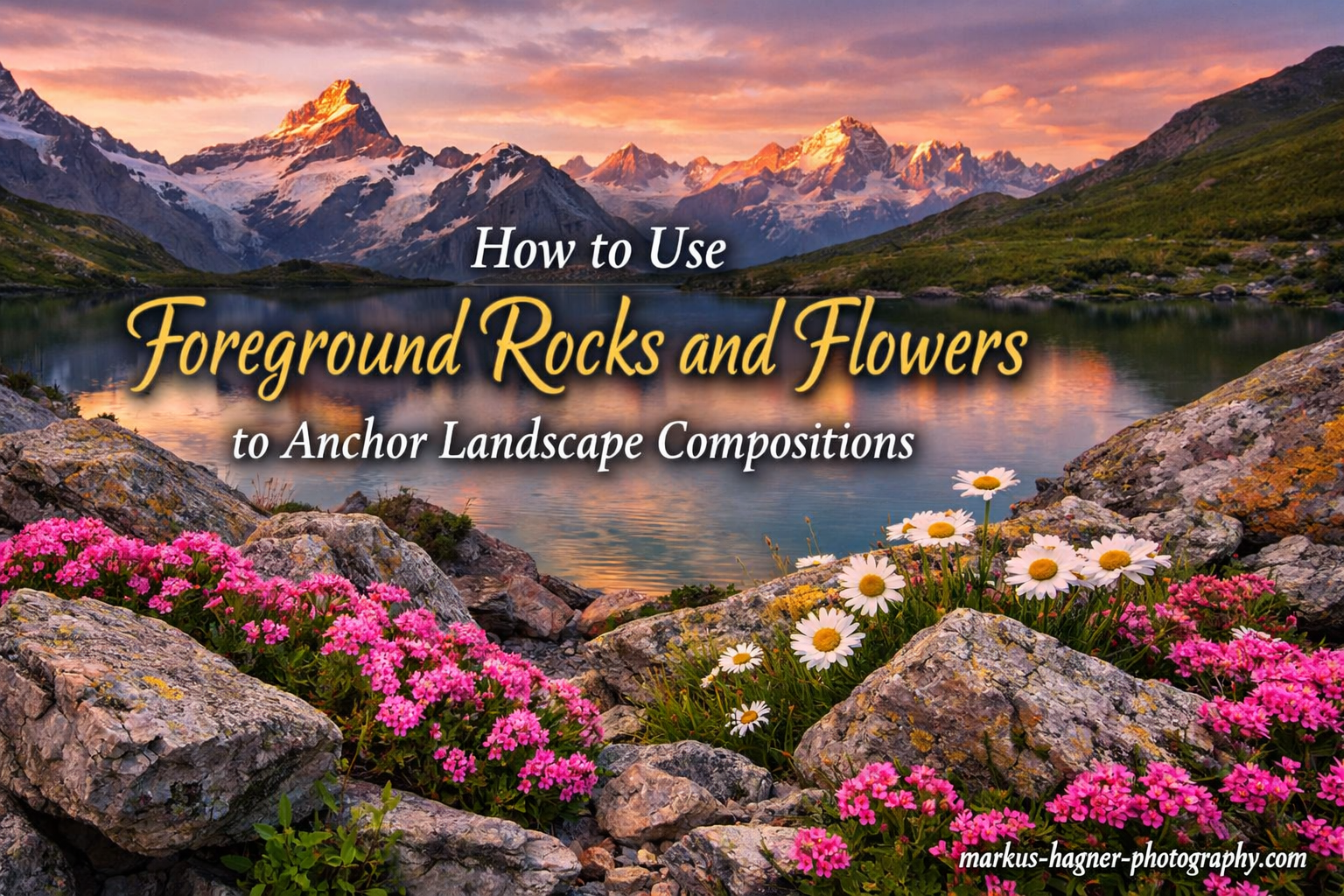
Foreground rocks and flowers serve as powerful visual anchors that transform flat landscape images into immersive three-dimensional experiences. When I first started shooting landscapes, my photos often felt distant and lacking depth. Everything changed when I learned how to use foreground elements effectively to draw viewers into the scene.
In this guide, I’ll show you exactly how to use foreground rocks and flowers to anchor your landscape compositions. You’ll learn practical techniques for finding, positioning, and capturing these elements to create more engaging images that hold the viewer’s attention.
Why Foreground Elements Matter in Landscape Photography?
Foreground rocks and flowers to anchor landscape compositions are essential because they create depth in what would otherwise be a flat two-dimensional image. When you place interesting elements close to your lens, you establish three distinct layers that guide the viewer’s eye through the entire scene.
Our brains naturally try to make sense of spatial relationships in photographs. Without foreground elements, viewers have no reference point for scale or distance. The entire landscape can appear compressed and distant, like viewing a scene through a window rather than being immersed in it.
Foreground elements serve as entry points that invite viewers into your image. They create a visual journey from bottom to top, leading the eye through foreground, middle ground, and background. This layered approach keeps viewers engaged longer and creates a more compelling viewing experience.
I’ve found that images with strong foreground anchors consistently perform better in online portfolios and social media. They simply feel more immersive and draw viewers in, creating an emotional connection that flat, distant landscapes struggle to achieve.
The Three-Layer Composition System
Understanding the three-layer composition system is fundamental to using foreground rocks and flowers effectively. This approach divides your frame into foreground, middle ground, and background, each serving a specific purpose in your composition.
The foreground layer contains elements closest to your camera, typically within a few feet of your lens. This is where your rocks, flowers, or other anchors live. The middle ground connects foreground to background, often containing hills, trees, or water. The background provides context and destination, usually featuring mountains, sky, or distant landmarks.
Think of these layers like a stage performance. The foreground is your front row, the middle ground is the main action, and the background sets the scene. All three layers need to work together to create a compelling image.
What makes this system powerful is how it creates perceived depth. By including elements at varying distances, you give viewers visual clues about spatial relationships. The wide-angle lens most landscape photographers use exaggerates this effect, making close elements appear larger and distant elements smaller, enhancing the three-dimensional feel.
How to Use Rocks as Foreground Anchors In 2026?
Rocks make excellent foreground anchors because they’re stable, textured, and available in almost any landscape environment. I’ve used rocks from volcanic formations in Iceland to coastal boulders in Maine, and they consistently add impact to landscape compositions.
When scouting for rock foregrounds, look for interesting textures and shapes. Cracked surfaces, layered sedimentation, or weathered patterns all add visual interest. A flat, featureless rock won’t engage viewers, but one with character becomes a subject in itself.
Positioning matters immensely with rock foregrounds. Get low, often just inches above ground level, to emphasize the rock’s presence. This low angle also stretches the perspective, making the rock appear more dominant while pushing the background further away, enhancing depth perception.
I recommend placing rocks slightly off-center rather than dead center in your frame. This creates asymmetry and visual tension that’s more engaging. Use the rule of thirds as a starting point, positioning your primary rock anchor along one of the imaginary grid lines.
Light quality transforms rock foregrounds. Side lighting reveals texture, while backlighting can create silhouettes with interesting rim light. Overcast days provide soft, even light that brings out subtle colors and details without harsh shadows.
Consider scale when working with rocks. A single, larger rock can serve as a powerful singular anchor, while a cluster of smaller rocks creates leading lines that guide the eye deeper into the frame. Both approaches work, depending on your vision for the scene.
How to Use Flowers as Foreground Anchors?
Flowers bring color, delicacy, and seasonal character to landscape foregrounds. I’ve found that wildflowers, in particular, add a sense of place and time that connects viewers emotionally to your image. A field of alpine blooms in summer or autumn gentians tells a story about season and location.
When using flowers as foreground elements, timing becomes critical. Many wildflowers bloom for only a few weeks each year. I research bloom schedules before trips and plan shoots around peak flowering periods. Missing the window by even a week can mean the difference between carpeted color and dried stems.
Wind presents a constant challenge with flower foregrounds. Even gentle breezes can cause motion blur during longer exposures. I use faster shutter speeds when possible, or wait for calm moments between gusts. Some photographers carry small reflectors or diffusion panels to block wind while shooting.
Get extremely low for flower foregrounds, often ground-level with your lens nearly touching the plants. This perspective isolates flowers against the background and emphasizes their importance in the composition. A ground-level tripod or even a beanbag can help stabilize your camera at these extreme angles.
Focus carefully when working with flowers. At such close distances, depth of field becomes extremely shallow. I often use focus stacking techniques, capturing multiple images at different focus distances and combining them in post-processing to ensure sharpness throughout the foreground element.
Consider flower density in your composition. A single isolated bloom creates one kind of image, while clusters or sweeps of flowers create another. Both work, but they communicate different moods. Sparse arrangements feel delicate and precious, while dense fields feel abundant and celebratory.
Combining Rocks and Flowers Effectively
Some of my most successful landscape images combine both rocks and flowers in the foreground. This combination creates visual contrast between the permanent, solid nature of stone and the temporary, delicate nature of blooms. The interplay speaks to themes of time, resilience, and natural cycles.
When combining elements, pay attention to color harmony. Yellow flowers against grey volcanic rock, purple blooms with sandstone, or white alpine flowers with dark granite can create striking color combinations. Consider complementary colors that make both elements pop.
Balance is crucial when combining multiple foreground elements. Avoid having rocks and flowers compete for attention. One should serve as the primary anchor while the other provides supporting interest. I usually establish a clear visual hierarchy through size, positioning, and lighting.
The relationship between elements matters. Flowers growing from rock crevices tell one story about persistence and adaptation. Rocks scattered through a meadow of wildflowers suggest another. Pay attention to these natural relationships and let them inform your composition.
Spatial relationships become more complex with multiple elements. Consider how rocks and flowers interact with each other and with the middle and background. Leading lines created by rock formations can guide the eye toward flower clusters, which then lead to distant mountains or sky.
Technical Settings for Sharp Foregrounds
Sharp foregrounds require specific technical considerations. The most common mistake I see is blurry foreground elements that distract rather than enhance. Understanding depth of field and proper focusing technique is essential for successful foreground work.
Aperture selection controls how much of your scene appears sharp from front to back. For foreground work, I typically use apertures between f/11 and f/16. Smaller apertures (larger f-numbers) increase depth of field but introduce diffraction that slightly softens the entire image. F/11 to f/16 represents the sweet spot for most landscape situations.
Focal length dramatically affects foreground rendering. Wide-angle lenses (16-24mm on full frame) exaggerate the apparent size of close elements while pushing distant elements further away. This creates maximum depth perception but can make foregrounds appear overly dominant. Longer focal lengths compress perspective, making foreground and background feel closer together.
Focus distance is perhaps the most critical and misunderstood setting. Many photographers autofocus on their foreground element, which often leaves the background soft. The hyperfocal distance technique focuses at a specific point that renders everything from half that distance to infinity acceptably sharp. Various apps and calculators can help determine this distance based on your focal length and aperture.
Focus stacking provides maximum sharpness throughout the scene. This technique involves capturing multiple images at different focus distances, then combining them in software. I use this approach when shooting very close foreground elements with distant backgrounds, as it ensures sharpness throughout the entire depth range.
Tripod height affects foreground emphasis. Lower tripods emphasize foreground elements and enhance depth perception. I often work with my camera just inches above ground level for maximum foreground impact. Higher viewpoints diminish foreground presence and can flatten the overall composition.
Common Mistakes to Avoid
After reviewing thousands of landscape images and teaching workshops, I’ve identified several common mistakes photographers make with foregrounds. Avoiding these pitfalls will immediately improve your landscape compositions.
Too much foreground dominates the image and leaves little room for the broader landscape. If your foreground occupies the bottom half or more of your frame, reconsider your composition. The foreground should enhance, not overwhelm. Step back slightly or raise your camera angle to restore balance.
Blurry foregrounds result from insufficient depth of field or improper focus technique. Always check focus at 100% magnification in the field. If your foreground isn’t sharp, adjust your aperture or focus distance and reshoot. There’s no fixing a blurry foreground in post-processing.
Cluttered, messy foregrounds distract rather than enhance. Not every rock or flower deserves inclusion in your frame. Be selective and choose elements that add value. Sometimes simply repositioning a few feet eliminates distracting elements and results in a cleaner composition.
Distracting bright spots in the foreground can pull attention away from your main subject. Our eyes are drawn to the brightest areas of an image. Ensure your foreground doesn’t contain highlights that compete with your intended focal point. Use exposure blending or graduated neutral density filters if needed to balance brightness.
Forcing foregrounds when none exist leads to weak images. Sometimes landscapes work better without foreground elements. Coastal scenes with dramatic sky, minimalist desert compositions, or forest interiors may not need foreground anchors. Learn to recognize when less is more.
Practical Field Tips for Finding Foregrounds
Finding effective foreground elements is often the hardest part of landscape composition. I’ve spent hours wandering beautiful locations unable to find a suitable foreground anchor. Here’s my practical approach to consistently finding foreground elements.
Scout locations without your camera first. Walk around, crouch down, look from different angles. When you’re not focused on shooting, you’ll see foreground possibilities more clearly. I often find my best compositions while casually exploring, then return with gear once I’ve identified the setup.
Work from background to foreground. Start by identifying your main subject and overall composition. Then look for foreground elements that enhance that specific view. This approach ensures your foreground serves the composition rather than driving it.
Get lower than you think necessary. Most photographers shoot from standing height or slightly below. Getting your camera inches from the ground opens entirely new foreground possibilities and dramatically changes perspective. A small camping stool or even sitting on the ground helps stabilize your camera at these extreme angles.
Use live view to compose when working at low angles. Composing through a viewfinder while crouched or lying on the ground is difficult and frustrating. Live view lets you see exactly what you’re getting and makes fine-tuning composition much easier.
Consider seasonal timing for flower foregrounds. Research bloom schedules for your target locations. Many wildflowers have brief peak periods. Plan trips around these windows and have backup locations ready in case blooms aren’t at peak when you arrive.
Practice with common elements before your big trips. Visit local parks and practice finding and composing foreground elements. Developing your eye for foreground possibilities close to home makes it much easier to spot opportunities in exotic locations during limited time windows.
How to Use Foreground Rocks and Flowers to Anchor Landscape Compositions In 2026?
Learning how to use foreground rocks and flowers to anchor landscape compositions transformed my photography. What once felt like distant, flat views became immersive experiences that draw viewers into the scene. The three-layer system of foreground, middle ground, and background creates depth and engagement that sets compelling landscapes apart from ordinary snapshots.
The techniques I’ve shared here come from years of field experience, countless mistakes, and gradual refinement. Start simple: look for one interesting rock or flower element, get low, and practice composing with clear foreground, middle ground, and background layers. As this becomes natural, you’ll begin seeing foreground opportunities everywhere.
Remember that foreground elements should enhance, not dominate. The best landscape compositions balance all three layers into a cohesive whole where each part supports and strengthens the others. Sometimes this means bold, dramatic foregrounds, and other times it means subtle, minimal anchors that suggest depth without demanding attention.
Every landscape offers different foreground possibilities. The key is developing the vision to see them, the technical skills to capture them sharply, and the judgment to use them effectively. With practice, you’ll create landscape images that truly immerse viewers in the places you’ve experienced.
Frequently Asked Questions
What are the 7 composition rules in photography?
The 7 commonly cited composition rules in photography are: Rule of Thirds (placing subjects along imaginary grid lines), Leading Lines (using natural lines to guide the eye), Symmetry and Patterns (creating visual balance), Framing (using natural frames to isolate subjects), Fill the Frame (eliminating empty space), Depth (creating foreground, middle ground, and background layers), and Viewpoint (shooting from unusual angles). These aren’t rigid rules but helpful guidelines for creating more engaging compositions.
What is the rule of 3 in landscape photography?
The rule of 3 in landscape photography refers to creating images with three distinct visual layers: foreground, middle ground, and background. This three-layer approach creates depth by establishing clear planes at different distances. The foreground provides an entry point, the middle ground connects foreground to background, and the background provides context and destination. All three layers should be sharp and work together to create a cohesive, three-dimensional image.
What aperture should I use for sharp foregrounds?
For sharp foregrounds in landscape photography, use apertures between f/11 and f/16. This range provides sufficient depth of field to keep both foreground and background elements sharp while minimizing diffraction softness. Smaller apertures like f/22 introduce diffraction that slightly softens the entire image. Larger apertures like f/8 may not provide enough depth of field when working with very close foreground elements.
How close should foreground elements be?
Foreground elements work best when positioned within 1-3 feet of your lens, though they can be closer with wide-angle lenses. The closer the foreground element, the more exaggerated its size and the greater the sense of depth it creates. However, very close elements require extremely small apertures or focus stacking techniques to maintain sharpness throughout the scene. Experiment with different distances to find the right balance for each composition.
What if there are no good foreground elements?
Not every landscape needs or benefits from foreground elements. Some scenes work better without them, such as minimalist desert compositions, dramatic sky-focused images, or scenes where the middle ground and background relationship is strong enough to stand alone. If you can’t find a suitable foreground after thorough searching, consider whether the composition might actually be stronger without one. Sometimes the best compositional decision is recognizing when less is more.