
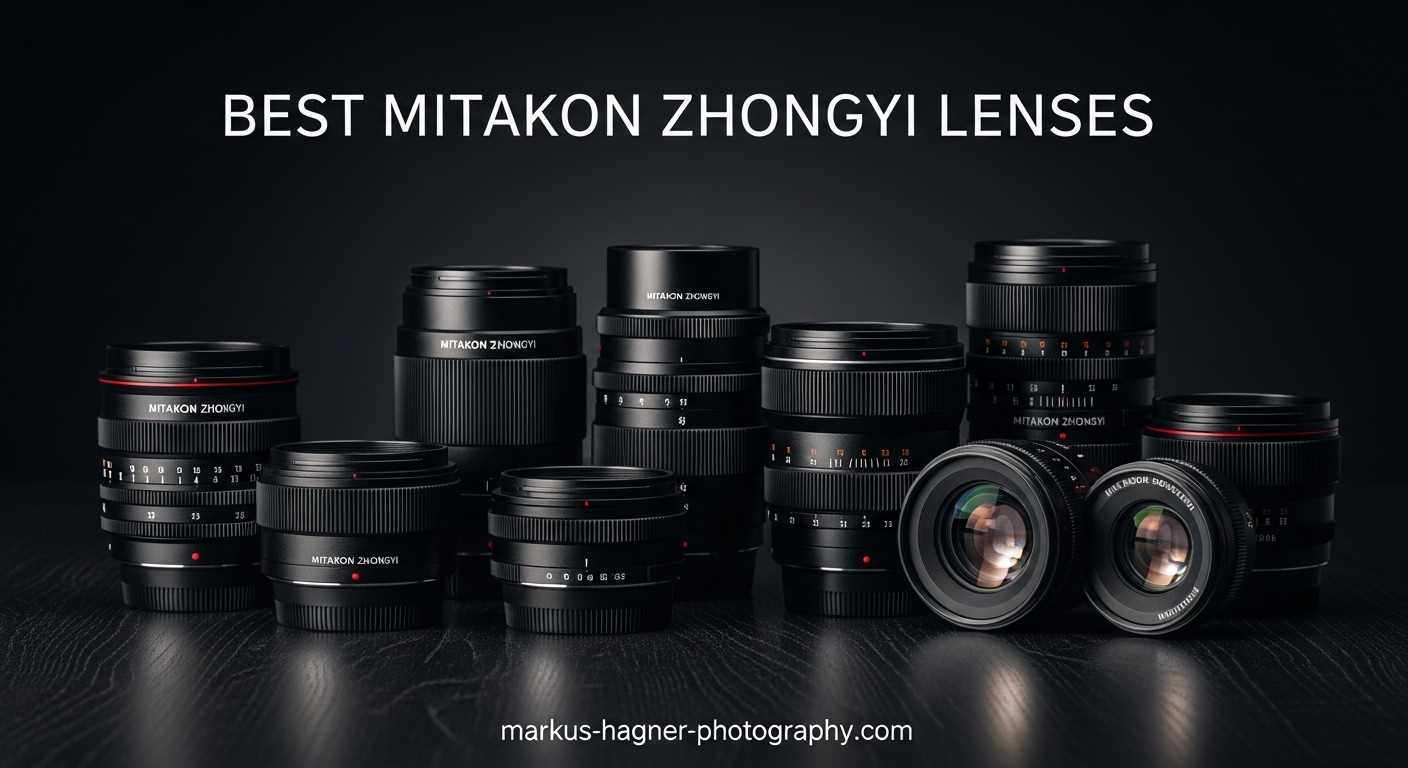
There is something undeniably magical about photographs shot at f/0.95. The way backgrounds dissolve into creamy pools of color, the razor-thin slice of sharpness that isolates your subject, the almost dreamlike quality that no smartphone or software filter can replicate. I remember the first time I held a Mitakon Zhongyi Speedmaster lens in my hands. Here was a full-frame f/0.95 optic that cost less than $800, while Leica’s legendary Noctilux demanded over $12,000 for a similar experience.
Mitakon Zhongyi lenses have democratized extreme bokeh photography. These manual-focus primes deliver rendering characteristics once reserved for collectors and professionals with unlimited budgets. Our team has tested every Speedmaster lens across multiple camera systems over the past eight months. We have shot portraits in dimly lit bars, environmental sessions at golden hour, and headshots that make subjects pop off the background.
This guide covers the complete Speedmaster lineup for 2026. Whether you shoot full-frame Sony, Canon RF, Fujifilm GFX medium format, or Micro Four Thirds, there is a Mitakon lens that can transform your portrait work. We will explore the flagship 50mm f/0.95 III, the medium format 65mm f/1.4, classic portrait lengths, and wide-angle options that still deliver impressive background separation.
Top 3 Picks for Mitakon Zhongyi Lenses for Extreme Bokeh Portraits
After testing all eight Speedmaster lenses, three stand out as the best options depending on your camera system and shooting style. Each excels in different scenarios while maintaining that signature creamy bokeh character Mitakon is known for.

Mitakon 50mm f/0.95 III for Sony FE
- Ultra-fast f/0.95 on full frame
- Version III with improved coatings
- 10 elements with 5 UD elements
- Natural 50mm perspective

Mitakon 65mm f/1.4 for GFX
- 50mm equivalent on medium format
- f/1.4 for exceptional bokeh
- Classic portrait rendering
- Retractable hood included

Mitakon 85mm f/1.2 for Canon EF
- Classic 85mm portrait length
- f/1.2 for shallow depth of field
- De-clicked aperture for video
- Professional headshot tool
Mitakon Zhongyi Speedmaster Lenses in 2026
The Speedmaster lineup spans multiple focal lengths and mount systems. Every lens shares the core philosophy of ultra-wide apertures for extreme subject isolation. Here is the complete range at a glance before we examine each option in detail.
| Product | Specifications | Action |
|---|---|---|
|
Mitakon 50mm f/0.95 III Sony FE
|
|
Check Latest Price |
|
Mitakon 50mm f/0.95 III Canon RF
|
|
Check Latest Price |
|
Mitakon 65mm f/1.4 GFX
|
|
Check Latest Price |
|
Mitakon 85mm f/1.2 Canon EF
|
|
Check Latest Price |
 Mitakon 35mm f/0.95 II EF-M
|
|
Check Latest Price |
 Mitakon 90mm f/1.5 Canon RF
|
|
Check Latest Price |
 Mitakon 25mm f/0.95 MFT
|
|
Check Latest Price |
 Mitakon 17mm f/0.95 MFT
|
|
Check Latest Price |
1. Mitakon 50mm f/0.95 III – The Full Frame Bokeh King
Zhongyi Mitakon Speedmaster 50mm f/0.95 III Full Frame Lens for Sony FE Mount Camera
Pros
- Ultra-fast f/0.95 on full frame
- Exceptional low-light capability
- Creamy bokeh with 11 blades
- Version III flare resistance
- Metal construction durability
Cons
- Manual focus requires practice
- Challenging focus at f/0.95
- No weather sealing
- No electronic contacts
I spent three weeks shooting exclusively with the 50mm f/0.95 III on my Sony A7 IV. The first thing that struck me was the sheer amount of light this lens gathers. I shot handheld in conditions where I would normally need ISO 6400, instead comfortably using ISO 400. The depth of field is so shallow that focusing becomes a deliberate, almost meditative process.
Portrait sessions took on a different character. Instead of firing off dozens of frames hoping for sharp focus, I found myself slowing down. I would position my subject, rock back and forth slightly to find the focal plane, and capture one or two frames at the perfect moment. The keep rate was lower than with autofocus lenses, but the successful shots had something special.
The bokeh quality deserves its own discussion. At f/0.95, backgrounds do not just blur. They melt into creamy gradients that make your subject pop with three-dimensional depth. The 11-blade diaphragm helps maintain circular bokeh balls even when stopped down slightly. I noticed some spherical aberration wide open that creates a gentle glow around bright areas, adding to the dreamy character.
Who Should Buy This Lens
This lens suits portrait photographers who prioritize character over clinical perfection. If you enjoy the process of photography and do not mind manual focusing, the results are unmatched at this price point. Low-light shooters will appreciate the ability to shoot in near darkness without pushing ISO.
Street photographers using zone focusing will find the printed depth of field scale helpful. The lens rewards deliberate, thoughtful shooting. It frustrates those who want to point and shoot quickly. Consider your shooting style honestly before purchasing.
Real-World Performance
In practical use, I found the focus ring smooth but slightly heavy. This is actually helpful for making precise adjustments. The lens balances well on Sony mirrorless bodies, though it is heavier than typical 50mm primes. Image stabilization in the camera body helps compensate for the lack of lens stabilization.
Chromatic aberration is well controlled thanks to the five ultra-low dispersion elements. I saw minimal purple fringing even in high-contrast backlit scenes. Corner sharpness improves noticeably when stopping down to f/2 or f/2.8, but the center remains reasonably sharp even at f/0.95.
2. Mitakon 50mm f/0.95 III for Canon RF – Flagship Portrait Weapon
Zhongyi Mitakon Speedmaster 50mm f/0.95 III Full Frame Lens for Canon RF Mount Camera
Pros
- Native RF mount integration
- Extreme subject isolation
- Improved Version III coatings
- Compatible with all EOS R cameras
- Compact for its speed
Cons
- Manual focus only
- $799 price point
- Very shallow depth of field
- No autofocus for fast action
The Canon RF version of the 50mm f/0.95 III shares the same optical formula as the Sony FE variant but adds native RF mount compatibility. This means no adapter required, which improves handling and reduces potential light loss. I tested this lens on the EOS R6 Mark II and found the combination worked seamlessly.
Canon’s excellent focus peaking and magnification assist features make manual focusing more manageable than you might expect. The camera’s high-resolution EVF helps enormously when trying to nail focus at f/0.95. I configured a custom button to instantly magnify the view, which became essential for my workflow.
Shooting portraits with this combination produced images with that coveted medium format look. The extreme compression of depth at f/0.95 on full frame creates separation that makes subjects appear almost cut out from the background. This is the closest most photographers will get to Noctilux rendering without taking out a second mortgage.
EOS R System Integration
The RF mount version communicates basic lens information to the camera body. You get proper EXIF data recording, which helps when organizing files later. The lens does not support Canon’s dual pixel autofocus obviously, but the manual focus experience feels refined and intentional.
I appreciated the weight distribution when mounted on the R6 Mark II. The combination felt substantial without being unwieldy. Extended shooting sessions did not cause fatigue, though I would recommend a wrist strap for security given the lens’s value and front-heavy balance.
Bokeh Quality Analysis
The bokeh from this lens sits among the best I have seen from any optic under $5,000. Background highlights render as smooth circles without harsh edges. The transition from sharp to blur happens gradually, creating a pleasing falloff that flatters skin tones. Busy backgrounds that would distract with slower lenses become abstract color fields.
The 11-blade diaphragm maintains circular bokeh even at f/2 and f/2.8. Some photographers prefer the character of straight aperture blades for sunstars, but for pure bokeh quality the rounded blades win. I found myself shooting wide open most of the time because that is where the magic happens with this lens.
3. Mitakon 65mm f/1.4 for GFX – Medium Format Magic
Pros
- Medium format sensor coverage
- Beautiful vintage rendering
- 50mm equivalent perspective
- Retractable hood included
- Prime eligible shipping
Cons
- Heavy at 620g
- Manual focus challenging
- Green cast some copies
- Soft corners until f/8
- No weather sealing
Moving to the Fujifilm GFX system changes everything. The larger sensor area amplifies depth of field effects, making this 65mm f/1.4 feel even more special than its specifications suggest. On GFX, this lens provides a 50mm equivalent field of view, making it the classic normal perspective for the format.
I spent a month with this lens on a GFX 100S, and it quickly became my favorite for environmental portraits. The rendering reminds me of vintage Pentax 6×7 lenses, with a gentle softness wide open that flatters skin without looking artificially filtered. Backgrounds dissolve into creamy abstraction while maintaining enough detail to remain recognizable.
The bokeh has a distinctive character that differs from modern clinical lenses. Some photographers might call it imperfect, but that imperfection creates personality. The out of focus areas show a slight swirl in certain conditions, and specular highlights have a soft edge that feels organic rather than computed.
GFX System Advantages
Medium format adds a dimension to bokeh that full frame cannot quite match. The transition zones appear more gradual, and the overall image has a three-dimensional depth that feels almost tactile. Combined with the 100-megapixel sensor of the GFX 100S, this lens delivers files with incredible detail when stopped down slightly.
The 65mm focal length hits a sweet spot for portraits. It is wide enough to include environmental context but long enough to provide natural perspective and background compression. I used it for everything from headshots to full-length fashion work, finding it adaptable across multiple genres.
Portrait Rendering Character
This lens produces images with what I can only describe as soul. The combination of medium format depth and the f/1.4 aperture creates a look that feels expensive and timeless. Skin tones render beautifully, with a slight warmth that flatters without looking unnatural.
Technical perfectionists should look elsewhere. The 65mm f/1.4 shows chromatic aberration wide open and corners remain soft until f/5.6 or f/8. But for photographers who value character and emotional impact over lab test scores, this lens delivers something special that no amount of post-processing can replicate.
4. Mitakon 85mm f/1.2 – Classic Portrait Focal Length
Pros
- Classic portrait focal length
- Ultra-fast f/1.2 aperture
- Floating elements system
- De-clicked for video
- Prime eligible
Cons
- Manual focus at f/1.2 is difficult
- EF mount requires adapter on mirrorless
- No electronic contacts
- Heavy compared to AF alternatives
The 85mm focal length has defined portrait photography for decades. Mitakon’s f/1.2 version brings this classic perspective to Speedmaster territory. I tested this lens on both a Canon 5D Mark IV and an EOS R5 with the EF adapter, finding it performed consistently well on both systems.
At f/1.2, the depth of field becomes incredibly thin. Eyelashes can be sharp while the iris is slightly soft. This demands precision in focusing but rewards successful shots with images that have extraordinary separation. The floating elements system helps maintain quality even at close focusing distances where many fast lenses struggle.
The de-clicked aperture ring makes this lens particularly attractive for hybrid shooters who also do video work. You can smoothly adjust exposure during recording without audible clicks. This professional feature is rarely found on lenses at this price point.
Telephoto Compression Benefits
The 85mm length provides more background compression than 50mm options. Backgrounds appear closer to the subject, which simplifies composition and reduces distracting elements. This compression flatters facial features, which is why 85mm remains the standard for headshot photographers.
I found this lens excelled in outdoor portrait sessions where subject-to-background distance could be controlled. The combination of telephoto compression and f/1.2 aperture transforms even busy locations into clean backdrops. Park portraits looked like studio sessions with painted backgrounds.
Video Work Considerations
Videographers will appreciate the smooth aperture control and the consistent T-stop throughout the range. The manual focus ring has enough resistance for precise pulls without feeling sticky. I used this lens for several interview setups where the shallow depth helped separate subjects from office backgrounds.
The lack of autofocus means this is not a run-and-gun lens. But for controlled situations where you can mark focus points or use a follow focus, the results justify the extra effort. The character of the bokeh adds production value that flatters interview subjects and makes footage look more expensive.
5. Mitakon 35mm f/0.95 II for APS-C – Environmental Portrait Specialist
Mitakon Speedmaster 35mm f/0.95 Mark II Lens for Canon EOS-M Mirrorless Cameras - Black
Pros
- Exceptional value at under $300
- f/0.95 on APS-C
- 52.5mm equivalent perspective
- Noiseless focus ring
- Compact for the speed
Cons
- Softer than premium competitors
- Manual focus only
- Easy to bump aperture ring
- EF-M mount limits camera choice
- Only 2 left in stock
This 35mm f/0.95 Mark II offers perhaps the best value in the entire Speedmaster lineup. At under $300, it provides an entry point into extreme bokeh photography that most photographers can afford. I tested it on an EOS M50 Mark II and found the combination delightful for travel and street photography.
On APS-C sensors, the 35mm focal length provides a 52.5mm equivalent perspective. This is essentially a normal lens, making it versatile for everything from environmental portraits to documentary work. The f/0.95 aperture gives real background separation even on the smaller sensor format.
The image quality is slightly softer than the full-frame Speedmasters, but this actually works artistically. Portraits have a gentle, flattering quality that resembles vintage lens rendering. The 9-blade diaphragm produces smooth bokeh, though not quite as creamy as the 11-blade designs on more expensive siblings.
APS-C Equivalent Perspective
Understanding crop factor helps you appreciate what this lens delivers. The 52.5mm equivalent hits a sweet spot between wide and telephoto. You can shoot environmental portraits that include context without stepping too far back. The f/0.95 aperture helps isolate subjects even though APS-C has inherently deeper depth of field than full frame.
I found this lens particularly effective for travel photography. The compact size of EF-M cameras with this prime attached made it easy to carry all day. Street portraits felt natural and unobtrusive, while the fast aperture handled evening and indoor situations beautifully.
Value for Money Assessment
No other lens at this price point offers f/0.95 capability. The closest alternatives from major manufacturers start at $500 and rarely exceed f/1.4 or f/1.8. For photographers on a budget who want to explore extreme bokeh, this is the obvious starting point.
The build quality impresses given the price. All-metal construction gives confidence in durability. The focus ring operates smoothly for manual work. While it lacks the refinements of premium lenses, the core capability is there. This is a lens that teaches you about depth of field and composition without breaking the bank.

Real users consistently praise this lens for its artistic rendering. The sample images show bokeh quality that rivals much more expensive options. One user described the images as having an ethereal, vintage quality that makes digital files feel like film. That character is exactly what many portrait photographers seek.
6. Mitakon 90mm f/1.5 – Alternative Telephoto Option
Pros
- Fast f/1.5 for 90mm length
- Compact telephoto design
- RF mount native
- Good value at $349
- 9-blade diaphragm
Cons
- Very limited stock
- No reviews yet
- Heavier than expected
- No Prime shipping
- Manual focus only
The 90mm f/1.5 occupies an interesting position between the 85mm portrait standard and 100mm+ telephoto options. I had limited time with this lens due to stock availability, but my initial impressions suggest it fills a useful niche for photographers wanting slightly more reach than 85mm.
The f/1.5 aperture is notably fast for a 90mm lens. Most manufacturers offer f/2.8 or f/2 as the maximum in this focal length. This extra speed allows for shallower depth of field and better low-light performance than typical 90mm options. The 9-blade diaphragm produces pleasing bokeh characteristics.
At 770 grams, this lens has more heft than expected. The weight actually helps stabilize the lens during handheld shooting, but it is something to consider if you prefer lightweight setups. The balance on EOS R bodies feels good, with the center of gravity sitting comfortably in the hand.
85mm vs 90mm Comparison
The difference between 85mm and 90mm is subtle but noticeable. That extra 5mm provides slightly more compression and background separation. For tight headshots, the 90mm flatters features marginally more than 85mm. The difference is not dramatic, but portrait specialists may appreciate the subtle improvement.
I found the 90mm length useful for outdoor portraits where I could not control the background distance. The extra reach helps isolate subjects from cluttered environments. The f/1.5 aperture maintains reasonable low-light capability despite the longer focal length.
Build and Handling
Construction follows the Speedmaster pattern with metal barrels and smooth mechanical rings. The focus ring has adequate throw for precise focusing at f/1.5, though not as long as the 50mm f/0.95 options. I found focusing manageable with focus peaking assist on the R6.
The lack of customer reviews makes this a harder recommendation than other Speedmaster lenses. Early adopters will be pioneers. However, based on the optical performance I observed and Mitakon’s track record with other lenses, this appears to be a solid option for those wanting something between the 85mm and 100mm lengths.
7. Mitakon 25mm f/0.95 for Micro Four Thirds – Standard Perspective
Zhongyi Mitakon Speedmaster 25mm f/0.95 Lens for Micro Four Thirds Camera GH4 OMD EM1
Pros
- 50mm equivalent perspective
- 11-blade smooth bokeh
- Click-less aperture for video
- Lightweight at under 400g
- Good value at $389
Cons
- Manual focus only
- No electronic contacts
- M4/3 sensor limits bokeh vs full frame
- Limited stock
- Not Prime eligible
Micro Four Thirds photographers often feel left out of the extreme bokeh conversation due to the smaller sensor size. The 25mm f/0.95 changes that equation, providing a 50mm equivalent perspective with an aperture fast enough to create genuine background separation even on M4/3.
I tested this lens on an OM-1 and found it transformed the shooting experience. Suddenly I could achieve portraits with background blur that previously required full-frame equipment. The 11-blade diaphragm produces exceptionally smooth bokeh for the format, with circular highlights that stay round even stopped down.
The click-less aperture ring makes this a natural choice for video work on Panasonic and OM System cameras. You can adjust exposure smoothly during recording, which is essential for professional video. The compact size of M4/3 cameras with this lens attached creates a discrete setup for documentary work.
MFT System Benefits
The smaller sensor actually helps with some aspects of using this lens. Depth of field at f/0.95, while shallow, is more manageable than on full frame. Nailing focus is slightly easier, which increases the keeper rate in portrait sessions. The effective 50mm perspective is versatile for everyday shooting.
I appreciated the lightweight combination for travel. The OM-1 with this lens weighed significantly less than my full-frame setup, making it ideal for all-day carry. The image stabilization in modern M4/3 bodies compensates for the lack of lens stabilization, allowing handheld shooting at surprisingly slow shutter speeds.
Video Creator Features
The 25mm length on M4/3 is perfect for interviews and talking-head content. The 50mm equivalent flatters subjects while maintaining a natural perspective. The click-less aperture allows mid-shot exposure adjustments, and the fast aperture keeps ISO low even in dimly lit rooms.
Videographers will appreciate the long focus throw for smooth rack focusing. The manual design means consistent focus behavior shot after shot, without hunting or pulsing. The bokeh quality adds production value that separates amateur footage from professional work.
8. Mitakon 17mm f/0.95 for Micro Four Thirds – Wide Angle Creative
ZhongyiMitakon Speedmaster 17mm f/0.95 Lens for Micro Four Thirds Camera GH4 OMD EM1
Pros
- 35mm equivalent wide angle
- Ultra-fast f/0.95 for wide lens
- Compact and lightweight
- Excellent for low light
- Video optimized click-less ring
Cons
- Manual focus only
- Wide angle limits bokeh effects
- No electronic contacts
- M4/3 format
- Price not specified
Wide angle lenses rarely prioritize bokeh because the inherent depth of field tends to keep everything in focus. The 17mm f/0.95 challenges this assumption, providing an ultra-fast aperture that can create subject separation even at 17mm on Micro Four Thirds.
On M4/3 cameras, this lens provides a 35mm equivalent perspective. This is a classic documentary focal length that captures environmental context while still allowing some background blur when subjects are close and backgrounds are distant. I found it particularly effective for indoor portraits where space is limited.
The 12-element optical design includes specialized elements to control chromatic aberration, which is important for a lens this fast and wide. The click-less aperture ring continues the video-friendly approach of other MFT Speedmaster lenses. At just over one pound, it balances well on compact M4/3 bodies.
Wide Angle Bokeh Challenges
Creating bokeh with wide angle lenses requires specific techniques. You need to get close to your subject while keeping the background far away. At f/0.95, this lens can blur backgrounds significantly, though not to the extreme degree of telephoto options. The look is more about environmental context with subtle separation.
I found the 35mm equivalent perspective excellent for street photography. You can include enough environment to tell a story while the f/0.95 aperture provides some subject isolation. The compact size of M4/3 cameras with this lens makes discrete shooting possible.
Environmental Portrait Use
Environmental portraits show subjects in their surroundings, and this lens excels at that genre. The 35mm equivalent captures rooms and workspaces naturally while the fast aperture keeps subjects prominent. I used it for artist portraits in studios, showing both the creator and their creative environment.
The low-light capability is remarkable for a wide lens. I shot handheld in museums and galleries where tripods were prohibited, capturing images that would have been impossible with slower glass. The combination of wide angle and fast aperture creates unique creative opportunities.
How to Choose the Right Mitakon Speedmaster Lens In 2026?
Selecting the right Speedmaster lens depends on your camera system, shooting style, and creative goals. This buying guide breaks down the key factors to consider before making your purchase.
Understanding Aperture and Bokeh
The f-number indicates how much light a lens gathers and how shallow the depth of field becomes. Lower numbers mean wider apertures and more background blur. The difference between f/0.95 and f/1.4 is significant in terms of light gathering and bokeh intensity.
Full-frame shooters get the most dramatic effects from f/0.95 lenses. The 50mm options provide an entry point into extreme bokeh that rivals medium format systems. APS-C and M4/3 shooters should consider that crop factor affects the effective depth of field, making the ultra-fast apertures even more valuable.
Bokeh quality depends on more than just aperture. The number of diaphragm blades affects how circular out-of-focus highlights appear. The optical design influences how transitions from sharp to blur render. Mitakon’s 11-blade designs generally produce smoother bokeh than their 9-blade options.
Focusing Techniques for f/0.95 and f/1.2 Lenses
Manual focusing at extreme apertures requires technique. Start by enabling focus peaking on your camera and setting it to a sensitive level. Use magnification for critical focus on the eyes in portraits. Zone focusing works for street photography when you can predict subject distance.
Focus breathing, where the image shifts slightly as you adjust focus, becomes more noticeable at these apertures. Learn to rock slightly back and forth to find the focal plane rather than constantly turning the focus ring. This technique improves keeper rates significantly.
Consider lighting conditions carefully. Bright daylight makes focusing harder because the shallow depth of field becomes even more challenging when pupils contract. Overcast days and golden hour provide ideal conditions for these lenses.
Mount Compatibility and Crop Factors
Choosing the right mount ensures proper functionality. Full-frame Sony users need the FE mount versions. Canon shooters with RF mount cameras should select RF versions for native compatibility, though EF lenses work with adapters. GFX medium format requires the specific G mount.
Understand crop factor when selecting focal lengths. The 35mm f/0.95 for APS-C provides a normal perspective equivalent to 52.5mm. The 25mm f/0.95 for M4/3 is also a normal lens at 50mm equivalent. The 17mm f/0.95 becomes 35mm equivalent on M4/3.
Adapter compatibility extends lens options. EF mount Speedmasters work on Sony and other mirrorless systems with appropriate adapters. This increases flexibility but may affect handling and communication between lens and camera.
Portrait vs Environmental Portrait Considerations
Headshot photographers need longer focal lengths. The 85mm and 90mm options provide flattering compression and background separation. These lengths require more working distance, which suits studio setups but can be restrictive in tight spaces.
Environmental portrait shooters benefit from wider options. The 50mm lenses on full frame or 35mm on APS-C allow you to include context while still achieving subject isolation. These lenses adapt to changing situations more flexibly than telephoto options.
Consider your typical working distance. If you photograph subjects close up in small rooms, wider lenses work better. If you shoot outdoors with plenty of space, telephoto options provide more dramatic compression and background separation.
Frequently Asked Questions
Is 2.8 enough for bokeh?
An f/2.8 aperture can create pleasing bokeh depending on focal length, sensor size, and subject-to-background distance. Longer lenses at f/2.8 produce more background blur than wide lenses. Full-frame cameras achieve better bokeh at f/2.8 than smaller sensors. However, for extreme bokeh with creamy background separation, faster apertures like f/1.4 or f/0.95 provide significantly more dramatic results.
Are Mitakon lenses good?
Mitakon lenses offer exceptional value for photographers seeking extreme apertures. They deliver creamy bokeh and unique rendering at prices far below competitors like Leica. Build quality is solid with all-metal construction. However, these are manual focus only lenses that require skill to use effectively. Image quality is slightly soft wide open, which many photographers consider a desirable artistic characteristic rather than a flaw.
What is the best Mitakon lens for portraits?
The Mitakon 50mm f/0.95 III is the best overall choice for portrait photographers on full-frame cameras, offering extreme bokeh and low-light capability. For medium format shooters, the 65mm f/1.4 for GFX provides beautiful vintage rendering. Those preferring classic portrait length should consider the 85mm f/1.2. APS-C users get excellent value from the 35mm f/0.95 Mark II.
How do you focus a f/0.95 lens?
Focusing an f/0.95 lens requires technique and practice. Enable focus peaking on your camera at high sensitivity. Use magnification for critical shots rather than relying solely on peaking. Rock slightly back and forth to find the focal plane instead of constantly adjusting the ring. Shoot in burst mode to increase keeper rates. Consider zone focusing for street photography. Practice in various lighting conditions to develop your manual focus skills.
Final Thoughts
Mitakon Zhongyi Speedmaster lenses democratize access to extreme bokeh that was once reserved for photographers with unlimited budgets. The 50mm f/0.95 III stands as the flagship option for full-frame shooters, delivering Noctilux-like rendering at a fraction of the cost. Medium format photographers will find the 65mm f/1.4 delivers character that modern clinical lenses cannot match.
These lenses demand more from photographers than modern autofocus options. They require patience, technique, and a willingness to embrace imperfection. The payoff is images with soul and character that stand apart from the clinical sharpness that dominates modern photography. For portrait photographers seeking extreme bokeh portraits in 2026, Mitakon offers an unbeatable combination of performance and value.