
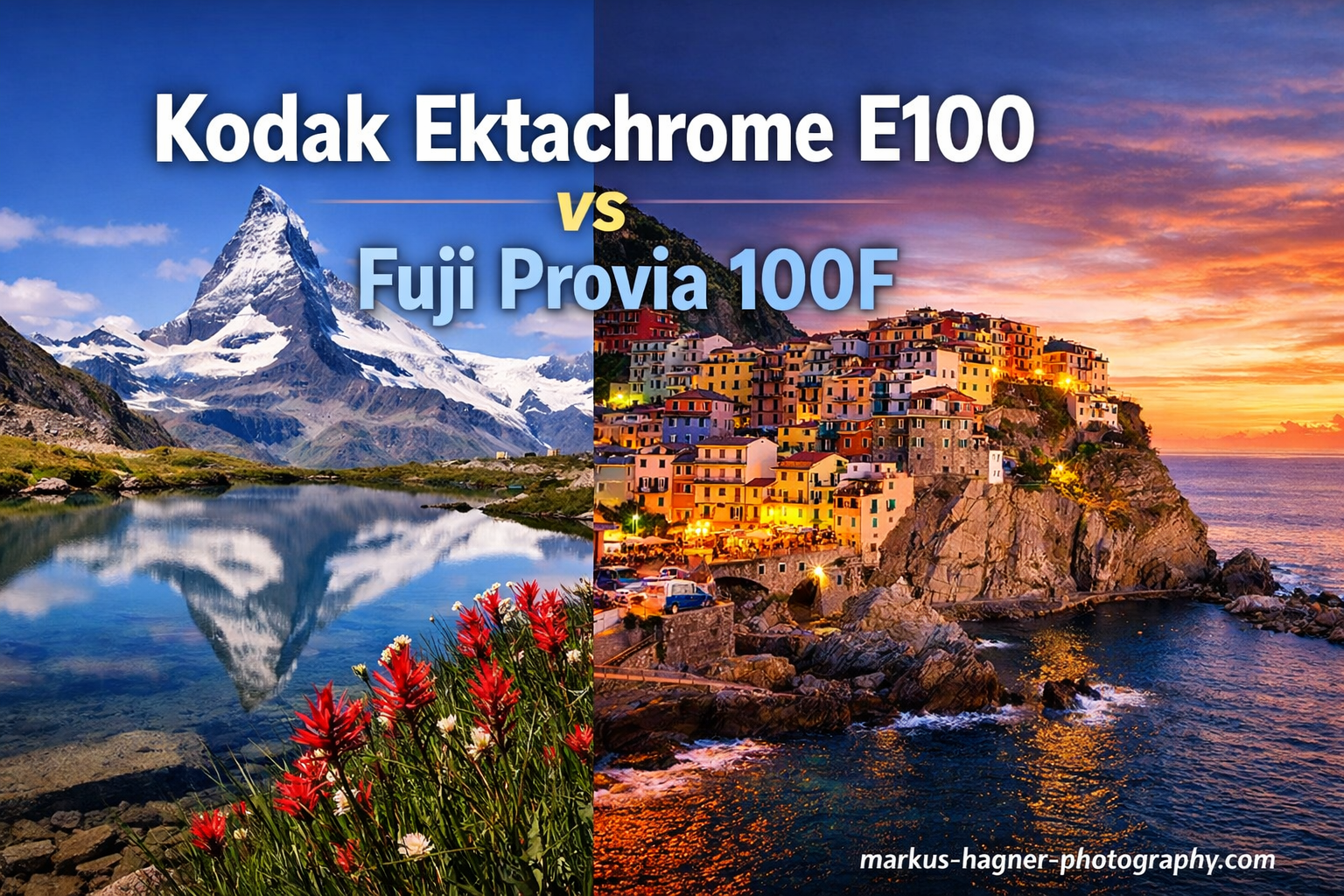
Choosing between Kodak Ektachrome E100 and Fuji Provia 100F is one of the most common dilemmas facing film photographers today. Both are professional ISO 100 slide films using the E6 process, yet they deliver distinctly different color characteristics that can make or break your images.
Kodak Ektachrome has a fascinating history. Originally discontinued in 2013 due to declining demand, Kodak brought it back in 2018 after passionate pleas from the film community. The new E100 uses the same T-GRAIN emulsion technology as its predecessor but with modern manufacturing improvements. Fuji Provia 100F, on the other hand, has remained in continuous production since its introduction, though recent supply chain issues have made it increasingly difficult to find.
After shooting dozens of rolls of both films across various conditions, I can tell you that the choice largely depends on your subject matter and personal color preferences. If you want the quick verdict: Provia generally wins for skin tones and portraits with its warmer rendering, while Ektachrome excels at landscapes with its vibrant greens and reds. But there is much more nuance to explore.
In this comprehensive Kodak Ektachrome E100 vs Fuji Provia 100F comparison, I will break down every aspect from color characteristics and exposure latitude to pricing and availability so you can make the right choice for your photography.
Kodak Ektachrome E100 vs Fuji Provia 100F: Quick Comparison
Before diving deep, here is a side-by-side look at how these two professional slide films compare across key specifications.
| Product | Specifications | Action |
|---|---|---|
 Kodak Ektachrome E100 (2-Pack) Kodak Ektachrome E100 (2-Pack) |
|
Check Latest Price |
 Fuji Provia 100F Fuji Provia 100F |
|
Check Latest Price |
As you can see, both films share the same ISO 100 sensitivity and E6 processing requirements. The key differences emerge in their color rendering, format availability, and real-world performance characteristics.
Kodak Ektachrome E100: In-Depth Review
Kodak Professional Ektachrome E100 Color Transparency Film (35mm Roll Film, 36 Exposures) – 2-Pack with Cleaning Cloth
Pros
- Vibrant color rendering with greener greens and redder reds
- Extremely fine grain structure ideal for scanning
- Wide dynamic range with neutral tonal scale
- Low D-min for cleaner whites and enhanced highlights
- More forgiving in harsh lighting conditions
Cons
- Only available in 35mm format
- Tends toward cooler blue/yellow cast
- Higher price point than competitors
- New formulation has limited track record
Shooting Kodak Ektachrome E100 feels like rediscovering what made slide film special in the first place. The film delivers that distinctive look where colors pop without appearing oversaturated, and the fine grain structure makes even 35mm scans look remarkably detailed.
The color palette leans distinctly cool. Ektachrome tends toward blue and yellow tones, which gives landscapes a crisp, almost ethereal quality. Greens appear more vibrant and natural, while reds have an intensity that grabs attention without feeling artificial. This characteristic makes E100 particularly well-suited for nature photography, botanical subjects, and scenes where you want that classic slide film punch.
One thing I learned quickly: many experienced photographers recommend using an 81a warming filter with Ektachrome. The film has a tendency toward a subtle blue cast, especially in open shade or overcast conditions. An 81a filter warms things up just enough to balance the tones without overpowering the film’s natural character. I shot several rolls with and without the filter, and the difference is noticeable in skin tones and neutral subjects.
The T-GRAIN emulsion technology deserves special mention. Kodak designed this micro-structure optimized emulsion specifically for scanning, and it shows. Highlights retain remarkable detail, and the low D-min characteristic means whites appear cleaner and brighter. If you primarily scan your slides rather than project them, Ektachrome is exceptionally well-suited to digital workflows.
Where Ektachrome falls short is format variety. Unlike Provia, which is available in 35mm, 120 medium format, and even 4×5 large format sheets, Ektachrome E100 is currently only manufactured in 35mm cartridges. For photographers who shoot multiple formats, this limitation is significant. You will need a different film stock entirely if you want to shoot medium or large format slide work.
Exposure latitude is respectable for a slide film, though not exceptional. You get about 3-4 stops of usable dynamic range, which is typical for E6 films. The film handles overexposure better than Provia in my experience, retaining highlight detail even when I was slightly aggressive with metering. Underexposure is less forgiving, as you would expect from transparency film.
At approximately $32-35 per roll when purchased individually (the 2-pack brings the per-roll cost down slightly), Ektachrome sits at the premium end of the slide film market. Factor in E6 processing costs, and you are looking at a significant investment per image. For professional work where the distinctive color rendering matters, it justifies the expense. For casual shooting, the cost adds up quickly.
Fuji Provia 100F: In-Depth Review
Pros
- Excellent color balance with natural reproduction
- Warmer skin tone rendering preferred by portrait photographers
- Available in 35mm
- 120
- and 4x5 formats
- Better exposure latitude than Ektachrome
- Proven track record with 93+ positive reviews
Cons
- Often out of stock due to supply chain issues
- Becoming expensive and harder to find
- Requires precise exposure
- Less vibrant greens and reds than Ektachrome
Fuji Provia 100F has earned its reputation as the workhorse of professional slide photography. With a 4.4-star rating from over 90 Amazon reviews, it clearly delivers consistent results that photographers trust. After shooting Provia extensively, I understand why it remains the go-to choice for so many professionals.
The standout characteristic of Provia is its color balance. Where Ektachrome leans cool, Provia renders warmer overall tones that many photographers find more immediately pleasing. Skin tones in particular benefit from this warmth. Faces appear natural and flattering without the slight blue cast that can affect Ektachrome portraits. If you primarily photograph people, Provia is almost certainly the better choice.

The natural color reproduction extends across the entire spectrum. Blues render true without veering purple, greens appear accurate rather than hyper-vibrant, and the overall palette feels closer to how our eyes perceive the world. This neutrality makes Provia excellent for commercial work, product photography, and any situation where color accuracy matters more than dramatic punch.
One major advantage of Provia is its format availability. You can find it in 35mm rolls, 120 medium format, and 4×5 large format sheets. This versatility matters enormously if you shoot across multiple camera systems. A photographer who shoots both 35mm Leica and a medium format Hasselblad can use the same film stock and achieve consistent results across formats.
Exposure latitude is slightly better than Ektachrome, which is one reason Provia gets recommended for challenging lighting. The film tolerates small metering errors more gracefully, giving you a bit more margin for error. That said, it is still slide film with all the inherent limitations of the format. Precise metering remains essential, and you should never expect the 10+ stops of latitude that color negative films provide.
The elephant in the room is availability. Provia 100F has experienced significant supply chain disruptions in recent years. Many major retailers show it as out of stock or available only for backorder. Specialty photo suppliers sometimes have inventory, but prices have climbed accordingly. This scarcity frustrates photographers who have built workflows around Provia and now find themselves uncertain about future supply.
Pricing currently sits around $48-50 per 35mm roll on Amazon, though street prices vary considerably depending on availability. When you can find it in stock, Provia often costs slightly less than Ektachrome per roll. The problem is actually getting your hands on it. Many photographers have started keeping backup stocks or switching to Ektachrome simply because Provia availability is so unpredictable.
For portraiture specifically, Provia 100F remains my top recommendation among currently available slide films. The warmer skin tone rendering, combined with excellent color balance and slightly better exposure latitude, gives it a real advantage for photographing people. If you shoot portraits on slide film, Provia is worth the effort to source.
Kodak Ektachrome E100 vs Fuji Provia 100F: Head-to-Head Comparison
Color Characteristics: Warm vs Cool
The most immediately noticeable difference between these films is their color temperature bias. Ektachrome E100 leans cool, producing images with subtle blue and yellow undertones. Provia 100F renders warmer, with a color palette that many describe as more natural and immediately pleasing.
This difference becomes most apparent in neutral subjects. White walls, gray cards, and overcast skies will show a slight coolness on Ektachrome and relative warmth on Provia. Neither approach is wrong; they simply serve different aesthetic goals. Ektachrome’s cool rendering can give images a crisp, modern feel. Provia’s warmth creates a more classic, inviting atmosphere.
For specific colors, Ektachrome produces greener greens and redder reds. Vegetation appears more vibrant, and red objects have an intensity that draws the eye. Provia renders these colors more neutrally, which can actually be preferable when you want accurate reproduction rather than enhanced saturation.
Skin Tone Performance
If you photograph people, this category matters enormously. Provia wins hands-down for skin tone rendering. The warmer color palette flatters most skin tones, and faces appear natural without color correction. Ektachrome can introduce a slight blue cast to skin that requires post-processing or filtration to correct.
Forum discussions consistently highlight this difference. One photographer noted, “I think Provia renders skin tones better than E100. Less blue.” Another commented that they prefer Ektachrome for landscapes but always reach for Provia when photographing people. My own experience confirms this consensus.
That said, Ektachrome skin tones are not bad. They simply require more care. Using an 81a warming filter helps considerably, and many photographers have learned to work with the film’s characteristics to achieve excellent portrait results. But if you want skin tones that look right straight out of the lab, Provia is the safer bet.
Landscape and Nature Performance
Here is where Ektachrome often shines. The vibrant greens and enhanced reds make foliage, flowers, and natural scenes appear more dramatic. Blue skies render with excellent depth, and the cooler overall tone gives landscapes a crisp, professional quality.
Provia handles landscapes well too, with more neutral color reproduction. If you want accurate documentation rather than enhanced drama, Provia’s restraint can be an advantage. Nature photographers who prioritize realism over impact often prefer this approach.
Both films handle direct sunlight and open shade competently. Ektachrome may have a slight edge in harsh lighting, as forum users have noted it seems “more forgiving in harsh light than Provia.” The lower contrast characteristic helps retain detail in challenging conditions.
Exposure Latitude and Metering
Both films offer approximately 3-4 stops of usable dynamic range, which is typical for E6 slide films. Provia has slightly better exposure latitude overall, tolerating small metering errors more gracefully than Ektachrome.
This difference is not dramatic, but it matters for practical shooting. If you occasionally miss your metering by a third of a stop, Provia will be more forgiving. Ektachrome demands precision, though it handles slight overexposure reasonably well.
For metering, I recommend the same approach with both films: meter for midtones or slightly bias toward highlights. Slide film has limited shadow recovery, so protecting highlights usually produces better results. A dedicated light meter helps, as does shooting in consistent lighting conditions when possible.
Grain and Sharpness
Both films feature extremely fine grain that should satisfy even demanding photographers. Ektachrome uses Kodak’s T-GRAIN emulsion technology, which produces a particularly smooth grain structure optimized for scanning. Provia uses Fuji’s own advanced emulsion technology with similarly impressive results.
In practical terms, the grain difference is negligible. Both films scan beautifully and print well to reasonable enlargement sizes. Large format photographers will not see meaningful grain differences between these stocks in 4×5 or larger sizes.
Format Availability
This is a decisive category. Provia 100F is available in 35mm, 120 medium format, and 4×5 large format. Ektachrome E100 is currently manufactured only in 35mm cartridges.
If you shoot medium format or large format, Provia is essentially your only option between these two films. Kodak has not announced plans to expand Ektachrome to other formats, though film photographers continue to hope for such developments.
For 35mm-only shooters, this limitation may not matter. But photographers who work across formats should consider whether committing to Ektachrome makes sense when they cannot use it across their entire kit.
Push and Pull Processing
Both films can be push-processed for increased effective speed or pull-processed for reduced contrast. Ektachrome generally handles push processing better, with cleaner results at EI 200 than Provia. For low-light situations where you need extra speed, Ektachrome push-processed one stop can deliver usable results.
Provia’s tighter exposure latitude makes push processing riskier. The already limited dynamic range shrinks further when you push, and shadow detail suffers. Pull processing works reasonably well with both films if you want to reduce contrast for high-contrast scenes.
Neither film is ideal for extreme push or pull processing. If you regularly need to shoot at speeds other than ISO 100, color negative film offers much more flexibility.
Cross-Processing Potential
Cross-processing E6 slide film in C-41 chemicals produces distinctive, high-contrast results with wild color shifts. Neither Ektachrome nor Provia is specifically optimized for cross-processing, but both can produce interesting results.
Ektachrome tends toward green-yellow color shifts when cross-processed, while Provia often produces more red-orange casts. The results are unpredictable and not suitable for professional work, but creative photographers sometimes embrace the chaos for artistic effect.
If cross-processing interests you, experimentation is key. Results vary significantly based on the specific lab, chemical freshness, and exposure of your original images. Neither film has a clear advantage in this category.
Pricing and Value Analysis
Slide film has never been cheap, and both Ektachrome and Provia sit at the premium end of the film market. Understanding the true cost helps set realistic expectations for your photography budget.
At current prices, Ektachrome E100 costs approximately $32-35 per 36-exposure roll when purchased individually. The 2-pack option brings the per-roll cost down to around $32.50, representing modest savings. Provia 100F currently lists around $48-50 per roll on Amazon, though prices fluctuate based on availability.
Here is where things get complicated: Provia’s street price varies enormously depending on supply. When widely available, Provia often costs less than Ektachrome per roll. During supply shortages, prices spike, and many retailers simply cannot keep it in stock. Ektachrome, being more consistently available, offers more predictable pricing.
Factor in E6 processing, which typically runs $15-25 per roll at professional labs, and you are looking at $45-60 per roll in total costs. Each exposure represents a meaningful investment. This reality makes slide film best suited for intentional, considered photography rather than rapid-fire shooting.
For value, Provia generally offers better per-roll economics when available at normal prices. But the unpredictable availability makes it difficult to plan budgets and workflows around. Ektachrome costs more but offers reliable supply, which has real value for photographers who need consistency.
Both films are worth their cost for the right applications. If you need the distinctive color characteristics of either stock for professional or artistic work, the investment makes sense. For casual shooting or learning, the expense may be harder to justify.
Frequently Asked Questions
Which film tends to be warmer and which tends to be cooler?
Fuji Provia 100F generally renders warmer overall tones, making it preferred for portraits and skin tones. Kodak Ektachrome E100 leans cooler with blue and yellow undertones. Many photographers use an 81a warming filter with Ektachrome to balance its cool cast.
What is the difference between Kodak Ektachrome E100 and Fuji Provia 100F?
Both are ISO 100 E6 slide films with fine grain and professional quality. Key differences include color rendering (Ektachrome cooler with vibrant greens/reds, Provia warmer with natural skin tones), format availability (Ektachrome 35mm only, Provia in 35mm/120/4×5), and exposure latitude (Provia slightly better). Ektachrome uses T-GRAIN emulsion optimized for scanning.
Is Kodak Ektachrome discontinued?
Kodak Ektachrome was discontinued in 2013 but was successfully reintroduced in 2018 as Ektachrome E100. It is currently in production and widely available worldwide in 35mm format.
Has Provia 100F been discontinued?
Fuji Provia 100F has not been officially discontinued, but it has experienced significant supply chain issues. It is frequently out of stock at major retailers, though it can often be backordered or found through specialty photo suppliers.
Is Kodak Ektachrome worth the higher price?
Ektachrome E100 is worth it for photographers who need its distinctive color rendition, vibrant greens and reds, and excellent scanning characteristics. At approximately $32-35 per roll, it costs more than many alternatives but delivers professional results for landscape and nature photography. The value depends on whether you need its specific characteristics.
Final Verdict: Which Slide Film Should You Choose?
After extensive shooting with both films, I can confidently say there is no universal winner in the Kodak Ektachrome E100 vs Fuji Provia 100F debate. The right choice depends entirely on your subject matter, format needs, and personal aesthetic preferences.
Choose Kodak Ektachrome E100 if:
- You primarily shoot landscapes, nature, or botanical subjects
- You want vibrant greens and enhanced reds in your images
- You prefer a cooler color palette with crisp rendering
- You shoot 35mm exclusively and do not need medium or large format
- You want reliable availability and predictable pricing
- You prioritize scanning quality and digital workflow integration
Choose Fuji Provia 100F if:
- You photograph people and prioritize flattering skin tones
- You want warmer, more natural color reproduction
- You shoot medium format or large format in addition to 35mm
- You need slightly better exposure latitude for challenging lighting
- You prefer more neutral, accurate color rendering
- You can manage the uncertainty of supply chain fluctuations
For most portrait photographers, Provia remains the superior choice despite availability challenges. The skin tone rendering alone justifies the effort to source it. For landscape and nature work, Ektachrome’s vibrant color palette gives images that extra punch many photographers seek.
My personal approach? I keep both in my bag. Provia for portraits and people-focused work, Ektachrome for landscapes and nature. Having both options available lets me match the film to the subject rather than forcing one stock to do everything.