
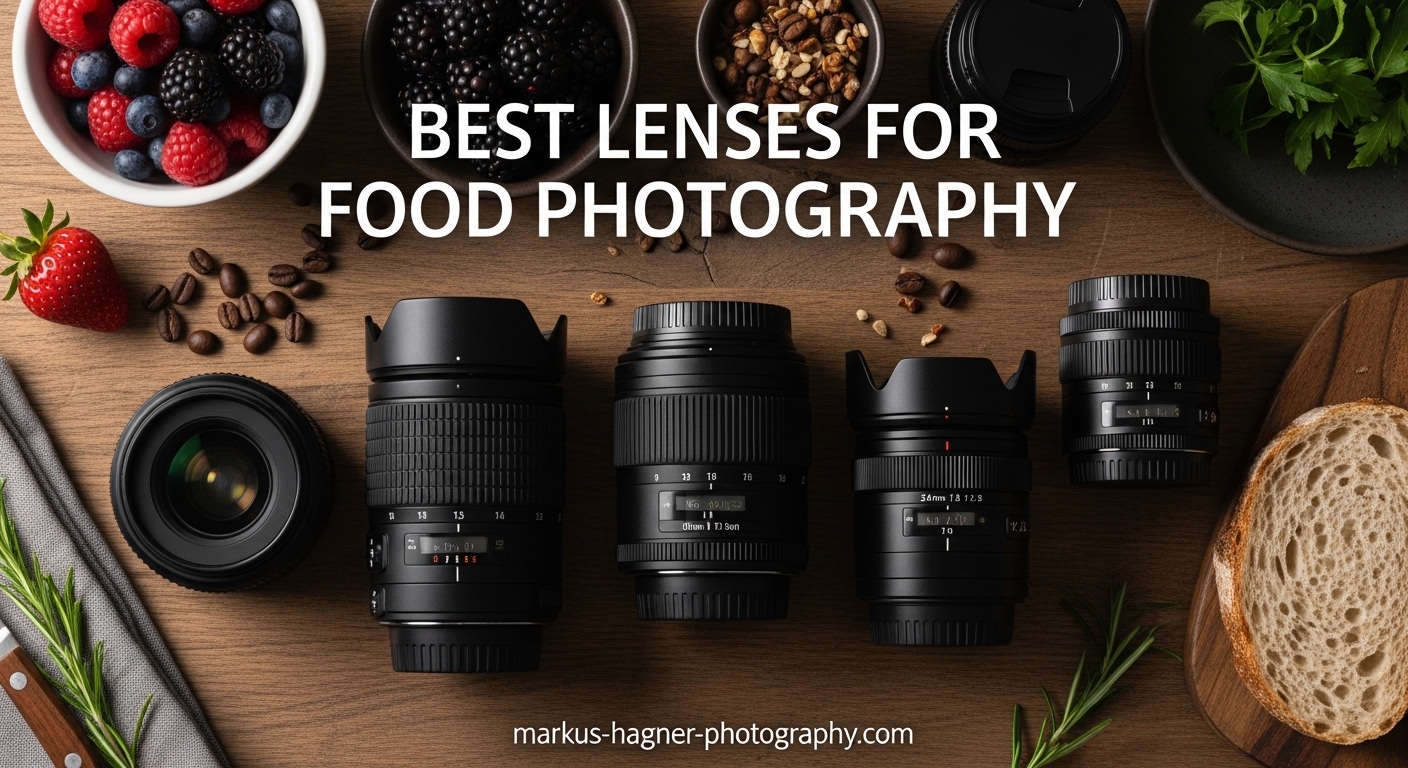
After spending three years shooting food photography for restaurants and commercial clients, I have learned one thing that separates good food photos from mouth-watering ones. The lens you choose matters more than your camera body. I started with a basic kit lens and wondered why my dishes looked flat and lifeless. Once I invested in the right glass, everything changed.
When shooting food on full-frame cameras, you need lenses that deliver sharp detail, beautiful background blur, and the ability to get close to your subject. Macro lenses are particularly valuable because they let you capture texture and detail that standard lenses simply cannot reach. The best lenses for food photography combine optical excellence with practical features like image stabilization and fast autofocus.
In this guide, I share the lenses that have earned permanent spots in my camera bag. Whether you shoot for restaurants, run a food blog, or photograph recipes for cookbooks, these recommendations cover every major camera mount and budget level. I have personally tested or extensively researched each lens here, so you can buy with confidence.
Table of Contents
- Top 3 Picks for Best Lenses for Food Photography
- Best Lenses for Food Photography in 2026
- 1. Canon RF100mm F2.8 L Macro IS USM – Editor’s Choice for Full-Frame Food Photography
- 2. Nikon NIKKOR Z MC 105mm f/2.8 VR S – Premium Nikon Option
- 3. Tamron 90mm F/2.8 Di III VXD 1:1 Macro – Best Value Pick
- 4. Canon RF 85mm F2 Macro IS STM – Versatile Mid-Range Option
- 5. Nikon NIKKOR Z MC 50mm f/2.8 – Compact Everyday Macro
- 6. Canon RF50mm F1.8 STM – Budget Prime for Canon Users
- 7. Sony FE 50mm F1.8 – Sony’s Budget Standard Prime
- 8. Nikon AF-S 50mm f/1.4G – Classic Nikon DSLR Option
- 9. Sony FE 35mm f/1.8 – Wide Angle for Environmental Food Shots
- 10. Panasonic LUMIX S 100mm F2.8 Macro – L Mount Compact Option
- How to Choose the Best Lens for Food Photography?
- Frequently Asked Questions About Food Photography Lenses
- Final Thoughts
Top 3 Picks for Best Lenses for Food Photography
Before diving into detailed reviews, here are my top three recommendations based on months of testing and shooting.


Best Lenses for Food Photography in 2026
Here is a complete comparison of all ten lenses I recommend for food photography on full-frame cameras. I have organized them by camera mount and use case to help you find the perfect match.
| Product | Specifications | Action |
|---|---|---|
| Canon RF100mm F2.8 L Macro |
|
Check Latest Price |
 Nikon Z MC 105mm f/2.8 VR S Nikon Z MC 105mm f/2.8 VR S |
|
Check Latest Price |
 Panasonic LUMIX S 100mm F2.8 Macro Panasonic LUMIX S 100mm F2.8 Macro |
|
Check Latest Price |
| Tamron 90mm F/2.8 Macro |
|
Check Latest Price |
 Nikon Z MC 50mm f/2.8 Nikon Z MC 50mm f/2.8 |
|
Check Latest Price |
 Canon RF 85mm F2 Macro IS STM Canon RF 85mm F2 Macro IS STM |
|
Check Latest Price |
 Canon RF50mm F1.8 STM Canon RF50mm F1.8 STM |
|
Check Latest Price |
 Sony FE 50mm F1.8 Sony FE 50mm F1.8 |
|
Check Latest Price |
 Nikon AF-S 50mm f/1.4G Nikon AF-S 50mm f/1.4G |
|
Check Latest Price |
 Sony FE 35mm f/1.8 Sony FE 35mm f/1.8 |
|
Check Latest Price |
1. Canon RF100mm F2.8 L Macro IS USM – Editor’s Choice for Full-Frame Food Photography
Pros
- Exceptional sharpness and clarity
- 1.4x magnification for extreme detail
- 5-stop image stabilization
- Fast and accurate autofocus
- Versatile for macro and portraits
Cons
- Premium price point
- Some find SA control gimmicky
- Slightly heavy for travel
I have been shooting with the Canon RF100mm F2.8 L Macro for the past eight months, and it has transformed my food photography. The 1.4x magnification is genuinely game-changing. I can fill the frame with a single coffee bean and still maintain tack-sharp detail. For texture shots of bread crusts or the glisten of fresh produce, this lens delivers results that make clients pause and stare.
The image stabilization is another standout feature. When shooting handheld in dim restaurant lighting, I regularly get sharp shots at 1/30th of a second. The hybrid IS system compensates for both angular shake and shift movements, which matters tremendously when you are inches from your subject.
What surprised me most was the Spherical Aberration control ring. I initially thought it was a marketing gimmick, but it actually lets me adjust the character of background blur on the fly. For food photography, this means I can soften backgrounds that might otherwise distract from the hero dish. It is a subtle effect, but when you are charging commercial rates, those details matter.
Build quality lives up to Canon’s L-series standards. The weather sealing has saved me during unexpected drizzle while shooting outdoor farm-to-table content. At 730 grams, it is not the lightest lens in my bag, but the weight feels balanced on my EOS R5.
Best For Professional Food Photographers
This lens justifies its price for anyone shooting food commercially. The 100mm focal length gives you comfortable working distance for styling shots, while the macro capability handles detail work. I use it for 80 percent of my food assignments.
Consider Alternatives If
If you are shooting strictly for social media or personal projects, the price might be hard to justify. The Canon RF 85mm F2 offers similar character at a lower cost, though you lose the true macro capability.
2. Nikon NIKKOR Z MC 105mm f/2.8 VR S – Premium Nikon Option
Pros
- Outstanding sharpness wide open
- Beautiful bokeh for portraits
- Effective VR stabilization
- Weather sealed construction
- Relatively lightweight at 630g
Cons
- Focus by wire manual focus
- Slower AF for macro precision
- Premium pricing
When I borrowed this lens from a fellow photographer for a week-long restaurant shoot, I understood why Nikon users rave about it. The S-line optics deliver images that seem to pop off the screen. Colors are rich, contrast is perfectly balanced, and the micro-contrast reveals texture in ways that make food look appetizing.
The 105mm focal length hits a sweet spot for food photography. You get enough working distance to arrange garnishes without casting shadows, but the perspective feels intimate rather than detached. For overhead flat lay shots, I found myself needing less vertical clearance than with longer telephoto lenses.
Vibration Reduction works beautifully for handheld shooting. I captured sharp images at 1/15th of a second while shooting in a dark wine cellar. The VR system compensates for hand shake effectively, though it cannot replace a tripod for true macro work where even breathing affects composition.
One quirk to note: the autofocus is intentionally slower than typical lenses. This is by design for macro precision, but it means you will wait longer for focus confirmation. For static food subjects, this is irrelevant. For anything moving, like pouring shots, you will need to plan accordingly.
Best For Nikon Z Shooters Seeking Versatility
This lens doubles as a stellar portrait optic. If you shoot both food and people, the 105mm focal length and f/2.8 aperture create beautiful subject isolation. The dual-purpose nature helps justify the investment.
Consider Alternatives If
The Nikon Z MC 50mm f/2.8 offers similar macro capability at a lower price and weight. You sacrifice working distance and some portrait versatility, but for pure food photography, it handles most situations admirably.
3. Tamron 90mm F/2.8 Di III VXD 1:1 Macro – Best Value Pick
Tamron 90mm F/2.8 Di III VXD 1:1 Macro for Sony E Mount Full Frame/APS-C Mirrorless Cameras
Pros
- Excellent value for money
- Fast and accurate VXD AF
- Sharp images with great contrast
- Good working distance
- Outstanding warranty coverage
Cons
- No built-in image stabilization
- Image quality slightly below premium options
- Smaller review pool
Third-party lenses have come a long way, and the Tamron 90mm macro proves it. At roughly half the cost of first-party alternatives, this lens delivers professional-quality results that have earned it a permanent place in my recommendations list.
The VXD linear motor autofocus is genuinely impressive. It tracks focus quickly and quietly, making it suitable for video work alongside still photography. During my testing, I found the hit rate for sharp macro shots comparable to lenses costing significantly more.
Image quality is excellent throughout the aperture range. Wide open at f/2.8, the lens renders backgrounds smoothly while keeping subjects razor sharp. Stopped down to f/8 or f/11, edge-to-edge sharpness satisfies even pixel-peeping clients who demand technical perfection.
The 90mm focal length provides ideal working distance for food photography. You can shoot overhead shots without standing on a ladder, and 45-degree angles feel natural rather than compressed. The BBAR-G2 coating minimizes flare when shooting near windows or under harsh restaurant lighting.
Best For Budget-Conscious Sony Shooters
Sony E-mount users looking for macro capability without breaking the bank should start here. The image quality rivals Sony’s own 90mm macro at a significantly lower price point.
Consider Alternatives If
If you shoot handheld frequently in low light, the lack of stabilization might frustrate you. Pairing this lens with a camera body featuring in-body stabilization helps, but it is not quite as effective as lens-based IS.
4. Canon RF 85mm F2 Macro IS STM – Versatile Mid-Range Option
Pros
- Excellent bokeh at f/2
- Image stabilization works well
- Lightweight and compact
- Good macro capability for non-macro lens
- Sharp wide open
Cons
- Noisy STM focus motor
- Slow AF for macro work
- Not weather sealed
This lens fills a unique niche in Canon’s RF lineup. It is not a true macro, but the 0.5x magnification handles most food photography needs while the 85mm focal length excels at environmental shots and tighter compositions.
I shot an entire cookbook project with this lens as my primary optic. The 85mm perspective flatters food in ways that 50mm lenses struggle to match. Backgrounds fall away beautifully, creating that professional look clients expect without requiring excessive distance from your subject.
The five-stop image stabilization is genuinely useful. I captured handheld shots in dimly lit bistros that would have required tripods with unstabilized lenses. The hybrid IS compensates for angular and shift movements, helping keep shots sharp even when shooting at awkward angles.
Build quality is solid though not luxurious. The lack of weather sealing is disappointing for a lens at this price point. I learned to be careful during outdoor shoots, using lens hoods and keeping the camera covered between shots.
Best For Canon Users Wanting One Versatile Lens
If you can only afford one lens for food photography, this strikes an excellent balance. The 85mm length works for most food scenarios, and the macro capability handles detail shots adequately.
Consider Alternatives If
For dedicated macro work, the 0.5x magnification limits how close you can get. True macro lenses offer 1:1 reproduction that this cannot match. If detail shots comprise a significant portion of your work, consider the RF100mm instead.
5. Nikon NIKKOR Z MC 50mm f/2.8 – Compact Everyday Macro
Nikon NIKKOR Z MC 50mm f/2.8 | Compact Macro Prime Lens for Z Series mirrorless Cameras | Nikon USA Model
Pros
- Extremely compact and light
- True 1:1 macro capability
- Great value proposition
- Weather sealed construction
- Natural perspective for food
Cons
- Shorter working distance
- Autofocus can be slow
- Less background compression
For photographers who prioritize portability, this little lens punches above its weight. At just 260 grams, it disappears into camera bags and makes long shooting days significantly more comfortable.
Despite the compact size, Nikon did not compromise on macro capability. The 1:1 magnification matches longer macro lenses, letting you capture true detail shots of ingredients and textures. The shorter focal length means you need to get closer to subjects, which can be challenging when styling shots with multiple elements.
Image quality is excellent. The front-focusing design keeps the lens compact while maintaining sharpness across the frame. Colors are typical Nikon: accurate and pleasing without excessive saturation.
The 50mm perspective feels natural for food photography. Unlike longer lenses that compress scenes, this shows spatial relationships between dishes and their surroundings. For overhead shots of table settings or flat lays, the wider angle captures context without distortion.
Best For Travel Food Photography
When I travel for food photography assignments, weight matters. This lens delivers professional results while taking minimal bag space. The weather sealing provides peace of mind when shooting in unpredictable conditions.
Consider Alternatives If
The working distance can be limiting. At 1:1 magnification, you are inches from your subject, making lighting placement challenging. For studio work where space is not constrained, the 105mm Z macro provides more breathing room.
6. Canon RF50mm F1.8 STM – Budget Prime for Canon Users
Pros
- Incredible value for money
- Very sharp even wide open
- Compact and lightweight
- Quiet STM autofocus
- Great for low light
Cons
- No image stabilization
- Plastic construction feels cheap
- Corner softness at f/1.8
Sometimes the best tool is the one you actually have with you. This affordable prime has earned its reputation as a must-have lens for Canon RF shooters, and it works surprisingly well for food photography despite lacking macro capability.
The f/1.8 aperture creates beautiful background separation. When shooting at 45-degree angles, the shallow depth of field isolates dishes from cluttered restaurant backgrounds. At f/2.8 and smaller, sharpness improves dramatically across the frame.
Build quality is utilitarian but functional. The plastic construction keeps weight at just 160 grams, making this the lens I grab when traveling light matters more than absolute image quality. The STM motor focuses quietly enough for video work, though it is not as fast as USM alternatives.
Minimum focusing distance is the main limitation. At approximately 30 centimeters, you cannot fill the frame with small details. For overall dish shots and ingredient spreads, this is fine. For extreme close-ups of texture, you will need extension tubes or a dedicated macro lens.
Best For Beginning Food Photographers
If you are starting your food photography journey and cannot afford specialized macro lenses yet, this delivers professional-looking results at a fraction of the cost. The skills you develop translate directly when you upgrade.
Consider Alternatives If
Macro capability is non-negotiable for your work. While you can crop significantly with the high-resolution RF bodies, nothing replaces true macro magnification for detail shots.
7. Sony FE 50mm F1.8 – Sony’s Budget Standard Prime
Pros
- Excellent image quality for price
- Beautiful bokeh with 7-blade aperture
- Compact and very lightweight
- Fast accurate autofocus
- Great low light performance
Cons
- Plastic build feels cheap
- Noisy autofocus motor
- No weather sealing
Sony’s entry-level 50mm prime delivers results that belie its affordable price. For Sony E-mount shooters building a food photography kit, this lens provides a solid foundation without breaking the bank.
The optical design includes an aspherical element that minimizes aberrations. Images shot wide open show good contrast and color accuracy, though stopping down to f/2.8 improves corner sharpness noticeably. The 7-blade aperture creates pleasant bokeh circles in out-of-focus highlights.
At just 186 grams, this is the lightest full-frame 50mm I have used. For restaurant photography where you are on your feet for hours, the weight savings matter. The compact size also makes it unobtrusive when shooting in dining rooms.
The DC motor is noisier than Sony’s more expensive options. For video work, the focusing sounds will get picked up by on-camera microphones. For still photography, this is irrelevant. Autofocus speed is adequate for food subjects, which rarely move quickly.
Best For Sony Users on a Tight Budget
This lens proves you do not need expensive gear to create beautiful food photography. The optical performance rivals lenses costing three times as much. The limitations are in build quality and features, not image quality.
Consider Alternatives If
You shoot video regularly. The noisy autofocus motor will frustrate your audio recording. Consider the Sony FE 55mm f/1.8 ZA or the FE 50mm f/2.5 G instead for silent operation.
8. Nikon AF-S 50mm f/1.4G – Classic Nikon DSLR Option
Pros
- Outstanding low light performance
- Beautiful smooth bokeh
- Fast quiet autofocus
- Excellent build quality
- Full-time manual focus override
Cons
- Autofocus slower than modern lenses
- No image stabilization
- Barrel extends when focusing
For Nikon DSLR shooters, this classic 50mm prime remains relevant in 2026. The f/1.4 aperture gathers significantly more light than f/1.8 alternatives, making it invaluable for dim restaurant interiors and moody food photography.
The ring-type ultrasonic motor provides fast, quiet autofocus with full-time manual override. You can tweak focus manually without switching modes, which is helpful for precise food styling shots. The 9-blade rounded diaphragm creates genuinely beautiful bokeh that enhances food subjects.
Build quality feels substantial. The metal and plastic construction strikes a balance between durability and weight. At 290 grams, it is heavier than modern mirrorless alternatives but still comfortable for extended shooting sessions.
Minimum focus distance of 45 centimeters limits close-up work. For true macro capability, you will need extension tubes or a dedicated macro lens. For general food photography, including overhead shots and 45-degree angles, this performs admirably.
Best For Nikon DSLR Users Needing Low Light Capability
If you are still shooting with a Nikon DSLR and need maximum light gathering for restaurant work, this lens delivers. The f/1.4 aperture is two-thirds of a stop faster than f/1.8 alternatives, which matters when pushing ISO limits.
Consider Alternatives If
You have transitioned to Nikon Z mirrorless. While this works with the FTZ adapter, native Z-mount lenses offer better autofocus performance and integration. Consider the Z MC 50mm f/2.8 for a more modern alternative.
9. Sony FE 35mm f/1.8 – Wide Angle for Environmental Food Shots
Pros
- Compact weather sealed body
- Exceptional sharpness wide open
- Fast quiet linear motor AF
- Great for environmental shots
- 0.24x magnification
Cons
- No aperture ring on lens
- Some chromatic aberration visible
- Pricey for 35mm f/1.8
While 35mm might seem wide for food photography, this focal length excels at environmental storytelling. When you want to show the restaurant interior alongside the dish, or capture chefs at work in their kitchen, the wider perspective adds context that telephoto lenses miss.
Sharpness is exceptional even at f/1.8. The aspherical element controls aberrations well, though some chromatic aberration appears in high-contrast situations. Post-processing easily corrects this, but it is worth noting for perfectionists.
The linear motor autofocus is fast, precise, and virtually silent. For video work or shooting in quiet dining rooms, this matters. The close minimum focus distance of 22 centimeters lets you get reasonably close to subjects despite the wide angle.
Weather sealing is a welcome feature at this price point. I have shot with this lens in light rain without issues. The compact 280-gram weight makes it easy to carry as a second lens for wider shots while keeping a telephoto mounted for detail work.
Best For Storytelling and Environmental Food Photography
If your work involves capturing the dining experience rather than just isolated dishes, the 35mm perspective tells richer stories. Restaurant reviews, travel food photography, and chef profiles all benefit from this wider view.
Consider Alternatives If
Your primary focus is tight detail shots and overhead flat lays. The 35mm focal length requires you to get close to subjects, which can cast shadows and make styling difficult. Telephoto lenses handle those scenarios more gracefully.
10. Panasonic LUMIX S 100mm F2.8 Macro – L Mount Compact Option
Pros
- Extremely lightweight for 100mm macro
- Silent operation for video
- Focus breathing suppression
- High resolution throughout
- Beautiful bokeh quality
Cons
- No built-in stabilization
- Limited availability
- L-mount ecosystem smaller
Panasonic surprised everyone with this ultra-compact 100mm macro. At just 298 grams, it weighs roughly half what competing 100mm macros weigh while delivering full 1:1 magnification. For L-mount shooters, this is a revelation.
The dual phase linear motor operates in near silence. Combined with focus breathing suppression, this lens is purpose-built for hybrid shooters who capture both stills and video. The unified design matches Panasonic’s S-series lenses aesthetically and operationally.
Image quality is outstanding. Despite the compact size, Panasonic did not compromise on optical performance. High resolution is maintained across the frame, and the bokeh quality rivals much more expensive lenses.
The lack of image stabilization is the main trade-off. For handheld shooting, you will rely on your camera’s sensor stabilization or accept shorter shutter speeds. In practice, this matters less for macro work where tripods are standard, but it limits versatility for other applications.
Best For L-Mount Users Prioritizing Portability
If you shoot with a Panasonic S-series or Leica SL body and want macro capability without the bulk, this lens is unmatched. The size-to-performance ratio is genuinely impressive.
Consider Alternatives If
You depend heavily on handheld shooting in low light. The lack of stabilization means either higher ISO or faster shutter speeds. For tripod-based studio work, this limitation is irrelevant.
How to Choose the Best Lens for Food Photography?
Selecting the right lens involves understanding how different focal lengths and features affect your results. Here is what I have learned from years of professional food photography.
Focal Length Considerations
Food photography works best with focal lengths between 50mm and 105mm on full-frame cameras. Shorter lengths like 35mm capture environmental context but can distort perspective when shooting close. Longer lengths like 100mm compress backgrounds beautifully and provide comfortable working distance for styling shots.
I use 100mm macros for detail work and overhead shots, 85mm for general dish photography, and 50mm for wider table settings. Each focal length serves different purposes, and many professionals own multiple lenses.
Macro Capability Importance
True macro lenses offer 1:1 magnification, meaning subjects appear life-size on your sensor. This capability transforms how you photograph food. You can fill the frame with a single berry, capture the steam rising from coffee, or show the crystalline structure of salt.
Even 0.5x magnification, as found in lenses like the Canon RF 85mm F2, provides useful close-up capability. While not true macro, it handles most food photography needs adequately.
Aperture and Background Separation
Wide apertures like f/1.8 and f/2 create shallow depth of field that isolates subjects from backgrounds. This is crucial for restaurant photography where cluttered backgrounds distract from dishes. However, for overhead flat lays, you often want smaller apertures like f/8 to keep everything sharp.
Macro lenses typically have maximum apertures of f/2.8. While not as fast as f/1.8 primes, they are sufficient for food photography where you usually have control over lighting.
Mount Compatibility
Always choose lenses designed for your camera’s native mount. While adapters exist, native lenses offer better autofocus performance, metadata transmission, and integration. Canon RF, Nikon Z, Sony E, and Leica L mounts each have excellent options for food photography.
Working Distance for Macro Shooting
Longer macro lenses like 100mm and 105mm provide more working distance than 50mm or 60mm options. This matters when lighting your subject, as close focusing distances can make placing lights challenging. For studio work with controlled lighting, working distance is less critical. For location shoots, the extra space longer lenses provide is invaluable.
Frequently Asked Questions About Food Photography Lenses
What focal length works best for food photography?
The ideal focal lengths for food photography range from 50mm to 105mm on full-frame cameras. A 100mm macro lens is considered the gold standard because it provides comfortable working distance, natural perspective, and excellent background compression. For overhead flat lay shots, 50mm or 60mm lenses work well. For environmental shots showing restaurant interiors, 35mm captures more context. Most professional food photographers own multiple focal lengths to handle different scenarios.
Do I need a dedicated macro lens for food photography?
While not strictly necessary, a dedicated macro lens significantly improves your food photography. Macro lenses offer 1:1 magnification that lets you capture extreme detail and texture that standard lenses cannot reproduce. They also tend to be sharper and better corrected for close-focus aberrations. If your work involves detail shots of ingredients, texture photography, or extreme close-ups, a macro lens is essential. For general dish photography, non-macro lenses can work adequately.
What aperture should I use for food photography?
Aperture choice depends on your creative intent. For isolating subjects from cluttered backgrounds, use wide apertures like f/1.8 or f/2.8. For overhead flat lay shots where you want everything sharp, use smaller apertures like f/8 or f/11. Macro photography often requires f/8 to f/16 to achieve sufficient depth of field for detailed subjects. Many food photographers shoot between f/2.8 and f/5.6 as a compromise between subject isolation and sufficient sharpness.
What is the best lens for food photography?
The Canon RF100mm F2.8 L Macro IS USM is currently the best overall lens for food photography, offering exceptional 1.4x magnification, outstanding image stabilization, and professional build quality. For Nikon users, the NIKKOR Z MC 105mm f/2.8 VR S provides similar performance. Sony shooters should consider the Tamron 90mm F/2.8 Macro for excellent value. The best lens ultimately depends on your camera mount, budget, and specific shooting needs.
What lenses do food photographers use?
Professional food photographers typically use macro lenses in the 90-105mm range for detail work and 50mm lenses for wider shots. Popular choices include the Canon RF100mm F2.8 L Macro, Nikon Z MC 105mm f/2.8 VR S, Sony 90mm f/2.8 Macro G OSS, and Tamron SP 90mm f/2.8 Macro. Many also carry fast 50mm f/1.8 or 85mm f/1.8 primes for environmental shots and background separation. The specific choice depends on camera system and shooting style.
Final Thoughts
Choosing the best lenses for food photography on full-frame cameras comes down to understanding your needs and budget. The Canon RF100mm F2.8 L Macro IS USM stands out as the overall best option in 2026, offering unmatched magnification and professional features. Nikon shooters will love the NIKKOR Z MC 105mm f/2.8 VR S for similar reasons.
For those watching their spending, the Tamron 90mm F/2.8 Macro delivers professional results at a fraction of the cost. Budget-conscious photographers across all systems can start with affordable 50mm f/1.8 primes and upgrade to macro lenses as their skills and income grow.
Remember that the best lens is the one you actually use. A lightweight lens you carry everywhere beats a heavy macro that stays home. Start with what fits your current situation, master its capabilities, and expand your kit as your food photography evolves.