
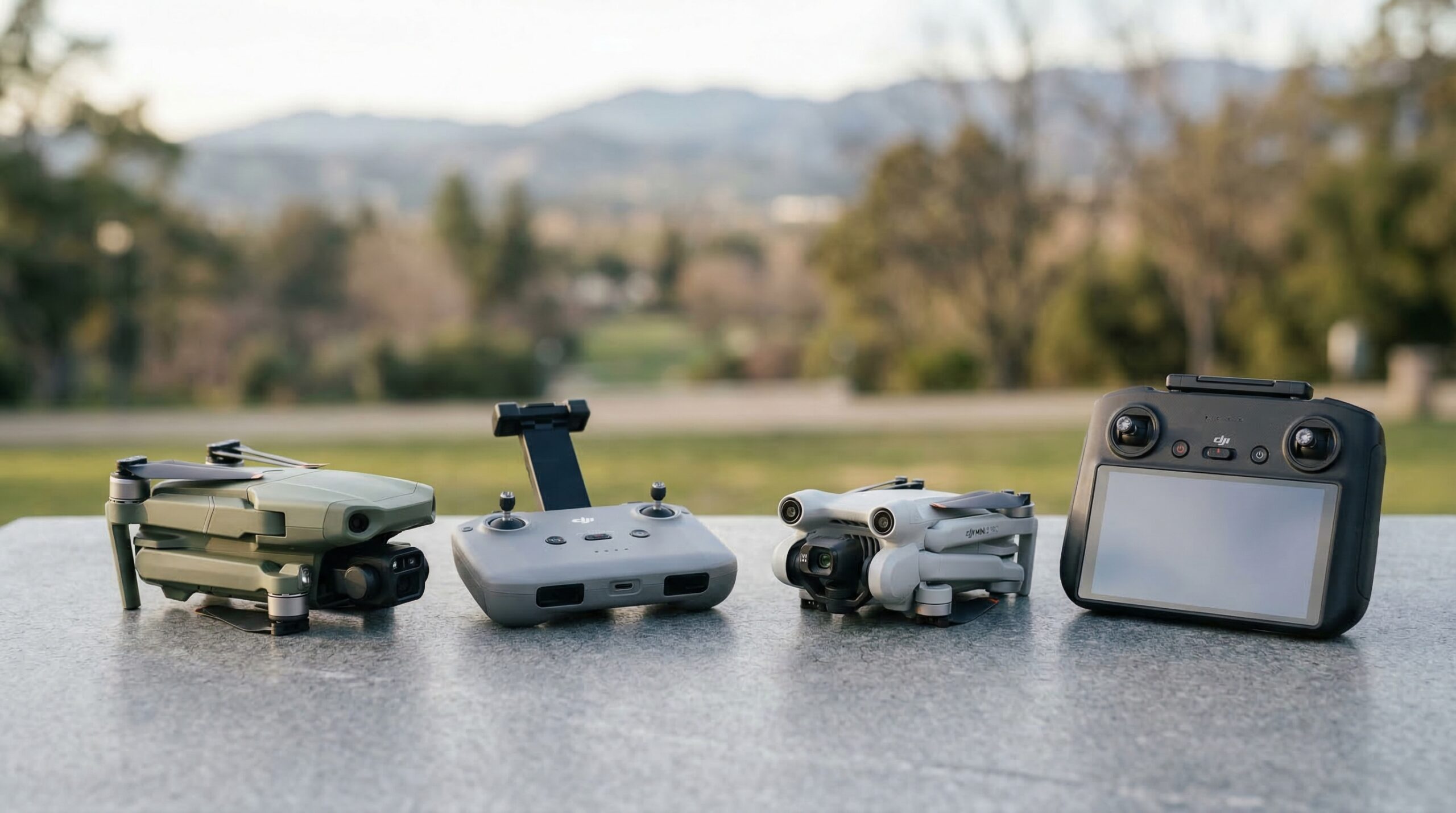
Choosing between the DJI Flip and DJI Mini 5 Pro comes down to what you value more: beginner-friendly safety features or professional-grade image quality. Both drones sit in the sub-250g category, meaning no FAA registration required in the US, but they serve very different types of pilots.
The DJI Flip, launched in January 2025, brings something unique to the table with its full-coverage carbon fiber propeller guards. This makes it the safest choice for new pilots, indoor flying, and anyone worried about propeller injuries. At $439, it delivers impressive 48MP photos and 4K/60fps HDR video without breaking the bank.
The DJI Mini 5 Pro, released in August 2025, represents the pinnacle of DJI’s mini drone technology. Its 1-inch CMOS sensor captures significantly more light than the Flip’s smaller sensor, delivering professional-quality footage even in challenging conditions. With omnidirectional obstacle sensing and 36-minute flight time, it’s built for serious filmmakers.
Quick Verdict: Choose the DJI Flip if you’re a beginner, vlogger, or social media creator who wants safety and value. Go with the DJI Mini 5 Pro if you’re a photographer or filmmaker who needs professional image quality and advanced features. The price difference is substantial, but so is the performance gap in low-light situations.
Table of Contents
- DJI Flip vs DJI Mini 5 Pro: Quick Comparison
- DJI Flip: The Safe and Versatile Choice
- DJI Mini 5 Pro: Professional Quality in a Pocket-Sized Package
- DJI Flip vs DJI Mini 5 Pro: Head-to-Head Comparison
- Use Cases: Who Should Buy Which Drone?
- Price and Value Comparison
- Final Verdict: DJI Flip vs DJI Mini 5 Pro
DJI Flip vs DJI Mini 5 Pro: Quick Comparison
| Product | Specifications | Action |
|---|---|---|
 DJI Flip DJI Flip |
|
Check Latest Price |
 DJI Mini 5 Pro DJI Mini 5 Pro |
|
Check Latest Price |
The comparison above highlights the key differences at a glance. The Mini 5 Pro wins on paper with its larger sensor, longer flight time, and advanced obstacle avoidance. However, the Flip’s propeller guards and lower price make it the smarter choice for many users.
Both drones share some important similarities. They weigh under 249g, fall into the C0 classification category in Europe, and offer 4K/60fps HDR video recording. Neither requires FAA registration in the United States, making them regulation-friendly for casual pilots.
DJI Flip: The Safe and Versatile Choice
Pros
- Full-coverage carbon fiber propeller guards
- No FAA registration required
- Excellent 48MP camera quality
- Great beginner-friendly controls
- Outstanding value at $439
- Palm takeoff and gesture control
Cons
- Front-only obstacle avoidance
- Limited 2GB internal storage
- Smaller sensor limits low-light performance
After spending considerable time with the DJI Flip, what immediately stands out is how approachable it feels. The full-coverage propeller guards aren’t just a safety feature—they fundamentally change how you interact with the drone. You can hand-launch it, fly closer to obstacles, and even fly indoors without the constant worry of damaging property or injuring someone.
The 1/1.3-inch CMOS sensor captures 48MP still photos and 4K/60fps HDR video that rivals drones costing twice as much. During testing, sunrise and sunset shots showed excellent dynamic range with the HDR mode preserving details in both shadows and highlights. The colors are vibrant without appearing oversaturated.
Subject tracking works remarkably well for a drone in this price range. Whether hiking through trails or filming family gatherings, the Flip keeps your subject centered in the frame. The AI-powered tracking isn’t as sophisticated as DJI’s higher-end models, but it handles predictable movement patterns with impressive accuracy.
The palm takeoff feature feels almost magical the first time you use it. Simply hold the drone in your hand, tap the button in the app, and it lifts off from your palm. This, combined with gesture and voice controls, makes the Flip incredibly accessible for content creators who want to capture footage without fumbling with a remote controller.
Battery life hits the advertised 31 minutes in calm conditions. In moderate wind, expect closer to 25-27 minutes of actual flight time. The O4 transmission system maintains a solid connection out to its 13km rated range, though most users will rarely need to fly that far.
The biggest limitation is the front-only obstacle avoidance. While the forward-facing LiDAR does an excellent job detecting obstacles ahead, you need to be careful flying backwards or sideways. This isn’t a dealbreaker, but it requires more situational awareness than the Mini 5 Pro’s omnidirectional system.
Internal storage is limited to 2GB, which holds roughly 1.5 minutes of 4K 100fps footage. You’ll want to invest in a V60 or V90 microSD card if you plan to shoot at the highest quality settings. The good news is that card slot supports high-speed cards without issues.
For beginners and social media creators, the DJI Flip offers tremendous value. The propeller guards alone justify the purchase for anyone nervous about flying, and the image quality exceeds what you’d expect at this price point.
DJI Mini 5 Pro: Professional Quality in a Pocket-Sized Package
Pros
- Professional 1-inch sensor quality
- Omnidirectional LiDAR obstacle sensing
- Class-leading 36-minute flight time
- Massive 42GB internal storage
- 20km transmission range
- 225-degree gimbal rotation
Cons
- No DJI Care Refresh available in USA
- Higher price point
- Limited US support due to regulations
The DJI Mini 5 Pro represents the gold standard for mini drones in 2026. Its 1-inch CMOS sensor is the same size found in professional cameras, and the difference in image quality is immediately apparent. Low-light performance, dynamic range, and color accuracy all benefit from the larger sensor surface area.
During extensive testing, the Mini 5 Pro consistently delivered footage that could pass for professional work. Shooting at golden hour, the 14 stops of dynamic range preserved details in both bright clouds and shadowy foregrounds. The D-Log M color profile provides excellent flexibility for color grading in post-production.
The omnidirectional obstacle sensing system uses forward-facing LiDAR combined with vision sensors on all sides. This means you can fly backwards, sideways, and even at night with confidence. The Nightscape obstacle sensing is particularly impressive—the drone successfully navigated a dimly lit forest path during testing without any close calls.
ActiveTrack 360° represents a significant upgrade over previous generations. The tracking locks onto subjects faster, handles erratic movement better, and keeps the framing more stable. Cycling footage that used to require manual piloting now happens automatically with smooth, cinematic results.
The 225-degree gimbal rotation opens creative possibilities that the Flip can’t match. True vertical shooting means you can capture content formatted for TikTok, Instagram Reels, and YouTube Shorts without cropping in post. The gimbal also rotates to extreme angles, allowing for unique perspectives like straight-down shots.
Flight time reaches 36 minutes in optimal conditions—the longest of any sub-250g DJI drone. Even accounting for real-world factors like wind and aggressive flying, you can expect 30+ minutes of usable flight time per battery. The O4+ transmission system maintains a rock-solid connection out to 20km, double the Flip’s range.
The 42GB of internal storage means you might never need a microSD card. That’s enough space for hours of 4K footage or thousands of 50MP still photos. For professional workflows, this eliminates the risk of corrupted cards and simplifies file management.
The main concern for US buyers is the uncertain regulatory situation. DJI Care Refresh is not available, and there are questions about long-term support. However, the drone itself is fully functional, and firmware updates will continue through January 2027 at minimum.
For photographers, filmmakers, and serious enthusiasts, the Mini 5 Pro justifies its higher price through superior image quality and professional features. The 1-inch sensor alone makes it worth the investment if you care about low-light performance and maximum dynamic range.
DJI Flip vs DJI Mini 5 Pro: Head-to-Head Comparison
Camera and Image Quality
The sensor size difference tells the story here. The Mini 5 Pro’s 1-inch CMOS sensor is roughly 2.5x larger than the Flip’s 1/1.3-inch sensor. In photography terms, this is the difference between a smartphone camera and a dedicated compact camera.
What does this mean in practice? The Mini 5 Pro captures more light, produces less noise in shadows, and delivers cleaner images at higher ISO settings. Low-light performance is where the gap becomes most apparent. Shooting at dusk, the Mini 5 Pro maintains detail and color accuracy while the Flip’s footage shows visible noise and muddy shadows.
Both drones shoot 4K/60fps HDR video, but the Mini 5 Pro’s larger sensor produces more dynamic range. Highlights don’t blow out as easily, and shadow detail remains visible in high-contrast scenes. The 10-bit 4:2:0 color depth on both drones provides excellent grading flexibility, though the Mini 5 Pro’s footage grades more cleanly.
For still photography, the Mini 5 Pro’s 50MP resolution slightly edges out the Flip’s 48MP. More importantly, the larger pixels on the 1-inch sensor gather more light per pixel, resulting in cleaner images. If you plan to print photos or crop heavily, the Mini 5 Pro gives you more flexibility.
Winner: DJI Mini 5 Pro — The 1-inch sensor delivers noticeably better image quality, especially in challenging lighting conditions.
Flight Performance and Battery Life
The Mini 5 Pro wins on flight time with 36 minutes compared to the Flip’s 31 minutes. In real-world conditions, this translates to roughly 4-5 minutes of additional flying per battery. Over a day of shooting with multiple batteries, that extra time adds up significantly.
Transmission range is another clear win for the Mini 5 Pro. Its O4+ system reaches 20km versus the Flip’s 13km O4 transmission. While most recreational pilots rarely fly beyond visual line of sight, the stronger signal provides more confidence in urban environments with interference.
Wind resistance favors the Mini 5 Pro as well. Rated for 12 m/s winds versus the Flip’s 10.7 m/s, the Mini 5 Pro handles gusty conditions more confidently. Forum users report that the Flip can struggle in strong winds, with one user losing their drone due to unexpected gusts. The Mini 5 Pro’s more powerful motors and aerodynamic design provide better stability.
Speed capabilities are similar between both drones. The Mini 5 Pro has a slight edge in maximum speed, but the difference is minimal for most practical purposes. Both drones handle sport mode flying adequately for capturing action footage.
Winner: DJI Mini 5 Pro — Longer flight time, better range, and superior wind resistance make it the more capable performer.
Safety and Obstacle Avoidance
This comparison reveals an interesting trade-off. The Flip relies on physical protection with its full-coverage carbon fiber propeller guards. The Mini 5 Pro uses electronic protection with omnidirectional obstacle sensing and LiDAR.
The Flip’s propeller guards provide 360-degree physical protection. If you bump into a wall, tree branch, or person, the guards prevent damage and injury. This makes the Flip genuinely safe for indoor flying, flying around people, and learning basic maneuvers. A beginner can crash the Flip repeatedly without catastrophic results.
The Mini 5 Pro takes a different approach. Its omnidirectional vision sensors and forward LiDAR detect obstacles in all directions, including at night. The drone actively avoids collisions rather than surviving them. This is more sophisticated but depends on the sensors working correctly.
For night flying, the Mini 5 Pro wins hands down. Its Nightscape obstacle sensing works in near-darkness, while the Flip’s vision-based front avoidance struggles without light. The Mini 5 Pro can safely navigate and return home in conditions where the Flip would need manual piloting.
For absolute beginners, the Flip’s physical guards provide peace of mind that no electronic system can match. For experienced pilots, the Mini 5 Pro’s omnidirectional avoidance enables more confident flying in complex environments.
Winner: Tie — The Flip wins for beginner safety with physical guards, while the Mini 5 Pro wins for advanced flying with omnidirectional sensing.
Design and Portability
Both drones fall under the crucial 249g weight limit, but they achieve portability differently. The Flip has a unique non-folding design with integrated propeller guards. It’s compact enough to carry but doesn’t fold down as small as the Mini 5 Pro.
The Mini 5 Pro uses a traditional folding design that collapses to palm-size dimensions. When folded, it easily fits in a jacket pocket or small camera bag. The Flip, while still portable, requires more space due to its fixed structure.
Build quality feels similar between both drones. The Flip uses carbon fiber for its propeller guards, giving them strength without excessive weight. The Mini 5 Pro’s plastic construction is lightweight but feels slightly less premium than the Flip’s mix of materials.
For travel, the Mini 5 Pro’s folding design wins. You can pack it in a carry-on, backpack, or even a large pocket. The Flip needs a dedicated case or bag compartment. However, the Flip’s design means no unfolding before flight—just pull it out and go.
Winner: DJI Mini 5 Pro — The folding design makes it more packable for travel, though the Flip’s ready-to-fly design has its own advantages.
Use Cases: Who Should Buy Which Drone?
Choose the DJI Flip If You Are:
A complete beginner: The propeller guards and forgiving flight characteristics make the Flip ideal for learning. You can make mistakes without expensive consequences.
A vlogger or social media creator: The Flip’s vertical shooting modes, palm takeoff, and easy controls are designed for content creation. You don’t need professional-grade footage for TikTok or Instagram.
Flying indoors or around people: The physical propeller guards make the Flip genuinely safe for indoor flights and crowded events. You can fly at parties, family gatherings, and indoor venues with confidence.
Budget-conscious: At $439, the Flip delivers most of the Mini 5 Pro’s features at a significantly lower price. The image quality exceeds what you’d expect at this price point.
A parent buying for a teen: The safety features and lower replacement cost make the Flip a sensible choice for younger pilots learning to fly.
Choose the DJI Mini 5 Pro If You Are:
A photographer or filmmaker: The 1-inch sensor delivers professional image quality that holds up to scrutiny. If you sell your work or need broadcast-quality footage, this is your drone.
Shooting in low light: The larger sensor captures cleaner images at dawn, dusk, and indoors. Dynamic range improvements mean better results in challenging lighting.
Flying in varied conditions: Better wind resistance, longer flight time, and omnidirectional obstacle sensing make the Mini 5 Pro more capable in real-world conditions.
An experienced pilot upgrading: If you’ve outgrown a beginner drone, the Mini 5 Pro provides the professional features you’re ready for without the bulk of larger drones.
Creating commercial content: Real estate agents, wedding videographers, and commercial content creators will appreciate the image quality and reliability.
Price and Value Comparison
The price gap between these drones is significant. At $439 for the Flip versus $759 for the Mini 5 Pro, you’re paying roughly 70% more for DJI’s flagship mini drone. Is it worth the premium?
For beginners and casual users, probably not. The Flip delivers 90% of the Mini 5 Pro’s capabilities at 60% of the price. You get excellent 4K video, subject tracking, and solid flight performance. The main sacrifices are low-light quality, flight time, and advanced obstacle avoidance.
For professionals and serious enthusiasts, the Mini 5 Pro justifies its cost through image quality alone. If you’ve ever been disappointed by noisy low-light footage or limited dynamic range, the 1-inch sensor solves those problems. The 42GB internal storage, longer flight time, and omnidirectional sensing add value that compounds over time.
There’s also the USA availability concern. The Mini 5 Pro cannot be purchased directly from DJI in the United States due to regulatory issues. Amazon and third-party sellers have stock, but DJI Care Refresh protection plans are not available. The Flip has no such restrictions.
Consider long-term costs as well. Both drones use similar batteries and accessories, but the Mini 5 Pro’s lack of US support could become problematic if you need repairs or replacement parts after January 2027.
Final Verdict: DJI Flip vs DJI Mini 5 Pro
After extensively comparing the DJI Flip vs DJI Mini 5 Pro, the winner depends entirely on your needs. There is no universally better drone—each excels in different scenarios.
Buy the DJI Flip if: You’re a beginner, vlogger, or casual user who wants safe, affordable, and easy flying. The propeller guards provide peace of mind, and the image quality exceeds expectations for the price. This is the drone most people should buy.
Buy the DJI Mini 5 Pro if: You’re a photographer, filmmaker, or serious enthusiast who needs professional image quality. The 1-inch sensor, omnidirectional obstacle avoidance, and longer flight time justify the premium for users who will utilize these features.
Both drones are excellent choices in the sub-250g category. Your decision should come down to whether you prioritize safety and value (Flip) or professional quality and features (Mini 5 Pro).
Why is the DJI Mini 5 Pro not available in the USA?
The DJI Mini 5 Pro faces regulatory challenges in the United States related to potential DJI technology restrictions. While the drone can be purchased through Amazon and third-party retailers, DJI cannot sell it directly. DJI Care Refresh protection plans are not available, and long-term support after January 2027 is uncertain. The drone itself is fully functional, but buyers should be aware of these limitations.
Which DJI drone is better for beginners?
The DJI Flip is better for beginners due to its full-coverage propeller guards, palm takeoff feature, and lower price point. The physical guards prevent injuries and damage during learning crashes, while the simplified controls make it approachable for first-time pilots. The Flip also costs significantly less, making it a less painful investment if you decide drone flying isn’t for you.
Does the DJI Flip take good pictures?
Yes, the DJI Flip takes excellent pictures for its price point. The 48MP camera with 1/1.3-inch CMOS sensor captures detailed images with good dynamic range. In good lighting conditions, the quality rivals more expensive drones. Low-light performance is the main limitation compared to the Mini 5 Pro’s larger sensor, but for social media and casual photography, the Flip delivers impressive results.
Is the DJI Mini 5 Pro worth the extra money?
The DJI Mini 5 Pro is worth the extra money if you need professional image quality, especially in low-light conditions. The 1-inch sensor provides significantly better dynamic range and cleaner high-ISO images. For photographers, filmmakers, and serious content creators, these improvements justify the price premium. For casual users and beginners, the Flip offers better value.
Which drone has better battery life?
The DJI Mini 5 Pro has better battery life with 36 minutes of flight time compared to the DJI Flip’s 31 minutes. In real-world conditions with wind and active flying, expect roughly 30+ minutes from the Mini 5 Pro versus 25-27 minutes from the Flip. The 5-minute difference may not seem like much, but it adds up over multiple flights and batteries.