
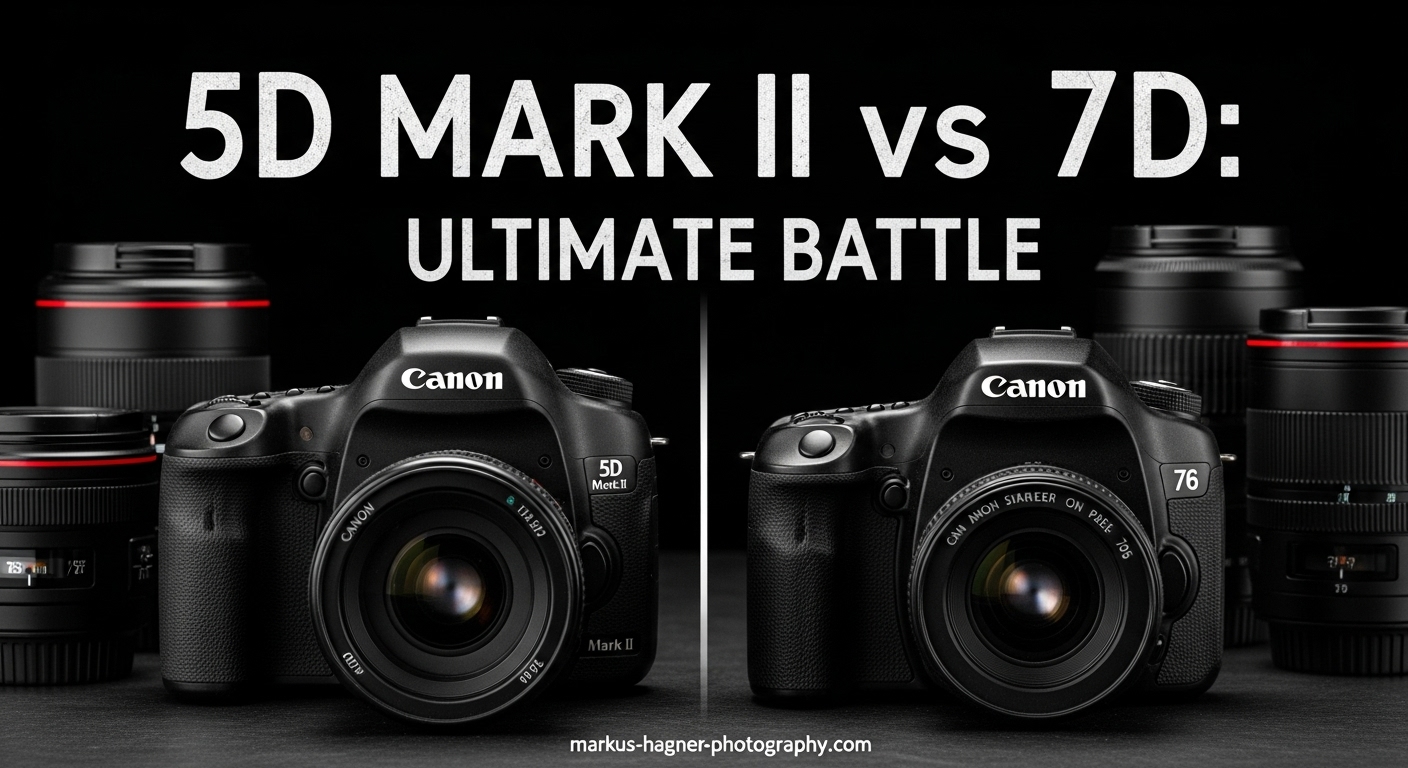
If you’re a photography enthusiast looking to upgrade your gear or enter the world of DSLRs, you’ve probably come across the Canon 5D Mark II and 7D. These two cameras, though released over a decade ago, remain popular choices for photographers on a budget or those looking for specific features. As someone who has spent countless hours with both cameras, I’m here to break down everything you need to know to make an informed decision.
Quick Overview: 5D Mark II vs 7D at a Glance
Before diving deep into the specifics, let’s start with a quick comparison table to give you an immediate sense of how these two cameras stack up against each other:
| Feature | Canon 5D Mark II | Canon 7D |
|---|---|---|
| Sensor | 21.1MP Full-Frame | 18.0MP APS-C |
| Image Processor | DIGIC 4 | Dual DIGIC 4 |
| ISO Range | 100-6400 (expandable to 12800/25600) | 100-6400 (expandable to 12800) |
| Autofocus | 9 points, 6 assist | 19 points, all cross-type |
| Continuous Shooting | 3.9 fps | 8 fps |
| Video | Full HD 1080p at 30fps | Full HD 1080p at 30fps |
| LCD Screen | 3.0-inch, 920k dots | 3.0-inch, 920k dots |
| Built-in Flash | No | Yes |
| Weather Sealing | Moderate | Better |
| Battery Life | Approx. 850 shots | Approx. 800 shots |
| Weight | 810g (body only) | 860g (body only) |
| Release Date | September 2008 | September 2009 |
Sensor and Image Quality: The Full-Frame vs APS-C Debate
When I first got my hands on both cameras, the most noticeable difference was right there in the sensor. The 5D Mark II boasts a full-frame sensor, while the 7D features an APS-C sensor. This fundamental difference shapes much of what makes these cameras unique.
The 5D Mark II’s 21.1-megapixel full-frame sensor delivers incredible image quality with a wider field of view. I discovered that when shooting landscapes or architecture, the full-frame sensor captures more of the scene without me having to step back. The larger pixels also contribute to better dynamic range and tonal gradation, making those sunset shots pop with natural color transitions.
On the other hand, the 7D’s 18-megapixel APS-C sensor provides a 1.6x crop factor. While this means you lose some of that wide-angle capability, it’s actually a blessing for wildlife and sports photographers. The crop factor effectively extends the reach of your lenses, making that 200mm lens behave more like a 320mm lens. I’ve captured some stunning bird shots with the 7D that would have been much more challenging with the 5D Mark II.
In terms of pure image quality at lower ISOs, both cameras produce excellent results. However, when you start pushing the ISO higher, the 5D Mark II’s larger sensor begins to show its advantage, producing cleaner images with less noise.
Autofocus Performance: Where the 7D Shines
If there’s one area where the 7D clearly outperforms the 5D Mark II, it’s autofocus. As someone who shoots a lot of action photography, I can tell you that autofocus performance can make or break your shots.
The 5D Mark II features a 9-point autofocus system with 6 additional assist points. While it was adequate for its time, I often found myself struggling when shooting fast-moving subjects. The center point is reasonably accurate, but the outer points leave much to be desired, especially in low light.
Enter the 7D with its revolutionary (at the time) 19-point autofocus system, with all points being cross-type. This means they can detect both horizontal and vertical lines, making them significantly more accurate and reliable. I discovered that when shooting sports or wildlife, the 7D’s autofocus system tracked moving subjects with impressive precision.
The 7D also introduced advanced autofocus customization options that were previously only found in Canon’s professional 1D series. You can adjust tracking sensitivity, acceleration/deceleration tracking, and AF point switching behavior. These features might seem overwhelming at first, but once you dial them in for your specific shooting style, they make a world of difference.
Low-Light Capabilities: The 5D Mark II’s Advantage
One area where the 5D Mark II truly excels is low-light performance. Thanks to its full-frame sensor with larger pixels, it handles high ISO settings remarkably well.
I’ve shot weddings with both cameras, and when the reception lights dim down, the 5D Mark II continues to produce usable images at ISO 3200 and even 6400 with careful post-processing. The noise pattern is more organic and film-like, which I find aesthetically pleasing.
The 7D, while no slouch in decent lighting, starts to show its limitations as the light fades. At ISO 3200, images become noticeably noisier, and detail begins to suffer. That said, for most casual shooting situations, the 7D’s low-light performance is still quite respectable.
If you’re primarily shooting in well-lit conditions or using flash, this difference might not be as significant. But if you’re like me and often find yourself shooting in challenging lighting without a flash, the 5D Mark II has a clear advantage.
Video Capabilities: A Tale of Two Pioneers
Both the 5D Mark II and 7D were groundbreaking in their video capabilities, but they approach video differently.
The 5D Mark II was actually the first DSLR to offer full HD 1080p video recording, and it took the filmmaking world by storm. Its full-frame sensor allowed for incredibly shallow depth of field, giving videos that cinematic look previously only achievable with expensive cinema cameras. I’ve shot short films with the 5D Mark II that still hold up today, especially when paired with good lenses.
However, the 5D Mark II does have some limitations in video mode. The initial firmware lacked manual control over exposure (though this was later fixed via a firmware update), and the camera’s contrast-based autofocus during video recording is slow and hunt-prone.
The 7D, released a year later, improved on some of these aspects. It offers the same 1080p resolution but with better manual controls out of the box. It also features a built-in microphone jack, which the 5D Mark II lacks, making it easier to connect external microphones for better audio quality.
One interesting note is that the 7D’s APS-C sensor creates a “crop factor” in video mode as well, which can be beneficial when you need extra reach but a drawback when shooting wide-angle scenes.
For serious video work, both cameras have largely been surpassed by newer models, but they can still produce beautiful footage in the right hands.
Build Quality and Ergonomics: Professional Feel vs Refined Control
When you pick up both cameras, you immediately notice the difference in build quality and ergonomics.
The 5D Mark II features a magnesium alloy body with moderate weather sealing. It feels solid and professional in hand, with a comfortable grip that I’ve found comfortable for extended shooting sessions. The button layout is relatively simple and straightforward, which is great for those who prefer a less cluttered interface.
The 7D, on the other hand, feels more like a mini-1D series camera. It has a more robust build with better weather sealing, making it more resistant to dust and moisture. I’ve shot with the 7D in light rain without any issues, something I’d be more hesitant to do with the 5D Mark II.
The 7D also features a more sophisticated control layout with a dedicated LCD panel on top for quick settings review and a new multi-controller that makes navigating menus and selecting autofocus points much more intuitive. As someone who values quick access to settings, I appreciate the 7D’s more advanced control system.
Both cameras have similar dimensions, but the 7D is slightly heavier at 860g compared to the 5D Mark II’s 810g. This difference is barely noticeable when shooting, but it might be a consideration if you’re carrying your gear all day.
Continuous Shooting Speed: Capturing the Action
If you shoot sports, wildlife, or any fast-moving subjects, continuous shooting speed is a critical factor to consider.
The 5D Mark II offers a respectable 3.9 frames per second (fps), which is adequate for general photography but can be limiting when trying to capture the perfect moment in fast-paced action. I’ve missed more than a few great shots because the 5D Mark II couldn’t keep up with the action.
The 7D, with its dual DIGIC 4 processors, doubles down with an impressive 8 fps continuous shooting rate. This makes it much more capable of capturing fast-moving subjects. When I switched from the 5D Mark II to the 7D for sports photography, my “keeper rate” increased significantly.
The 7D also has a larger buffer, allowing you to shoot more frames in a single burst before the camera slows down. For action photographers, this is a game-changer.
Battery Life: All-Day Shooting Potential
Both cameras use different battery systems, and this affects their battery life and usability.
The 5D Mark II uses the LP-E6 battery, which is rated for approximately 850 shots per charge. In my experience, this is fairly accurate, and I can typically shoot a full wedding or event on a single battery with some power to spare.
The 7D uses the same LP-E6 battery but is rated for slightly fewer shots at approximately 800 per charge. The difference is minimal in real-world use, and both cameras offer excellent battery life compared to many newer models.
One advantage of the 5D Mark II is that it was the first Canon camera to use the LP-E6 battery, which has become a standard in many Canon cameras. This means if you upgrade to a newer Canon DSLR or mirrorless camera in the future, you might be able to use the same batteries.
Both cameras also offer optional battery grips (BG-E6 for the 5D Mark II and BG-E7 for the 7D), which not only extend the battery life but also improve the ergonomics when shooting vertically.
Price and Value: Getting the Most Bang for Your Buck
Since both cameras have been discontinued for several years, they’re now available on the used market at significantly reduced prices. This makes them excellent options for photographers on a budget or those looking for a second body.
As of 2026, you can typically find a used Canon 5D Mark II in good condition for around $400-600, while a Canon 7D in similar condition might cost $300-500. These prices can vary based on shutter count, condition, and included accessories.
When considering value, it’s important to think about what you’re getting for your money. The 5D Mark II offers full-frame image quality that’s still impressive by today’s standards, while the 7D provides advanced autofocus and fast continuous shooting in a robust body.
Both cameras represent excellent value for photographers who understand their limitations and work within them. I’ve seen stunning images produced by both cameras in the hands of skilled photographers, proving that it’s not always about having the latest and greatest gear.
Also Read: Nikon FE vs FM
Who Should Buy the 5D Mark II?
Based on my experience with both cameras, the 5D Mark II is ideal for:
- Portrait and Wedding Photographers: The full-frame sensor produces beautiful portraits with pleasing bokeh and excellent skin tones. I’ve shot numerous weddings with the 5D Mark II, and clients have always been thrilled with the results.
- Landscape and Architecture Photographers: The wider field of view and superior dynamic range make the 5D Mark II a great choice for capturing expansive scenes and detailed architectural shots.
- Low-Light Enthusiasts: If you frequently shoot in dim conditions without flash, the 5D Mark II’s better high ISO performance will serve you well.
- Cinematographers on a Budget: The 5D Mark II’s full-frame video capabilities make it a great entry point into cinematic video production.
- Photographers Who Value Simplicity: If you prefer a more straightforward interface without too many complex settings, the 5D Mark II’s simpler layout might appeal to you.
Who Should Buy the 7D?
The 7D, on the other hand, is better suited for:
- Sports and Action Photographers: With its fast continuous shooting and advanced autofocus system, the 7D excels at capturing fast-moving subjects. I’ve shot everything from soccer games to track and field events with the 7D, and it rarely disappoints.
- Wildlife Photographers: The 1.6x crop factor effectively extends the reach of your lenses, and the advanced autofocus system helps keep sharp focus on animals in motion.
- Photographers Who Need Durability: If you often shoot in challenging conditions, the 7D’s better weather sealing and robust build will give you peace of mind.
- Those Who Value Advanced Controls: If you like having quick access to a wide range of settings and enjoy customizing your camera’s behavior, the 7D’s sophisticated control system will be right up your alley.
- Beginners Looking to Grow: The 7D offers more room to grow as a photographer, with its advanced features allowing you to expand your skills over time.
My Personal Experience with Both Cameras
I’ve owned and extensively used both the 5D Mark II and the 7D, and each has earned a special place in my photography journey.
I bought the 5D Mark II shortly after it was released, primarily for portrait and wedding work. The image quality blew me away, and clients were consistently impressed with the results. There’s something magical about the way this camera renders skin tones and captures subtle details in highlights and shadows.
A few years later, I added the 7D to my kit when I started getting more into sports and wildlife photography. The difference in autofocus performance and continuous shooting speed was immediately apparent. Suddenly, I was capturing action sequences that would have been impossible with the 5D Mark II.
What I discovered is that these cameras complement each other beautifully. Many professional photographers during that era used this exact combination: a 5D Mark II for portraits and landscapes, and a 7D for action and wildlife.
Even today, I occasionally pull out these cameras for specific projects or when teaching photography workshops. They’re both capable of producing stunning images in the right hands, and they represent an era when Canon was pushing the boundaries of what was possible in consumer DSLRs.
Pro Tips for Getting the Most Out of Either Camera
Whether you choose the 5D Mark II or the 7D, here are some tips I’ve learned over the years to help you get the most out of your camera:
- Invest in Good Glass: Both cameras deserve quality lenses. I’ve found that investing in good glass makes more difference to image quality than upgrading camera bodies. For the 5D Mark II, consider the Canon 50mm f/1.4 or the 24-70mm f/2.8. For the 7D, the 70-200mm f/2.8 is a game-changer for sports and wildlife.
- Master Manual Mode: While both cameras have excellent auto and semi-auto modes, learning to shoot in manual mode will give you complete control over your images. I discovered that my photography improved significantly when I took the time to understand the exposure triangle.
- Shoot in RAW: Both cameras produce excellent JPEGs, but shooting in RAW gives you much more flexibility in post-processing. I’ve been able to salvage shots that would have been unusable if shot in JPEG.
- Customize Your Settings: Take the time to go through the menu and customize the settings to your shooting style. I’ve set up custom shooting modes for different scenarios (portraits, sports, landscapes) that allow me to quickly switch between setups.
- Keep Your Firmware Updated: Both cameras received firmware updates that improved functionality. Make sure you’re running the latest version to get the best performance.
- Use the Right Focus Mode: For static subjects, use One-Shot AF. For moving subjects, use AI Servo. On the 7D, experiment with the different AF tracking settings to find what works best for your specific sport or activity.
- Back-Button Focus: If you haven’t tried back-button focusing, I highly recommend it. It separates the autofocus function from the shutter release, giving you more control over when and what the camera focuses on.
Final Verdict: 5D Mark II vs 7D
After spending years with both cameras, I can tell you that there’s no clear “winner” in the 5D Mark II vs 7D debate. The right choice depends entirely on your specific needs and shooting style.
If image quality, low-light performance, and that beautiful full-frame look are your priorities, the 5D Mark II is the way to go. It’s a camera that still produces stunning images by today’s standards and excels in portrait, wedding, and landscape photography.
If you need advanced autofocus, fast continuous shooting, and a more robust build, the 7D is the better choice. It’s a versatile workhorse that handles sports, wildlife, and action photography with ease.
For many photographers, the ideal solution is actually owning both cameras. I’ve used this combination for years, and it covers almost any shooting scenario I might encounter. The 5D Mark II handles portraits and landscapes, while the 7D takes care of sports and wildlife.
Ultimately, both cameras represent excellent value in 2026 and are capable of producing professional-quality results in the hands of a skilled photographer. Choose based on your specific needs, and you won’t be disappointed with either option.
Also Read: Canon 1DX Mark II vs 5D Mark IV
FAQ: 5D Mark II vs 7D
Which camera has better image quality?
The 5D Mark II generally produces better image quality, especially in low-light situations, thanks to its full-frame sensor with larger pixels. However, in good lighting conditions, both cameras produce excellent results.
Can I use EF-S lenses on the 5D Mark II?
No, the 5D Mark II is a full-frame camera and cannot use EF-S lenses, which are designed for APS-C sensors. The 7D, being an APS-C camera, can use both EF and EF-S lenses.
Which camera is better for video?
Both cameras shoot 1080p video, but the 5D Mark II has an advantage due to its full-frame sensor, which allows for a shallower depth of field and that cinematic look. However, the 7D offers better manual controls out of the box and has a microphone jack.
Is the 7D’s autofocus really that much better?
Yes, the 7D’s 19-point autofocus system with all cross-type points is significantly better than the 5D Mark II’s 9-point system, especially for tracking moving subjects and in low-light conditions.
Which camera is better for a beginner photographer?
The 7D might be better for a beginner who plans to shoot a variety of subjects, as it offers more room to grow with its advanced features. However, the 5D Mark II’s simpler interface might be less overwhelming for absolute beginners.
Can these cameras still be used professionally in 2026?
Absolutely. While they lack some of the modern features of newer cameras, both the 5D Mark II and 7D are still capable of producing professional-quality results in the right hands and for the right applications.
How do these cameras compare to modern entry-level DSLRs?
Modern entry-level DSLRs generally offer better autofocus, higher ISO performance, and more features. However, the 5D Mark II and 7D have better build quality and, in the case of the 5D Mark II, a full-frame sensor, which is still rare in entry-level cameras.
Which camera has better battery life?
The 5D Mark II has slightly better battery life, rated for approximately 850 shots compared to the 7D’s 800 shots. In real-world use, the difference is minimal.