
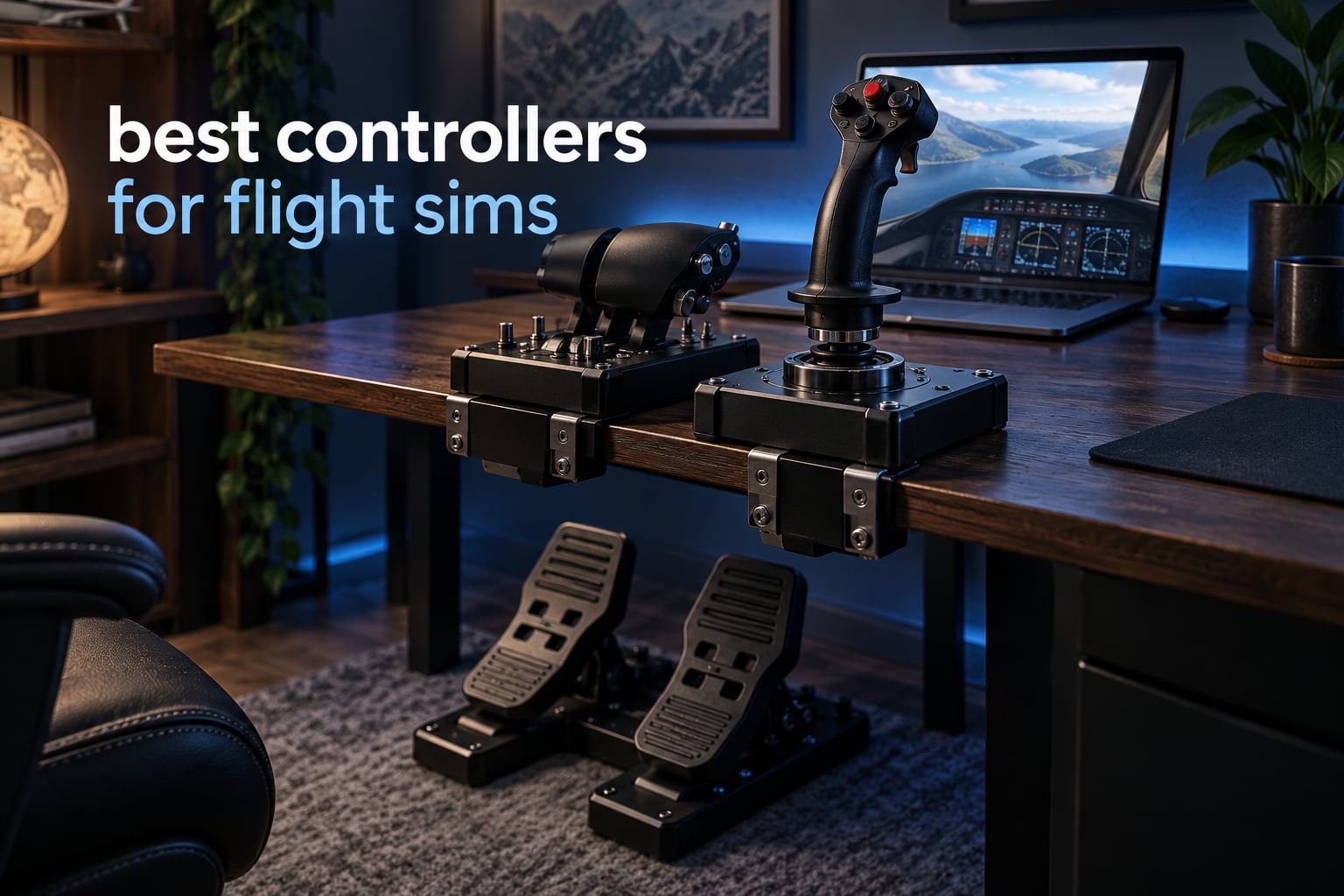
A gamepad gets you airborne. A real flight controller is what makes you fly. The best controllers for flight sims give you a physical stick or yoke with authentic axis range, a working rudder, and enough switches that you stop hunting for the trim wheel with your chin.
We spent weeks putting ten of the most popular flight sim controllers through MSFS 2024, X-Plane and a couple of combat sims, comparing centering force, axis resolution, throttle feel, button counts and the desk space each one eats up. Several of these have been in continuous production for a decade, which tells you something about the category itself.
This guide covers everything from a first HOTAS on a small apartment desk to a full metal throttle quadrant for Boeing procedures. Every pick below is a controller you can fly real procedures with, not a plastic shell. If you want the wider hardware picture first, we have covered flight sticks and HOTAS units and entry-level flight sticks in more depth.
Top 3 Picks: Flight Sim Controllers in 2026
These three cover the most common setups: a PC pilot who wants one box that just works, a console pilot who cannot use PC-only hardware, and a VR pilot who needs hall-effect precision.

Thrustmaster T-Flight Hotas X
- 12 buttons and 5 axes
- Detachable real-size throttle
- Dual twist and tilting-lever rudder
- Adjustable resistance dial

Thrustmaster T.Flight Hotas One
- Native Xbox Series X|S and PC support
- 14 programmable buttons
- Detachable throttle
- Adjustable stick resistance

Thrustmaster T16000M FCS HOTAS
- Hall effect magnetic sensors
- 4 independent axes with twist rudder
- 16 braille-identified action buttons
- T.A.R.G.E.T. software mapping
Best Controllers for Flight Sims (October 2026)
One table, every controller, the details that actually change how you fly. Wider axes and real rudder control matter more than any spec further down the list.
| Product | Specifications | Action |
|---|---|---|
| Thrustmaster T-Flight Hotas X |
|
Check Latest Price |
| Thrustmaster T.Flight Hotas One |
|
Check Latest Price |
 Logitech G X56 H.O.T.A.S. RGB Logitech G X56 H.O.T.A.S. RGB |
|
Check Latest Price |
 Logitech G PRO Flight Yoke System Logitech G PRO Flight Yoke System |
|
Check Latest Price |
 Turtle Beach VelocityOne Flight Turtle Beach VelocityOne Flight |
|
Check Latest Price |
 Logitech G X52 Flight Control System Logitech G X52 Flight Control System |
|
Check Latest Price |
 Thrustmaster TCA Captain Pack X Thrustmaster TCA Captain Pack X |
|
Check Latest Price |
| Thrustmaster T16000M FCS HOTAS |
|
Check Latest Price |
 Honeycomb Bravo Throttle Quadrant Honeycomb Bravo Throttle Quadrant |
|
Check Latest Price |
 Thrustmaster T.Flight Full Kit X Thrustmaster T.Flight Full Kit X |
|
Check Latest Price |
1. Thrustmaster T-Flight Hotas X: The Best All-Round Entry HOTAS
Pros
- Comfortable ergonomic hand rest and real-size throttle
- Detachable throttle for custom layouts
- Onboard memory and preconfigured mapping
- Dual rudder control options
- Weighted base stays planted
Cons
- Pronounced middle throttle detent feels sticky
- Short cable limits separation from the base
- Plastic build feels entry-level
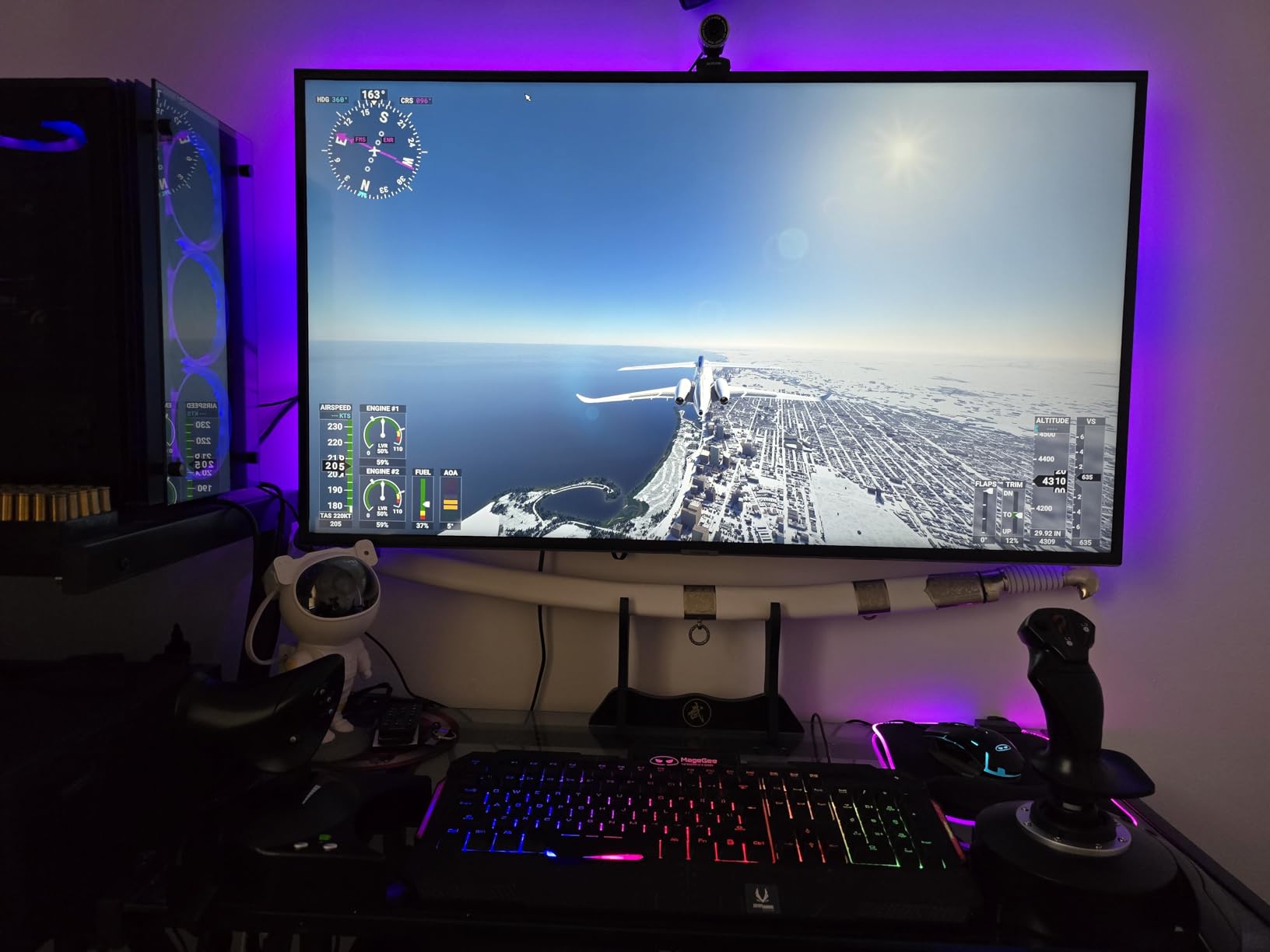
The T-Flight Hotas X is the stick we recommend to almost everyone starting out. It arrives with a real-size throttle already attached to a detachable base, and the mapping is close enough to correct that most people are flying within a few minutes of plugging it in.
That huge review count is not accidental. This is the stick that shows up in every beginner thread on r/MicrosoftFlightSim as the gateway purchase, then gets replaced two years later by something with hall effect sensors. That is not a failure. It is a very well-made first step that teaches you what you actually want.
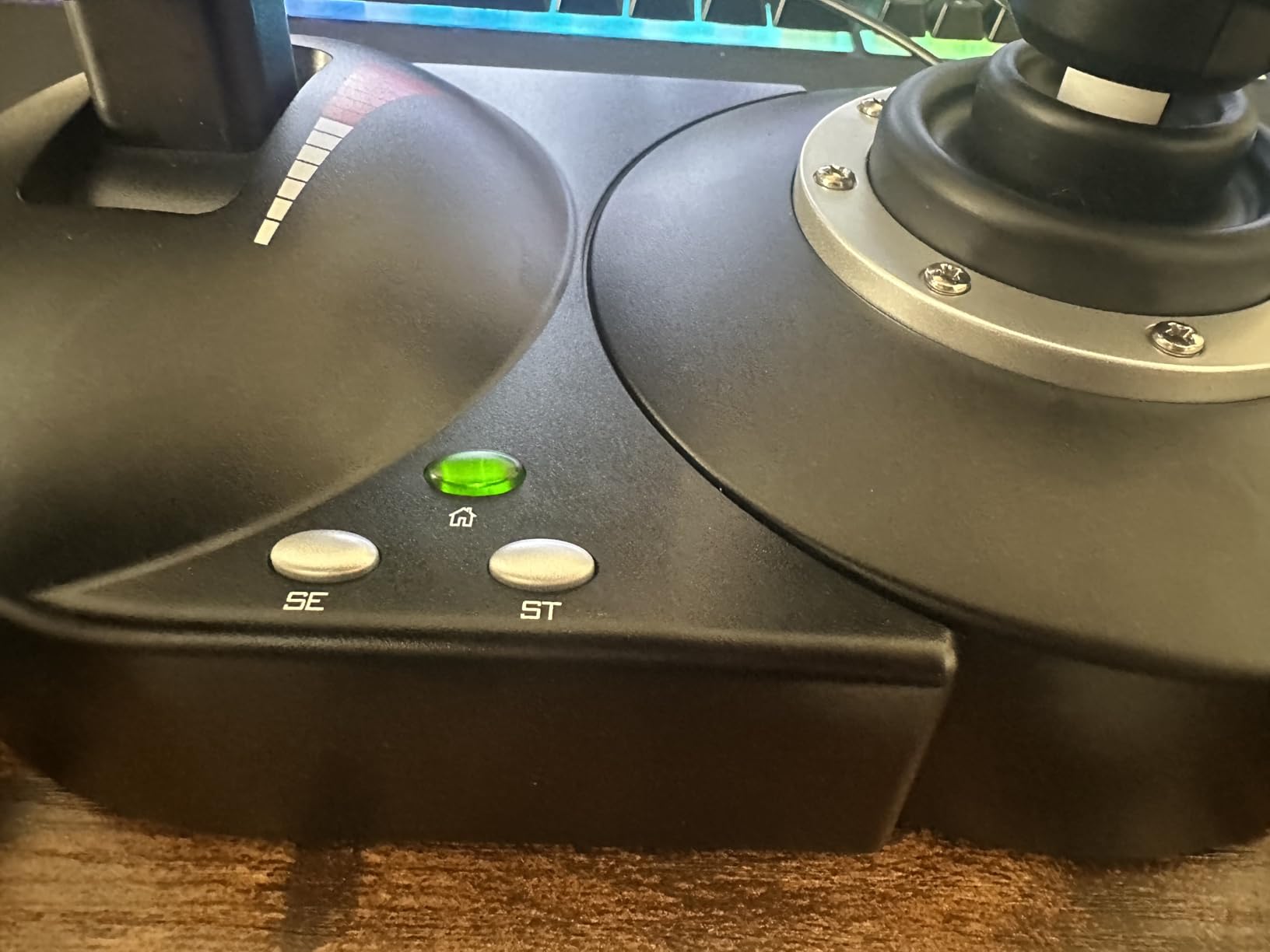
The hand rest is the standout. It is wide, angled and shaped so a long session does not leave your wrist barking, and the throttle has a full-size lever rather than the toy stick most competitors ship with. Buttons are placed where your fingers land, not where the designer thought looked tidy.
Rudder control is the quiet bonus. You get twist on the grip and a progressive tilting lever under the throttle, and the dial on the side lets you dial in centering resistance until the stick feels like the aircraft you are flying. The throttle unscrews for custom rigs, which is where this stick quietly outgrows its entry-level label.
The detent in the middle of the throttle travel is real and it is the most common complaint. It is a pronounced notch that some pilots read as cruise power and others fight with on every throttle push. The interconnect cable is also short, so plan your layout with that in mind.
Plastic is the other word you will read most. It feels fine in the hand and the weighted base keeps it from sliding, but if you want a metal grip that survives a decade of combat sim dogfights, look one section down.
Who the T-Flight Hotas X suits
It suits anyone who wants one purchase to cover MSFS 2024, X-Plane and Elite Dangerous without thinking about it. The detachable throttle and weighted base mean it works on a small desk today and on a proper frame later.
It also suits students. The braille-style button identifiers and the T.A.R.G.E.T.-friendly hardware layout mean you can build genuine muscle memory rather than hunting for switches with your eyes on the panel.
Where it falls short
It is not a VR controller. There is no hall effect sensor here, so you will want something else if you fly in a headset where you cannot see your hands.
It is also not the last upgrade most enthusiasts buy. Once you know you want metal, analog trim and no drift, this is the setup you grow out of rather than settle into.
2. Thrustmaster T.Flight Hotas One: The Best Controller for Xbox and PC
Pros
- Widely available HOTAS for Xbox Series X and Series S
- 14 programmable buttons and a hat switch
- Adjustable stick resistance
- Works with TFRP pedals on the sliding rail system
Cons
- Throttle is loose and drifts from position
- Console mapping limits multi-function buttons
- Grip too smooth for aggressive yaw
If you fly on an Xbox Series X or Series S, this is the practical answer. Almost every premium HOTAS on the market is PC-only over a USB connection that the console will not recognise, which leaves console pilots with a thin selection and a lot of forum guessing.
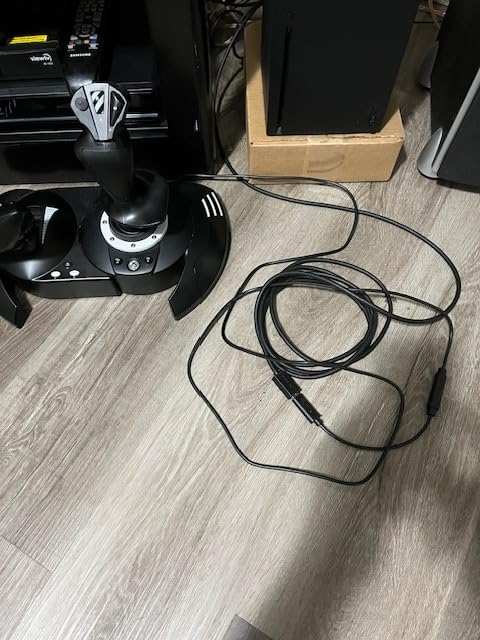
The Hotas One fixes that. It runs on PC, Xbox One and both current Xbox Series consoles with plug-and-play behaviour, and the throttle comes with a detachable base plus the same S.M.A.R.T. sliding rail system used by Thrustmaster rudder pedals, so you can build a full console rig in one ecosystem.
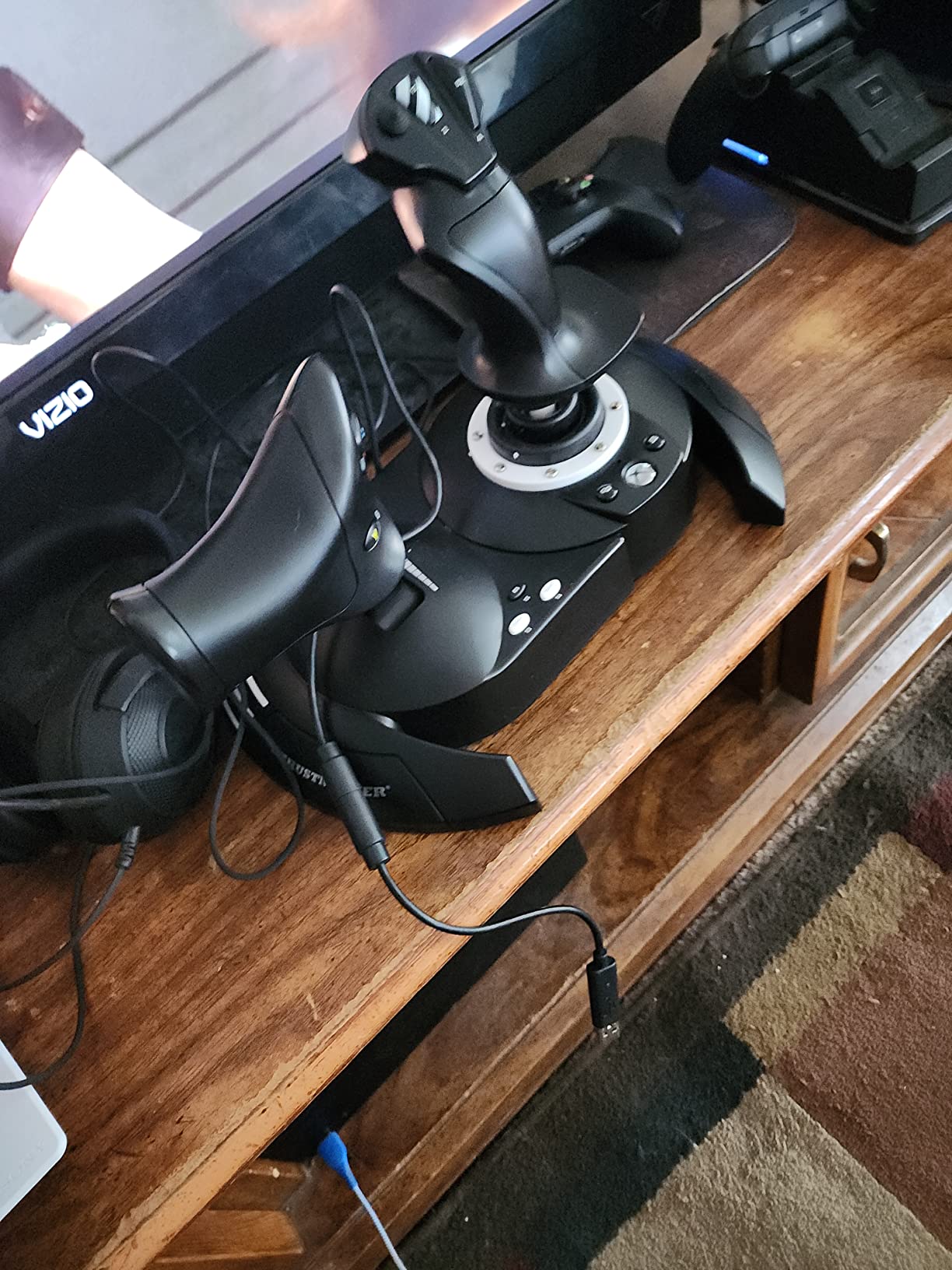
Hardware wise it is the more capable of the two entry Thrustmaster HOTAS units, with 14 programmable buttons instead of 12 and a hat switch up top. The adjustable resistance and responsive trigger let you set up light GA handling or heavy airliner feel without swapping hardware.
Owners consistently report good comfort, solid Windows 10 and 11 support and active firmware updates. The Allen key included for bolting the throttle to the base is a small touch that saves you a support ticket.
The throttle is the problem. It is very loose and will not hold an intermediate power setting, drifting back toward idle with the slightest touch. On a takeoff you will be pushing it back up constantly until you learn the feel.
Console limitations are the other half of the story. Xbox mapping does not allow multiple functions per button, and there is no calibration option in the console environment, so axes that wear in over a few years cannot be tuned back into shape from the couch.
Who the Hotas One suits
It suits console-first pilots who also want to bring the same rig to a PC session. The single purchase covers both, which removes the usual two-hardware juggling act.
It also suits anyone starting with MSFS 2024 on console and planning to move to PC hardware later, because the detachable throttle and pedal rail standard carry over.
Where it falls short
It falls short for pilots who fly heavy jets in VR, where a loose throttle and a smooth grip that slides during hard yaw inputs become problems fast.
It also falls short if you want per-button remapping on console, because the platform limits how many functions you can layer onto a single input.
3. Logitech G X56 H.O.T.A.S. RGB: The Best Controller for VR Flying
Logitech G X56 H.O.T.A.S Throttle and Joystick Flight Simulator Game Controller, 4 Spring Options, +189 Programmable Controls, RGB Lighting, 2x USB, PC – Black
Pros
- Massive switch
- dial and button count
- Ideal layout when you cannot see your controls in VR
- Hall effect sensors on the main axes
- Four swappable springs let you tune stick force
Cons
- Throttle very stiff from internal damping grease
- Large footprint and awkward for smaller hands
- Some models report stick drift and failing buttons
Every switch on this thing has a job, and in a headset that matters enormously. When you cannot see your hands, the ability to reach up, feel the layout and know which hat you are pressing is the difference between a smooth approach and fumbling for switches while the autopilot disconnects.
Add two POV hats, two 4-way switches, a throttle with its own controls, twin mini analog sticks and over 189 programmable inputs, and the X56 covers a cockpit layout that most people would need to assemble from several manufacturers. Twin throttles with a friction adjuster and a lock handle twin-engine work well, and the PTFE-coated grip surfaces stay grippy in VR glove use.
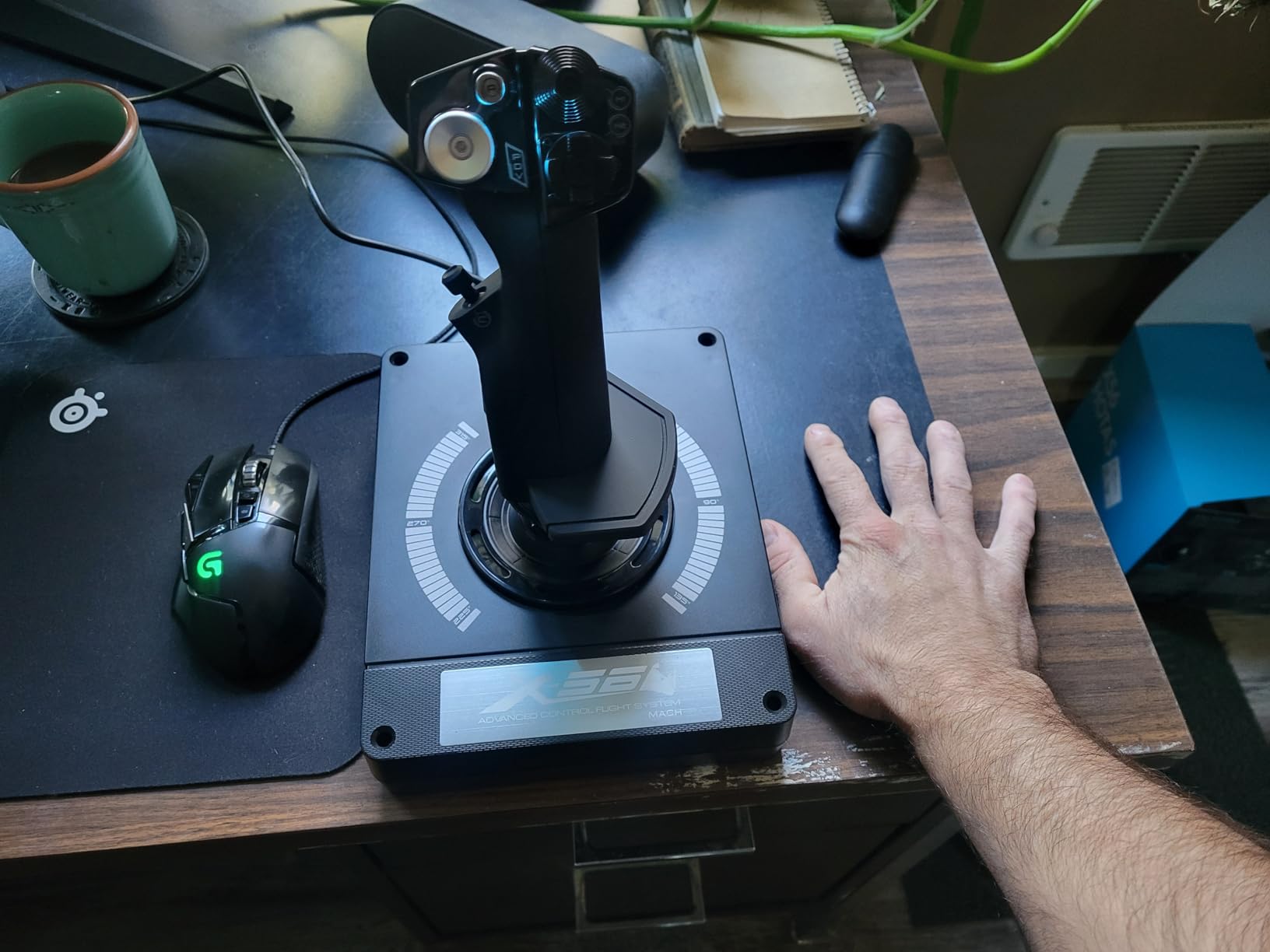
It is a re-engineered Saitek X56, and that history shows in both directions. The hall effect sensors on the aileron and elevator axes are a genuine improvement over the older potentiometer design, and the four-spring system lets you change stick weight as your technique improves without buying a new stick.
RGB backlighting is configurable through software, which sounds like a gimmick until you are flying a night VFR sightseeing route in a dark room and need to find the right switch fast.
The throttle is the recurring complaint, and it is a specific one. Thick internal damping grease makes it extremely stiff, slow to move quickly, and stiff enough to feel frozen when the sim is paused. Many owners work around it with a friction dial or by opening the unit and re-lubricating the mechanism.
Reliability complaints are the second theme. Drift on the main axes and buttons failing within weeks account for most of the critical reviews, and the mini analog stick sits exactly where your thumb rests by default. Toggles 1 to 6 also land under a resting wrist, which causes accidental activations until you relearn the grip.
Software is a minor annoyance too. The X56 is not supported inside Logitech G Hub, so it needs its own separate driver download that most people forget until something misbehaves.
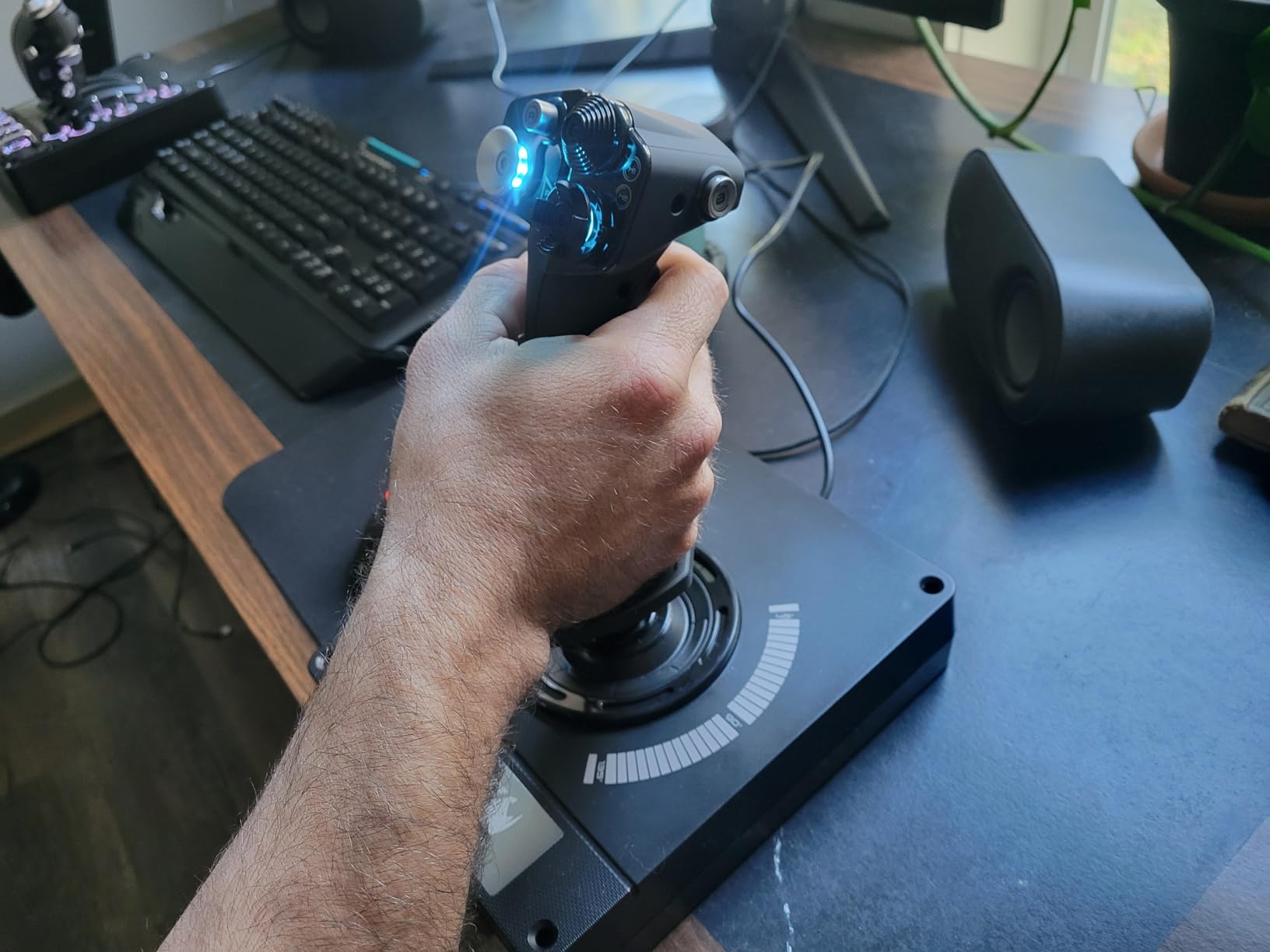
Who the X56 suits
It suits VR pilots flying wide-body and airliner procedures, where you need switches you can identify by touch and a layout dense enough to hold an entire flight deck. If your hands cannot be seen, this density is the whole point.
It also suits anyone who wants to run a dual-seat or multi-engine setup in MSFS and needs paired throttle control with a friction adjuster to coordinate two engines.
Where it falls short
It falls short for anyone with a small desk. The footprint is one of the largest here, and the button positions are tuned for large hands rather than smaller ones.
It also falls short for pilots who need a throttle that snaps to detents quickly in combat sims, because the damping grease slows everything down.
4. Logitech G PRO Flight Yoke System: The Best Yoke for General Aviation
Pros
- Smooth and accurate yoke for a fraction of metal yoke pricing
- Desk clamps hold securely
- Modular design accepts third-party throttles
- Two-year manufacturer warranty
Cons
- Soft spring feel compared to a real yoke
- Axis drift and dead zones need in-game tuning
- Throttle quadrant reported fragile
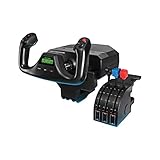
Most flight sim pilots learn to fly with a stick, then discover that the aircraft they actually want to fly Cessna 172s and Piper Cubs in has a yoke. The Logitech G PRO Flight Yoke is the least painful way to make that switch, and it is why so many GA-focused MSFS pilots end up owning one alongside a stick.
The shaft is stainless steel, which is the single most important thing to know about a plastic-looking yoke. It is the part that takes the load, and it does not flex the way cheap imitations do. Yoke rotation is smooth, predictable and easy to modulate, which is exactly what a light single-engine aircraft asks for.
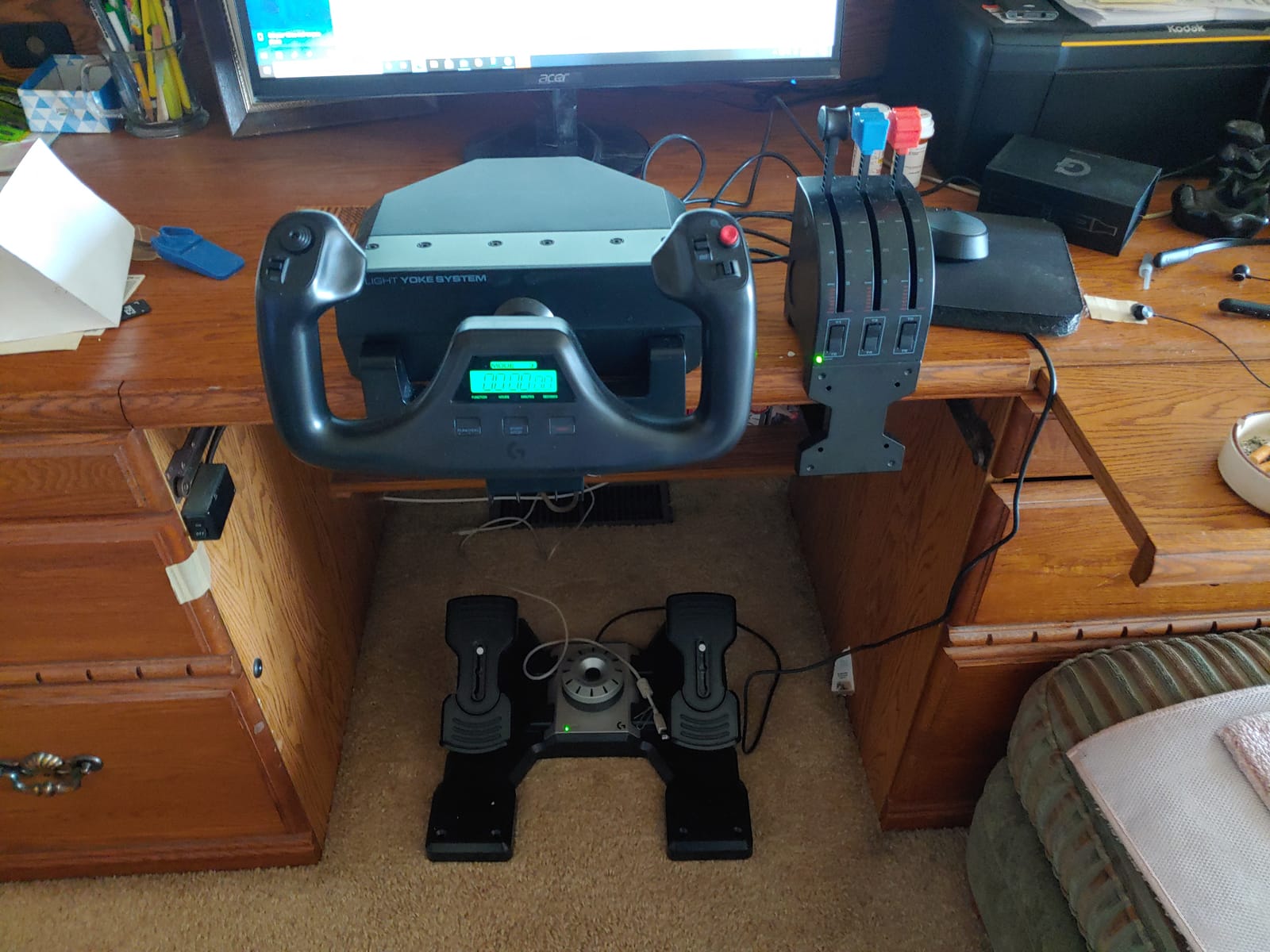
The box includes a throttle quadrant with its own cable, a PS/2 connector cable and two desk clamps, so you have a functioning two-axis GA setup out of the box without a second purchase. Optional software lets you map up to 75 controls and emulate keyboard commands, and it is preset for MSFS, FSX, X-Plane 10 and Prepar3D.
Real pilots tend to defend the soft spring response, and they have a point. A springy heavy yoke in a single-engine trainer feels nothing like a real one, and the Logitech feel is closer to a light aircraft control column. If your yoke feels dead in the middle, the fix is usually an S-curve or dead zone adjustment in the sim rather than new hardware.
Against that, some recent production has seen the throttle quadrant fail within months, and the plastic mounts and construction feel light under aggressive input. Dead zones and axis drift show up often enough that in-game tuning is not optional. There is also no macOS support, which matters if you fly X-Plane on a Mac.
Fourteen buttons is thin for modern airliners. The POV hat and three-position mode switch help, but a full A320 or 737 procedure will outrun this layout quickly and send you looking for a button add-on.
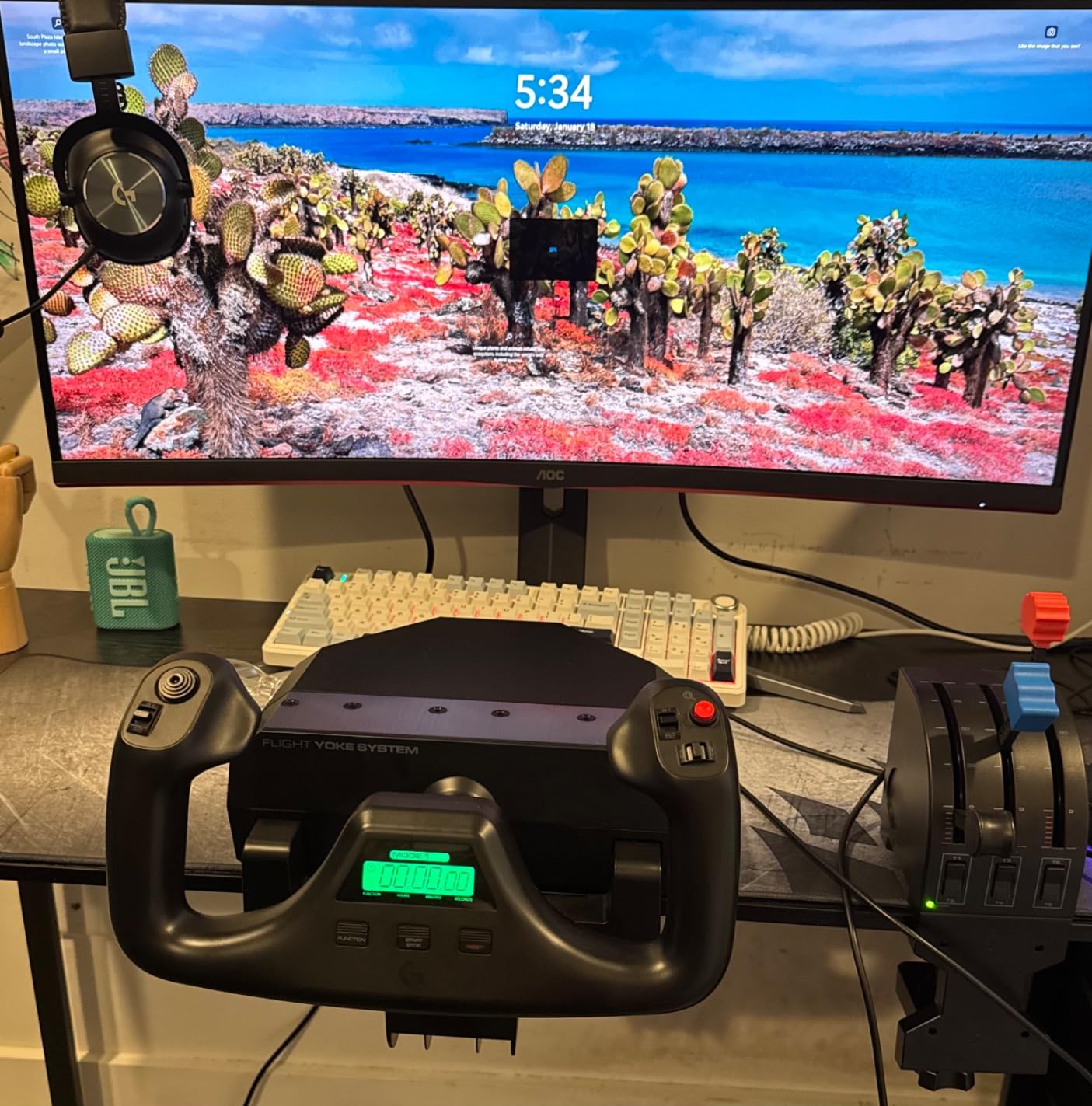
Who the G PRO Yoke suits
It suits GA, bush flying and VFR sightseeing pilots who want a proper two-axis control column with a throttle in the box. The included clamps mean you can be flying a Cub in ten minutes.
It also suits anyone who wants a cheap way to learn whether a yoke suits them before committing to a metal cockpit rig, because the modular design accepts add-on throttles later.
Where it falls short
It falls short for wide-body and heavy airliner procedure flying, where fourteen buttons is not enough to run a full checklist without reaching for the keyboard.
It also falls short if you fly on macOS, where there is no support at all, and if you need a firm-feeling control column rather than a soft one.
5. Turtle Beach VelocityOne Flight: The Best All-in-One Controller for Xbox
Turtle Beach VelocityOne Flight Universal Control System – Xbox Series X & Xbox Series S, Xbox One & Windows 10 & 11 PCs with Yoke Handle, Throttle Quadrant, Trim Wheel & Rudder Controls
Pros
- Everything in one box including rudder controls
- Dedicated pitch trim wheel
- Works on Xbox Series X and Series S and Windows
- Secure clamping system
Cons
- Some models arrive with a dead pitch axis
- Yoke is jerky until broken in
- Flight management display is confusing
Console flight sim pilots are usually told to buy three products and bolt them together. The VelocityOne Flight is the rare all-in-one answer, with a yoke, a modular throttle quadrant, integrated rudder and brake controls and a dedicated pitch trim wheel, all clamped to your desk in one go.
The trim wheel deserves its own sentence because it is the feature owners mention most. Elevator trim is a constant in airliner procedures, and doing it with a switch on the yoke means your eyes stay on the panel. The yaw axis runs a true 180 degrees through a non-contact hall effect sensor, which is a better sensor type than most budget yokes use.
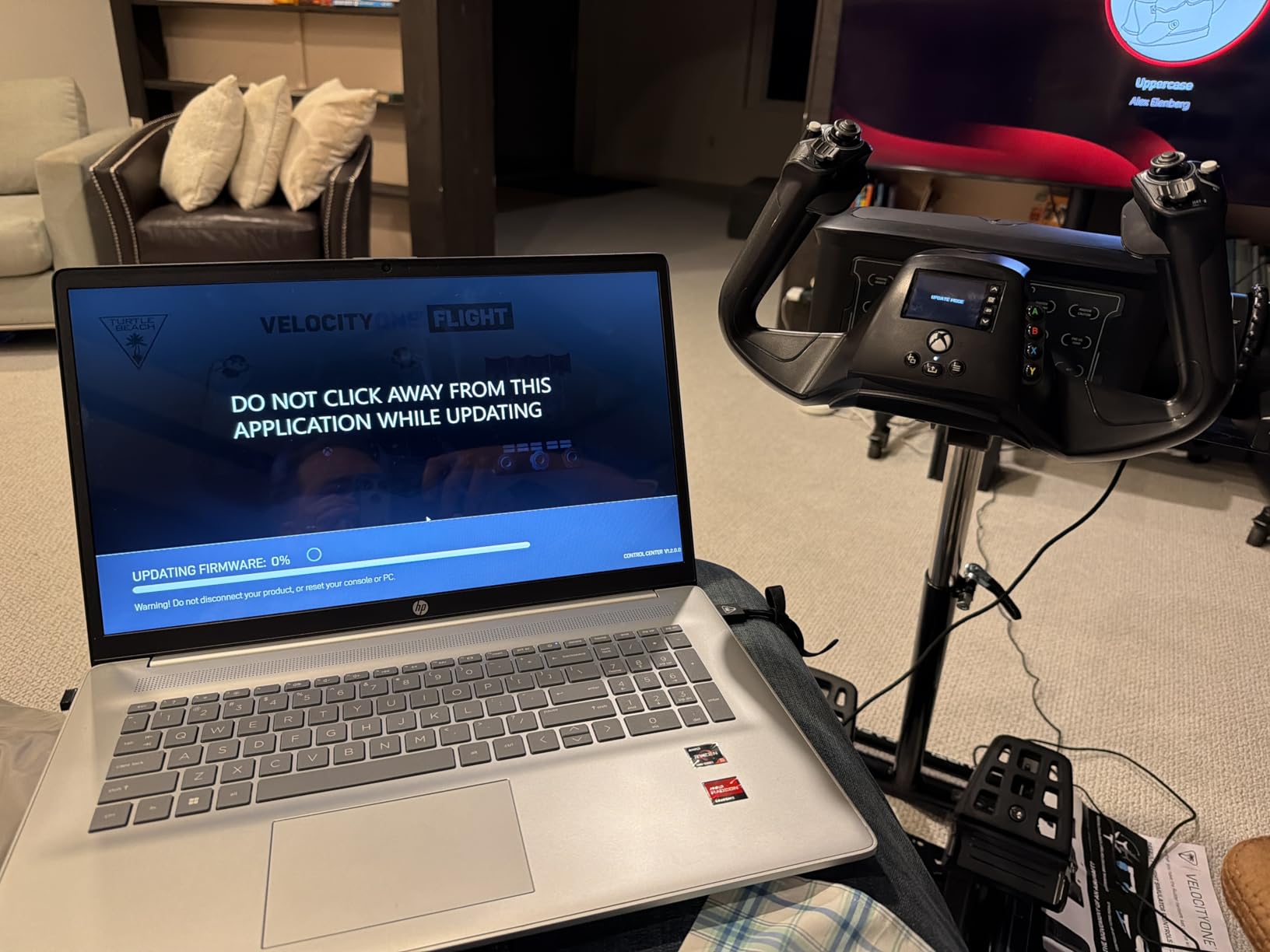
Control density is genuinely high for the category: twelve analog axes, two POV switches and two 4-way hats, with a full-colour flight management display and an authentic status indicator panel on the PC side. The throttle quadrant uses customisable lever handles, so you can set up piston, twin or quad layouts without buying new parts.
Turtle Beach support is the quiet strength here. Owners with defective models report fast replacements, which matters when the alternative is a long return process on a console accessory.
The quality control spread is the problem, and it is not subtle. A share of models arrive with a yoke that registers no pitch input at all, and that accounts for most of the critical reviews. Check the pitch axis on day one so you can return it quickly.
The yoke also feels jerky out of the box and binds until it breaks in. POV hats detach easily, the status lights stay lit permanently, and the on-screen flight management display confuses most pilots rather than helping them. Standalone rudder pedals on console also perform poorly compared with the integrated ones.
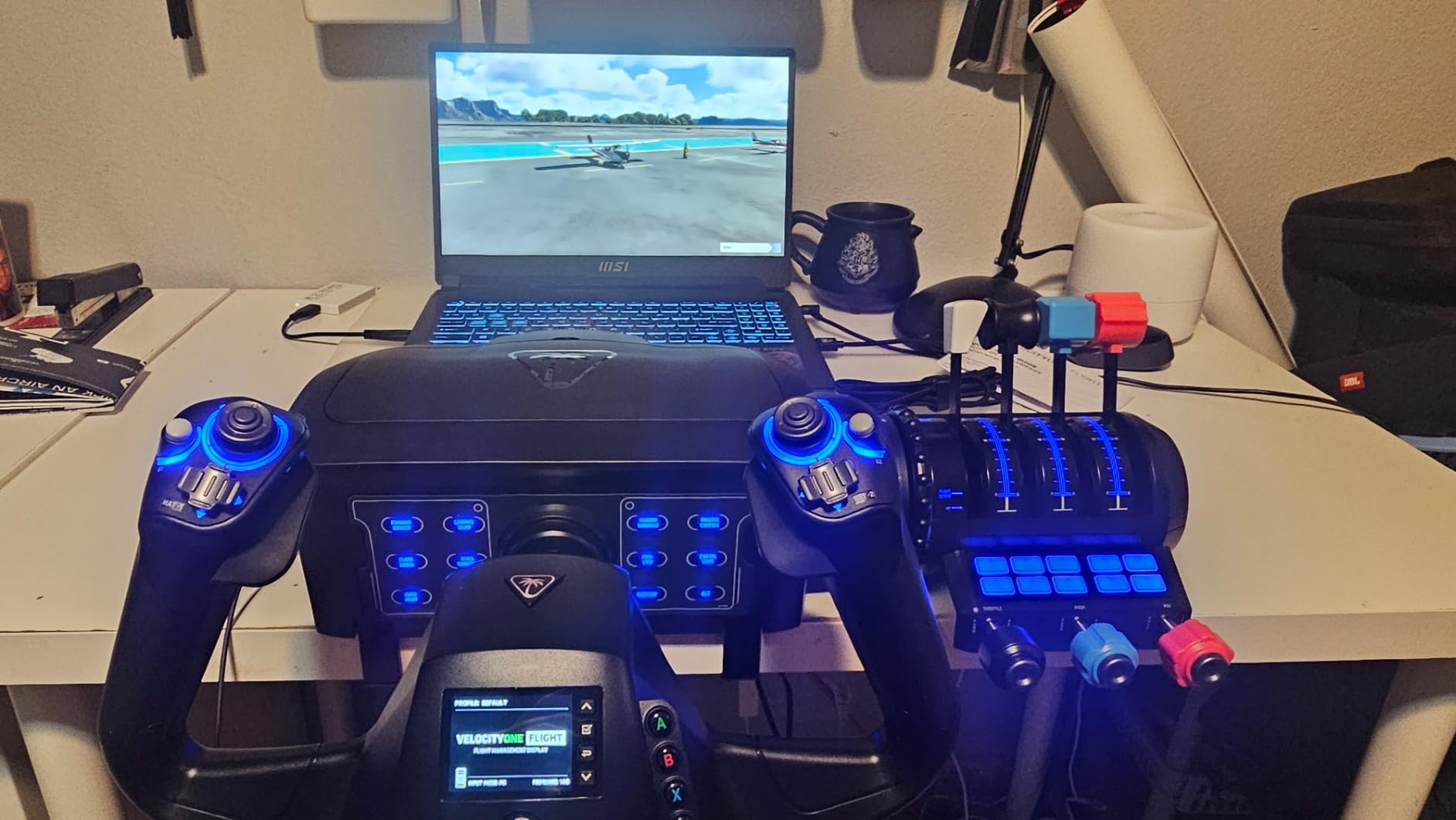
Who the VelocityOne Flight suits
It suits console players who want a complete, working flight deck without researching three compatible accessories or dealing with drivers on a console. Everything is designed for MSFS 2020 and MSFS 2024 on both Xbox and Windows.
It also suits anyone who wants a full-color flight display and status indicator panel for authenticity without building a cockpit from separate modules.
Where it falls short
It falls short for pilots who cannot accept a component arriving broken. The defective-pitch-axis reports are frequent enough that you should test it on arrival rather than trusting the box.
It also falls short for anyone who needs a precise analog trim wheel, since the display and indicator functions add bulk without adding the fine control input some procedure flyers rely on.
6. Logitech G X52 Flight Control System: The Best Budget Controller for Space Sims
Pros
- Rubberized grippy surfaces and solid build
- Logical button and hat layout for space sims
- Reliable straight out of the box in Elite Dangerous
- Throttle resistance suits long space voyages
Cons
- Throttle tension adjuster has little effect
- Single USB connection fixes stick to throttle
- LEDs often stop lighting on Windows 11
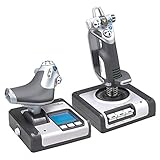
The X52 has been flying in sims for a very long time, and the reason is simple: it works. Magnetic non-contact sensors on the X and Y axes mean the resolution is genuinely good, and the whole package plugs into Elite Dangerous with a usable default mapping before you touch any software.
For space sims specifically, the button layout is the argument. Switches, hats, a thumb wheel and a pinky switch sit exactly where your fingers already rest in a cockpit grip, and 282 programmable commands across three modes give you room to run a multi-ship loadout or a station-heavy vessel without running out of inputs.
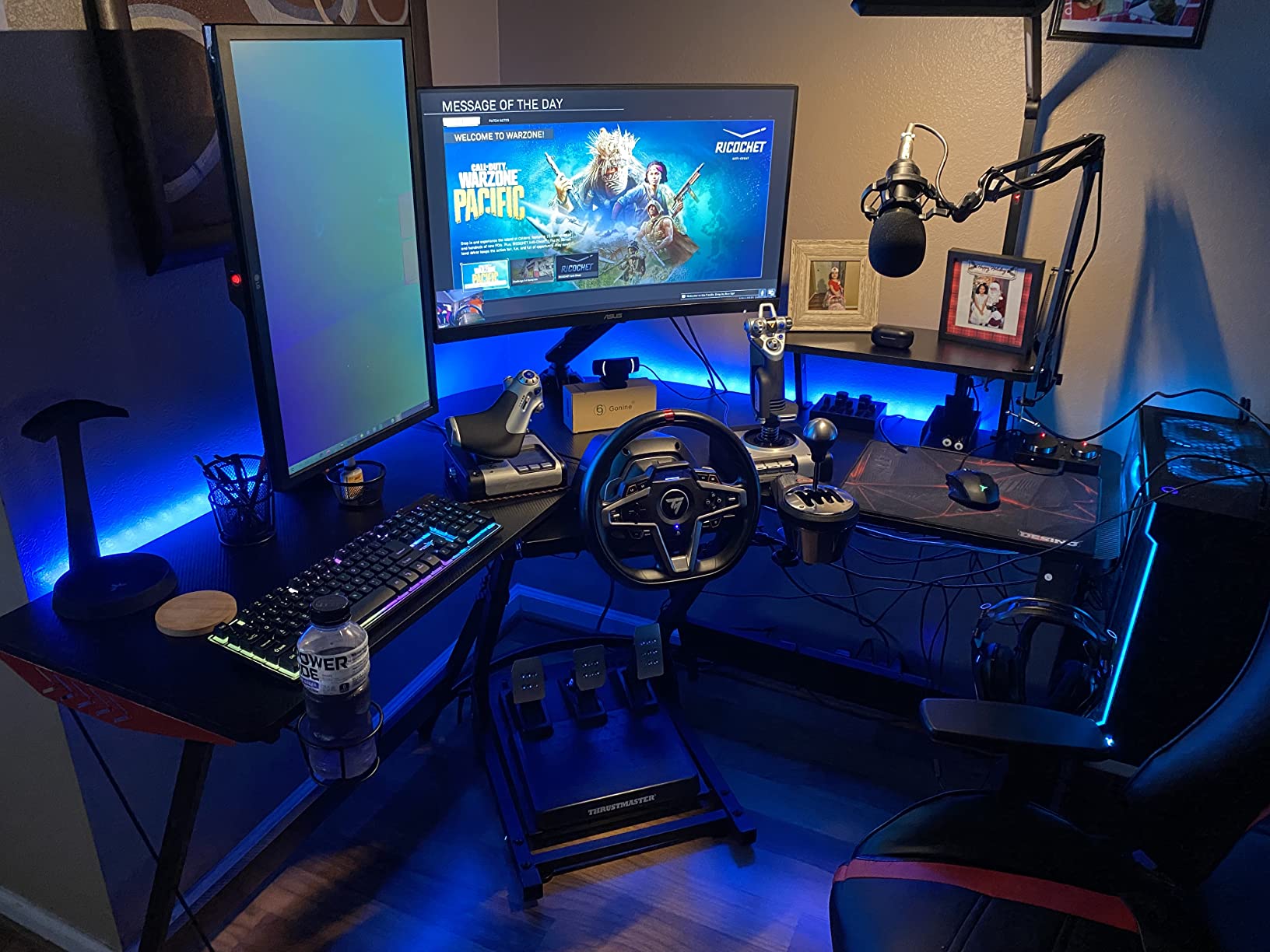
The multifunction LCD with a built-in flight timer is more useful than it sounds on long sessions, and the rubberized surfaces keep your hand planted in zero-g manoeuvres where a smooth plastic stick would slide.
Reliability is the real strength. Many owners report hundreds of hours with no faults, and the 3D twist with a rudder lock gives you coordinated yaw without a separate pedal set on a desk where pedals do not fit.
Throttle behavior is where it frustrates people. The tension adjustment does not change much, so the lever stays firm, and the detents at 25 and 75 percent plus slow drift off the set position make it hard to trim a steady cruise. The small mouse nubbin on the throttle is very sensitive and imprecise for fine adjustments.
The single USB connection is the structural limitation. The stick connects to the throttle by serial cable and cannot be paired with a different throttle, so this is a sealed system. LEDs also tend to stop lighting after a day on Windows 11 until you adjust the joystick panel, and the pinky switch and thumb wheel wear out over extended use.
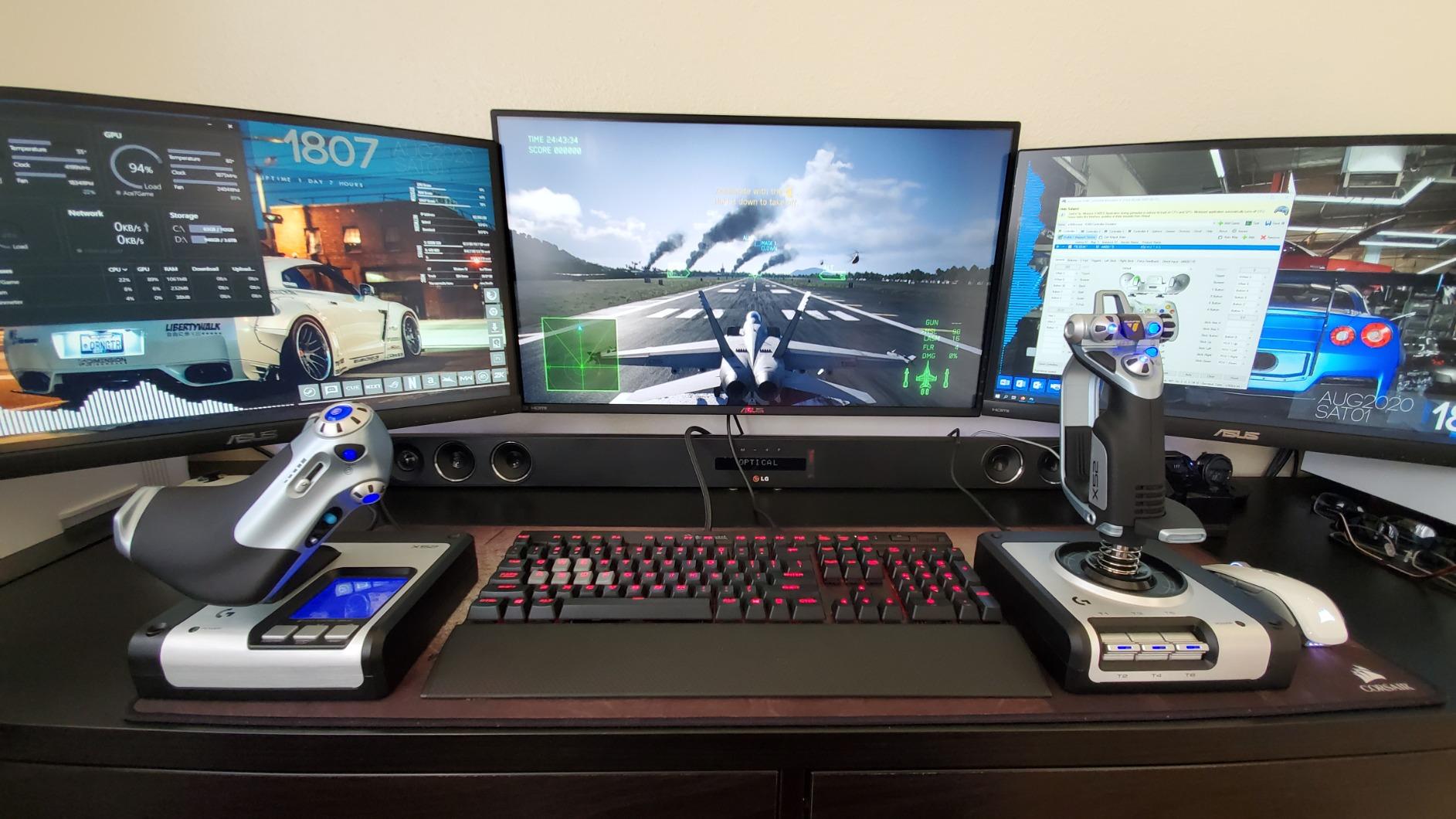
Who the X52 suits
It suits space sim and combat sim pilots who want a huge control surface count and a layout their hands learn in one session. The button density is the selling point, and in a ship cockpit that is where the value is.
It also suits anyone who wants a sealed, dependable setup and does not plan to swap throttles or add pedals later. Nothing about this package needs replacing.
Where it falls short
It falls short for anyone who wants to build a custom cockpit layout, because the sealed single-USB design rules out mixing in another throttle or stick.
It also falls short if you need a smooth throttle with usable tension adjustment, since the lever stays firm and drifts off the set position.
7. Thrustmaster TCA Captain Pack X: The Best Controller for Airbus Simmers
Pros
- Officially licensed 1:1 Airbus A320 replicas
- Realistic control layout for airliner procedures
- Four swappable sidestick button modules
- Single-cable hub keeps the desk tidy
Cons
- Not useful as a general-purpose stick
- Rudder needs handle rotation or separate pedals
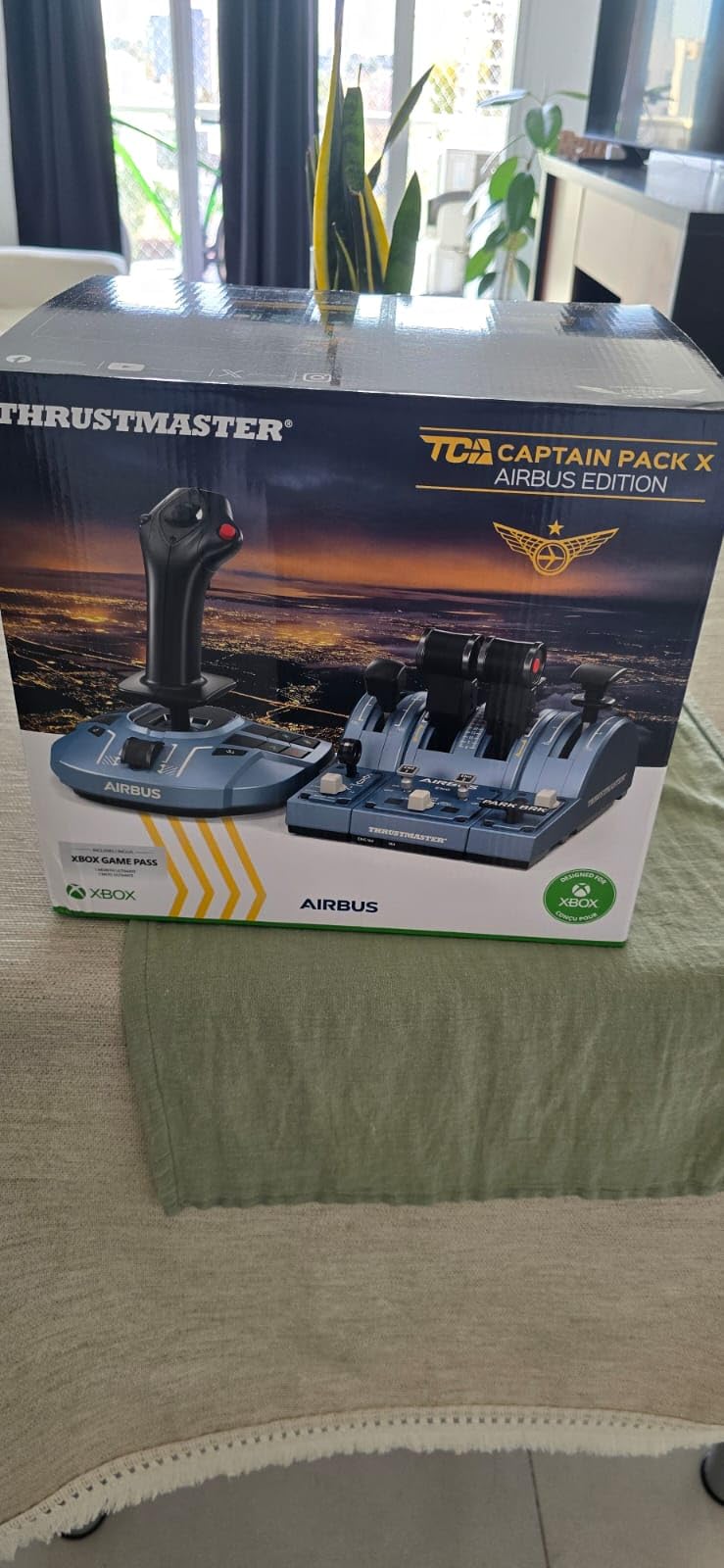
Everything about the TCA Captain Pack X is a decision in favour of the A320. The sidestick and throttle quadrant are officially licensed 1:1 scale replicas, and that specificity is the entire appeal. If you fly the Airbus, this is the closest you get to the real cockpit on a desk.
The quadrant carries 31 action buttons and four axes covering landing gear, autobrake, rudder trim, the trim wheel and the parking brake, which is enough to fly a full Airbus procedure without touching the keyboard. The built-in thrust reverser on the throttle levers is a detail most generic quadrants do not offer, and it makes the landing roll feel properly Airbus.
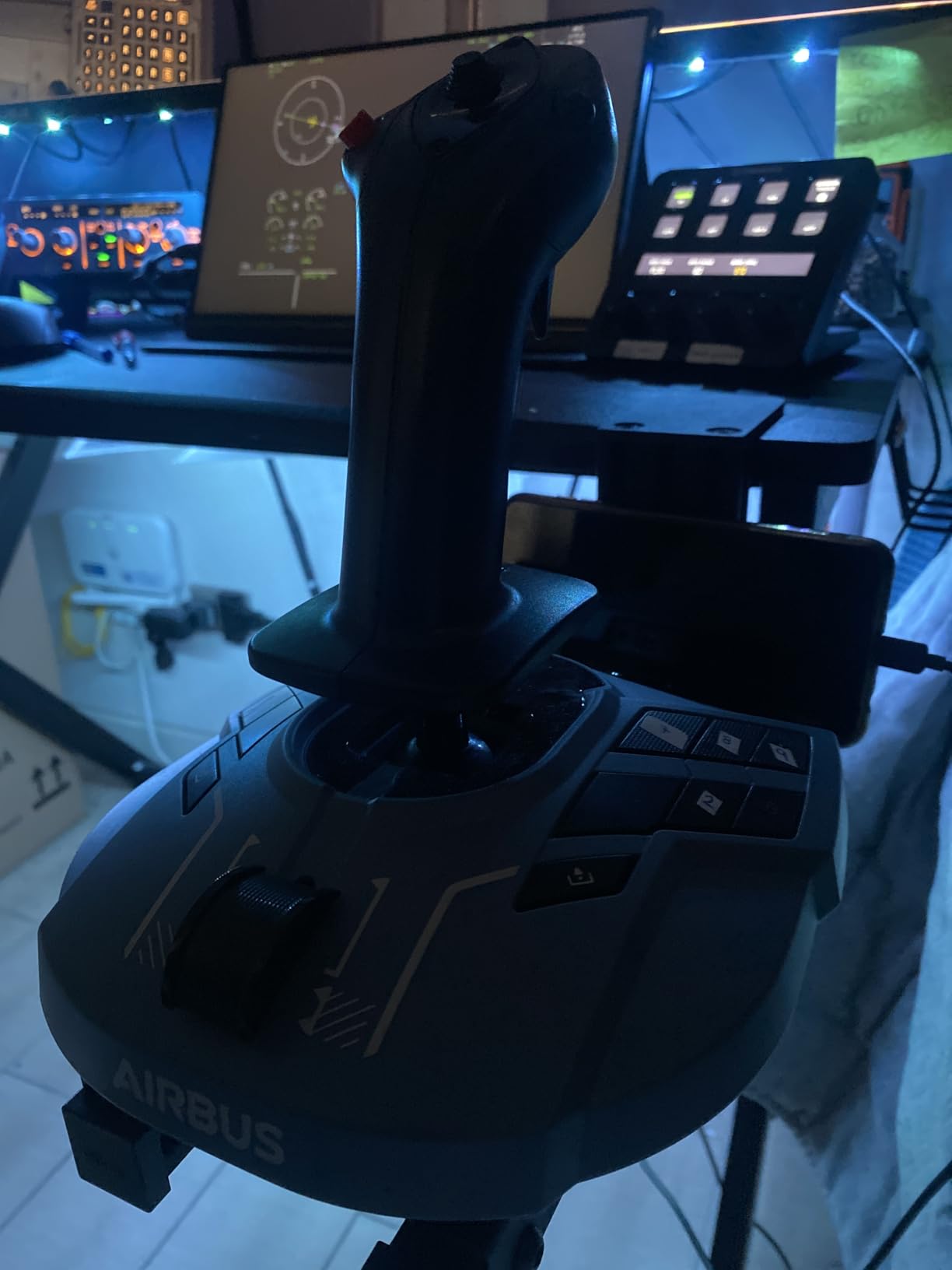
The sidestick has 14 remappable tactile buttons plus four swappable head modules, so you can change the button layout for a different aircraft family instead of buying a new stick. Rotating the sidestick handle handles rudder, with a lock and unlock function to stop it turning in cruise.
The Ecosystem Hub on the back of the quadrant is a genuinely good design decision. Everything runs through one cable, which keeps a two-piece cockpit rig down to a single USB drop and a much tidier desk than a pile of adapters.
The trade-off is scope, and it is a large one. This is not a general-purpose flight sim controller. It has no twist rudder, the handle is not a joystick you can use in a fast mover or a fighter jet, and flying anything that is not an Airbus sidestick aircraft will feel wrong. There is also no single-stick version for pilots who want both.
Rudder through handle rotation is workable but tiring on long flights, and dedicated rudder pedals are a separate purchase if you want the comfort.
Who the TCA Captain Pack X suits
It suits pilots who are locked into Airbus procedures and want the cockpit layout to match the sim rather than approximate it. Autobrake, gear and thrust reverser all live where the real aircraft puts them.
It also suits Xbox pilots who want an airliner setup, since this pack carries native console support alongside PC.
Where it falls short
It falls short for anyone who flies a mixed lineup, because a sidestick replica simply does not work in a general aviation aircraft or a combat jet.
It also falls short for long-session comfort on rudder, since rotating the handle for hours is a different experience from a proper pedal set.
8. Thrustmaster T16000M FCS HOTAS: The Most Versatile for Accuracy
Pros
- Very high axis accuracy for a stick at this level
- Hardware reliability and tactile braille button IDs
- Compact footprint beside a mouse and keyboard
- Weighted bases stay put in dogfights
Cons
- Throttle can be sticky or jittery out of the box
- Throttle and base buttons feel soft
- Throttle mini stick is imprecise
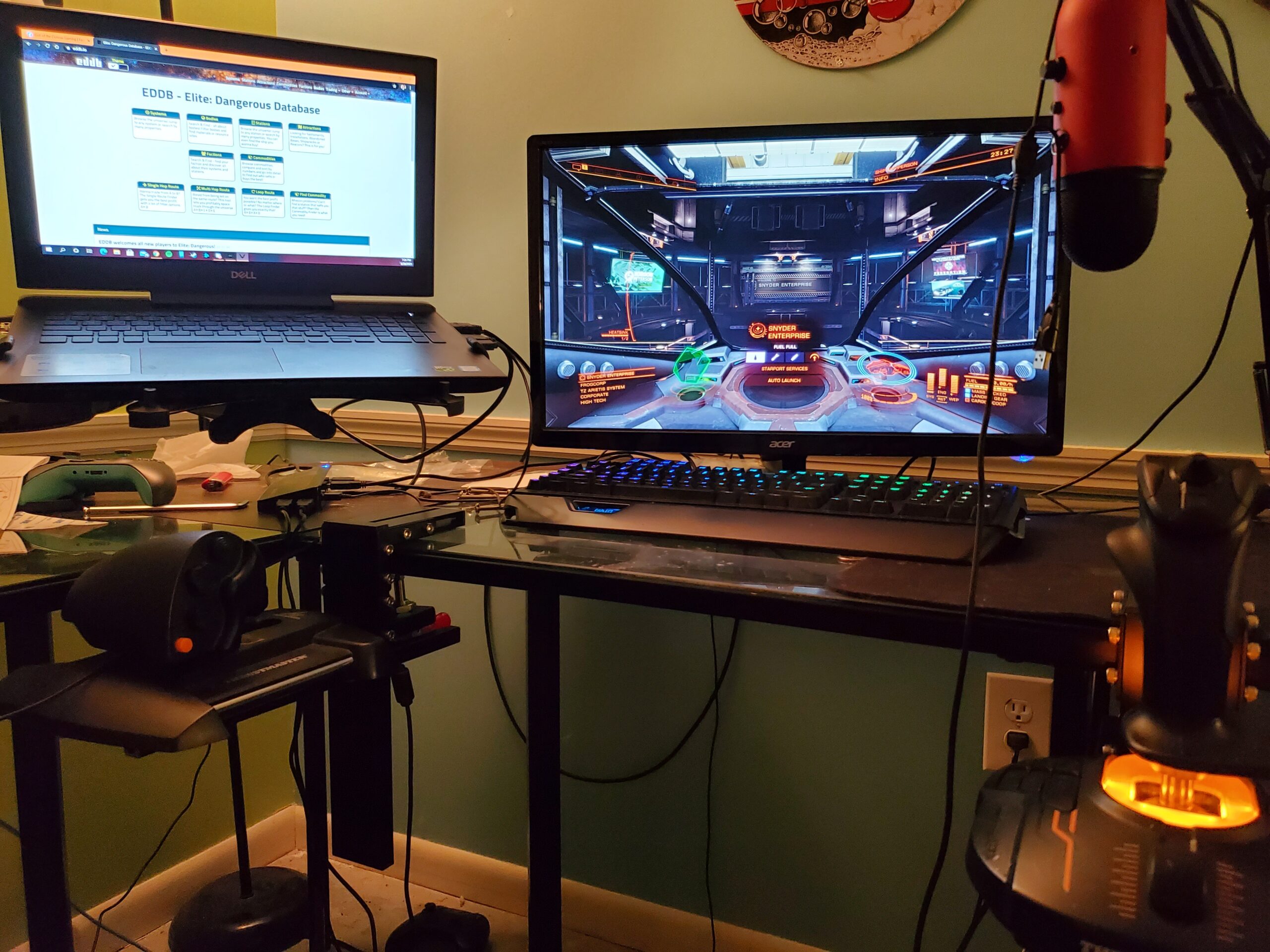
The T16000M FCS is the enthusiast answer in this list, and the sensor is the reason. Hall effect magnetic sensors on the pitch and roll axes give resolution and smoothness that potentiometer sticks cannot match, and unlike a hall effect yoke the compact footprint means it fits beside your mouse and keyboard without rearranging the desk.
Four independent axes including twist rudder, plus a push mini-stick, an 8-way POV hat, two 4-way switches, a two-position slider and 16 action buttons with physical braille identification. Those braille dots are a small design decision with a large effect: you can find the parking brake or the fuel pump without taking your eyes off the runway.
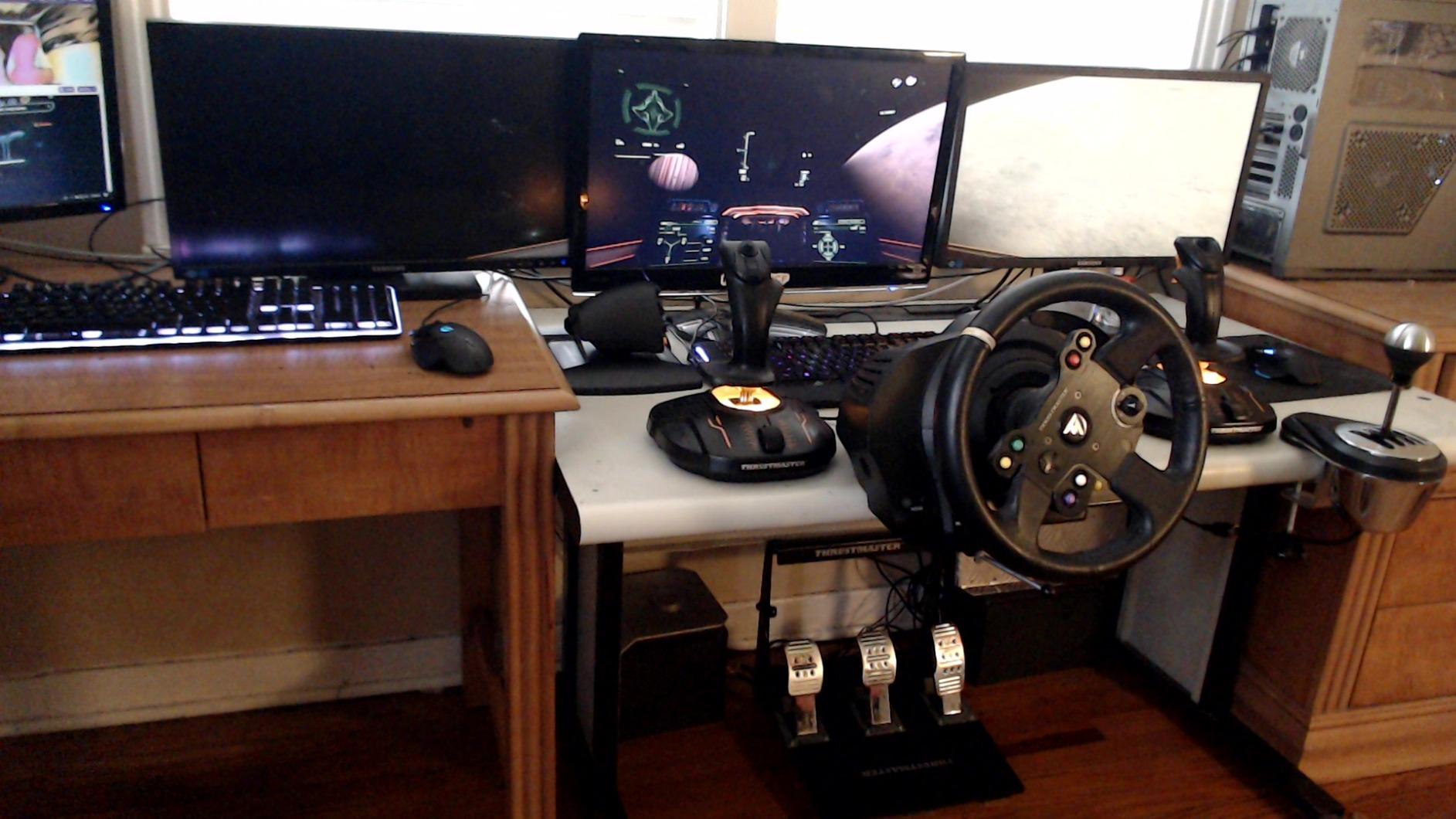
T.A.R.G.E.T. software handles mapping and profiles, and with hardware-based button support you can run a fully keyboard-free cockpit. Thrustmaster TFRP pedals plug into the throttle, so a full three-axis rig is one extra purchase rather than a rebuild.
Owners consistently credit the build quality. This is hardware that feels designed rather than assembled, and the weighted bases hold position through aggressive dogfight inputs where lighter sticks walk across the desk.
The throttle is the standard complaint. Out of the box it can be sticky or jittery, and most owners fix it with the tension adjustment screw on the underside plus a re-lubrication. Buttons on the throttle and base feel soft and squishy, the rear base buttons are stiff and hard to reach, and the mini analog stick on the throttle has noticeable physical jiggle.
The throttle body is also bulky with an awkwardly placed pinky wheel, and some owners report jitter developing near the end of the one-year warranty period, so keep your receipt.
Who the T16000M FCS suits
It suits pilots who have outgrown an entry stick and want sensor precision and tactile button quality without moving to a full metal cockpit rig. The upgrade path is a pair of pedals rather than a new platform.
It also suits anyone who cares about accuracy over novelty. The sensors, the braille identifiers and the T.A.R.G.E.T. integration are all about repeatable, learnable input rather than features.
Where it falls short
It falls short for pilots who will not open the throttle. The stickiness and jitter that owners fix with lubrication and a tension screw are present from day one and the warranty is only one year.
It also falls short for console players, because it connects to Windows over USB and has no Xbox support.
9. Honeycomb Bravo Throttle Quadrant: The Best Metal Build
Pros
- Premium metal construction and positive switch feel
- Switches engine configurations in seconds
- Annunciator panel with 14 warning lights
- Large aftermarket ecosystem of real-scale parts
Cons
- Very large desk footprint
- Trim wheel is not analog and reverse is a switch
- No Xbox support and steep setup curve
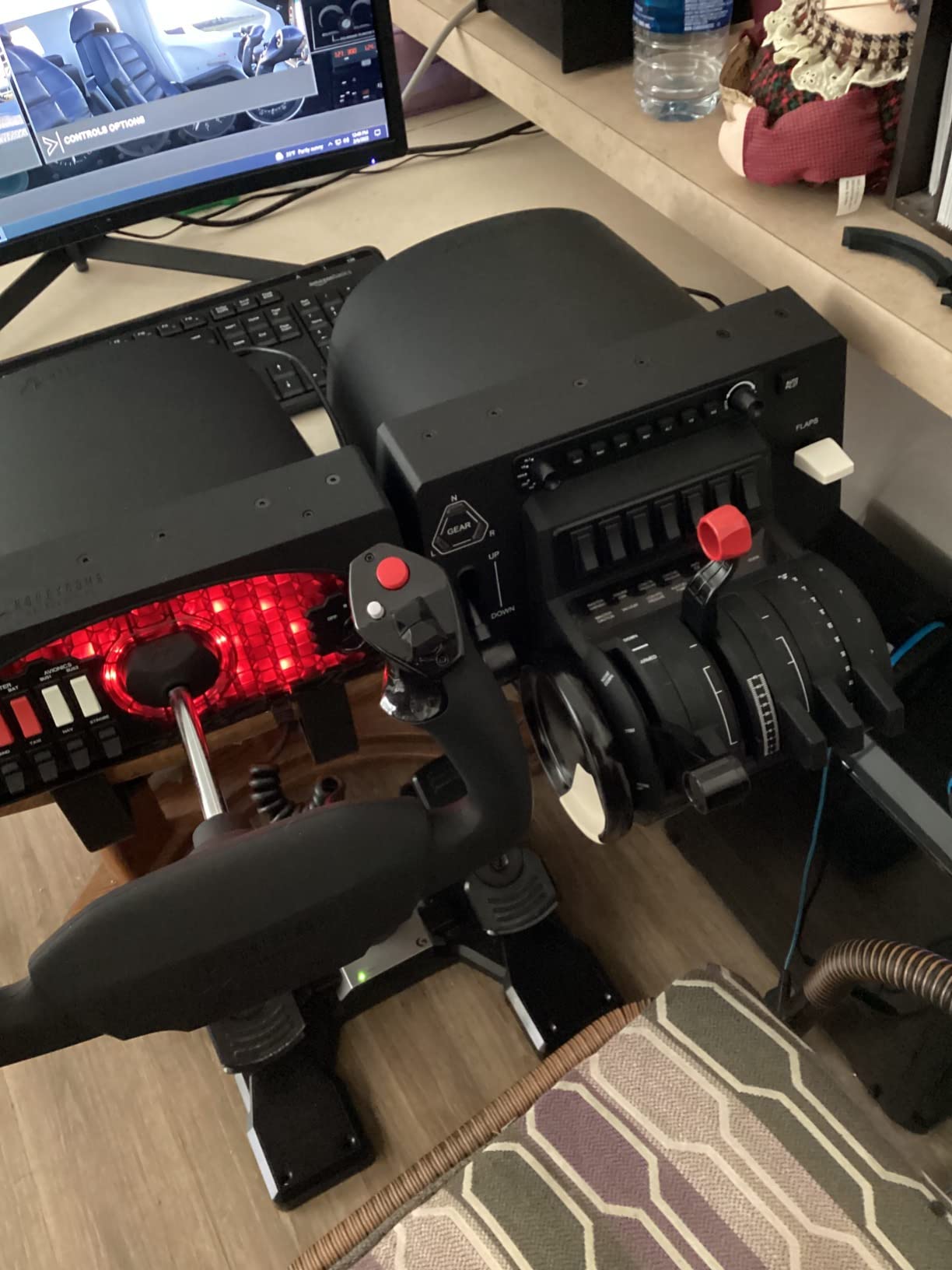
The Bravo is the highest-rated product we tested for this roundup, and the rating reflects build quality more than anything else. The metal construction, the positive switch feel and the throttle tension are a level above every plastic unit in this list, and experienced sim pilots notice the difference within a few minutes.
What it actually is, is a configurable cockpit system rather than a throttle alone. It supports single-engine general aviation through four-engine commercial aircraft, with configurable throttle levers, an autopilot panel, an annunciator panel, gear and flap levers and a trim wheel. The annunciator carries seven two-way programmable switches and fourteen warning lights, which turns a bare desk into something that looks like a flight deck.
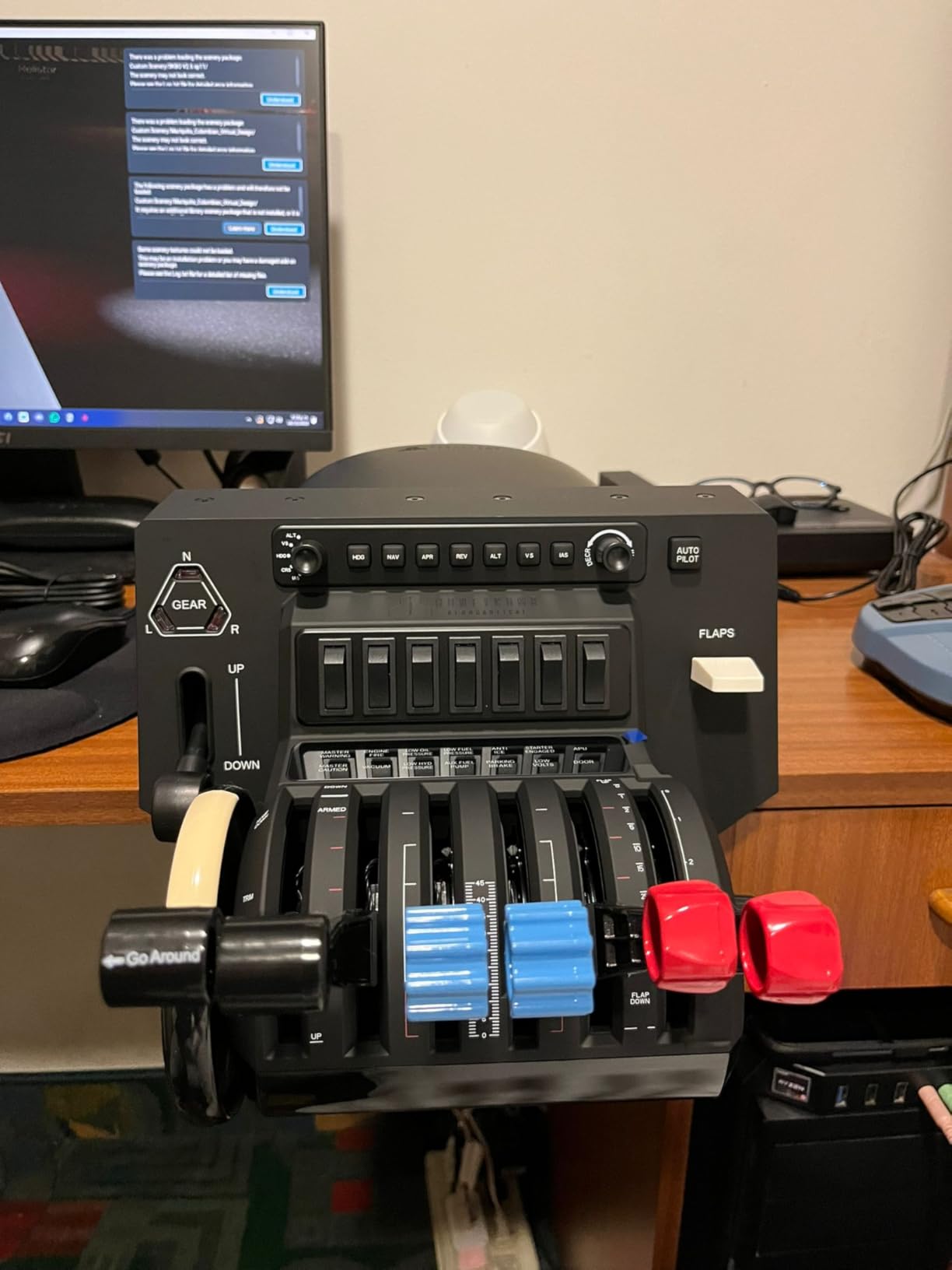
Changing between piston, twin turboprop and quad-jet configurations takes seconds rather than a rebuild, and the gear lever carries red and green LED landing gear indicator lights. The mounting hardware is genuinely good, and there is a large aftermarket ecosystem of real 737-scale throttles and A320 handles that fit later.
It is a throttle, not a full rig. You still need a stick or yoke, and the natural partner is the Honeycomb Alpha, which is where it works well in VR.
Now the constraints. The footprint is very large, and this is the single biggest reason people return it. The trim wheel is not analog, and reverse thrust is only a switch, so realistic reverse management is limited. The airliner throttle handles are, in the words of one reviewer, comically small.
Setup has a steep learning curve, it needs a driver download for PC use, and the drivers do not work on Xbox. X-Plane 12 mapping is unreliable, particularly on Apple Silicon, which is worth knowing if that is your sim.
Who the Honeycomb Bravo suits
It suits GA and Boeing procedure pilots who want a permanent desk installation and plan to stay in the same cockpit layout for years. The metal build is a buy-once purchase, and aftermarket parts extend it further.
It also suits VR pilots, because a physical throttle with real levers is far easier to operate by touch than an on-screen control.
Where it falls short
It falls short for anyone with a small desk. The footprint is the most common reason this gets sent back, so measure your available depth before committing.
It also falls short for console players, since there is no Xbox support, and for pilots who need analog reverse thrust or analog trim.
10. Thrustmaster T.Flight Full Kit X: The Best Complete Kit for Xbox and PC
Thrustmaster T.Flight Full Kit X – Joystick, Throttle and Rudder Pedals for Xbox Series X|S/Xbox One/PC
Pros
- Stick
- throttle and rudder pedals in one box
- Adjustable stick resistance
- Plug-and-play with functions preconfigured
- Pedals are well made and fully remappable
Cons
- Throttle lever is soft and drifts toward idle
- Some models arrive faulty or fail to connect
- Occasional PC detection problems
Most people buying flight sim hardware end up assembling a three-piece rig over several purchases. The T.Flight Full Kit X puts the joystick, the detachable throttle and the TFRP rudder pedals with slide rails in a single box, and it carries native support for Xbox Series X, Series S, Xbox One and PC.
That completeness is the appeal. You get 14 action buttons and five axes on the HOTAS, three axes on the pedals and adjustable joystick resistance, with the functions already configured. The pedals plug into the throttle, so the whole rig is one USB drop and no software hunting.
Adjustable stick resistance lets one rig cover a light trainer and a heavy transport without changing hardware, and the detachable pieces mean you can position the throttle close for a cramped desk or further out on a large one. The pedal slide rails also let you set the distance between heel rest and pedals, which is how you make a cheap kit fit your leg length.
The throttle lever is the recurring complaint, and it is a specific one. It is very soft and drifts to idle under its own weight, so it will not hold an intermediate power setting without a light hand. That is the opposite failure mode from the X56, and both come from the same category of cost-cutting.
Quality control is also mixed. A number of models arrive faulty, intermittently fail to connect, or have dead buttons, and a few buyers report issues with detection on PC. Test the whole chain in your sim before you rely on it. The other constraint is desk depth, because adding a pedal set to a stick and throttle needs considerably more space.
Who the T.Flight Full Kit X suits
It suits anyone who wants proper rudder control from day one without researching pedals separately. Three axes on the pedals, not a twist grip, is the right answer for cross-country and IFR procedures.
It also suits console pilots moving between Xbox and PC, since the same kit handles both and the pedals travel with it.
Where it falls short
It falls short for anyone with a shallow desk. The pedal set plus a stick plus a throttle needs real front-to-back room, and a small desk means the pedals sit awkwardly under the keyboard edge.
It also falls short for pilots who need a throttle that holds a set power setting firmly, because the soft lever drifts to idle under its own weight.
How to Choose a Flight Sim Controller in 2026
Start with the aircraft, not the hardware. Every decision below makes more sense once you know whether you want to fly a Cessna 172 around a valley, a 737 through a departure procedure, or a fighter in a combat sim. The controller that is perfect for one of those is wrong for the other two.
Joystick, yoke or HOTAS
A joystick is the most accurate and most transferable input. It maps to nearly every aircraft, it takes up the least desk space, and it is the easiest to pair with rudder pedals. If you fly more than one type of aircraft, a joystick is almost always the right starting point.
A yoke matches general aviation and older airliners, where the real control is a column you push and pull. It is less precise, less accurate and less common, but flying a Cub on a yoke teaches you the right technique. Buy a yoke as a second device for GA flying rather than as your only controller.
A HOTAS puts a throttle on the same base as the stick so your hand never leaves the controls. For MSFS 2024 that is a genuine advantage, because power management is half of the workload on any takeoff. It also means a bigger desk footprint, which is the constraint most people hit first.
Which platform decides the shortlist
PC is the open platform, and every premium option works there. If you are on PC, your only real decision is budget and aircraft type.
Xbox Series X and Series S narrow the field sharply. Only a handful of these products carry native console support, including the T.Flight Hotas One, the TCA Captain Pack X, the T.Flight Full Kit X and the Turtle Beach VelocityOne Flight. Check the platform list before buying anything else, because a PC-only stick simply will not be detected on a console.
Console mapping also has limits you will notice. You cannot layer multiple functions onto one button, and calibration options are limited, so buy a console unit expecting to keep it for the life of the console generation rather than fine-tuning it.
Sensors and the drift question
Potentiometer sensors wear and drift. Hall effect sensors are magnetic and non-contact, so they do not have a rubbing surface and do not develop a centre offset over years. This is the single biggest technical difference in this roundup.
Drift is the most common reason people replace a stick. A stick that no longer returns reliably to centre makes instrument approaches unpleasant and impossible to trim properly. Products with hall effect sensors, such as the T16000M FCS, the X56 and the VelocityOne Flight, sidestep the problem rather than asking you to manage it.
Do not buy a cheap stick expecting a decade. The community consensus on r/hotas and r/flightsim is that entry-level plastic sticks work well for two or three years and then get replaced, and that planning for one upgrade early is less frustrating than replacing the same stick twice.
Rudder pedals, twist grips and desk space
Twist rudder is compact and works, but it limits how fine your yaw input can be. Dedicated pedals give you real heels-down coordination, and on IFR procedures with a lot of small rudder inputs the difference shows up immediately.
Pairing is simpler than most guides suggest. Thrustmaster TFRP pedals plug into the Thrustmaster throttle, so any Thrustmaster HOTAS pairs with them. VKB and Virpil have their own pedal lines with a USB connection that sits alongside rather than behind. Budget one additional purchase for pedals unless your stick already includes them, as the T.Flight Full Kit X and the VelocityOne Flight do.
Measure your desk before you order. A HOTAS plus pedals is a two-foot-plus footprint front to back, and the wider units in this list are noticeably deeper than a bare stick. Apartment desks and shared workspaces are the number one reason people buy a stick they cannot really use, and the fix is a separate pedal platform or a narrower single-piece unit like the T16000M.
Software and the upgrade path
Thrustmaster hardware is supported through T.A.R.G.E.T., which handles profiles, macros and per-aircraft mappings and is the deepest ecosystem in this category. Logitech devices have their own software, though the X56 needs a separate driver download rather than running inside Logitech G Hub. Honeycomb requires a driver download for PC and has no console support.
A practical upgrade path looks like this. Start with a single stick or an entry HOTAS, add pedals when you fly IFR procedures, add a throttle or quadrant when power management starts costing you time, and consider a metal yoke or cockpit system only once you know your preferred layout. If you want a wider look at entry-level options, our beginner flight stick guide covers that tier in detail.
One more note on display hardware. A flight sim puts a lot of information in the corners of your screen, and monitor response matters as much as the controller. We covered that in our guide to gaming monitors for sims, and the same response-time argument applies to cockpit displays.
Frequently Asked Questions
What controller do you need for flight simulator?
You need a flight stick, HOTAS or yoke rather than a keyboard, mouse or gamepad. Any of them will let you fly, but the differences are meaningful: a stick gives the most accuracy and works across all aircraft, a HOTAS adds throttle control on the same base so your hand never leaves the controls, and a yoke matches general aviation. Pair it with rudder pedals if you fly IFR procedures, since twist rudder cannot give you the fine heel-down input that instrument flying needs.
Which controllers are compatible with Microsoft Flight Simulator?
All of the controllers in this guide work with Microsoft Flight Simulator on PC, and the majority work as plug-and-play devices with a default mapping. Console compatibility is narrower: the Thrustmaster T.Flight Hotas One, the TCA Captain Pack X, the T.Flight Full Kit X and the Turtle Beach VelocityOne Flight carry native Xbox One and Xbox Series X or S support. The Logitech G PRO Flight Yoke has no macOS support, and the Honeycomb Bravo requires a driver download and has no console support.
Which is better for flight simulation, a joystick or a yoke?
A joystick is better for most people because it is more accurate, takes less desk space and works across every aircraft type from a Cessna 172 to a wide-body jet. A yoke is better if you specifically want to fly general aviation, because the control column feel matches a light single-engine aircraft. Many serious pilots fly both and keep the yoke as a second device for GA flying rather than replacing their stick with one.
Do I need rudder pedals for a flight sim?
Not to start. Twist rudder on a stick such as the Thrustmaster T-Flight Hotas X or the T16000M FCS is enough to learn coordinated flight and take off, land and cruise. Dedicated pedals become worthwhile once you fly IFR approaches, because heel-down input is far more precise than twisting a grip, and they also last you over a long session. If your controller already includes pedals, such as the T.Flight Full Kit X or the Turtle Beach VelocityOne Flight, you do not need to buy anything more.
What is the best budget flight sim controller?
The Thrustmaster T-Flight Hotas X is the best starting point for most PC pilots because it includes a real-size detachable throttle, 12 programmable buttons, onboard memory and a weighted base, all configured and ready to fly. The Thrustmaster T.Flight Hotas One is the equivalent choice for Xbox Series X and Series S. On a very tight budget, a bare entry stick plus a keyboard works while you learn, and you can add a throttle once you know your preferred layout.
The Best Controller for Your Flight Sim Setup in 2026
For most people, the Thrustmaster T-Flight Hotas X is the best controllers for flight sims pick on this list. It is the most reviewed controller here for a reason, it includes a real-size throttle, and it teaches you the fundamentals without asking you to fight a stiff lever or a drifting axis.
Console pilots should take the T.Flight Hotas One, and anyone who wants one box with a yoke, throttle, trim wheel and rudder built in should look at the Turtle Beach VelocityOne Flight. If you have outgrown the entry tier, the T16000M FCS HOTAS gives you hall effect precision without moving to a full cockpit, and the Logitech G PRO Flight Yoke covers general aviation properly.
Whatever you choose, the controllers for flight sims you end up flying will be the ones you can learn without thinking. Buy the level of hardware that matches the aircraft you want to fly, add pedals when you start flying IFR, and give it room on the desk.