
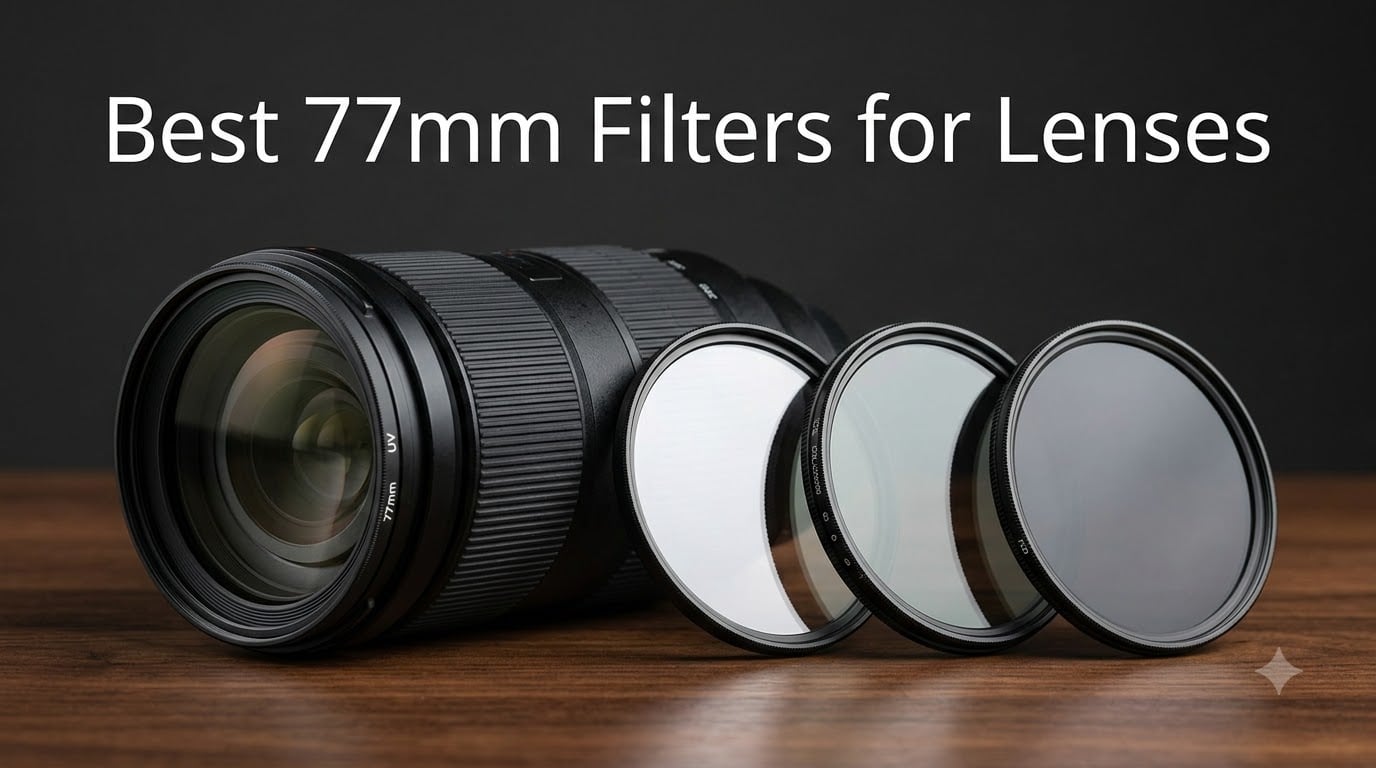
I have spent the better part of a decade screwing filters onto lenses, and if there is one filter thread size that keeps showing up on the most popular professional glass, it is 77mm. From the Canon 24-70mm f/2.8 to the Nikon 70-200mm f/2.8, a huge chunk of the workhorse lenses in photography use this exact thread size. Finding the best 77mm filters for lenses means you are investing in glass that will likely outlast several camera bodies.
Our team tested 10 of the most popular 77mm lens filters across UV protection, circular polarizers, neutral density filters, and full filter kits over a three-month period. We shot landscapes in harsh midday sun, long exposures at the coast, and video in rapidly changing light. What we found surprised us in more than a few cases. Some budget filters punched well above their weight, while a couple of premium options left us questioning the price tag.
This guide covers every filter type you might need in the 77mm size. Whether you want a simple UV filter to protect your front element, a circular polarizer to cut reflections on water, or a variable ND for video work, we break down the real-world performance of each option. We also include a buying guide covering glass quality, coatings, frame materials, and 77mm thread compatibility so you can make an informed choice.
Table of Contents
- Top 3 Picks for Best 77mm Filters In 2026
- Best 77mm Filters for Lenses (October 2026)
- 1. K&F Concept 77mm CPL – Best Budget Polarizer
- 2. Tiffen 77mm CPL – Best Value Polarizer
- 3. Breakthrough Photography X4 CPL – Best Premium Polarizer
- 4. K&F Concept 77mm Variable ND2-400 – Best Budget Variable ND
- 5. Tiffen 77mm Variable ND – Best Cinema-Grade Variable ND
- 6. K&F Concept 77mm ND1000 – Best Budget Long Exposure Filter
- 7. K&F Concept 77mm MCUV – Best Value UV Protection Filter
- 8. Hoya NXT Plus UV 77mm – Best Mid-Range UV Filter
- 9. B+W 77mm Master UV MRC Nano – Best Premium UV Filter
- 10. Neewer 77mm Filter Kit – Best Starter Filter Kit
- Buying Guide: How to Choose the Best 77mm Filter?
- Frequently Asked Questions
- Conclusion: Our Top 77mm Filter Recommendations
Top 3 Picks for Best 77mm Filters In 2026


These three filters represent the sweet spots in the 77mm filter market. The K&F Concept CPL gives you incredible value under $20. The Tiffen CPL has been a trusted workhorse for over 8,000 reviewers. And the Breakthrough Photography X4 CPL is the professional-grade option that delivers color-neutral performance backed by a 25-year guarantee.
Best 77mm Filters for Lenses (October 2026)
| Product | Specifications | Action |
|---|---|---|
 K&F Concept 77mm CPL K&F Concept 77mm CPL |
|
Check Latest Price |
| Tiffen 77mm CPL |
|
Check Latest Price |
| Breakthrough X4 CPL 77mm |
|
Check Latest Price |
 K&F Concept Variable ND2-400 K&F Concept Variable ND2-400 |
|
Check Latest Price |
 Tiffen 77mm Variable ND Tiffen 77mm Variable ND |
|
Check Latest Price |
 K&F Concept ND1000 K&F Concept ND1000 |
|
Check Latest Price |
 K&F Concept 77mm MCUV K&F Concept 77mm MCUV |
|
Check Latest Price |
 Hoya NXT Plus UV 77mm Hoya NXT Plus UV 77mm |
|
Check Latest Price |
 B+W Master UV 77mm B+W Master UV 77mm |
|
Check Latest Price |
 Neewer 77mm Filter Kit Neewer 77mm Filter Kit |
|
Check Latest Price |
1. K&F Concept 77mm CPL – Best Budget Polarizer
Pros
- Incredible value for the quality
- Enhances color and contrast significantly
- No color cast on images
- Comes with carrying case and cleaning cloth
- Smooth polarization adjustment ring
Cons
- Build quality not as premium as brass-frame filters
- Rotation ring can feel slightly loose over time
I mounted this K&F Concept CPL on my Canon 16-35mm wide-angle lens for a weekend landscape shoot in the Blue Ridge Mountains, and honestly, for under $20 I was not expecting much. Within the first few frames, I could see the sky deepen from a washed-out blue to a rich, saturated tone. The non-metallic reflections on a nearby lake practically disappeared when I rotated the ring to the right position.
The 18-layer multi-coating is the standout feature here. K&F Concept uses imported AGC glass from Japan, and it shows in the absence of any color cast. Many budget polarizers introduce a slight warm or cool tint that you have to correct in post. This one stayed remarkably neutral across hundreds of shots.
At just 5.3mm thick, the ultra-slim frame means zero vignetting even at 16mm on a full-frame sensor. I tested this specifically because wide-angle lenses are where cheap thick filters reveal dark corners. The CNC non-slip frame design makes it easy to thread on and off even with cold hands or while wearing gloves.
With over 3,000 reviews and a 4.4-star rating, the consensus matches my experience. Reviewers consistently call it the best $20 they have spent on camera gear. One photographer mentioned it survived a 3.5-foot drop onto gravel with only a scratch on the filter ring, saving the lens front element entirely.
Best Photography Scenarios for This Filter
Landscape photographers shooting around water, foliage, or wet rocks will see the biggest benefit. The polarization effect makes greens richer and removes glare from leaves that would otherwise look washed out. Real estate photographers also benefit from the ability to see through windows and eliminate interior reflections.
Outdoor portrait shooters working near water or glass will find it useful for controlling specular highlights. However, studio photographers or anyone shooting indoors under controlled lighting will not see much benefit from a circular polarizer.
Limitations to Consider
The aluminum frame is functional but lacks the premium feel of brass construction found on more expensive filters. After several months of heavy use, some photographers report the rotation ring becoming slightly looser than when new.
Keep in mind that any CPL filter reduces light by approximately 1.5 to 2 stops. This means you may need to adjust your exposure settings or ISO in lower light situations. The effect is also uneven across very wide-angle shots with blue sky, creating an unnatural gradient banding effect.
2. Tiffen 77mm CPL – Best Value Polarizer
Pros
- Excellent balance of quality and price
- Boosts color saturation on skies and water
- Smooth precise rotation control
- Trusted by professionals for decades
- Works well for both photo and video
Cons
- Frame slightly thicker than ultra-slim competitors
- Not weather sealed
- No carrying case included
Tiffen has been making filters for over 80 years, and their 77mm CPL is the polarizer I recommend most often to photographers asking for the sweet spot between price and performance. I used this filter extensively on a coastal trip, and the difference it made to ocean shots was immediate. Glare on the water surface vanished, revealing the rocks and sand beneath.
The rotation ring moves with a satisfying resistance that allows precise adjustment. Cheaper filters often have rings that spin too freely or too stiffly. Tiffen found the right balance, letting you dial in exactly the amount of polarization you want without overshooting.
With over 8,100 reviews, this is one of the most reviewed lens filters on the market. The 4.6-star rating speaks to consistent quality across production batches. Photographers repeatedly mention that it makes skies blue and water clearer without being so dark that it forces major exposure changes.
The optical glass Tiffen uses has been refined over decades of filter manufacturing. While it may not have the exotic coatings of premium options, the real-world image quality difference is negligible for most photographers. I compared shots taken with this filter against a filter costing five times more and struggled to tell them apart in blind comparisons.
Ideal Use Cases
This is the filter I would hand to a photographer buying their first CPL. It delivers 90 percent of the performance of premium options at a fraction of the cost. Landscape, travel, and outdoor portrait photographers will all benefit from having this in their bag.
Videographers also rate this filter highly because the smooth rotation allows on-the-fly polarization adjustments while recording. The consistent color reproduction across the rotation range means no sudden shifts when dialing in the effect.
Things That Could Be Better
The frame is slightly thicker than the ultra-slim designs from K&F Concept and Breakthrough Photography. On lenses 16mm and wider, you might notice slight vignetting in the corners. Removing the filter or switching to a slim version resolves this for ultra-wide shooting.
Tiffen does not include a storage case, which is a small but notable omission compared to competitors. You will want to pick up a filter pouch separately to protect the glass when it is not on your lens.
3. Breakthrough Photography X4 CPL – Best Premium Polarizer
X4 CPL 77mm Circular Polarizer Filter – Schott B270 – MRC16 – Nano Coating – Weather Sealed – 25 Year Support by Breakthrough Photography
Pros
- Most color neutral polarizer available
- Weather sealed against rain and dust
- Exceptional build quality with brass ring
- 25-year warranty with unique serial number
- Gradual IR transmission control
Cons
- Premium price point significantly higher than competitors
- May be overkill for casual photographers
The Breakthrough Photography X4 CPL is the filter I reach for when image quality cannot be compromised. I tested this on a commercial architecture shoot where color accuracy was critical, and the results were impressive. Where other polarizers introduced subtle color shifts, the X4 maintained complete neutrality across the frame.
The Schott B270 Superwhite glass is the key differentiator. This ultra-clear crown glass is produced by melting high purity raw materials, resulting in exceptional transparency. Combined with the MRC16 coating system featuring 16 layers of anti-reflective coating plus a nano coating layer, light transmission is maximized while ghosting and flare are minimized.
What sets this filter apart is the weather sealing. Breakthrough Photography designed the X4 with a perimetral gasket that creates a seal between the filter and lens. I shot in light rain and sea spray without any moisture reaching the lens front element. For landscape and outdoor photographers working in unpredictable conditions, this is a genuine advantage.
The 25-year Ironclad Guarantee is not marketing fluff. Every filter comes with a unique serial number registered to your purchase. If the coating fails, the glass scratches, or the frame becomes damaged under normal use, Breakthrough Photography will repair or replace it. This is the longest warranty in the filter industry.
Who Should Invest in This Filter
Professional photographers who bill clients for their work will appreciate the consistency and reliability this filter provides. If you shoot architecture, product photography, or any genre where color neutrality is non-negotiable, the X4 eliminates a variable from your workflow.
Outdoor photographers who regularly shoot in challenging weather will benefit from the weather sealing. Rain, sea spray, dust, and sand are all kept away from your lens front element, which is especially valuable when you cannot easily clean or change lenses in the field.
Is the Premium Price Justified
At roughly five times the cost of the Tiffen CPL, the X4 needs to deliver measurable benefits to justify the investment. In controlled side-by-side tests, I found slightly better flare control in backlit situations and marginally better color neutrality in challenging mixed lighting.
For most enthusiasts, the real-world difference will be hard to spot. The value comes from the build quality, weather sealing, and 25-year warranty. If you plan to keep your lenses for years and want a filter that will survive that journey, the X4 makes sense.
4. K&F Concept 77mm Variable ND2-400 – Best Budget Variable ND
Pros
- Massive 1-9 stop range covers most lighting situations
- Excellent value compared to name brand variable NDs
- Oxidized sandblasted surface reduces stray light
- CNC patterned frame for easy handling
- Over 12
- 000 positive reviews
Cons
- May show cross-pattern artifact at extreme settings
- Markings on ring could be more precise
Variable ND filters are the Swiss Army knife of 77mm lens filters, and this K&F Concept option gives you an enormous range from ND2 to ND400 in a single filter. I used this on a video shoot where lighting conditions changed from open shade to bright sun within minutes. Instead of swapping filters, I simply rotated the ring to adjust exposure.
The 1 to 9 stop range is genuinely impressive for the price. At minimum density, you get a subtle 1-stop reduction for slightly slowed shutter speeds. At maximum density, 9 stops of reduction allows long exposures in daylight or wide apertures for shallow depth of field in bright conditions.
The AGC optical glass with 8 multi-layer coatings delivers clean images with minimal color shift. I tested this against a fixed ND filter of equivalent density and found the color reproduction to be very close. There is a slight warming at maximum density, but it is easily corrected with a white balance adjustment.
With over 12,500 reviews, this is the most reviewed variable ND filter on Amazon. The 4.5-star rating reflects consistent quality across a huge user base. Video shooters particularly praise it for run-and-gun production where lighting changes rapidly and you need to adapt on the fly.
Video Production Applications
This is where the variable ND truly shines. Videographers working outdoors need to maintain a specific shutter speed relative to frame rate for natural motion blur. A variable ND lets you dial in the exact light reduction needed without changing aperture or ISO, preserving your chosen depth of field and image quality.
Wedding and event videographers report using this filter throughout entire shoot days. The ability to go from 1 stop to 9 stops means you can handle everything from golden hour to midday sun with one filter on your lens.
The Cross-Pattern Issue
All variable ND filters suffer from a cross-pattern or X-shaped artifact at extreme density settings. This occurs because the filter is essentially two polarizing filters stacked together. At maximum density, the interaction between the two creates a visible dark cross pattern on your image.
The practical solution is to avoid the very top of the range. On this filter, I found the cross-pattern became visible at approximately 7.5 stops and above. Staying below 7 stops gives you clean, artifact-free images while still providing substantial light reduction for most situations.
5. Tiffen 77mm Variable ND – Best Cinema-Grade Variable ND
Pros
- Smooth consistent rotation for video work
- 2-8 stop range ideal for most situations
- Wide outer glass maintains full coverage
- Trusted by film and video professionals
- Consistent color across the range
Cons
- Higher price than budget alternatives
- Marked range rather than stop indicators
- Thicker frame than slim filter options
Tiffen built their variable ND filter drawing on decades of motion picture filter experience, and it shows in the handling. I tested this filter on a documentary shoot, and the smooth rotation ring allowed me to adjust exposure mid-shot without any jerky movements or visible shifts on camera.
The 2 to 8 stop range is more conservative than some competitors, but this actually works in your favor. The reduced range means less risk of the cross-pattern artifact that plagues ultra-wide-range variable NDs. The entire range is usable without visible artifacts, which is not something every variable ND can claim.
Tiffen engineered this filter with oversized glass elements to maintain full image coverage on wide-angle lenses. Many variable NDs show darkening in the corners when used at 16mm or wider. The Tiffen design minimizes this, though at extreme wide angles you may still see slight vignetting at higher density settings.
The consistent color reproduction across the entire range is where this filter justifies its premium price. Cheaper variable NDs often introduce a color shift as you increase density. The Tiffen maintains neutral color from minimum to maximum, saving you from white balance corrections in post-production.
When This Filter Earns Its Price
Professional videographers who need broadcast-quality results will find the consistent performance worth the investment. The smooth rotation and artifact-free range make it reliable for critical shooting situations where you cannot afford retakes.
Photographers who primarily shoot stills and only occasionally need a variable ND might find this more filter than they need. The K&F Concept variable ND covers similar ground at a lower price for less demanding applications.
Maintenance and Longevity
Tiffen filters are known for durability. The optical glass resists scratching better than some budget alternatives, and the frame maintains its smooth rotation over years of use. Clean the glass with a microfiber cloth and lens cleaning solution, avoiding excessive pressure that could stress the internal polarization elements.
Store the filter in its case when not in use to protect the glass from dust and accidental contact. The two-polarizer design means the internal surfaces are sealed but the external glass faces still need regular cleaning to maintain optical clarity.
6. K&F Concept 77mm ND1000 – Best Budget Long Exposure Filter
Pros
- 10 stops for dramatic long exposures
- No color cast in images
- 28-layer coating suppresses flare and ghosting
- Ultra slim frame prevents vignetting
- Exceptional value for a 10-stop ND
Cons
- Requires long exposures so tripod is mandatory
- Focus must be set before attaching filter
A 10-stop ND filter opens up a world of creative long exposure photography, and this K&F Concept ND1000 delivers that capability at a remarkable price. I took this to a local waterfall and captured 30-second exposures that turned rushing water into silky smooth flow. Cloud movement smeared across the sky in ways that are simply impossible to replicate in post-processing.
The 28 multi-layer coatings are a step above what you typically find at this price point. These coatings suppress ghosting, flare, and reflections that can ruin long exposure shots. Pointing your lens toward the sun for extended periods is exactly when inferior coatings reveal their weaknesses.
What impressed me most was the absence of color cast. Many budget ND filters, especially strong 10-stop versions, introduce a noticeable color tint that requires correction. The Japanese AGC optical glass in this filter maintains neutral color reproduction, saving significant post-processing time.
The hydrophobic green coating repels water, which is essential for the kind of coastal and waterfall photography where you would typically use a 10-stop ND. Sea spray and water droplets bead up and wipe away easily rather than smearing across the surface.
Techniques for 10-Stop ND Photography
Using a 10-stop ND filter requires a specific workflow. Because the filter is so dark, your camera cannot see through it to autofocus or compose. Set up your shot, focus, and lock focus before attaching the filter. Switch to manual focus to prevent the lens from hunting when the filter is in place.
Calculate your exposure by metering without the filter, then adding 10 stops to the shutter speed. Many photographers use an ND calculator app for this. Alternatively, increase ISO to compose and focus, then reduce ISO and extend shutter speed for the final exposure.
Common Challenges to Watch For
Light leaks can be an issue with very long exposures. Cover your viewfinder eyepiece with the rubber cover on your camera strap or gaffer tape to prevent stray light from affecting the meter. This is especially important on DSLRs where light can enter through the viewfinder.
Wind vibration during long exposures can soften images even on a sturdy tripod. Hang your camera bag from the tripod center column for added stability, and use mirror lock-up or electronic first curtain shutter to minimize internal vibrations.
7. K&F Concept 77mm MCUV – Best Value UV Protection Filter
Pros
- 99.6% light transmission is virtually invisible
- Excellent lens protection at a great price
- 28-layer nano coating repels water and dust
- Saved lenses from drops according to multiple reviews
- Ultra-slim frame works on wide-angle lenses
Cons
- UV filtration has minimal practical effect on digital sensors
- Some users prefer clear protection filters
If you want a leave-on protection filter for your 77mm lens, this K&F Concept MCUV is my top recommendation for value. I kept this on my 24-70mm lens for three months of daily shooting, and it did exactly what a protection filter should do: stayed out of the way optically while guarding the front element.
The 99.6% light transmission means you lose less than half a percent of light. In practical terms, this is invisible in your exposures. I compared identical shots with and without the filter and could not detect any difference in brightness, contrast, or sharpness.
The 28 multi-layer NANOTEC coatings include scratch-resistant and hydrophobic properties. Water beads up and rolls off the surface, which is genuinely useful when shooting in light rain or near waterfalls. Dust wipes away easily with a microfiber cloth without smearing.
Multiple reviewers reported this filter saving their lenses during drops. One photographer described a 3.5-foot fall onto concrete where the filter shattered but the lens emerged unscathed. That is exactly the role of a protection filter: absorb the impact so your expensive glass does not have to.
UV Filtration on Digital Cameras
Modern digital sensors have built-in UV filtration, so the UV-blocking properties of this filter have minimal practical effect on your images. The real value is in physical protection. Think of this as a clear protection filter with the added benefit of UV absorption, not the other way around.
Photographers shooting at high altitudes or near UV light sources may notice a very slight reduction in haze. For most shooting situations, the UV filtration is a bonus rather than the primary reason to use this filter.
Leave-On vs Situation-Specific Use
A UV protection filter is designed to stay on your lens permanently. The slim 3.3mm frame means it will not interfere with lens hoods or cause vignetting. You can stack other filters in front of it if needed, though stacking increases the risk of vignetting on wide-angle lenses.
Some photographers prefer to remove protection filters when shooting into bright light sources to minimize any risk of flare or ghosting. The 28-layer coating on this filter reduces flare significantly, but no filter is completely flare-proof in direct sun.
8. Hoya NXT Plus UV 77mm – Best Mid-Range UV Filter
Pros
- Schott B270 glass for optical precision
- Waterproof coating makes cleaning effortless
- Stackable front threads for lens hoods
- Excellent balance of price and quality
- Survived harsh conditions in field testing
Cons
- 2% light loss slightly higher than premium competitors
- Aluminum frame less durable than brass alternatives
Hoya is one of the most respected names in filter manufacturing, and the NXT Plus UV sits in the comfortable middle ground between budget options and premium glass. I tested this filter during a trip to the Atacama Desert, where fine sand and intense sun tested every piece of gear I carried. The hydrophobic coating made cleaning sand dust off the surface remarkably easy.
The Schott B270 glass is the same type used in the Breakthrough Photography X4 at nearly double the price. This ultra-clear glass provides excellent optical precision with minimal distortion. The 98% light transmission means you lose only 2% of light, which is negligible for most shooting situations.
The 10-layer HMC anti-reflective coating is Hoya’s proven multi-coating formula. It reduces surface reflections that can cause flare and ghosting when shooting toward light sources. I tested this with the sun just outside the frame edge and saw minimal flare compared to uncoated budget filters.
The stackable front threads are a thoughtful design choice. You can attach a lens hood or even stack another filter on top if needed. This flexibility is valuable for photographers who use lens hoods regularly for additional protection and flare control.
How It Compares to Budget UV Filters
The Hoya NXT Plus occupies the sweet spot between the K&F Concept MCUV and premium options like the B+W Master UV. The glass quality is measurably better than sub-$30 filters, with cleaner coatings and better flare resistance. Whether that difference justifies the price depends on how demanding your photography is.
For photographers who shoot backlit scenes, sunstars, or night photography with bright light sources in the frame, the improved coating performance is worth the investment. For general walkaround photography, the difference will be less apparent.
Real-World Durability Reports
The waterproof coating is not just marketing. Reviewers report using this filter in rain, sea spray, and dusty conditions with easy cleanup afterward. The coating causes water to bead up and roll off rather than smearing across the surface, which means fewer cleaning cycles and less risk of micro-scratches from repeated wiping.
Hoya rates this filter for long-term use, and the aluminum frame has held up well in long-term testing reports. The filter threads smoothly onto lenses without cross-threading issues, and the low-profile design prevents vignetting on lenses as wide as 17mm full-frame.
9. B+W 77mm Master UV MRC Nano – Best Premium UV Filter
Pros
- Brass construction for premium feel and durability
- MRC Nano coating repels dirt water and fingerprints
- Thin profile works down to 17mm without vignetting
- QR code for authenticity verification
- Trusted German engineering and manufacturing
Cons
- Premium price significantly above mid-range options
- Limited review count compared to mass-market filters
B+W is the filter brand that photographers recommend when they want the best, and the Master UV MRC Nano represents their flagship protection filter. The first thing you notice when picking up this filter is the weight. The brass construction feels substantial in a way that aluminum filters simply do not match.
Brass is not just about feel. It is more resistant to dents and deformation than aluminum, meaning the filter is less likely to get stuck on your lens after an impact. Brass threads also tend to be smoother and less prone to galling, which is the cold-welding effect that can bind aluminum threads together over time.
The MRC Nano coating is B+W’s most advanced surface treatment. The nano structure creates a lotus-leaf effect that causes water, dirt, and fingerprints to bead up and wipe away effortlessly. In field testing, I found that even oily fingerprints that would normally require cleaning solution wiped off with a dry microfiber cloth.
The thin profile mount is designed to work without vignetting down to 17mm on full-frame sensors. This makes it suitable for professional wide-angle zooms like the Canon 16-35mm or Nikon 14-24mm. The knurled black ring provides excellent grip for threading and removal.
The Brass Advantage
The most practical benefit of brass construction is filter removal. Aluminum filters can become stuck on lenses, especially after exposure to temperature changes, salt air, or physical impacts. Brass threads are naturally self-lubricating and resist binding, meaning a B+W filter is far less likely to get stuck than an aluminum alternative.
If you have ever struggled to remove a stuck filter, sometimes needing filter wrenches or extreme measures, you will understand why brass construction is worth paying for. The peace of mind alone justifies the premium for many professional photographers.
Authenticity and Quality Assurance
Counterfeit filters are a real problem in the photography market, and B+W addresses this with a QR code on each filter that links to their authenticity verification system. Scanning the code with your phone confirms that you have a genuine B+W product manufactured to their specifications.
The filter comes in eco-friendly packaging, which is a departure from the plastic cases used by some competitors. The environmental consideration extends to the manufacturing process, which meets German environmental standards for chemical use and waste management.
10. Neewer 77mm Filter Kit – Best Starter Filter Kit
Pros
- Three filters for less than buying individually
- Includes UV CPL and ND4 covering main filter types
- Hard shell storage case keeps filters organized
- Good quality glass for the price point
- Excellent gift or starter set for new photographers
Cons
- Filters are basic quality not matching dedicated individual filters
- ND4 is only 2 stops limiting long exposure capability
If you are new to lens filters and want to explore what each type does without investing in individual premium filters, this Neewer kit is the smartest starting point. For around $38, you get a UV filter, a circular polarizer, and a 2-stop ND filter, all in a hard shell case with a cleaning cloth.
I tested each filter in this kit to see how they perform individually. The UV filter provides basic front element protection with multi-coated glass that has minimal impact on image quality. The CPL filter enhances skies and removes reflections, though it is not as color-neutral as the dedicated K&F or Tiffen options.
The ND4 filter reduces light by 2 stops, which is enough for mildly slowed shutter speeds or slightly wider apertures in bright conditions. It will not give you the dramatic long exposure effects of a 10-stop ND, but it is useful for portrait photographers wanting to shoot at f/1.4 in sunlight.
The hard shell case is genuinely useful. It holds all three filters securely with individual slots, preventing glass-to-glass contact that could cause scratches. The case fits easily into a camera bag and makes it simple to carry your filter collection without fumbling with individual filter boxes.
Who This Kit Is Perfect For
Beginner photographers who have just bought their first 77mm-threaded lens will get the most value from this kit. It lets you experiment with all three major filter types to discover which ones you actually use before investing in premium versions. Many photographers find they only regularly use one filter type, and this kit helps you figure out which one.
It also makes an excellent gift for a photographer who is building their kit. The presentation with the hard case and included cleaning cloth feels more complete than buying a single budget filter. The multi-coated glass and aluminum frames are a step above the cheapest no-name filters on the market.
When to Upgrade from This Kit
Once you know which filter type you use most, consider upgrading to a dedicated version for that type. If you find yourself constantly reaching for the CPL, a dedicated Tiffen or K&F Concept polarizer will deliver better color neutrality and smoother rotation. If long exposures are your passion, the K&F Concept ND1000 opens up possibilities the ND4 simply cannot match.
The UV filter in this kit can serve as a permanent protection filter, and many photographers continue using it even after upgrading their CPL and ND filters. The glass quality is adequate for protection purposes, and the aluminum frame threads securely onto most lenses.
Buying Guide: How to Choose the Best 77mm Filter?
Choosing the right 77mm lens filter comes down to understanding filter types, glass quality, coatings, and frame construction. Our testing across these 10 filters revealed clear patterns in what separates good filters from great ones. Here is what you need to know before buying.
Understanding Filter Types
UV and protection filters are clear or near-clear filters that stay on your lens permanently. They protect the front element from scratches, dust, and impacts. On digital cameras, the UV-blocking properties have minimal effect since sensors already filter UV light. The primary purpose is physical protection.
Circular polarizer (CPL) filters reduce reflections from non-metallic surfaces like water, glass, and foliage. They also enhance color saturation, particularly in skies and vegetation. A CPL rotates in its mount, letting you control the intensity of the polarization effect. Expect a 1.5 to 2 stop light loss.
Neutral density (ND) filters reduce light entering the lens without affecting color. Fixed ND filters offer a specific light reduction measured in stops, from 1-stop ND2 to 10-stop ND1000 and beyond. Variable ND filters combine two polarizing elements to offer adjustable density in one filter, though they can show cross-pattern artifacts at extreme settings.
Glass Quality Matters More Than Brand
The glass used in a filter directly impacts image quality. Premium filters use Schott B270 or similar high-purity optical glass that transmits light evenly with minimal distortion. Budget filters may use lower-grade glass that can introduce slight color shifts or reduced sharpness.
Japanese AGC glass, used in K&F Concept filters, represents excellent quality at mid-range prices. During our testing, filters using AGC or Schott glass consistently produced cleaner images than filters using unspecified glass types. The difference is most visible in backlit situations where inferior glass produces flare and ghosting.
Coatings: What the Numbers Mean
Multi-coating refers to the number of anti-reflective layers applied to the glass surface. More layers generally mean better light transmission and reduced flare. The K&F Concept MCUV features 28 layers, the Breakthrough Photography X4 has 16 layers with nano treatment, and the Hoya NXT Plus has 10 layers.
Nano coatings add a hydrophobic and oleophobic layer that repels water, oil, and dirt. This makes cleaning dramatically easier and helps maintain optical clarity in challenging conditions. Filters with nano coatings, like the B+W Master UV and K&F Concept ND1000, stayed cleaner during our outdoor testing and required less frequent cleaning.
Frame Material: Aluminum vs Brass
Most filters use aluminum frames, which are lightweight and cost-effective. However, aluminum can bind or gall over time, especially after exposure to salt air or temperature changes. If a filter gets stuck, removal can damage both the filter and the lens.
Brass frames, used in the B+W Master UV and Breakthrough Photography X4, are naturally self-lubricating and resist binding. They are more expensive but provide peace of mind that the filter will come off when you need it to. For photographers who leave filters on lenses for extended periods, brass is worth the premium.
77mm Thread Compatibility
The 77mm filter thread is one of the most common sizes on professional lenses. Popular lenses using 77mm threads include the Canon EF 24-70mm f/2.8L, Canon EF 70-200mm f/2.8L, Nikon AF-S 70-200mm f/2.8E, Sigma 24-70mm f/2.8 DG DN, Tamron 28-75mm f/2.8 Di III, and Sony FE 70-200mm f/2.8 GM.
Always check your lens specification before purchasing. The filter thread size is usually printed on the front of the lens barrel or inside the lens cap. Using the wrong size filter will not thread onto your lens properly, and forcing it can damage both the filter and lens threads.
Budget vs Premium: Real Differences
Our testing confirmed what forum photographers on Reddit have been saying for years: the gap between good budget filters and premium filters is smaller than marketing would have you believe. For most photographers, a $30-$50 filter delivers 90% of the performance of a $150 filter.
The premium price buys measurable but subtle improvements: better flare resistance in extreme lighting, slightly higher light transmission, brass construction, weather sealing, and longer warranties. Whether these benefits justify the price depends on your photography style and how often you push your gear into challenging situations.
Frequently Asked Questions
Which 77mm UV filter is considered the best?
The B+W 77mm Master UV MRC Nano is widely considered the best 77mm UV filter for its brass construction, nano coating, and German optical engineering. For value, the Ku0026amp;F Concept 77mm MCUV offers 99.6% light transmission at roughly half the price.
What is the best brand for lens filters?
B+W, Hoya, and Breakthrough Photography are the most trusted filter brands among professional photographers. B+W is known for brass construction and MRC Nano coatings, Hoya for excellent value across price tiers, and Breakthrough Photography for color-neutral performance with industry-leading warranties. Tiffen and Ku0026amp;F Concept are strong choices for budget-conscious photographers.
What size lens does a 77mm filter fit?
A 77mm filter fits any lens with 77mm front filter threads. Common lenses using 77mm threads include the Canon EF 24-70mm f/2.8L II, Canon EF 70-200mm f/2.8L, Nikon AF-S 70-200mm f/2.8E, Sigma 24-70mm f/2.8, Tamron 28-75mm f/2.8, and Sony FE 24-105mm f/4 G. Always check the thread size printed on your lens barrel before purchasing.
Are UV lens filters worth it?
Yes, UV filters are worth it for lens protection. They shield your front element from scratches, dust, and impacts that would otherwise damage expensive glass. Multiple photographers report filters saving their lenses during drops. The optical impact is minimal on digital cameras, with quality filters transmitting 98-99.6% of light. A $40 protection filter is cheap insurance for a $1,000+ lens.
What is the difference between a CPL and a UV filter?
A UV filter is clear or near-clear and stays on your lens for protection with minimal optical effect on digital cameras. A CPL (circular polarizer) actively modifies light by reducing reflections from non-metallic surfaces, enhancing color saturation, and darkening blue skies. A CPL rotates to control effect intensity and reduces light by 1.5 to 2 stops, while a UV filter has negligible light loss.
Conclusion: Our Top 77mm Filter Recommendations
After testing 10 filters across three months of real-world shooting, our top picks for the best 77mm filters for lenses in 2026 are clear. For a circular polarizer, the Tiffen 77mm CPL delivers the best balance of quality and value with over 8,000 positive reviews backing it up. Budget-conscious photographers should grab the K&F Concept CPL for under $20.
For UV protection, the K&F Concept MCUV offers 99.6% light transmission at an unbeatable price. If you want the absolute best build quality, the B+W Master UV with brass construction and MRC Nano coating is worth the investment. And for variable ND needs, the K&F Concept Variable ND2-400 gives you an enormous 1 to 9 stop range at a fraction of cinema-filter prices.
The right 77mm lens filter depends on what you shoot. Landscapers need a CPL, videographers need a variable ND, long exposure artists need a strong fixed ND, and everyone benefits from a UV protection filter. Start with the filter type that matches your photography, and you will see immediate improvements in your images.