
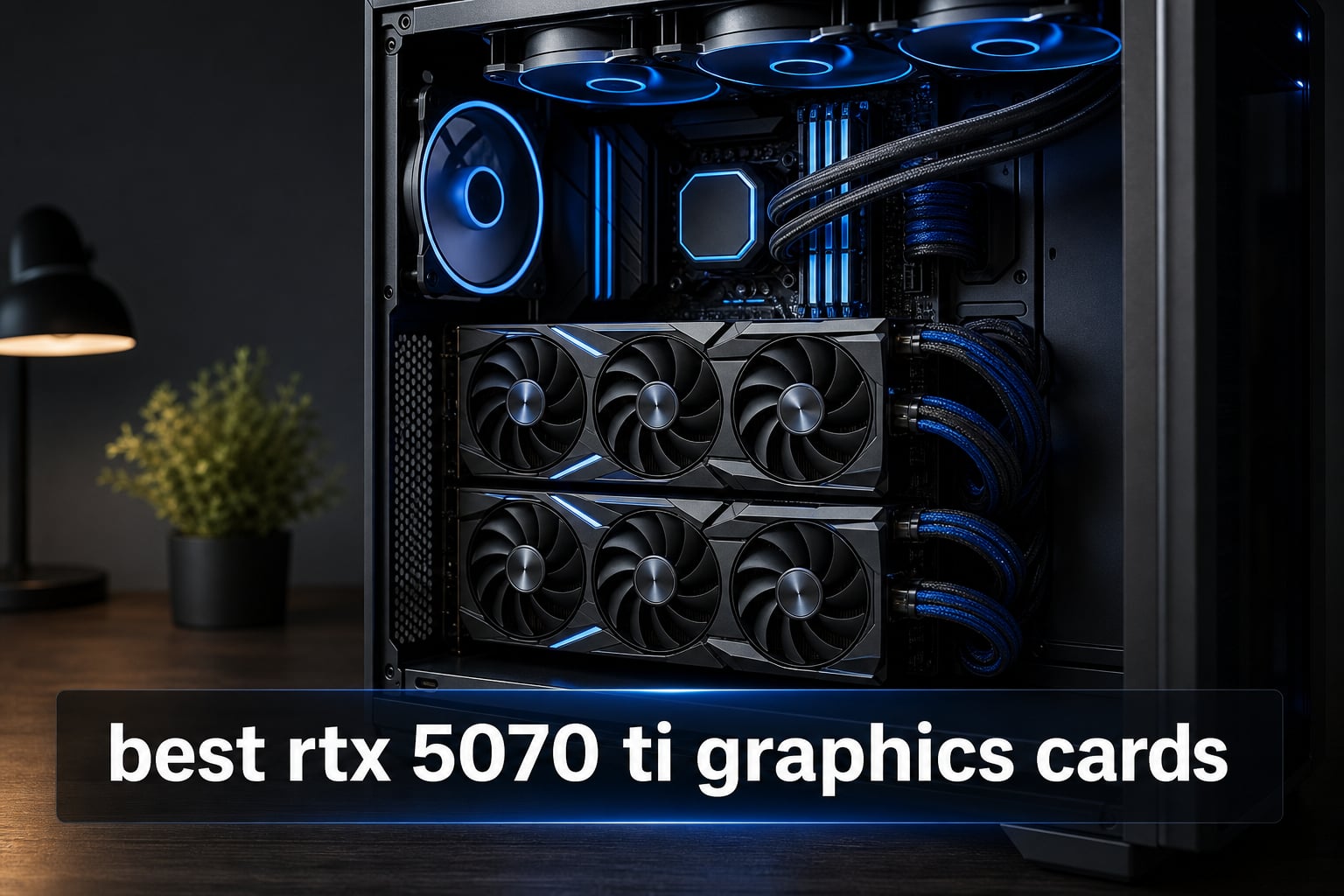
The GIGABYTE RTX 5070 Ti Eagle OC ICE SFF is my best overall pick because it combines a 2600 MHz listed clock, 16GB of GDDR7 memory, a three-year manufacturer warranty, and NVIDIA SFF-ready status in a 11.97-inch card. The PNY RTX 5070 Ti OC Triple Fan is the straightforward value-focused alternative, while ZOTAC’s Solid SFF OC is the compact-feature pick for builders who want a support stand, fan-stop behavior, and confirmed 12-inch length.
Finding the best rtx 5070 ti graphics cards is less about chasing a dramatic frame-rate gap and more about matching the board to your case, power-cable route, display setup, and tolerance for a larger cooler. Every card here uses NVIDIA’s GeForce RTX 5070 Ti with 16GB of 256-bit GDDR7 memory and PCIe 5.0, so the common Blackwell platform, DLSS 4, ray tracing support, and high-resolution gaming capability are already present across the list.
NVIDIA positions the GPU as a high-end option with 8,960 CUDA cores, fourth-generation RT cores, and fifth-generation Tensor cores. In practical buying terms, it makes sense for high-refresh 1440p play, 4K gaming with sensible settings, GPU-accelerated creative applications, and AI-assisted workloads, but the board partner determines the physical package around that chip.
I ranked these listings by verified clock information, cooling design, physical dimensions where supplied, output selection, warranty, buyer ratings, and review volume. I did not treat a factory overclock as a promise of a major gaming lead: the forum feedback behind this guide consistently puts board-to-board results close together, often within a few percent, and that is the sensible expectation when the GPU and memory capacity are shared.
Temperature and noise matter a great deal to real buyers, yet the supplied listings do not provide a controlled, like-for-like temperature or decibel dataset. Rather than invent figures, I point to the hardware each card uses—three-fan coolers, copper baseplates, heatpipes, airflow cutouts, and fan-stop modes—and flag where measured testing should be your final tie-breaker.
One more practical warning: coil whine can vary from one individual card to another, even within the same model. Check your case clearance before ordering, leave room for the power connector bend, and keep warranty terms in view; those three checks are more dependable than a small advertised clock difference.
Table of Contents
- Top 3 Picks Answer Most RTX 5070 Ti Buyers’ Needs In 2026
- RTX 5070 Ti Cards in 2026 Share the Same Core Platform
- 1. GIGABYTE Eagle OC ICE SFF Is the Best Overall Balanced Pick
- 2. GIGABYTE RTX 5070 Ti SFF Is a Straightforward Compact Three-Fan Card
- 3. GIGABYTE AERO OC Is the Best White Full-Length Option
- 4. MSI Gaming Trio OC Plus Is the Feature-Rich Large-Case Choice
- 5. PNY OC Triple Fan Is the Most Sensible Conventional Value Pick
- 6. PNY Epic-X ARGB OC Is the Best Lighting-Focused PNY Alternative
- 7. MSI Ventus 3X OC Is the Cooler-First SFF-Ready Choice
- 8. ZOTAC Solid SFF OC Is the Most Complete Compact-Build Package
- 9. MSI Ventus 3X PZ OC Is the Similar-Cooler Alternative With Less Buyer History
- 10. PNY OC Triple Fan Plus Is the Lowest-Rated Option Here
- The Right RTX 5070 Ti Card Starts With Fit, Cooling Evidence, and Warranty
- Case clearance should decide the first cut
- Cooling hardware should guide a noise shortlist
- Factory overclocks should be treated as tie-breakers
- Power and cable routing deserve a deliberate check
- Ports and warranty can outlast a minor clock difference
- RTX 5080 and RX 9070 XT comparisons need workload-specific research
- FAQ Answers the Main RTX 5070 Ti Buying Questions
- The Eagle OC ICE SFF Is the Safest First Choice in 2026
Top 3 Picks Answer Most RTX 5070 Ti Buyers’ Needs In 2026
Choose the Eagle OC ICE SFF for the strongest all-round fit on the supplied specifications, the PNY OC Triple Fan for a conventional triple-fan card with a 2572 MHz listed boost, or the ZOTAC Solid SFF OC when confirmed 12-inch length, fan-stop operation, and a bundled support stand matter more than decorative lighting.


These labels are use-case calls, not claims that one board changes the underlying GPU tier. If a case is especially compact, the model with documented dimensions deserves priority over a card whose listing merely says SFF-ready without publishing every measurement.
RTX 5070 Ti Cards in 2026 Share the Same Core Platform
The quick view below covers all ten analyzed cards. It is useful for narrowing the field, but check the individual review notes before deciding because listings vary in how much dimensional, warranty, and connector information they disclose.
| Product | Specifications | Action |
|---|---|---|
| GIGABYTE RTX 5070 Ti Eagle OC ICE SFF |
|
Check Latest Price |
 GIGABYTE RTX 5070 Ti SFF GIGABYTE RTX 5070 Ti SFF |
|
Check Latest Price |
 GIGABYTE RTX 5070 Ti AERO OC GIGABYTE RTX 5070 Ti AERO OC |
|
Check Latest Price |
 MSI RTX 5070 Ti Gaming Trio OC Plus MSI RTX 5070 Ti Gaming Trio OC Plus |
|
Check Latest Price |
| PNY RTX 5070 Ti OC Triple Fan |
|
Check Latest Price |
 PNY RTX 5070 Ti Epic-X ARGB OC PNY RTX 5070 Ti Epic-X ARGB OC |
|
Check Latest Price |
 MSI RTX 5070 Ti Ventus 3X OC MSI RTX 5070 Ti Ventus 3X OC |
|
Check Latest Price |
| ZOTAC RTX 5070 Ti Solid SFF OC |
|
Check Latest Price |
 MSI RTX 5070 Ti Ventus 3X PZ OC MSI RTX 5070 Ti Ventus 3X PZ OC |
|
Check Latest Price |
 PNY RTX 5070 Ti OC Triple Fan Plus PNY RTX 5070 Ti OC Triple Fan Plus |
|
Check Latest Price |
All ten provide 16GB of GDDR7, a capacity that helps this class of graphics card remain comfortable with demanding game textures and creator workloads. The meaningful separators are the cooler and case-fit details, not the memory allocation.
1. GIGABYTE Eagle OC ICE SFF Is the Best Overall Balanced Pick
Pros
- 2600 MHz listed clock
- SFF-ready status
- WINDFORCE cooling
- 3-year warranty
Cons
- No detailed height listed
- Only 81 reviews
The Eagle OC ICE SFF takes the lead because the listing answers the buyer questions I care about without adding unnecessary uncertainty. It pairs a 2600 MHz GPU clock with 16GB GDDR7, PCIe 5.0, WINDFORCE cooling, and a three-year manufacturer warranty.
Its 4.8 rating from 81 reviews is encouraging, with 87% of reviewers awarding five stars. The small review pool is not proof of long-term reliability, but it is a better early signal than a listing with little or no buyer feedback.
Its 11.97-inch Length Makes Case Planning Straightforward
The published body is 11.97 inches long and 4.96 inches wide, and GIGABYTE calls it NVIDIA SFF-ready. That combination makes this card a sensible first check for smaller cases, although I would still compare the manual’s maximum GPU clearance with room for the power lead.
The listed 2.7-pound weight is also useful when choosing whether to add a support bracket. A secure card mount is cheap insurance against sag in a desktop build.
Its 2600 MHz Clock Is a Modest Factory Advantage
A listed 2600 MHz clock gives the Eagle OC ICE SFF a credible specification advantage over base-clock entries in this group. It should not be read as a guarantee of a visibly different gaming experience from another 5070 Ti, because the same underlying GPU remains the main performance driver.
I would choose it for a white-themed or compact system that needs known dimensions, but verify cooler clearance around the side panel before committing. The listing confirms DisplayPort and HDMI video outputs, yet does not spell out the exact port count.
2. GIGABYTE RTX 5070 Ti SFF Is a Straightforward Compact Three-Fan Card
Pros
- Three-fan WINDFORCE cooler
- SFF-ready status
- VGA holder included
- 3-year warranty
Cons
- 2452 MHz listed clock
- Exact slot thickness not listed
This GIGABYTE SFF card is for the builder who wants a conventional black three-fan RTX 5070 Ti with a known compact footprint. It has a 2452 MHz listed GPU clock, 28,000 MHz listed memory clock, 16GB of GDDR7, and the same 11.97-by-4.96-inch dimensions as the Eagle OC ICE SFF.
GIGABYTE includes a versatile VGA holder, which is a useful practical addition in a system that travels or sits upright for years. The 4.8 rating across 77 reviews and 87% five-star share are solid, although the review count remains modest.
Its Included Holder Helps With Long-Term Mounting
The support hardware is the key distinction here. A holder does not replace correct PCIe-slot installation, but it can reduce stress on the card and motherboard when the system is moved.
At 1.2 pounds in the listing, the weight data differs sharply from several other triple-fan cards, so I would treat it as a listing figure rather than a comparison-grade measurement. The physical length and width are the more useful fit checks.
Its SFF Label Needs a Full Clearance Check
SFF-ready means the card is intended for compact-build compatibility; it does not mean it fits every small enclosure. Before buying, match the 11.97-inch length and 4.96-inch width to your case limits and confirm that the three-fan shroud has intake space.
Choose this model if the included holder and compact, plainly specified layout matter more than an advertised factory overclock. The supplied data confirms three fans, but it gives no measured acoustic result, so quiet-operation comparisons would need independent testing.
3. GIGABYTE AERO OC Is the Best White Full-Length Option
Pros
- AERO OC factory clock
- Three-fan WINDFORCE cooler
- 3-year warranty
- 13.46-inch length disclosed
Cons
- Long 13.46-inch body
- 4.7 rating with some one-star reviews
The GIGABYTE AERO OC is the model I would inspect first for a white build with a roomy case. It shares the Eagle OC ICE SFF’s 2600 MHz listed GPU clock and 16GB GDDR7 specification, but its 13.46-inch length puts it in a different fit category.
Its three-fan WINDFORCE system and 4.03-pound listed weight indicate a more substantial physical package. The 4.7 rating is still strong over 103 reviews, though 5% one-star reviews make it worth reading the most recent buyer comments for patterns that matter to your own build.
Its 13.46-inch Body Requires a Mid-Tower Mindset
Measure from the rear PCIe slots to the front fan or radiator before selecting the AERO OC. A stated length of 13.46 inches is enough to rule it out of many compact cases even before accounting for cable bend clearance.
The 5.59-inch width is equally important in glass-sided cases. A card can fit lengthwise and still sit too close to the side panel for a comfortable power-connector route.
Its Factory Clock Targets Aesthetic-Focused Builds
The AERO OC offers a 2600 MHz listed clock, a three-fan cooler, and the familiar RTX 5070 Ti platform. It is a sensible aesthetic-first selection when its dimensions fit; it is not a reason to ignore less elaborate models that use the same GPU.
The listing confirms HDMI and DisplayPort support and up to 7680 by 4320 output. It does not list every port count, so multi-monitor buyers should confirm that detail from the current manufacturer documentation.
4. MSI Gaming Trio OC Plus Is the Feature-Rich Large-Case Choice
Pros
- TRI FROZR 4 cooling
- RGB lighting
- DisplayPort 2.1b and HDMI 2.1b
- metal backplate
Cons
- 338mm long
- 2-year manufacturer guarantee
The MSI Gaming Trio OC Plus is the most feature-forward card in this roundup for a spacious gaming tower. MSI lists a 2572 MHz GPU clock, TRI FROZR 4 cooling with three STORMFORCE fans, RGB lighting, a reinforced metal backplate, and both DisplayPort 2.1b and HDMI 2.1b.
It also has the largest buyer-feedback base here: 543 reviews at a 4.6 average rating. That depth makes the rating more informative than a high score based on a few dozen reviews, although individual feedback still cannot predict your particular card’s fan behavior or coil whine.
Its 338mm Length Rules Out Many Compact Cases
MSI gives the Gaming Trio OC Plus a 338mm length, which is roughly 13.3 inches. Treat that as a firm compatibility gate, then add clearance for a front radiator and for the power cable behind a side panel.
The listing calls it a 2.5-slot card and recommends a 650W-or-greater PSU. Verify your power supply’s capacity and that the connector path does not press sharply against the case panel.
Its Modern Outputs Suit Advanced Display Setups
DisplayPort 2.1b and HDMI 2.1b are explicit strengths for a user planning newer high-bandwidth displays. The card’s output selection deserves more attention than a small clock delta if you use several monitors or plan a display upgrade.
MSI’s two-year manufacturer guarantee is shorter than the three-year cover stated on several other listings. That does not settle the reliability question, but warranty duration is a meaningful ownership difference when specifications are otherwise close.
5. PNY OC Triple Fan Is the Most Sensible Conventional Value Pick
Pros
- 2572 MHz boost
- 2.98-slot design
- three fans
- 3-year warranty
Cons
- Not Prime eligible
- Exact length not provided
The PNY RTX 5070 Ti OC Triple Fan is my practical pick for buyers who want the core RTX 5070 Ti experience without paying for RGB or an oversized visual design. Its verified specifications include a 2572 MHz boost clock, 16GB GDDR7 on a 256-bit interface, three fans, PCIe 5.0, and a three-year warranty.
It has a 4.6 average from 396 reviews, with 86% five-star feedback, plus a strong #19 listing rank in the graphics-card category. The rating base is large enough to make it one of the more established products in this ten-card set.
Its 2.98-Slot Design Needs Width Clearance
PNY identifies this board as 2.98 slots wide, so leave the adjacent expansion area clear and check your case’s GPU-thickness allowance. That width matters even if a chassis has plenty of length, especially in compact layouts with bottom fans or a capture card.
The source does not give a card length, which is the one missing fit figure I would want before a small-case purchase. Ask PNY or consult the current official product page rather than assuming every triple-fan cooler is the same size.
Its 2572 MHz Boost Is a Sensible No-Frills Specification
A 2572 MHz listed boost places this PNY alongside the MSI Gaming Trio OC Plus on paper. The common GPU means I would not expect a massive real-world split, but the specification is plenty for a buyer who wants an overclocked model without making RGB a requirement.
PNY bundles a 16-pin-to-three-8-pin power cable according to the listing. That can help with compatibility, but route it gently and check the required space around the connector before closing the side panel.
6. PNY Epic-X ARGB OC Is the Best Lighting-Focused PNY Alternative
Pros
- 2640 MHz listed boost
- ARGB lighting
- three-fan cooling
- 3-year warranty
Cons
- Dimensions not specified
- Shared 396-review listing data
The PNY Epic-X ARGB OC is the clear choice between PNY’s reviewed options if visible lighting is part of the build brief. It combines ARGB, a three-fan cooler, PCIe 5.0, 16GB GDDR7, and a 2640 MHz listed boost clock—the highest stated boost figure in this set.
The listing carries a 4.6 rating from 396 reviews, with 86% five-star feedback. Because that same review total appears on another PNY item, I would confirm current review attribution before treating the count as model-specific evidence.
Its ARGB Is the Reason to Choose It Over the Plain PNY Card
The Epic-X name and ARGB specification make this a better fit for a windowed gaming PC where coordinated lighting matters. If your case has no window, the standard PNY OC Triple Fan has a very similar core specification and may be easier to justify based on function alone.
PNY also describes support for NVIDIA Studio drivers and RTX acceleration in creative applications. That is a platform advantage shared with the other RTX 5070 Ti cards, rather than a unique Epic-X performance trait.
Its 2640 MHz Boost Does Not Replace Fit Research
The 2640 MHz listed boost is appealing, but PNY does not supply physical dimensions in the analyzed data. Do not let the largest clock number in this guide override the unglamorous case-clearance check.
The listing confirms up to 7680 by 4320 output, HDMI and DisplayPort connectivity, and three fans. It does not supply a measured noise result, so compare independent acoustic testing if low fan noise is your defining requirement.
7. MSI Ventus 3X OC Is the Cooler-First SFF-Ready Choice
Pros
- TORX Fan 5.0
- Nickel-plated copper baseplate
- SFF-ready
- 3-year warranty
Cons
- Dimensions need verification
- 2497 MHz listed clock
The MSI Ventus 3X OC is a strong candidate for the buyer who prefers a functional cooler design over RGB. MSI specifies TORX Fan 5.0, a nickel-plated copper baseplate, square Core Pipes, 16GB GDDR7, NVIDIA SFF-ready status, and a 2497 MHz listed clock.
Its 4.6 rating from 240 reviews and 84% five-star share offer a meaningful amount of customer feedback. The listing also clearly states three DisplayPort 2.1a connections plus one HDMI 2.1b, which makes display planning unusually easy.
Its Copper Baseplate and Core Pipes Target Heat Transfer
MSI says the nickel-plated copper baseplate captures heat from the GPU and memory, while square Core Pipes increase contact with the baseplate. Those are credible design details for a buyer prioritizing cooling hardware, but they are not substitutes for a controlled temperature comparison.
TORX Fan 5.0 uses blades linked by ring arcs to stabilize airflow. I would put this card on a noise-focused shortlist, then use third-party testing to decide between it and other three-fan designs.
Its Published Dimensions Need Confirmation Before an SFF Build
The listing gives dimensions of 15.2 by 9.3 inches, figures that look inconsistent with the SFF-ready claim and may reflect packaging rather than the installed card. Treat the SFF label as a helpful starting point, not clearance confirmation.
The three DisplayPort 2.1a and single HDMI 2.1b outputs are confirmed features. That port mix is excellent for a multi-display desk, but count your actual display cables and adapters before choosing any graphics card.
8. ZOTAC Solid SFF OC Is the Most Complete Compact-Build Package
Pros
- 12-inch length
- IceStorm 2.0 cooling
- FREEZE fan stop
- Support stand included
Cons
- 2+1-year warranty format
- 3.8-pound listed weight
The ZOTAC Gaming Solid SFF OC is my preferred compact-build alternative when a detailed features list matters. It has a confirmed 12-inch length, a 2482 MHz boost clock, three 90mm BladeLink fans, IceStorm 2.0 cooling, composite heatpipes, pass-through airflow, FREEZE fan stop, a metal backplate, and a bundled GPU support stand.
Its 4.6 rating comes from 140 reviews, 83% of which are five-star reviews. This is solid support from buyers, but the compact name should never be mistaken for a guarantee of fit in a very small sandwich-layout case.
Its 12-inch Length Gives Builders a Useful Starting Point
At 12 inches long and 1.6 inches wide in the listing, the Solid SFF OC has one of the clearest fit disclosures in this roundup. It is still a triple-fan graphics card, so account for the shroud height, the 16-pin connector area, and the case’s air intake path.
The included support stand is welcome with a 3.8-pound listed weight. Use it only after the card is correctly seated and the chassis is stable.
Its Fan-Stop Feature Helps Light-Load Noise Goals
ZOTAC explicitly lists FREEZE Fan Stop and active fan control. Those features can reduce fan activity at low load, which is relevant for a quiet desktop or creative workstation, though they do not tell us how loud the card is while gaming.
The card provides three DisplayPort 2.1b outputs and one HDMI 2.1b, along with stated four-display and 8K readiness. That is excellent connectivity on paper for users who run several modern displays.
9. MSI Ventus 3X PZ OC Is the Similar-Cooler Alternative With Less Buyer History
Pros
- TORX Fan 5.0
- SFF-ready
- Nickel-plated copper baseplate
- 3-year warranty
Cons
- Only 95 reviews
- Physical dimensions not specified
The MSI Ventus 3X PZ OC mirrors the core cooler story of the standard Ventus 3X OC: TORX Fan 5.0, a nickel-plated copper baseplate, square Core Pipes, 16GB GDDR7, and SFF-ready positioning. It lists a 2482 MHz clock, three DisplayPort 2.1a outputs, one HDMI 2.1b output, and a three-year warranty.
The difference is buyer history and disclosure. Its 4.6 rating is based on 95 reviews, with 81% five-star feedback, so I would favor the better-established Ventus 3X OC if all other current details were equal.
Its Cooling Hardware Matches MSI’s Proven Ventus Formula
The PZ OC uses the same named cooling components as the standard Ventus review above. That makes it a reasonable shortlist entry for airflow-focused builds, especially when you want the specified modern display outputs.
Actual card-to-card temperatures depend on the enclosure, room conditions, fan curve, and silicon behavior. Do not translate a named cooler into a specific temperature result without a controlled review.
Its Missing Dimensions Require Extra Due Diligence
The data does not give installed-card dimensions, despite calling the model SFF-ready. That leaves a gap for the buyer most likely to care about the claim, so get an exact length, height, and thickness before using it in a small case.
The product listing identifies the interface as PCI-Express x4, an unusual figure for this product class. I would verify the official specification page because the same listing also positions the card as an RTX 5070 Ti gaming card with conventional display outputs.
10. PNY OC Triple Fan Plus Is the Lowest-Rated Option Here
Pros
- 2572 MHz boost
- 2.99-slot design
- DLSS 4 support
- 3-year warranty
Cons
- 4.4 rating
- Only 64 reviews
- Not Prime eligible
The PNY OC Triple Fan Plus has a respectable specification sheet—2572 MHz boost, 16GB GDDR7, PCIe 5.0, three fans, 2.99-slot design, and a three-year warranty—but it lands last because its 4.4 rating is the lowest in this group. It also has only 64 reviews, and 8% are one-star reviews.
That rating does not mean every unit is poor, and the core Blackwell and DLSS 4 feature set remains the same. It means I would need a compelling case-specific reason or particularly favorable current availability before ranking it above the PNY and MSI alternatives with stronger buyer feedback.
Its 2.99-Slot Width Is a Real Compatibility Requirement
A 2.99-slot card needs almost three expansion slots of clearance and may obstruct adjacent hardware. Check motherboard layout, capture cards, bottom-mounted fans, and cable routes before ordering.
PNY lists the card at 1.9 kilograms, which suggests using a well-supported horizontal mount. The analyzed listing does not provide length, so it is not my first recommendation for a small-form-factor case.
Its Rating Makes Current Buyer Feedback Especially Important
With a 4.4 average rating and 79% five-star share, this model warrants a close read of recent reviews before purchase. Look for repeated reports that apply to your setup, not isolated comments that could reflect shipping damage, a single faulty unit, or mismatched expectations.
Its fifth-generation Tensor cores, fourth-generation ray-tracing cores, Reflex support, and Studio-driver support reflect the shared NVIDIA RTX platform. Those features are useful, but they do not explain why this model should outrank its closer-reviewed rivals.
The Right RTX 5070 Ti Card Starts With Fit, Cooling Evidence, and Warranty
Start with physical compatibility, because a more elaborate cooler is useless if it blocks a front radiator, presses against the glass, or leaves too little room to bend the power cable. Write down maximum GPU length, maximum height, available slot thickness, and the clearance around the connector before comparing model names.
Case clearance should decide the first cut
Use manufacturer dimensions where they are published: the Eagle OC ICE SFF is 11.97 inches long and 4.96 inches wide, the GIGABYTE SFF is also 11.97 by 4.96 inches, the AERO OC is 13.46 by 5.59 inches, the Gaming Trio OC Plus is 338mm long, and the ZOTAC Solid SFF OC is 12 inches long. For models without dimensions in the supplied data, find the current manufacturer measurements before buying.
SFF-ready is a helpful category label, not a universal physical standard. Small-form-factor builders should also check the case manual for cable-routing space, GPU thickness, and whether the fans will sit close to a side panel or restricted intake.
Cooling hardware should guide a noise shortlist
Every option here has a triple-fan layout, but the details differ. GIGABYTE uses WINDFORCE on its listed cards; MSI names TRI FROZR 4 or TORX Fan 5.0 with a copper baseplate and Core Pipes; ZOTAC specifies IceStorm 2.0, three 90mm fans, composite heatpipes, pass-through airflow, and fan-stop operation.
Those details identify candidates worth investigating, not winners of a temperature contest. Forum discussions rightly put real thermal and acoustic testing first, and the available source data lacks controlled temperature, noise-normalized, VRAM-temperature, or power-draw figures for these exact listings.
Factory overclocks should be treated as tie-breakers
The advertised clocks range from 2452 MHz on the GIGABYTE SFF listing to 2640 MHz on the PNY Epic-X ARGB OC listing. Because these cards use the same GeForce RTX 5070 Ti processor and memory capacity, the factory-clock number is best used after fit, cooler design, and warranty have narrowed the choices.
Forum users commonly report that board-partner performance differences sit within a small range. That is why I would not buy a card that is too large, poorly supported by your case, or missing a desirable warranty simply for a small frequency advantage.
Power and cable routing deserve a deliberate check
The MSI Gaming Trio OC Plus listing recommends a 650W-or-greater PSU, and the PNY OC Triple Fan includes a 16-pin-to-three-8-pin cable. These are useful facts, but every build needs a full PSU-capacity assessment based on its processor, storage, cooling, and peripherals.
Avoid a sharp bend at the graphics-card connector. Plan the cable route before installation, and verify that the side panel closes without forcing the cable into an awkward position.
Ports and warranty can outlast a minor clock difference
The MSI Gaming Trio OC Plus specifies DisplayPort 2.1b and HDMI 2.1b, the MSI Ventus models specify three DisplayPort 2.1a plus one HDMI 2.1b, and the ZOTAC gives three DisplayPort 2.1b plus one HDMI 2.1b. If you use several displays, that confirmed port count may settle the choice immediately.
Warranty terms are another useful separator: GIGABYTE’s listed cards and the PNY and Ventus listings state three years, while the Gaming Trio OC Plus lists two years and ZOTAC lists 2+1 years. Read the exact registration and regional terms before treating a longer stated period as automatic coverage.
RTX 5080 and RX 9070 XT comparisons need workload-specific research
Community discussions often ask whether an RTX 5070 Ti should be compared with an RTX 5080 or RX 9070 XT. That is a broader GPU-tier decision, not a board-partner decision, and it calls for current independent game, creator-app, power, and feature testing rather than a cooler comparison alone.
Once you have committed to the RTX 5070 Ti, return to this roundup and select the board that fits your chassis and display setup. The best rtx 5070 ti graphics cards are the ones whose physical details match the system you actually own.
FAQ Answers the Main RTX 5070 Ti Buying Questions
Which version of RTX 5070 Ti is best?
The GIGABYTE RTX 5070 Ti Eagle OC ICE SFF is the best all-round version in this guide because its listing combines a 2600 MHz clock, 16GB GDDR7, NVIDIA SFF-ready status, published 11.97-inch length, WINDFORCE cooling, a three-year manufacturer warranty, and a 4.8 rating. Choose ZOTAC Solid SFF OC when a 12-inch card with fan-stop operation and a support stand better fits the build, or choose MSI Gaming Trio OC Plus for its stated DisplayPort 2.1b and HDMI 2.1b outputs in a large case.
Is the RTX 5070 Ti a good graphics card?
Yes. The RTX 5070 Ti is a high-end Blackwell GPU with 8,960 CUDA cores, 16GB of GDDR7 memory, fourth-generation RT cores, fifth-generation Tensor cores, and DLSS 4 support. It suits high-refresh 1440p gaming, 4K gaming with appropriate settings, GPU-assisted content creation, and AI workloads; select the board partner by case fit, cooling hardware, ports, warranty, and verified review feedback.
Is the 5070 Ti considered high end?
Yes. The RTX 5070 Ti is considered a high-end GPU because it combines 16GB GDDR7 memory with NVIDIA Blackwell architecture, 8,960 CUDA cores, advanced ray-tracing hardware, and DLSS 4. It is a sensible choice for users seeking high-refresh 1440p or smooth 4K gaming, but it is not the highest tier in NVIDIA’s product stack.
What is the best RTX 5070 graphics card?
For an RTX 5070 Ti, the GIGABYTE Eagle OC ICE SFF is the best balanced choice in this roundup. It has a 2600 MHz listed clock, 16GB GDDR7, SFF-ready status, published 11.97-inch length, and a three-year warranty. The PNY OC Triple Fan is a strong plain-design alternative with a 2572 MHz boost and three-year warranty, while the ZOTAC Solid SFF OC adds a 12-inch length disclosure, fan-stop behavior, and a bundled support stand.
The Eagle OC ICE SFF Is the Safest First Choice in 2026
The GIGABYTE Eagle OC ICE SFF is the first card I would consider for its compact documented dimensions, 2600 MHz listed clock, WINDFORCE cooling, SFF-ready designation, three-year warranty, and strong early rating. The PNY OC Triple Fan is the sensible uncomplicated alternative, while the ZOTAC Solid SFF OC stands out where its confirmed 12-inch length, fan-stop operation, support stand, and explicit four-display support solve real build needs.
For the best rtx 5070 ti graphics cards, start with the case manual and display requirements, then compare warranty and cooler hardware. That process is more likely to lead to a satisfying long-term build than choosing solely by a small factory-overclock number.