
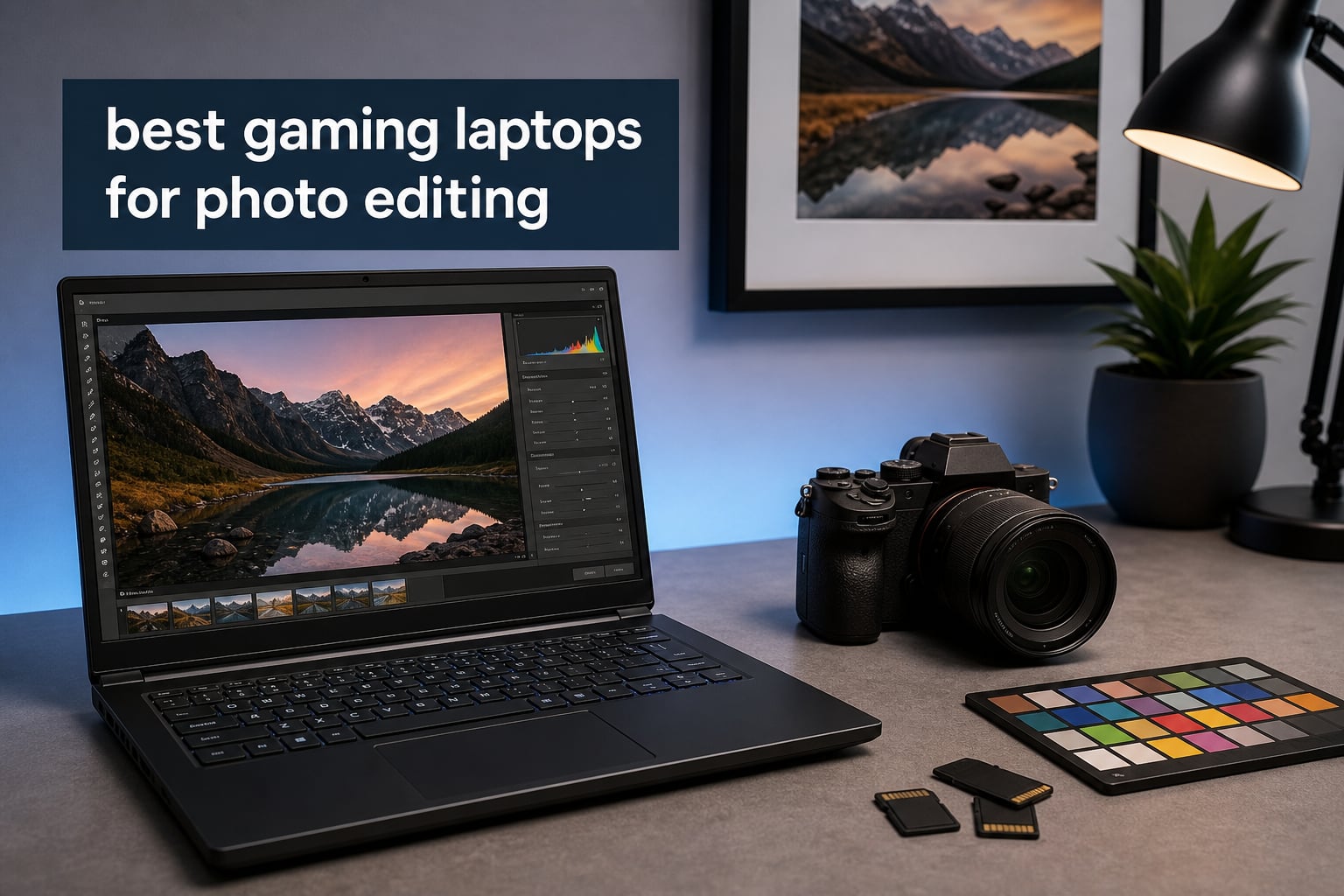
Yes, the best gaming laptops for photo editing can handle large RAW catalogs, layered Photoshop files, and modern games well, but the screen decides whether the results are trustworthy. A dedicated GPU and a fast processor make editing feel responsive; a display with unverified or narrow color coverage can still make a powerful machine the wrong choice for print-critical work.
I ranked these gaming laptop photo editing options from the supplied specifications and the available customer-review summaries, with color gamut, memory, storage, and ports carrying more weight than refresh rate. Community discussions repeatedly make the same point: calibrate the panel when accurate color matters, and do not mistake a high-Hz screen for a color-accurate screen.
For 2026, my leading picks are the GIGABYTE AORUS MASTER 16 for its Pantone Validated OLED panel, the Acer Nitro 16S AI for its stated 100% sRGB IPS screen and 2TB SSD, and the NIMO N158 for a lighter 32GB option. Read the panel notes closely if you edit for client delivery, since glossy screens reflect more light and several listings do not state a full color-gamut claim.
The top 3 picks give photographers the clearest starting point
The AORUS is the strongest display-first choice in this group, while the Nitro 16S pairs a stated sRGB panel with generous memory and storage. The NIMO is a more portable choice for catalog work, but its listing does not publish a gamut figure, so I would treat an external calibrated display as part of its serious photo workflow.
The best gaming laptops for photo editing in 2026 are easier to compare side by side
Use this overview to narrow the list, then check the individual display discussion before choosing. A stated wide-gamut panel is more useful to a photographer than a refresh-rate figure alone.
| Product | Specifications | Action |
|---|---|---|
 GIGABYTE AORUS MASTER 16 GIGABYTE AORUS MASTER 16 |
|
View on Amazon |
 Acer Nitro 16S AI Acer Nitro 16S AI |
|
View on Amazon |
 NIMO N158 NIMO N158 |
|
View on Amazon |
 MSI Crosshair 18 HX AI MSI Crosshair 18 HX AI |
|
View on Amazon |
 ASUS ROG Strix G16 ASUS ROG Strix G16 |
|
View on Amazon |
 Lenovo Legion 5 Lenovo Legion 5 |
|
View on Amazon |
 MSI Katana 15 HX MSI Katana 15 HX |
|
View on Amazon |
 Acer Nitro V 17 AI Acer Nitro V 17 AI |
|
View on Amazon |
 Lenovo Legion Pro 7i Lenovo Legion Pro 7i |
|
View on Amazon |
 GIGABYTE Gaming A16 GIGABYTE Gaming A16 |
|
View on Amazon |
The GIGABYTE AORUS MASTER 16 is the display-first all-round pick
Pros
- Pantone Validated OLED
- 100% DCI-P3 coverage
- 32GB expandable memory
- Thunderbolt 4
Cons
- 5.5 pound chassis
- 1TB storage
The AORUS MASTER 16 takes my first spot because its listing supplies the display facts photographers need: a 2560×1600 OLED panel, 100% DCI-P3 coverage, and Pantone validation. That is a materially stronger starting point for editing color than a listing that only says IPS and 165Hz.
Its Core Ultra 9 275HX, RTX 5070 Ti with 12GB GDDR6, and 32GB of DDR5 memory form a high-capacity workstation for Lightroom Classic photo editing and Photoshop GPU acceleration. The 1TB Gen5 NVMe SSD should be quick for current projects, although active photographers who retain many RAW shoots may fill it sooner than expected.
I also like the connectivity: two Thunderbolt 4 USB-C ports, two USB 3.2 Gen 2 ports, HDMI, and Ethernet support docked editing without an immediate hub purchase. The available review summary is excellent at 4.9 from 10 reviews, but that small review count is not the same as a long track record.
The AORUS suits color-managed editing and demanding GPU work
This is the pick I would shortlist first for a photographer who needs a wide-gamut internal screen and also works on GPU-assisted masking, filters, panoramas, or high-resolution composites. OLED contrast can make shadow review especially comfortable, while the 16:10 panel gives more vertical space than a standard 16:9 screen.
The 99Wh battery capacity is substantial on paper, though high-output gaming hardware and an OLED panel can consume power quickly during export or gaming. Carrying 5.5 pounds is reasonable for a 16-inch machine, yet it is not a casual all-day shoulder-bag laptop.
The AORUS needs a storage plan and sensible screen setup
The key trade-off is the supplied 1TB capacity, which asks you to plan an archive drive or network storage if you keep years of RAW files locally. I would keep the working catalog and previews on the internal SSD, then move completed shoots to a backed-up external drive.
Pantone validation is useful, not permission to skip calibration for paid output. Set a suitable brightness for the room, use a hardware calibrator when color matching matters, and review prints under the intended light.
The Acer Nitro 16S AI is the balanced 32GB and 2TB editing choice
Pros
- 100% sRGB IPS panel
- 2TB Gen4 SSD
- 32GB memory
- RTX 5070 Ti
Cons
- 32GB memory ceiling
- 76Wh battery
The Acer Nitro 16S AI is a very practical answer for photographers who want a complete out-of-box configuration rather than a machine that immediately needs more memory or storage. Its 16-inch 2560×1600 IPS display is specified at 100% sRGB, which covers the common web and general-photo workflow more clearly than an unspecified panel.
The Ryzen AI 9 365 has 10 cores up to 5GHz, while the RTX 5070 Ti carries 12GB of GDDR7. With 32GB of DDR5 and a 2TB Gen4 SSD, this system has headroom for a large Lightroom catalog, Photoshop, browser tabs, and a substantial local shoot folder at the same time.
The supplied review summary shows a 4.8 rating from 16 reviews, so the early feedback is strong but still limited in volume. Its 4.8-pound weight and 0.78-inch thickness are friendlier for travel than the largest models here.
The Nitro 16S suits sRGB delivery and large local catalogs
I would pick this model for web galleries, social delivery, and general photo work where accurate sRGB handling is the central display requirement. The 180Hz refresh rate is primarily a gaming benefit, but it does not take away from the more relevant 100% sRGB specification.
The 2TB SSD is its standout convenience for a photographer: it can hold an operating system, apps, a working Lightroom catalog, previews, and recent image folders without forcing an immediate storage shuffle. Backups still belong on a separate drive, because a larger internal SSD is not a backup.
The Nitro 16S requires realistic memory and gamut expectations
The listing states a maximum of 32GB RAM, so choose this configuration knowing that it is already at that ceiling. That is enough for most still-photo workflows, but it reduces the upgrade path for someone who later adds heavy video, 3D, or virtual-machine tasks.
100% sRGB is a solid target, but it is not a published AdobeRGB or DCI-P3 promise. A calibrated external wide-gamut monitor remains the safer route for print work that calls for a larger color space.
The NIMO N158 is the lighter 32GB option for catalog-focused work
Pros
- 3.75 pound weight
- 32GB expandable to 64GB
- USB4 port
- Micro SD reader
Cons
- Integrated Radeon graphics
- display gamut not stated
The NIMO N158 is different from the dedicated-GPU machines because it uses AMD Radeon 780M integrated graphics rather than an RTX card. Its Ryzen 7 8745HS, 32GB of DDR5, and 1TB PCIe 4.0 SSD still make it a credible machine for organizing images, adjusting individual RAW files, and working in a moderate Photoshop document.
At 3.75 pounds, it is the portability standout in this list, and its 75Wh battery is paired with a manufacturer-stated 15.5-hour battery-life figure. I would treat that runtime claim as a light-work figure rather than a promise for continuous exports or gaming.
The major photo-editing question is the 15.6-inch 1920×1080 IPS display, whose color coverage is not listed. That missing detail matters more than the 180-degree hinge, so this is a best fit for photographers who can verify the panel with a calibrator or connect a known-good monitor through USB4 or HDMI 2.1.
The NIMO works for mobile culling and external-monitor editing
This machine is suitable for travelers who value a lower carry weight, a full 32GB of RAM, and an onboard Micro SD reader for ingesting camera media. USB4 also gives the setup room to use a capable dock or an external GPU later, as stated in the listing.
For Lightroom catalog management, culling, standard RAW adjustments, and retouching without large AI or multilayer workloads, the hardware balance makes sense. The integrated graphics are the dividing line: I would not select it for frequent GPU-heavy Photoshop effects, panoramic merges, or demanding games.
The NIMO needs display verification before color-critical delivery
The FHD resolution gives less workspace than the 2560×1600 models, and no sRGB, DCI-P3, or calibration claim is supplied. Do not assume that an IPS label alone tells you enough about gamut or Delta E.
Its review average is 4.6 from 23 reviews, with the supplied summary noting some lower ratings. That makes careful setup checks during the return period sensible: inspect the panel, test the keyboard and ports, and run your normal editing applications.
The MSI Crosshair 18 HX AI gives editors the largest stated wide-gamut canvas
Pros
- 18 inch QHD+ workspace
- 100% DCI-P3 panel
- 24-core CPU
- Thunderbolt 4
Cons
- 6.83 pound weight
- 1TB storage
The MSI Crosshair 18 HX AI is for the photographer who wants a broad internal workspace and does not plan to travel light. Its 18-inch 2560×1600 IPS panel is specified at 100% DCI-P3, a useful wide-gamut claim for color-aware work and a comfortable canvas for side-by-side Library and Develop views.
Under the panel, the 24-core Core Ultra 9 275HX, RTX 5070 8GB GDDR7, and 32GB DDR5-5600 configuration are equipped for large catalog previews, exports, and Photoshop tasks. The 90Wh battery is sizeable, but a 6.83-pound computer belongs in a desk-and-trip routine more than an everyday commuter routine.
The listing includes Thunderbolt 4, HDMI 2.1, USB-A, and Ethernet, which is a welcome port set for storage, display, and wired-network work. The review average is 4.6 from 22 reviews, an encouraging figure that remains a fairly small buyer sample.
The Crosshair 18 suits desk-based photo and gaming sessions
I would favor this model when editing comfort on the built-in screen takes priority over low bag weight. The physical size is helpful when checking fine retouching, comparing two images, or keeping tool panels open without crowding the photograph.
The 100% DCI-P3 claim is an important advantage over many gaming panels, while the 240Hz rating is a side benefit for games. For color-managed photo applications, calibrating the display and setting the correct ICC profile still remains part of responsible setup.
The Crosshair 18 asks for a stationary workflow and archive storage
At nearly 7 pounds before the charger, this is a poor fit for someone who edits in cafes or carries equipment on foot for long periods. Its 1TB NVMe SSD is fast but can become crowded once the 32GB memory and powerful CPU encourage more local work.
Plan for an external SSD or a desktop archive, and keep the active job set on the laptop. That approach preserves speedy access without turning the internal drive into the only home for irreplaceable files.
The ASUS ROG Strix G16 is the most established RTX 5060 option here
Pros
- 508 reviews
- Core i7 16-core CPU
- Thunderbolt 4
- 90Wh battery
Cons
- 16GB RAM
- display gamut not stated
The ASUS ROG Strix G16 earns attention because its 4.5 rating is supported by 508 reviews, far more feedback than any other model in this group. Its Core i7-14650HX has 16 cores up to 5.2GHz, and the RTX 5060 has 8GB of graphics memory for accelerated photo work and gaming.
I would not overlook the starting 16GB DDR5 configuration, though. It can run Lightroom and Photoshop, but a photographer with a growing catalog, high-resolution files, or several open applications will feel more comfortable at 32GB; the supplied listing does not promise expandability.
The 16-inch 1920×1200 LED screen has a 16:10 ratio, 165Hz refresh rate, and ROG Nebula Display certification, but the provided data does not state an sRGB or DCI-P3 percentage. That keeps it below the models with explicit gamut information for color-critical internal-screen use.
The ROG Strix G16 suits buyers who value a deeper review record
This is a sensible option for an editor who wants an RTX-equipped system with a substantial pool of customer feedback rather than relying only on early impressions. The 90Wh battery, Wi-Fi 7, Thunderbolt 4, HDMI, and three USB ports also cover a practical mix of travel and desk use.
ASUS lists ROG Intelligent Cooling with a vapor chamber and a Stealth Mode. That matters for a gaming laptop for Lightroom because quiet surroundings make concentrated culling and retouching more pleasant, although fan behavior always depends on workload and performance mode.
The ROG Strix G16 needs a RAM and display-color check
Sixteen gigabytes is a workable floor, not my preferred photo-editing target when several Adobe applications run together. Confirm upgrade options with the seller or manufacturer before assuming a future 32GB route.
For web work, calibrating the panel and confirming sRGB behavior can make it usable. For print matching or wide-gamut color grading, I would connect a calibrated external monitor unless you can independently verify the internal screen’s coverage.
The Lenovo Legion 5 combines an OLED screen with Core i9 editing power
Pros
- OLED 2560x1600 display
- Core i9 14900HX
- 32GB DDR5
- Wi-Fi 7
Cons
- display is glossy
- weight listing conflicts
The Lenovo Legion 5 has a compelling photo-work specification: a 15.1-inch 2560×1600 glossy OLED display, Core i9-14900HX, RTX 5070 8GB GDDR7, 32GB DDR5-5600, and a 1TB Gen4 NVMe SSD. That combination places strong processor and graphics resources behind a high-resolution screen.
The supplied listing has conflicting weight information, with product details showing 10 pounds and technical details stating 4.19 pounds. I would verify the shipping or unit weight before making a portability decision rather than presenting either number as settled.
Its listed 4.3 rating from 17 reviews is positive enough to consider, though it has less buyer history than the ASUS. The 82% five-star figure reported in the supplied review summary is helpful context, but the sample remains small.
The Legion 5 suits photographers who want OLED detail and strong compute resources
The 2560×1600 resolution is more comfortable for editing than FHD, and 32GB of memory is the right starting point for a photographer handling a sizeable Lightroom Classic catalog. Wi-Fi 7, Gigabit LAN, four USB ports, and HDMI offer useful options for ingesting, backup, and an external display.
The Core i9 and RTX 5070 have ample scope for Photoshop GPU acceleration and demanding RAW file processing. That makes this laptop for photographers who mix serious editing with games and do not want to separate those roles across two systems.
The Legion 5 requires reflection control and model verification
Glossy OLED screens can look rich indoors, but they reflect windows and overhead lights more readily than matte panels. I would edit critical color in a controlled room or use an external calibrated monitor when reflections distract from tonal judgment.
The listing does not publish a gamut percentage or factory-calibration claim, despite the OLED specification. Ask for panel details or measure the screen yourself before trusting it for output where exact color is non-negotiable.
The MSI Katana 15 HX offers stated DCI-P3 coverage in a compact format
Pros
- 100% DCI-P3 QHD panel
- RTX 5060
- Cooler Boost 5
- seven ports
Cons
- 16GB starting memory
- limited review count
The MSI Katana 15 HX stands out because its listing explicitly says 15.6-inch QHD, 165Hz, and 100% DCI-P3. That is a meaningful photo-editing advantage in a system with a Core i7-14650HX and RTX 5060, particularly for someone who values panel coverage above the larger screen size of a 17- or 18-inch laptop.
Its starting memory is 16GB DDR5-5600 and storage is 1TB NVMe. Those specifications are fine for an organized single-project workflow, but I would check whether memory upgrades are supported if Lightroom, Photoshop, and other applications need to stay open together.
MSI lists Cooler Boost 5 shared-pipe thermals, HDMI output up to 8K, USB-C with DisplayPort and Power Delivery, Wi-Fi 6E, RJ45, and several other ports. The review rating is 4.3 from 17 reviews, another case where the display specs are clearer than the depth of buyer feedback.
The Katana 15 suits wide-gamut editing in a smaller desk footprint
This is a strong candidate for photographers who want a stated P3 panel but do not need an 18-inch chassis. QHD resolution gives more useful image and panel space than FHD, while the RTX 5060 can support Lightroom’s and Photoshop’s GPU-enabled features.
I also like the connectivity for a mixed workflow. USB-C DisplayPort can feed a monitor, HDMI can serve a second display or presentation screen, and RJ45 helps when moving large folders across a wired network.
The Katana 15 needs more memory planning for larger catalogs
For light to moderate RAW editing, 16GB may be acceptable. For batch photo editing, complex Photoshop layers, large panoramic merges, or frequent multitasking, 32GB creates a more comfortable margin.
The 75Wh battery should not be mistaken for all-day export power, and fan noise can rise when a shared cooling system is under sustained load. Do long exports on a desk with airflow, and use a performance profile that fits the noise level you can tolerate.
The Acer Nitro V 17 AI prioritizes screen size and RTX 5070 capability
Pros
- 17.3 inch screen
- 32GB DDR5
- RTX 5070
- wide port selection
Cons
- FHD resolution
- display gamut not stated
The Acer Nitro V 17 AI pairs a large 17.3-inch FHD IPS display with 32GB of DDR5, an RTX 5070, and an AMD Ryzen 7 260 processor. Its capacity makes it attractive for photographers who want room to edit locally without beginning at 16GB of memory.
The display is the compromise. At 1920×1080 on a 17.3-inch panel, image detail and interface space are lower than on the QHD and WQXGA models, and the listing does not state sRGB, DCI-P3, or calibration information.
It weighs 5.97 pounds and includes eight ports, with HDMI, USB, and Ethernet among them. The supplied review summary shows a 4.2 rating from 24 reviews, so I would view it as a compute-first choice rather than a display-first recommendation.
The Nitro V 17 suits photographers who need memory and a bigger physical screen
A 17.3-inch display is easier to view from a distance and can feel less cramped than a 15.6-inch machine when working at a desk. The RTX 5070 and 32GB memory provide a good foundation for current editing applications, AI-assisted tools, and casual or serious gaming.
The broad port count is helpful for a photographer who regularly attaches card readers, backup drives, a monitor, and a wired network. Build a workflow around an external calibrated display if output color is important.
The Nitro V 17 needs resolution and gamut trade-offs accepted upfront
FHD is not unusable for photo editing, but it does not offer the fine on-screen inspection or roomy interface of a 2560×1600 panel. It is best for photographers who value a physically larger screen more than pixel density.
Because no gamut figure appears in the supplied specifications, do not judge color accuracy from IPS technology or 144Hz alone. Calibration can improve a screen’s behavior, but it cannot create a wide color gamut that the panel does not possess.
The Lenovo Legion Pro 7i is the highest-capacity choice for heavy creative work
Pros
- RTX 5080 with 16GB VRAM
- 2TB SSD
- OLED WQXGA
- 32GB DDR5
Cons
- 10.7 pound listed weight
- glossy display
The Lenovo Legion Pro 7i has the deepest hardware specification in this roundup: a Core Ultra 9 275HX with 24 cores, RTX 5080 with 16GB GDDR7, 32GB DDR5-6400, and two 1TB M.2 SSDs for 2TB total storage. That is a serious foundation for large photo libraries, graphics-intensive Photoshop tools, and demanding parallel workloads.
Its 16-inch OLED WQXGA screen runs at 240Hz, while the listing describes it as glossy. Resolution and OLED contrast are attractive for close inspection, but a glossy surface requires control of room reflections when you are judging shadow detail or color.
The trade-off is portability: the supplied weight is 10.7 pounds, making this a transportable workstation rather than a laptop I would want to carry daily. Its 4.4 rating comes from 13 reviews, so the hardware case is much stronger than the depth of buyer-history evidence.
The Legion Pro 7i suits large files and GPU-intensive creative tasks
This is the machine for a photographer who regularly handles very large layered files, massive catalogs, high-resolution panoramas, or related video and 3D workloads. The 16GB graphics memory and 32GB system memory offer useful capacity beyond routine single-image edits.
The included 2TB SSD configuration is also unusually convenient for keeping active work local. Even then, retain at least one independent backup because fast internal storage should never be the sole copy of an image archive.
The Legion Pro 7i needs a desk-first workflow and panel validation
The size and listed 10.7-pound weight point toward a fixed editing station, perhaps paired with a monitor, keyboard, and external backup drives. The 99.99Wh battery can support untethered work, but it does not change the physical bulk.
The specifications do not state a color-gamut percentage or a factory-calibration result. Treat the OLED panel as promising hardware, not proof of calibrated color, and verify it before using it as the only reference for print work.
The GIGABYTE Gaming A16 is a portable RTX option with a clear color warning
Pros
- 4.9 pound weight
- RTX 5060
- Thunderbolt 4
- 180 degree hinge
Cons
- 45% NTSC gamut
- 16GB memory
The GIGABYTE Gaming A16 brings a Core i7-13620H, RTX 5060, 16GB DDR5, 1TB Gen4 NVMe storage, and Thunderbolt 4 into a 4.9-pound chassis. Its 16-inch 1920×1200 IPS screen and 180-degree hinge make it physically flexible for general mobile work.
For photo editing, however, the decisive listing fact is the stated 45% NTSC color gamut. That is the reason I place it last for photographers who need dependable on-screen color; no amount of RTX power changes the underlying gamut limitation.
The buyer feedback is also more mixed than the other products, with a 3.9 rating from 26 reviews and a supplied summary noting 24% one-star reviews. Those points do not make it unusable, but they call for more caution than the headline CPU and GPU suggest.
The Gaming A16 suits external-display workflows and general creative use
This laptop can still make sense if most serious editing happens on a calibrated external monitor. Thunderbolt 4, HDMI, and USB-C support a docked setup, while its lighter weight and 19.45mm chassis are practical for taking files between locations.
The RTX 5060 can accelerate supported tools, and the 16:10 display is nicer for document work than standard 16:9. For browsing, culling, file management, and edits that will be checked on another screen, it remains a capable hardware platform.
The Gaming A16 should not be the sole color reference for photographers
A 45% NTSC panel is a known limitation for a color accurate gaming laptop, especially when judging saturated colors or preparing print-oriented work. I would not choose this screen as the only reference for client delivery, even after calibration.
The 16GB memory is another point to assess before purchase. If your normal workflow includes Lightroom Classic, Photoshop, browser research, and cloud backup together, ask about memory expansion or move toward a listed 32GB configuration.
The buying rules for photo editing start with the panel, not the refresh rate
A gaming laptop can be excellent for photo editing when its screen, memory, and storage match the work. Use the display first to screen out poor fits, then choose the CPU and GPU level that suits the volume and complexity of your images.
The right display has stated gamut coverage and a calibration plan
For web delivery, look for a panel with stated 100% sRGB coverage. For broader creative color work, a stated 100% DCI-P3 panel can be attractive, although the editing application, operating system, and export destination still need proper color management.
Delta E describes the gap between an intended color and the displayed color; lower is better, and a value below 2 is often used as a strong target for photo work. None of the supplied listings gives a Delta E figure, so do not invent one from a marketing label.
Factory or Pantone validation is helpful evidence, as on the AORUS MASTER 16, but it is not a replacement for checking a display in your own room. A hardware calibrator creates a profile for the panel and helps match its brightness and white point to the work you deliver.
The right memory and processor keep catalogs responsive
Sixteen gigabytes of RAM can cover basic editing, but 32GB is the better target for Lightroom Classic photo editing, a large catalog, layered Photoshop files, and multitasking. The models here that start at 32GB reduce the chance that memory becomes the early constraint.
A modern Core i7, Core i9, Core Ultra 9, Ryzen 7, or Ryzen AI 9 processor can handle standard RAW file processing well. More cores help during exports and preview generation, but a balanced computer with sufficient RAM and a good display is more useful than a fast CPU behind a weak panel.
The right GPU helps, but it does not replace display accuracy
An RTX laptop for photo editing helps supported features in Photoshop and Lightroom, including GPU-assisted display work and certain AI-driven tools. The RTX 5060, 5070, 5070 Ti, and 5080 machines in this list provide dedicated graphics, while the NIMO relies on Radeon 780M integrated graphics.
Dedicated graphics matter more when you stack demanding operations, use complex masking, blend panoramas, work with high-resolution files, or also game. For straightforward RAW adjustments and culling, a strong processor and 32GB of memory can matter more than chasing the top GPU tier.
The right storage keeps the working catalog separate from the archive
Use the internal NVMe SSD for the operating system, editing applications, your active Lightroom catalog, previews, and current jobs. A 1TB drive is workable, while a 2TB drive gives more room to leave recent shoots online; neither removes the need for a separate backup.
For a straightforward routine, ingest cards to a primary drive, copy the shoot to a second drive, and confirm both copies before formatting the card. This is more useful protection than relying on one fast laptop drive, regardless of its capacity.
The right chassis matches where you actually edit
Large 17- and 18-inch gaming laptops are comfortable desk computers but take more effort to carry, and some listed weights approach or exceed 6 pounds. Smaller models such as the 3.75-pound NIMO or 4.9-pound GIGABYTE A16 are easier to move but make more compromises in graphics capability or panel quality.
Battery capacity matters, yet gaming hardware commonly runs louder and consumes more power under exports, games, and GPU-heavy jobs. Expect to edit plugged in for long sessions, keep vents clear, and use headphones or a quiet profile when fan noise would distract you.
The right ports make camera, monitor, and backup work simpler
Look for USB-C or Thunderbolt 4 for a dock, HDMI or DisplayPort for an external monitor, and enough USB-A ports for drives and card readers. Ethernet can be useful for rapid transfers to network storage, while an onboard Micro SD reader can simplify travel workflows.
Before choosing, write down the devices you attach on a normal job. A laptop with the right ports avoids turning every edit into a chain of adapters, and a calibrated external monitor can correct a weak internal-screen choice.
The direct answers below address the most common laptop questions
Are gaming laptops good for photo editing?
Yes. Gaming laptops can be very good for photo editing because they pair fast processors, dedicated graphics, and NVMe storage with enough memory for Lightroom and Photoshop. The deciding factor is the screen: choose a model with stated sRGB or wider-gamut coverage, calibrate it when color matters, and do not assume a fast refresh rate means accurate color.
What type of laptop is best for photo editing?
The best photo-editing laptop has a display with stated 100% sRGB or wider coverage, 32GB of RAM for heavier catalogs, a modern multi-core processor, and a fast NVMe SSD. A dedicated RTX GPU is helpful for accelerated Photoshop and Lightroom tasks, while an external calibrated monitor is wise for print-critical work.
Would a gaming PC be good for photo editing?
Yes. A gaming PC or gaming laptop has the CPU and GPU power for RAW processing, batch exports, Photoshop layers, and AI-assisted tools. For photo editing, direct more attention to display gamut, calibration, memory capacity, storage, and backup than to gaming refresh-rate claims.
Do I need 32gb RAM for photo editing?
You do not need 32GB for every edit, but 32GB is the better target for large Lightroom Classic catalogs, high-resolution RAW files, layered Photoshop work, and running several apps together. Sixteen gigabytes can cover lighter work, yet it leaves less room for large previews, batch operations, and multitasking.
Do photographers prefer Mac or PC?
Photographers use both. A Windows gaming laptop is a strong choice when you want dedicated RTX graphics, varied port options, and gaming alongside editing; a Mac can suit those who prefer its ecosystem. In either case, the display, calibration, memory, storage, and backup routine matter more than the logo.
The AORUS MASTER 16 is my best gaming laptop for photo editing recommendation
Choose the GIGABYTE AORUS MASTER 16 when a Pantone Validated, 100% DCI-P3 OLED screen and 32GB memory are your priorities. Choose the Acer Nitro 16S AI when a stated 100% sRGB IPS panel and 2TB SSD fit your workflow, and treat every unspecified panel as a screen to calibrate or pair with an external monitor.
The best gaming laptops for photo editing in 2026 are not simply the ones with the biggest GPU. Pick the machine whose display, memory, storage, ports, carry weight, and backup plan fit the photographs you actually make.